6 Safe Dessert for Gestational Diabetes Recipes You Can
Six dessert for gestational diabetes recipes that satisfy your sweet tooth without spiking blood sugar, with carb counts and pairing tips you can use.

In this article(18)
A pregnancy craving for something sweet, a glucose meter on the counter, and a mental list of everything you cannot have. That sums up most evenings after a gestational diabetes diagnosis. The good news is that you do not have to give up dessert entirely, and finding a dessert for gestational diabetes recipes that actually work is more about smart pairings than total restriction.
These six recipes are built around the same core idea: real ingredients, controlled carbs, and enough protein or fat to keep your blood sugar from climbing too fast. Each one has been tested for portion size and sweetness so you finish the bowl feeling satisfied, not deprived.
Why You Can Still Enjoy Dessert with Gestational Diabetes
Diabetes-friendly dessert recipes work because of two things: portion control and the way different macronutrients affect blood sugar. A small dessert built around fiber, protein, and healthy fat will spike your glucose far less than a "sugar-free" version stuffed with refined flour or sugar alcohols.
Mayo Clinic notes that women with gestational diabetes can include treats in moderation as part of a balanced eating pattern, especially when those treats are paired with protein or fat (Mayo Clinic on gestational diabetes nutrition). The protein and fat slow gastric emptying, which means the carbs you do eat hit your bloodstream more gradually.
Complete restriction also tends to backfire. Cutting out every sweet for nine months sets up a cycle of cravings, willpower fatigue, and eventual overeating. A small planned dessert, eaten right after a balanced meal, usually causes a smaller blood sugar response than a "forbidden" dessert eaten alone three days later.
For more on what a balanced day looks like, our gestational diabetes diet guide walks through meal structure, carb targets, and pregnancy-safe staples.
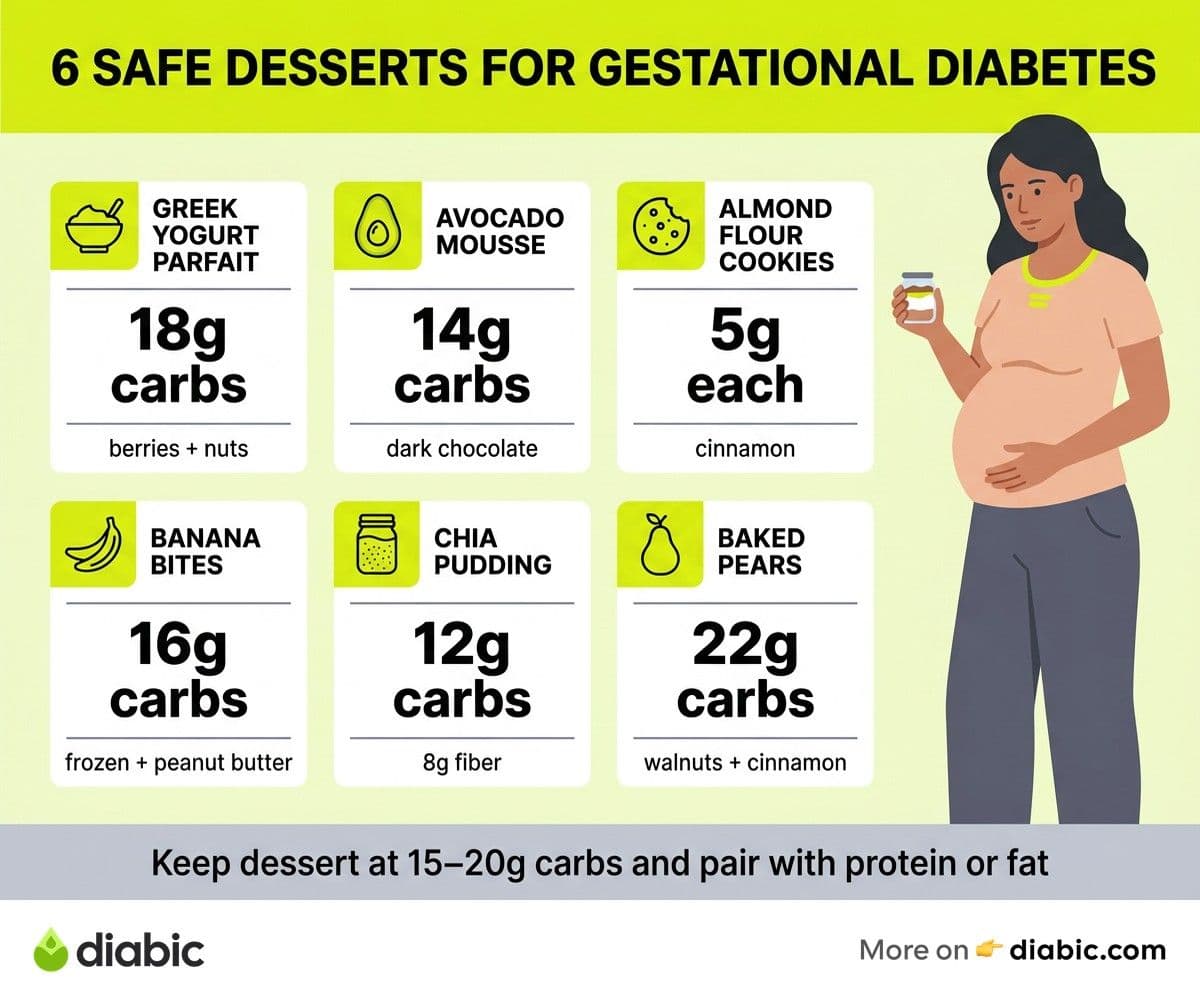
6 Safe Dessert for Gestational Diabetes Recipes
These diabetes friendly desserts recipes are designed for one to two servings each, so you can portion easily. Carb counts are estimates based on standard ingredient sizes and may vary slightly with brands.
1. Greek yogurt parfait with berries and nuts
Per serving: ~18g carbs, 16g protein, 8g fat
Ingredients:
- 3/4 cup plain whole-milk Greek yogurt
- 1/4 cup mixed berries (blueberries, raspberries, or strawberries)
- 2 tablespoons chopped walnuts or sliced almonds
- 1 teaspoon vanilla extract
- Optional: 1/2 teaspoon monk fruit sweetener or a small drizzle of honey
Instructions:
- Stir vanilla and sweetener into the yogurt.
- Layer half the yogurt in a glass, top with half the berries and nuts, and repeat.
- Eat right away or refrigerate for up to 4 hours.
The protein in Greek yogurt and the fat in nuts blunt the natural sugar in berries, making this one of the most blood-sugar-friendly desserts you can build.
2. Dark chocolate avocado mousse
Per serving: ~14g carbs, 4g protein, 18g fat (makes 2 servings)
Ingredients:
- 1 ripe avocado
- 3 tablespoons unsweetened cocoa powder
- 3 tablespoons monk fruit sweetener or erythritol
- 1/4 cup unsweetened almond milk
- 1 teaspoon vanilla extract
- Pinch of salt
- 1 tablespoon dark chocolate shavings (85% or higher) for topping
Instructions:
- Blend avocado, cocoa, sweetener, almond milk, vanilla, and salt until completely smooth.
- Divide between two small ramekins.
- Chill for 30 minutes, then top with chocolate shavings before serving.
The fat from the avocado is the secret here. It carries the chocolate flavor and keeps the dessert from spiking blood sugar the way a flour-based mousse would.
3. Almond flour cookies with cinnamon
Per cookie: ~5g carbs, 3g protein, 8g fat (makes 12 cookies)
Ingredients:
- 2 cups blanched almond flour
- 1/4 cup monk fruit sweetener
- 1 teaspoon ground cinnamon
- 1/2 teaspoon baking soda
- 1/4 teaspoon salt
- 1 large egg
- 1/4 cup melted unsalted butter or coconut oil
- 1 teaspoon vanilla extract
Instructions:
- Preheat oven to 350F and line a baking sheet with parchment.
- Whisk dry ingredients in a bowl.
- Stir egg, melted butter, and vanilla into the dry mix until a dough forms.
- Scoop tablespoon-sized balls, flatten gently, and bake for 10 to 12 minutes until edges are golden.
- Cool on the sheet for 5 minutes before moving.
Two cookies with a glass of milk make a satisfying after-dinner treat without the carb load of a flour-based cookie. For more low-carb baked options, see our roundup of diabetes-friendly cookie recipes.
4. Frozen banana bites with peanut butter
Per serving (6 bites): ~16g carbs, 5g protein, 8g fat
Ingredients:
- 1 medium banana, sliced into 12 rounds
- 2 tablespoons natural peanut butter (no added sugar)
- 1 ounce dark chocolate (85% or higher), melted
- Flaky sea salt for finishing
Instructions:
- Lay banana slices on a parchment-lined plate.
- Spread a small dab of peanut butter on half the slices, then top with the remaining slices to make sandwiches.
- Drizzle with melted dark chocolate and sprinkle with sea salt.
- Freeze for at least 1 hour, then store in a container in the freezer.
Bananas are higher in natural sugar than berries, so the peanut butter and dark chocolate are doing real work to keep this in the safe range. Stick to one serving.
5. Chia seed pudding with coconut
Per serving: ~12g carbs (8g fiber), 6g protein, 14g fat (makes 2 servings)
Ingredients:
- 1/4 cup chia seeds
- 1 cup unsweetened coconut milk (the carton kind, not canned)
- 1 tablespoon monk fruit sweetener
- 1/2 teaspoon vanilla extract
- 2 tablespoons unsweetened shredded coconut
- 2 tablespoons fresh berries (optional topping)
Instructions:
- Whisk chia seeds, coconut milk, sweetener, and vanilla in a jar.
- Refrigerate overnight (or at least 4 hours) until thick.
- Stir before serving and top with shredded coconut and berries.
Chia seeds are largely fiber, which means the net carb count is even lower than the total. This is one of the most filling desserts on the list.
6. Baked pears with walnuts and cinnamon
Per serving: ~22g carbs (5g fiber), 3g protein, 10g fat
Ingredients:
- 2 small ripe pears, halved and cored
- 2 tablespoons chopped walnuts
- 1 teaspoon cinnamon
- 1 tablespoon unsalted butter, divided
- Optional: 1 tablespoon plain Greek yogurt per serving
Instructions:
- Preheat oven to 375F.
- Place pear halves cut-side up in a baking dish.
- Top each half with a small piece of butter, walnuts, and a sprinkle of cinnamon.
- Bake for 20 to 25 minutes until pears are tender.
- Top with a dollop of Greek yogurt before serving.
Whole fruit is a smarter dessert choice than juice or processed sweets because the fiber and the food matrix slow down sugar absorption. Pears, in particular, have a lower glycemic load than many other fruits.
Tips for Making Any Dessert Safer for Blood Sugar
Beyond these six recipes, a few diabetes dessert recipes easy principles will help you adapt almost any traditional sweet into something more blood-sugar-friendly. The moves below are the same ones we use to redesign recipes for our newsletter.
Swap refined wheat flour for almond flour, coconut flour, or a blend. Almond flour has roughly a quarter of the carbs of all-purpose flour by volume and adds protein and fat. Coconut flour is even lower in carbs but absorbs more liquid, so use about a third of the amount called for and add an extra egg or splash of milk.
Use natural sweeteners thoughtfully
Monk fruit, stevia, and allulose are all reasonable choices that do not raise blood sugar in most people. The ADA notes that non-nutritive sweeteners can be a useful tool for reducing total sugar intake when used in moderation (ADA on sweeteners). Sugar alcohols like erythritol are also low-glycemic, but some people experience digestive upset, especially during pregnancy.
Honey, maple syrup, and coconut sugar still raise blood sugar, but in small amounts (a teaspoon or two in a recipe that serves several) they may fit your daily plan. They are not "free."
Always pair sweets with protein or fat
A small cookie alone will spike blood sugar more than the same cookie eaten right after a meal that contained protein and fat. The simplest pairing is a glass of milk, a small handful of nuts, or a dessert that has the protein and fat already built in (which most of the recipes above do).
Portion small, then test
Serving size is the lever that quietly does most of the work. A two-bite portion of dessert often satisfies the same craving as a full slice, especially when you eat it slowly. After dessert, check your blood sugar at 1 and 2 hours so you learn how your body responds. This is data, not judgment. For more recipe ideas in this style, see our easy diabetes dessert recipes collection.
From my experience: In 14 years with diabetes, the recipe I keep coming back to is the chia pudding. It is almost embarrassingly simple, but it is the only "dessert" my numbers consistently like, and the texture genuinely satisfies the craving for something pudding-y. I make a jar on Sunday night and pull from it all week. The win is not finding a perfect dessert. The win is finding one or two you trust and rotating them.
Pregnancy is short, and gestational diabetes is usually a temporary chapter. A few well-built desserts can get you through the months ahead without the cycle of restriction and rebound that makes any eating plan fall apart.
Frequently Asked Questions
What desserts can you eat with gestational diabetes?
Desserts built around protein-rich ingredients (Greek yogurt, eggs, nuts), healthy fats (avocado, nut butters, coconut), low-glycemic fruits (berries, pears), and small amounts of natural sweeteners tend to work best. The recipes in this guide (Greek yogurt parfaits, chia pudding, almond flour cookies, baked pears) are all good starting points. Always pair sweets with a meal or a protein source, and keep portions modest.
Are sugar-free desserts safe for gestational diabetes?
Sugar-free desserts can be helpful, but read the label carefully. Some "sugar-free" products contain sugar alcohols (sorbitol, maltitol) that may cause digestive discomfort, especially during pregnancy. Others are loaded with refined flour and still raise blood sugar significantly. The phrase "sugar-free" does not always mean low in carbohydrates. Whole-food-based desserts with monk fruit or stevia tend to be a safer bet than processed sugar-free products.
How many carbs should a gestational diabetes dessert have?
Most dietitians suggest keeping dessert in the 15 to 20 gram range when eaten alone, or up to 30 grams when included as part of a meal that already has protein, fat, and fiber. Your specific target depends on your meal plan and your numbers, so check with your dietitian or diabetes educator.
Can I eat fruit as dessert with gestational diabetes?
Yes, with structure. Whole fruit (especially berries, pears, apples, and citrus) eaten alongside a protein or fat is a smart dessert choice. Avoid juice, dried fruit, and large servings of high-glycemic fruits like ripe bananas or grapes on their own. The baked pear recipe above is a good example of how to make fruit work as a satisfying dessert.
Will eating dessert harm my baby?
A modest, well-paired dessert is unlikely to cause harm to you or your baby. The bigger concern is consistently elevated blood sugar over weeks and months, not a single planned treat. Talk to your provider about your post-meal glucose targets so you know what numbers to aim for after dessert. Lean on the dessert for gestational diabetes recipes above, keep portions modest, and check your numbers an hour and two hours later so you learn what your body actually likes.
Dr. Rezwana Parvin Rumpa is an obstetrics and gynaecology specialist with clinical focus on gestational diabetes, PCOS, and fertility. She holds the MRCOG (Final Part) from the Royal College of Obstetricians and Gynaecologists in London, the MRCPI (Final Part) from the Royal College of Physicians of Ireland, and an MBBS from Shaheed Monsur Ali Medical College under Dhaka University. Dr. Rumpa serves as a Senior Medical Officer in the Obs and Gynae department at BRB Hospitals Ltd, where she has spent three years managing prenatal care, emergency obstetric cases, and women's-health surgery. On Diabic, she medically reviews content for women living with diabetes, with particular attention to pregnancy, PCOS, and reproductive-health intersections.
Medically reviewed by
Dr. Shanto Arian is an internal medicine physician now specializing in clinical and aesthetic dermatology, with a parallel academic focus on epidemiology and public health. He holds an MBBS, MPH, MSc (UK), MRCP (UK), MRCPI (Ireland), Diploma in Dermatology (UK), and Diploma in Aesthetic Medicine (USA). Dr. Arian trained in internal medicine, including hospital work on hematology cases such as graft-versus-host disease, before moving toward dermatology. Skin is one of the earliest places diabetes shows itself, from acanthosis nigricans and diabetic dermopathy to slow foot wound healing, and that intersection is where his clinical and Diabic-review work meet. On Diabic, Dr. Arian medically reviews content on diabetes diagnosis, complications, dermatologic manifestations, and pharmacotherapy, ensuring every claim aligns with current ADA, NICE, and peer-reviewed literature.
More from Diabetes Knowledge
View all
8 High Fiber Foods That Help with Prediabetes
Add these 8 high fiber foods for prediabetes to slow glucose absorption, support steady blood sugar, and meet the daily fiber target most people miss.

Mediterranean Diet for Prediabetes: A Practical Guide
The mediterranean diet for prediabetes is one of the best-studied eating patterns for prevention. Here is what to eat, what to avoid, and how to start.

Nutrition Plan for Gestational Diabetes
A structured nutrition plan for gestational diabetes with macronutrient targets, sample meals, key nutrients, and tips to adjust based on blood sugar.
Clinician-reviewed habits, plain-language guides, and honest answers - the small shifts that make living with diabetes feel lighter, every day.