Best Glucometer for Elderly and Low-Vision Users
Best glucometer for elderly and low-vision users: large displays, audio readouts, no-coding strips, and budget picks that make daily testing easier.

In this article(17)
Choosing the best glucometer for elderly users means looking past the marketing and focusing on what actually makes daily testing manageable. Large backlit displays, audio readouts, no-coding test strips, a stable grip, and a clean low-cost path to refill supplies all matter more than feature lists. If you are picking a meter for a parent, a grandparent, or for yourself as your vision or dexterity changes, the right device makes the difference between testing as planned and skipping days.
A meter that requires steady hands, sharp eyes, and three confirmation taps to start a test is the wrong meter if you have arthritis or low vision. A meter that announces the result out loud, lights up clearly in dim rooms, and uses strips with a wide port is the right one. The picks below all check those boxes at different price points.
What to Look for in the Best Glucometer for Elderly Users
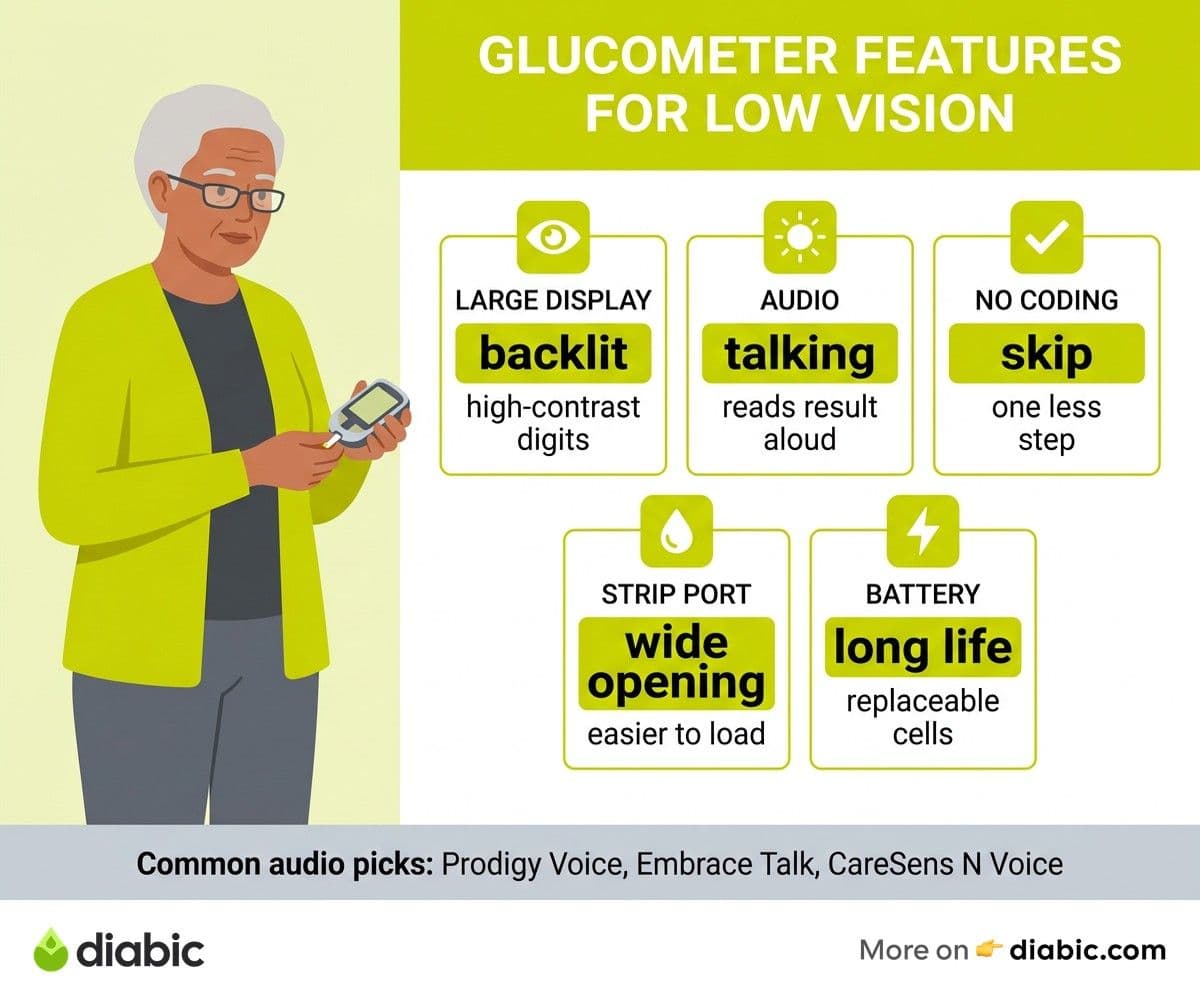
A large, backlit display with high-contrast numbers is non-negotiable. Look for digit heights of at least half an inch and a strong contrast between the screen background and the numbers themselves. White numbers on a dark blue or black background tend to read more clearly for older eyes than the gray-on-gray screens you see on many cheap meters online.
Audio readout is the single most useful accessibility feature if you have low vision. Talking meters announce the result, the date, and sometimes the trend, and they remove the need to read a small screen at all. The American Foundation for the Blind maintains resources on talking blood glucose meters and other diabetes-related assistive technology, and their guidance is worth reviewing before buying.
A simple interface with minimal buttons reduces errors. Meters with one-button operation, where inserting a strip turns the device on automatically, are easier than ones requiring power-on, mode-select, and confirm sequences. The fewer steps between taking the meter out of the case and seeing a result, the more reliable your testing becomes day to day.
Strip handling and lancing comfort
Test strips need a wide port that accepts blood from any angle. Some strips require precision placement, which is hard if you have tremors or poor depth perception. Strips with a clear visual fill window also help, because they show whether enough blood has been applied without making you interpret a beep code.
No-coding strips eliminate one of the most common sources of error in older meters. Older devices needed a code chip or manual code entry that matched the strip lot, and forgetting this step produced reliably wrong results. Every meter on this list uses no-coding strips, which means you insert a strip and test without any setup beyond turning the meter on.
Lancing devices vary widely in usability. Look for a larger barrel that is easier to grip, an adjustable depth setting that can be set once and left alone, and a clear loading mechanism. The ADA Standards of Care 2026 section on older adults with diabetes emphasizes simplifying daily routines, and lancing comfort is a meaningful part of that simplification.
Best Glucometers for Seniors in 2026
Our picks below were chosen for accessibility first, accuracy second, and cost third. All of them meet FDA accuracy standards, and all are widely available in the United States. Strip availability and pharmacy coverage matter for long-term use, and these brands all have established supply chains.
Best for large display: Contour Next One
The Contour Next One has a clear backlit screen, large digits, and a smartLIGHT feature that flashes green, yellow, or red based on whether your reading is in target. The visual color cue is a strong feature if you do not always retain target ranges by memory. Strip handling is forgiving, with a wide sample port that accepts blood from any angle and a second-chance application option that lets you add more blood within 60 seconds of underfilling.
Strip cost runs around 30 to 50 cents each in pharmacy retail, with significant savings through mail-order suppliers and Medicare-covered providers. The meter itself is often available free with a starter kit. Independent accuracy reviews consistently rate Contour Next strips among the most accurate on the market, which matters more than display features when the numbers drive medication decisions.
Best talking meter: Prodigy Voice
The Prodigy Voice is built specifically for blind and low-vision users. It speaks every step of the testing process out loud in English or Spanish, including instructions, the result, the date and time, and trend information. Buttons are large with tactile markings, and the device fits comfortably in older hands.
If you have hearing loss, the audio quality is clear enough at high volume. Strip handling is straightforward, and the meter signals audibly when enough blood has been applied. Strip cost is comparable to other mainstream brands, and the Prodigy line is covered by Medicare under the standard durable medical equipment benefit. If you have significant vision loss, this is the strongest pick on the market.
Best for ease of use: Accu-Chek Guide Me
The Accu-Chek Guide Me reduces testing to a small number of clear steps. The strip vial uses a SmartPack design that releases one strip at a time when tipped, which removes the fumbling that comes with traditional vials. The meter has a large display, simple two-button operation, and a strip port that lights up to help users guide the strip into place.
Accuracy is solid and meets ISO 15197 standards, with strips available at most major pharmacies. The lancing device that ships with the meter is one of the more comfortable options on the market, with a clear depth indicator. If you find traditional strip vials frustrating, the SmartPack feature is a meaningful daily improvement.
Best budget senior-friendly option: ReliOn Premier BLU
The ReliOn Premier BLU sells exclusively through Walmart at a low retail price, and the strips are among the cheapest on the market while still meeting FDA accuracy standards. Strips run roughly 18 cents each, which makes a meaningful difference for seniors on fixed incomes who pay cash or who exceed Medicare's monthly strip allowance.
The display is large and backlit, and the meter itself is light and easy to grip. The interface is simpler than higher-end meters, which can be a feature rather than a limitation if you want minimal complexity. Bluetooth connectivity to a free app is optional and easy to skip if a paper logbook is the preferred way to track results.
Comparison table
For a wider look at meter options across all user types, our roundup of reliable blood glucose meters for home testing covers picks at additional price points.
Glucometers With Smartphone Connectivity for Caregivers
Bluetooth-enabled meters let results sync automatically to a smartphone app, where they can be viewed by a family member or caregiver remotely. The Contour Next One pairs with the Contour Diabetes app, and the Accu-Chek Guide pairs with the mySugr app. Both apps support sharing reports with caregivers and clinicians by email or in-app invitation.
For seniors who do not own a smartphone, a caregiver can keep the paired phone nearby during testing or set up the meter to sync to a household tablet. The ReliOn Premier BLU also offers Bluetooth connectivity to its free companion app. The advantage is that missed tests, very low readings, and very high readings can trigger alerts on the caregiver's phone without the senior needing to make a call.
Setting up remote monitoring works best when it is not overwhelming for the user. Configure the app once, set realistic alert thresholds together with your senior, and limit notifications to readings outside a defined safety range. The goal is supportive oversight, not constant surveillance. If your older adult feels monitored too closely, they often disengage from testing entirely, which defeats the purpose.
For families managing a senior at risk of severe lows, our piece on CGM vs glucometer discusses when continuous monitoring becomes a stronger fit than a fingerstick meter. Some CGM systems offer dedicated caregiver share features that surpass what app-connected meters can do.
How to Help a Senior Use a Glucometer Correctly
Set up the meter once and leave it set up. Pre-program targets, time and date, and audio settings before you hand it over. The fewer changes the user has to make, the more likely they are to test consistently. Most meters let you set target ranges so the device flags out-of-range readings without anyone having to remember the numbers.
Simplify the routine to three steps that can be repeated the same way every time. Step one: insert a strip. Step two: lance the side of the fingertip and apply blood. Step three: read or listen to the result and record it. Anything beyond this needs a clear reason. Our step-by-step guide to using a glucometer breaks the technique down further.
Label supplies clearly. A bin or tray with the meter, strips, lancets, alcohol wipes, and logbook in one place reduces the cognitive load of testing. A laminated card with the three testing steps in large print can sit alongside the supplies and serve as a visual cue. Color coding the supplies (blue for strips, red for lancets) helps users with mild memory or vision issues.
Common challenges and adaptations
Tremor makes strip handling difficult. The Accu-Chek Guide Me's SmartPack vial helps because it dispenses one strip at a time. A tabletop strip holder is another low-cost adaptation. For severe tremor, a caregiver may need to load the strip while the user handles the lancing.
Arthritis affects grip and lancing pressure. Look for lancing devices with a larger barrel and a one-button release rather than a twist-cap design. Warm hands lance more easily because blood flow is better, so a warm wash before testing reduces the need for hard squeezing. A heating pad on the hand for two minutes before testing can also help.
Low vision is best addressed by audio meters first and high-contrast displays second. The Prodigy Voice removes the visual demand entirely. For users with partial vision, the Contour Next One's color cues plus a magnifying lamp at the testing station can be enough. Reading glasses dedicated to the testing station, kept in the same place every day, help users avoid the small frustration of searching for them at every test.
Memory challenges deserve a different approach entirely. If a senior is forgetting whether they tested or what the result was, a Bluetooth meter that auto-syncs to an app removes the memory load. A timer or smart speaker reminder at the testing time also helps. Consider whether the testing routine itself needs to be simpler, perhaps once daily rather than four times, depending on the management plan.
When dexterity, vision, and memory challenges stack up, a continuous glucose monitor becomes worth a serious conversation. A CGM removes the daily fingerstick routine entirely, and modern sensors are easy for caregivers to apply on the user's behalf. The trade-off is cost and the wearable itself, but for some seniors, this is the more sustainable path. Our companion piece on diabetes wearable devices for children covers some of the same caregiver-facing app features that apply to elderly users as well.
Cost and Insurance for Senior Glucometers
Medicare Part B covers blood glucose meters and test strips as durable medical equipment when prescribed for diabetes management. Coverage is typically 80 percent of the Medicare-approved amount after the Part B deductible is met, with the remaining 20 percent owed by the beneficiary or covered by Medigap or Medicare Advantage plans. The standard allowance is 100 strips and 100 lancets every 90 days for non-insulin users, and 300 strips every 90 days for insulin users.
The Medicare.gov diabetes supplies page walks through current coverage rules and lists qualifying suppliers. Mail-order suppliers contracted with Medicare often have lower out-of-pocket costs than retail pharmacies, and most accept Part B assignment, meaning they bill Medicare directly. This simplifies the process for seniors who do not want to handle reimbursement paperwork.
Free meter programs are common across most major brands. Contour, Accu-Chek, and Prodigy all offer meters at no cost when paired with a strip starter kit, and many manufacturers run loyalty programs for ongoing strip purchases. The meter itself is rarely the expensive part of the equation. Strips are.
Reducing strip costs on a fixed income
Buy strips in larger packs when budget allows. The per-strip cost drops noticeably at 100-count and 200-count sizes compared to 50-count packs. Mail-order suppliers like Edgepark, Byram Healthcare, and CCS Medical often beat pharmacy retail prices, and they handle Medicare billing directly.
Generic and store-brand strips can be a meaningful saving for cash-pay seniors. The ReliOn Premier BLU is the most prominent example, but several other low-cost meters paired with sub-25-cent strips are available at major retailers. Accuracy on these meters is generally within FDA standards, but it is worth checking independent reviews before switching long-term.
The AARP diabetes resources hub lists patient assistance programs, manufacturer copay cards, and nonprofit support options for seniors who need help affording supplies. State-level programs vary, and a quick call to a local Area Agency on Aging often surfaces options that are not widely advertised. Cost should not be the reason a senior skips testing, and there are usually paths to bring it down.
From my experience: When I was helping my grandfather with his diabetes routine in his late seventies, the meter he had been using for years had a screen so small he was essentially guessing at the numbers. We switched him to a meter with a backlit display and pre-set targets, and his testing consistency improved within two weeks. Fourteen years of living with type 1 diabetes myself taught me that the technology only works when it fits the person using it. The best glucometer for an elderly user is the one they will actually pick up and use without frustration.
FAQ
What is the easiest glucometer for seniors to use?
The Accu-Chek Guide Me ranks among the easiest because of its SmartPack strip vial, large display, and minimal-button operation. The Contour Next One is a close second, with strong accuracy and a forgiving strip port that accepts blood from any angle. For seniors with significant vision loss, the Prodigy Voice is the easiest because it removes the need to read a screen entirely. The right pick depends on which challenge (vision, dexterity, memory) is most pressing.
Which glucometer has the best large display?
The Contour Next One has one of the largest, clearest backlit displays among current meters, with the added benefit of color-coded target indicators. The Accu-Chek Guide Me also offers a large backlit screen with high-contrast digits. For seniors who want the largest screen possible, some specialty meters like the Embrace Talk also offer oversized displays, though strip availability and accuracy data are weaker than the mainstream picks above.
Does Medicare cover blood glucose meters for seniors?
Yes, Medicare Part B covers blood glucose meters and test strips when prescribed by a doctor for diabetes management. The beneficiary typically pays 20 percent of the Medicare-approved cost after the Part B deductible, unless they have supplemental coverage through Medigap or Medicare Advantage. Strip allowances vary by whether the user is on insulin, with insulin users receiving a larger quarterly allowance. A qualifying Medicare-contracted supplier bills Medicare directly in most cases.
The best glucometer for elderly users is rarely the one with the most features. It is the one that fits the user's eyes, hands, and routine without becoming another thing to learn. Match the meter to the specific challenge in front of you, set it up once with realistic targets, and revisit the choice every year or two as needs change. A device that gets used daily, even an inexpensive one, beats a premium meter that sits unused on a shelf.
Shahriar P. Shuvo is the founder of Diabic. He has lived with diabetes for over 14 years, and built Diabic to deliver the practical, evidence-based self-management tools he wished existed when he was first diagnosed. By trade, Shahriar is a senior design and frontend engineer with 6+ years shipping products at Agora, Timescale (now Tiger Data), and ShareTrip. He writes from the intersection of lived diabetes experience and product craft, focused on what works in daily management rather than what sounds good in a textbook.
Medically reviewed by
Dr. Rezwana Parvin Rumpa is an obstetrics and gynaecology specialist with clinical focus on gestational diabetes, PCOS, and fertility. She holds the MRCOG (Final Part) from the Royal College of Obstetricians and Gynaecologists in London, the MRCPI (Final Part) from the Royal College of Physicians of Ireland, and an MBBS from Shaheed Monsur Ali Medical College under Dhaka University. Dr. Rumpa serves as a Senior Medical Officer in the Obs and Gynae department at BRB Hospitals Ltd, where she has spent three years managing prenatal care, emergency obstetric cases, and women's-health surgery. On Diabic, she medically reviews content for women living with diabetes, with particular attention to pregnancy, PCOS, and reproductive-health intersections.
More from Devices & Technology
View all
Fasting vs Postprandial Glucose: What's the Difference
Fasting vs postprandial glucose readings tell different stories about your blood sugar. Learn what each number means and how to act on it.

Online Diabetes Coaching: How to Choose a Good One
Online diabetes coaching can fill the gaps between doctor visits. Learn what credentials to check, red flags to avoid, and how to pick a quality program.

Diabetes App Comparison: 5 Tested Picks 2026
A hands-on diabetes app comparison of MyNetDiary, MySugr, Glucose Buddy, Diabetes M, and One Drop, with pros, cons, pricing, integrations, and a feature.
Clinician-reviewed habits, plain-language guides, and honest answers - the small shifts that make living with diabetes feel lighter, every day.