Gestational Diabetes Diet: What to Eat
A gestational diabetes diet guide for pregnancy, covering foods to eat, foods to limit, meal structure, and practical tips for steady blood sugar.

In this article(33)
A gestational diabetes diet can feel overwhelming right after your diagnosis, especially when you are already navigating everything else that comes with pregnancy. The good news is that eating well with gestational diabetes does not mean giving up flavor, variety, or the foods you love. It means making smarter choices about what goes on your plate and how often you eat, so that both you and your baby stay healthy through the rest of pregnancy.
You did not cause this. Gestational diabetes is largely driven by the hormones your placenta produces, and it can happen even when you have eaten thoughtfully your whole life. What you eat from this point forward, though, becomes one of the most powerful tools you have for keeping blood sugar steady.
Understanding Gestational Diabetes and Nutrition
Gestational diabetes is a form of high blood sugar that develops during pregnancy, usually around weeks 24 to 28, when placental hormones make your cells more resistant to insulin. Most women's bodies adapt by producing extra insulin. When that adaptation falls short, blood sugar starts to rise.
The role of a diet diabetes pregnancy plan is to take pressure off that system. According to the American Diabetes Association, nutrition is the cornerstone of gestational diabetes management, and most women can manage their blood sugar effectively through food and movement alone.
The aim is steady blood sugar, not extreme restriction. Your baby still needs a full range of nutrients, including carbohydrates, and your own energy needs are real. The work is in choosing the right kinds of carbs, balancing them with protein and fat, and spreading meals across the day so no single meal is too heavy a load. We cover the broader framework in our healthy diet for gestational diabetes overview if you want a deeper look at the principles.
Why pregnancy hormones change the equation
Hormones like human placental lactogen, cortisol, and progesterone rise as your pregnancy progresses, and all of them work against insulin. This is why blood sugar can become harder to manage in the third trimester even when your eating has not changed.
Knowing this helps remove the guilt many women feel after a high reading. A higher number after the same meal you had last week is often biology, not behavior. Your job is to keep adjusting the inputs and to talk with your care team when patterns shift.
What "balance" really means here
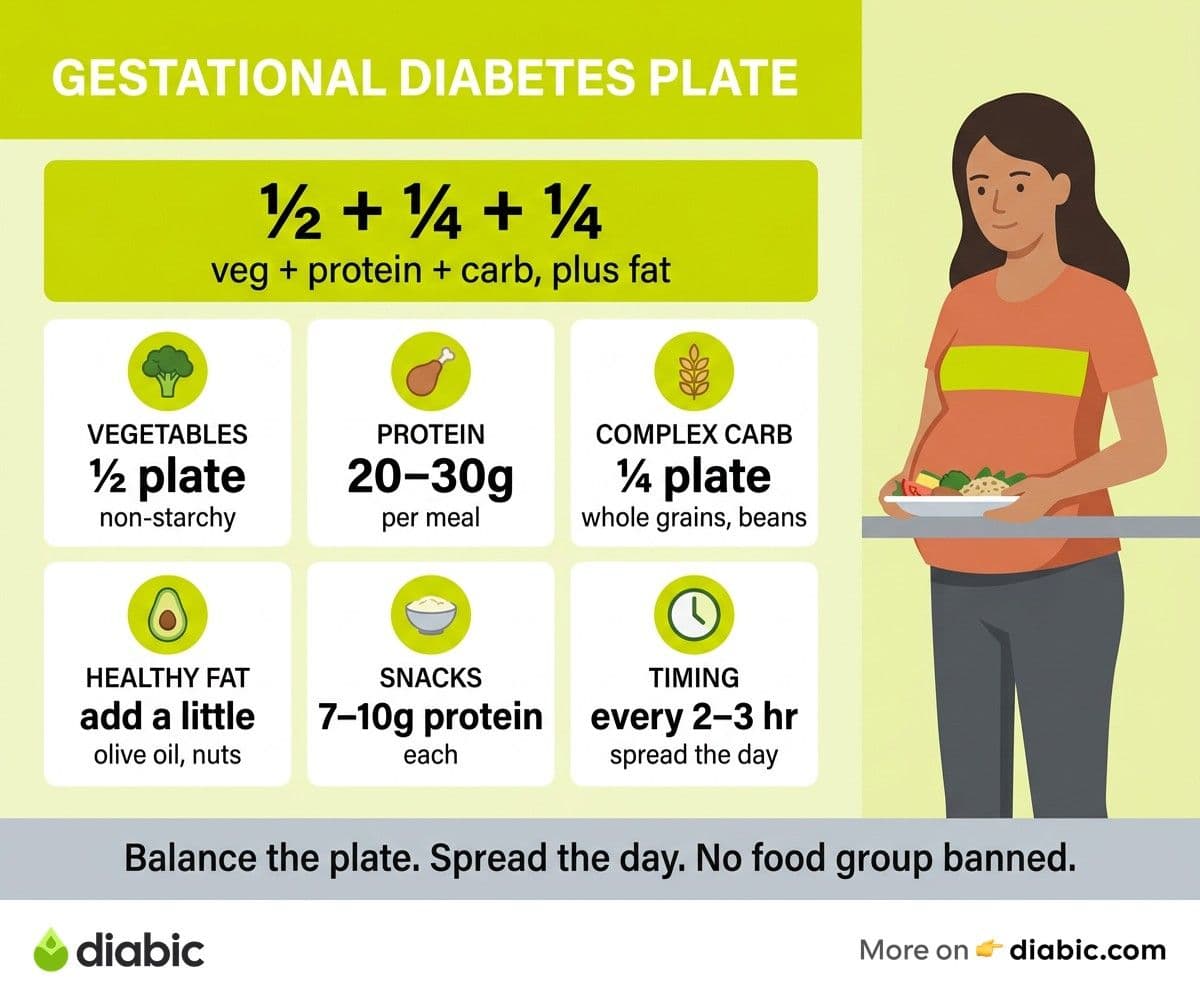
Balance in this context means three things on every plate when possible: a fiber-rich carb, a lean protein, and a healthy fat. That trio slows glucose absorption and keeps you full between meals.
It also means balance across the day. A single perfect meal followed by six hours of nothing and then a huge dinner is harder on blood sugar than three steady meals with snacks in between.
Gestational Diabetes Diet: Foods to Eat
A diabetes diet gestational plan is not a list of forbidden foods. It is a working list of foods your body handles well, which you can mix and match without overthinking every meal.
The categories below are the staples that show up in nearly every credible gestational diabetes nutrition resource, including those from the Centers for Disease Control and Prevention. Build most of your meals from these.
Lean proteins
Protein at every meal and snack is one of the most reliable ways to steady blood sugar during pregnancy. Chicken, turkey, fish low in mercury (salmon, sardines, trout, light tuna in moderation), eggs, tofu, tempeh, Greek yogurt, cottage cheese, and beans are all solid choices.
A reasonable target is 20 to 30 grams of protein per main meal and 7 to 10 grams at each snack. You do not need to track perfectly. Including a clear protein source at every eating occasion handles most of the work.
Non-starchy vegetables
Leafy greens, broccoli, cauliflower, peppers, zucchini, cucumbers, mushrooms, asparagus, and tomatoes contribute fiber, vitamins, and volume without driving blood sugar up. Aim to make these the visual base of lunch and dinner.
Pregnancy can shift your taste preferences in unpredictable ways. If raw salad is unappealing, lean into cooked vegetables: roasted, sauteed, blended into soup, or stirred into eggs.
Healthy fats
Fat slows the absorption of carbs eaten alongside it and keeps meals satisfying. Avocado, olive oil, nuts, seeds, nut butters, and fatty fish are all excellent.
A small handful of almonds with an apple, or a slice of whole-grain toast with avocado, behaves very differently in your body than the carb alone. Fat is not something to fear during pregnancy.
Complex carbs in measured portions
Carbs are still on the menu. They just need to be the right kinds and the right portions. Steel-cut or rolled oats, quinoa, barley, whole-grain bread (where "whole" is the first ingredient), brown rice, sweet potatoes, beans, and lentils all release glucose more slowly than refined options.
Most women with gestational diabetes do best with about 30 to 45 grams of carbs at meals and 15 to 20 grams at snacks, but your dietitian may adjust these targets based on your readings. For a fully mapped week of meals built on these foods, see our 7-day gestational diabetes meal plan.
A note on fruit
Fruit is healthy, and nothing about gestational diabetes makes it off-limits. The trick is portion and pairing. Berries, apples, pears, oranges, and stone fruits paired with protein or fat tend to land softly. Tropical fruits like pineapple and ripe banana are higher impact for many women, and morning fruit on an empty stomach is the most likely time for a spike.
Foods to Avoid or Limit
A healthy diet for gestational diabetes does not mean a list of strict bans. It means knowing which foods consistently push blood sugar in the wrong direction so you can make conscious trades.
Sugary drinks and fruit juice
This is the single biggest swap for most women. Soda, sweet tea, lemonade, sweetened coffee drinks, and even 100% fruit juice deliver a fast load of sugar with no fiber, protein, or fat to slow it down.
Water, sparkling water, unsweetened iced tea, and milk in moderation are reliable defaults. If you crave the flavor of juice, eat the whole fruit instead. The fiber changes everything.
Refined carbohydrates
White bread, white rice, regular pasta, pastries, crackers, and most boxed cereals digest fast and tend to leave you hungry an hour later. Whole-grain alternatives, sourdough (which often digests more gently), or smaller portions paired with protein and fat usually land better.
You do not have to eliminate these. Save them for occasions, keep portions modest, and never eat them on their own.
Sweets and pastries
Cake, cookies, donuts, candy, ice cream, and similar sweets are the classic blood-sugar-spiking foods, especially eaten alone or on an empty stomach. The combination of refined flour, sugar, and often very little fiber or protein is hard for any body to handle, let alone one with reduced insulin sensitivity.
Cravings are real during pregnancy and you do not need to white-knuckle them. There are smarter ways to satisfy a sweet tooth, and we cover gentler options in our roundup of safe desserts for gestational diabetes.
Large portions of fruit at one sitting
A bowl of mixed fruit can carry 40 to 60 grams of carbs, which is a meal's worth of carbs in one sitting. Splitting fruit across the day, pairing it with protein or fat, and choosing lower-impact options like berries can keep the same total intake without the spike.
How to Structure Your Meals and Snacks
Meal structure may matter as much as food choices for gestational diabetes. The way carbs are spaced across the day shapes your blood sugar pattern almost as much as the carbs themselves.
The general framework most dietitians use is three smaller meals plus two or three snacks per day. We dig deeper into specific portions and timing in our nutrition plan for gestational diabetes guide, and the principles below apply to most women.
Three meals, two to three snacks
Spreading carbs across five to six eating occasions, instead of two or three large ones, keeps the load on each meal small enough for your insulin to handle. It also helps prevent the long gaps that trigger overeating later.
A simple rhythm might look like: breakfast, mid-morning snack, lunch, afternoon snack, dinner, and an evening snack. The exact timing matters less than the spacing.
Why spacing matters for stability
Long gaps between meals can drive your blood sugar both too low and then too high, when you finally eat and overshoot. Consistent spacing keeps your body in a steadier place.
A useful target is to eat every three to four hours during the day. If you forget a snack, that is fine. If you regularly go six hours, that is worth adjusting.
Bedtime snack strategy
Many women with gestational diabetes wake up with elevated fasting blood sugar, partly because of overnight hormone shifts. A small bedtime snack that combines a slow-digesting carb with protein or fat (like Greek yogurt with a few berries, or whole-grain toast with peanut butter) can help stabilize overnight blood sugar.
Skip the bedtime snack if your fasting numbers are consistently in range. Add it in if mornings are a problem, and ask your dietitian about specific portions.
Borrowing principles from other diets
The framework of frequent, balanced meals overlaps with other blood-sugar-friendly approaches. If you are interested in how this same logic applies before or after pregnancy, our prediabetes diet guide covers similar territory in a non-pregnancy context.
Practical Tips for Managing Gestational Diabetes Through Food
Knowing what to eat and actually eating that way during pregnancy are different challenges. Fatigue, nausea, food aversions, and a packed schedule make the second one harder than usual.
The Mayo Clinic and most diabetes educators emphasize practical, realistic adjustments over perfect plans. The tips below are the ones that hold up in real pregnant-life conditions.
Pair carbs with protein at every meal and snack
This single rule handles most of the work of a gestational diabetes diet. An apple becomes an apple with peanut butter. Toast becomes toast with eggs. Crackers become crackers with cheese.
The pairing slows glucose absorption and keeps you full longer. It is also easy to remember when you are tired and standing in front of the fridge.
Test to learn, not to judge
Blood sugar testing is information, not a report card. A high reading after a particular food tells you that food, in that portion, at that time of day, did not work well for your body. It does not tell you that you failed.
Keep a simple log of what you ate and your number. Patterns will emerge within a week or two. Use those patterns to adjust portions and pairings, and bring the log to your appointments.
Meal prep for busy days
Pregnancy is exhausting. Decisions made when you are tired tend to be the wrong ones for blood sugar.
You do not need a Sunday meal-prep marathon. Boil a few eggs, wash and chop one or two vegetables, cook a pot of quinoa or beans, and stock easy snacks (Greek yogurt, cheese sticks, nuts, hummus, hard-boiled eggs). When the easy choice is also the helpful choice, the rest gets easier.
Ask for help
Cooking, planning, and grocery shopping take energy you may not have. Asking a partner, family member, or friend for help with one of these is not a luxury. It is reasonable.
From my experience: I have lived with diabetes for 14 years, and the pattern that has surprised me most is how much of "diet" is really "kitchen logistics." When I stocked the right snacks at eye level and prepped two anchor meals on Sunday, my blood sugar numbers got better even though my willpower had not changed at all. Pregnancy magnifies this. Make the helpful choice the easy choice, and trust that the structure does most of the work.
Working with Your Healthcare Team
A gestational diabetes diagnosis usually comes with access to a care team you may not have had before. Use it. The combination of an OB-GYN or midwife, a registered dietitian, and sometimes a diabetes educator is one of the most useful supports you can have right now.
The American College of Obstetricians and Gynecologists recommends individualized nutrition counseling for every woman diagnosed with gestational diabetes, and most insurance plans cover at least one or two visits. If you have not been referred yet, ask.
Why a registered dietitian helps
A dietitian who specializes in gestational diabetes can translate the general principles in this guide into specific portions, meal templates, and adjustments for your readings. They can also help with food aversions, cultural foods, vegetarian eating, and any other constraint that does not fit a generic handout.
If your numbers are mostly in range but a few stubborn ones keep showing up, a 30-minute conversation with a dietitian often solves what hours of online research cannot.
Discussing dietary changes with your OB-GYN
Bring your blood sugar log to every appointment. If your fasting numbers are creeping up, if you are losing weight, or if you cannot keep food down, your provider needs to know.
Some women need insulin or oral medication despite doing everything right with food. That is not a failure. Pregnancy hormones are powerful, and adding medication is a tool, not a punishment.
Monitoring blood sugar targets during pregnancy
Most providers aim for fasting numbers under about 95 mg/dL, one-hour post-meal numbers under 140 mg/dL, and two-hour post-meal numbers under 120 mg/dL, though specific targets may vary based on your situation. Talk to your doctor about the goals that fit you.
The targets are tighter than for type 2 diabetes outside of pregnancy because your baby's growth is sensitive to higher glucose. Hitting them most of the time, not all of the time, is the realistic goal.
FAQ
What should I eat with gestational diabetes during pregnancy?
Focus on lean proteins, non-starchy vegetables, healthy fats, and complex carbohydrates in controlled portions. Eating three smaller meals plus two or three snacks per day, with a clear protein source at each, helps maintain steady blood sugar far better than two or three large meals.
The simple rule that handles most situations is to pair carbs with protein at every eating occasion. An apple becomes an apple with peanut butter. Toast becomes toast with eggs. This slows glucose absorption and keeps you full between meals.
What foods should you avoid with gestational diabetes?
Limit sugary drinks, fruit juice, white bread, white rice, refined cereals, pastries, candy, and large portions of fruit at one sitting. Foods made with refined flour and added sugar tend to spike blood sugar the most.
You do not need to eliminate these completely in most cases. Smaller portions, less often, and always paired with protein or fat is the practical approach for most women. Check labels for added sugars (look for "syrup," "cane sugar," "fructose," and similar) since they hide in many foods you would not expect.
Can I still eat fruit with gestational diabetes?
Yes. Fruit is healthy and a normal part of a gestational diabetes diet. Berries, apples, pears, oranges, and peaches paired with protein or fat tend to land softly. Tropical fruits like pineapple and ripe banana are higher impact for many women.
Watch portion size, eat fruit with a snack rather than alone on an empty stomach, and split larger fruits across two eating occasions. A whole apple with peanut butter at 3 p.m. usually works better than half a melon at 10 a.m. on its own.
How quickly will my blood sugar improve after changing my diet?
Many women see improvements within a few days, especially in post-meal numbers. Fasting numbers often take a bit longer because they are influenced by overnight hormones.
Give a new pattern a full one to two weeks of consistent eating before deciding it is not working. If your numbers are not budging despite consistent effort, that is information for your care team, not a personal failure. Sometimes pregnancy hormones outpace what diet alone can manage, and adding medical support is the right next step.
A gestational diabetes diet is not forever. For most women, blood sugar normalizes after delivery, and the eating habits you build now become part of a foundation that lowers your long-term risk of type 2 diabetes. The work you are doing right now is for two people, and the good news is that most of it adds up to the same thing: a steadier, more balanced way of eating that supports both of you.
Dr. Rezwana Parvin Rumpa is an obstetrics and gynaecology specialist with clinical focus on gestational diabetes, PCOS, and fertility. She holds the MRCOG (Final Part) from the Royal College of Obstetricians and Gynaecologists in London, the MRCPI (Final Part) from the Royal College of Physicians of Ireland, and an MBBS from Shaheed Monsur Ali Medical College under Dhaka University. Dr. Rumpa serves as a Senior Medical Officer in the Obs and Gynae department at BRB Hospitals Ltd, where she has spent three years managing prenatal care, emergency obstetric cases, and women's-health surgery. On Diabic, she medically reviews content for women living with diabetes, with particular attention to pregnancy, PCOS, and reproductive-health intersections.
Medically reviewed by
Dr. Shanto Arian is an internal medicine physician now specializing in clinical and aesthetic dermatology, with a parallel academic focus on epidemiology and public health. He holds an MBBS, MPH, MSc (UK), MRCP (UK), MRCPI (Ireland), Diploma in Dermatology (UK), and Diploma in Aesthetic Medicine (USA). Dr. Arian trained in internal medicine, including hospital work on hematology cases such as graft-versus-host disease, before moving toward dermatology. Skin is one of the earliest places diabetes shows itself, from acanthosis nigricans and diabetic dermopathy to slow foot wound healing, and that intersection is where his clinical and Diabic-review work meet. On Diabic, Dr. Arian medically reviews content on diabetes diagnosis, complications, dermatologic manifestations, and pharmacotherapy, ensuring every claim aligns with current ADA, NICE, and peer-reviewed literature.
More from Diabetes Knowledge
View all
Can Prediabetes Be Reversed? What Research Shows
Can prediabetes be reversed? For many people, yes. Here is what the science says about diet, exercise, timelines, and what works without medication.

7-Day Gestational Diabetes Meal Plan
A ready-to-use 7-day gestational diabetes meal plan with breakfast, lunch, dinner, snacks, and a grocery list to keep blood sugar steady all week.

Prediabetes Diet: What to Eat and Avoid
A complete prediabetes diet guide covering foods to eat, foods to limit, a sample day of meals, and the research that shows why food choices matter.
Clinician-reviewed habits, plain-language guides, and honest answers - the small shifts that make living with diabetes feel lighter, every day.