Newly Diagnosed Type 2 Diabetes: Where to Start
Newly diagnosed type 2 diabetes feels overwhelming, but the first steps are simpler than you think. Get a clear, calm starting plan from day one.

In this article(18)
Hearing the words "you have type 2 diabetes" can land like a punch, even when you half expected the news. The mind fills with questions about food, medication, complications, and what your life looks like from here. The good news is that newly diagnosed type 2 diabetes does not mean figuring it all out at once.
The first steps are simpler than most people expect. A few clear actions in the first weeks lay the groundwork for steady, sustainable management. Nothing has to be perfect right now, only directional. This guide maps out exactly where to begin without trying to solve every long-term question on day one.
If you are reading this in the parking lot after a doctor's appointment or scrolling through tabs late at night, take a breath first. People manage type 2 diabetes well every day. The path forward is real, and there is more flexibility in it than the internet sometimes suggests.
Your First Week After a Newly Diagnosed Type 2 Diabetes Label
The first week is mostly about understanding what just happened and setting up the basics. You do not need a meal plan, a workout program, or a complete identity shift in the next seven days. You need clarity on your numbers, the right starter supplies, and one or two small habits to begin.
A type 2 diagnosis usually comes from an A1C of 6.5 percent or higher, a fasting blood glucose of 126 mg/dL or higher confirmed twice, or a random glucose above 200 mg/dL with symptoms. According to the American Diabetes Association, type 2 diabetes is the most common form of diabetes and develops when cells become resistant to insulin and the pancreas cannot keep up with demand. Knowing exactly which test was used and what your number was helps you have a real conversation with your care team.
Schedule a follow-up within two to four weeks if your doctor has not already. Bring a short list of questions: What is my A1C and what is the goal? Are you starting any medication? Should I see a diabetes educator or dietitian? How often should I check blood sugar at home? Do I need any other lab work or screenings? A primer like our What Is Type 2 Diabetes guide is helpful background to read before that visit.
Processing the emotional reaction belongs in week one too. Some people feel relief because months of fatigue and thirst now have a name. Others feel grief, fear, or anger. All of those are normal. You do not have to be motivated yet. You only have to show up to the next appointment with your numbers, your questions, and one observation about how the diagnosis is sitting with you.
Understanding Your Numbers
The number game with type 2 has fewer values than type 1, which is good news for anyone who finds spreadsheets stressful. Your A1C, your fasting blood glucose, and your post-meal glucose tell most of the story. The CDC's guide to managing blood sugar lays out the standard targets used in most American clinics.
What your A1C result means
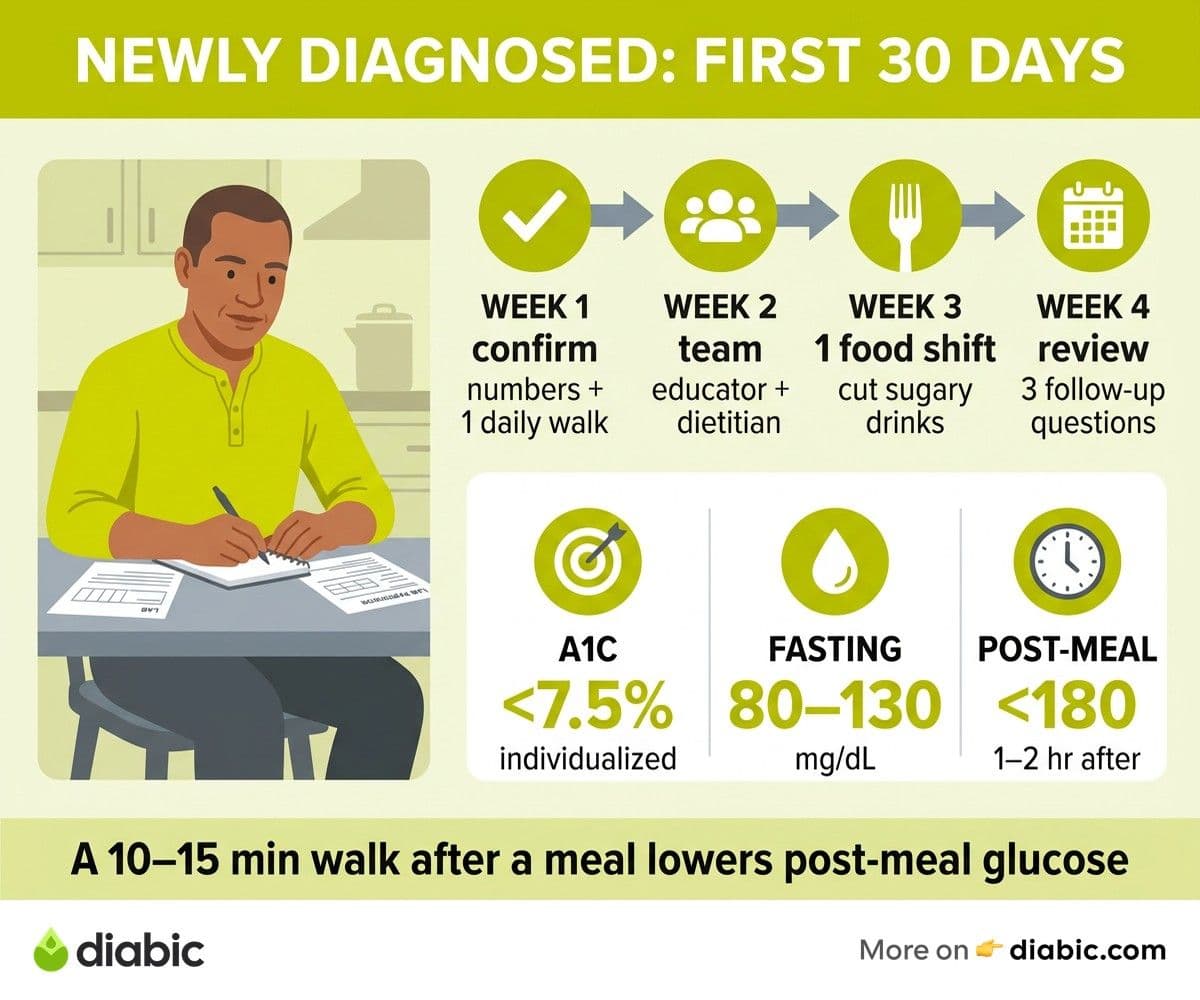
A1C reflects your average blood sugar over the past two to three months. A normal A1C is below 5.7 percent. Prediabetes runs from 5.7 to 6.4 percent. Type 2 diabetes is diagnosed at 6.5 percent or above. Common A1C goals after diagnosis range from below 6.5 to below 7.5 percent, depending on age, complications, and how you respond to treatment.
A1C is not a grade and it is not a moral measure. It is a snapshot. Your first follow-up A1C, usually three months after diagnosis, will show whether your current plan is moving you in the right direction. Small drops matter. A change from 8.4 to 7.6 percent is meaningful clinical progress.
Fasting and post-meal blood glucose targets
Daily numbers run alongside A1C. Fasting blood glucose targets typically sit between 80 and 130 mg/dL. Post-meal targets, measured one to two hours after the first bite, are usually below 180 mg/dL. Your provider may tighten or loosen these based on your situation, including age, kidney function, and risk of hypoglycemia.
Using a meter at home without obsessing
Most people newly diagnosed with type 2 are asked to check at fasting and sometimes one to two hours after meals, particularly when starting medication or making dietary changes. Logging is more useful than memorizing. A simple notebook or an app showing your number plus what you ate helps your provider see patterns and adjust the plan. Avoid checking 12 times a day out of anxiety. Numbers do not change because you stare at them, and constant checking can fuel burnout in week one.
Building Your Care Team
Type 2 diabetes is a team sport, even if your team has only two members at the start. The NIDDK guide on managing diabetes highlights how multidisciplinary support consistently produces better outcomes than going it alone. Building a team early saves you from googling at 11 p.m.
Primary care versus endocrinology
Many people manage type 2 diabetes with their primary care doctor, especially in the first years when treatment is mostly lifestyle and a single oral medication. An endocrinologist becomes more important if your A1C does not respond, if you need injectable medications, or if you have other endocrine conditions. Either path is reasonable. What matters is that your doctor is comfortable adjusting your plan as it evolves.
Diabetes educators and dietitians
A certified diabetes care and education specialist, often called a CDCES, is one of the most underused resources in American healthcare. Most insurance plans cover diabetes self-management education and support, often called DSMES, with a doctor's referral. Two to four sessions in the first year can teach you carb counting, meal planning, glucose pattern recognition, and how to talk to your doctor about adjustments.
A registered dietitian with diabetes expertise is the other high-value team member. The right dietitian will not hand you a 1,200-calorie photocopy. They will look at how you actually eat and help you change two or three things first. If injectable medications enter the picture or oral options expand, our deeper guide to type 2 diabetes treatment options walks through how each class works, including metformin for type 2 diabetes, which remains the most common first-line choice.
Mental health support
Diabetes distress is common and often missed. The combination of new diagnosis, daily decisions, and lifestyle pressure pushes many people into anxiety or low mood, especially in the first six months. A therapist who understands chronic illness, even for a handful of sessions, is a worthwhile investment. Many diabetes care teams now include a behavioral health specialist for exactly this reason.
Food and Eating: A Practical Starting Point
Food is the topic everyone obsesses over after a diagnosis, and the rules are less strict than your group chat thinks. There is no single official diabetes diet. What works depends on your culture, your schedule, your medications, and your preferences. The first principle is that you do not need a complete overhaul on day one.
Focus on three early shifts that move the needle for most people. Reduce sugary drinks and added sugars first, since liquid sugar hits blood glucose harder than almost any other category. Cut back on refined carbs like white bread, pastries, and chips by half, replacing some with whole grains, beans, or vegetables. Add a protein source and a non-starchy vegetable to most meals to slow glucose rises and keep you full.
Reading nutrition labels becomes a useful skill. Look at total carbohydrates per serving, then check the serving size, since that is where many products hide a doubled portion. Fiber slows absorption, so a food with 30 grams of carbs and 8 grams of fiber behaves differently from a food with 30 grams of carbs and 1 gram of fiber. For more structured guidance, especially if you are also navigating prediabetes in a family member, our prediabetes diet guide covers what to prioritize and what to scale back.
Meal timing and portion awareness matter as much as ingredient swaps. Eating at roughly consistent times helps your medication work predictably, especially metformin or sulfonylureas. The plate method from the ADA is a simple visual: half non-starchy vegetables, a quarter lean protein, a quarter whole grains or starchy vegetables, with a piece of fruit or a small serving of dairy on the side. You do not have to count calories to start. Small wins compound fast.
Movement and Activity
Movement is the second lever that changes type 2 diabetes outcomes, and the entry point is much lower than people assume. A 10 to 15 minute walk after dinner can lower post-meal glucose by 20 to 30 mg/dL, sometimes more. That is medication-level impact from a single habit you can start tonight.
The longer-term target most major guidelines agree on is 150 minutes per week of moderate-intensity activity, plus two sessions of strength work. You do not need to start there. Adding a 10-minute walk three days a week and building from there is a realistic six-week plan. Resistance training matters because muscle is the largest sink for blood glucose in the body. More muscle generally means better insulin sensitivity.
Movement also affects how the condition unfolds over time. Our look at how type 2 diabetes progresses explains why early activity habits often slow the trajectory of medication needs and complication risk. Pick something you do not hate. The best exercise is the one you keep doing in February when motivation has worn off.
Managing the Emotional Side
The emotional ride after a new diagnosis can be intense. Common reactions include fear about complications, denial that anything has to change, frustration at having "earned" the diagnosis, and grief for a version of life that felt simpler. None of these reactions are signs that you are doing it wrong. They are signs you are processing a real change.
From my experience, after 14 years with diabetes, the first six months were the hardest mentally. I bounced between intense effort and quiet avoidance. What helped me was treating diabetes management as a skill I was learning rather than a test I had to ace immediately. I let my A1C move down at its own pace and gave myself permission to ask questions that felt obvious. None of it was a verdict on my future.
A diagnosis is a starting point, not a sentence. Online communities like r/diabetes_t2, the ADA's local programming, and Facebook groups for newly diagnosed people give you a place to ask the small questions that do not justify a doctor's call. Local in-person diabetes support groups often meet through hospitals and YMCAs. The ADA mental health hub lists verified mental health professionals familiar with diabetes if you want one-on-one support.
Consider professional counseling if low mood lasts more than two weeks, if you are avoiding checks or appointments out of fear, or if your relationship with food is becoming distressing. Diabetes adds layers to body image, eating, and identity that benefit from a trained ear. Asking for help early shortens the rough patches.
A Realistic First 30 Days
Pulling it together, a doable first month after a newly diagnosed type 2 diabetes label looks something like this. In week one, confirm your A1C and starter prescriptions, schedule a follow-up, and start a 10 to 15 minute walk after one meal a day. In week two, ask about a referral to a diabetes educator and a dietitian, and start logging your meals and any home glucose readings. In week three, pick one food change to commit to, like cutting sugary drinks, and add a second short walk to the day. In week four, review your numbers, write down three questions for your follow-up, and notice what is already easier than it felt on day one.
That is the whole starting plan. It is not flashy. It works because each step is small enough to keep doing. The wins build on each other, and within a few months, the routines stop feeling like effort and start feeling like life.
FAQ
What to do when first diagnosed with type 2 diabetes?
Start by learning what your test numbers mean and schedule a follow-up with your doctor to discuss a management plan. Begin monitoring your blood sugar at home if your provider asks you to, make small dietary adjustments such as cutting sugary drinks, and start moving more with short walks after meals. Build a care team that includes a diabetes educator and dietitian, and give yourself time to process the emotional impact.
How to manage type 2 diabetes after diagnosis?
Management involves regular blood sugar monitoring, taking prescribed medications such as metformin, eating a balanced diet with attention to carbohydrate intake, exercising regularly, and attending follow-up appointments. Most people start with lifestyle changes and one oral medication, then adjust the plan over time based on A1C and how they feel. Connecting with a diabetes community can also provide ongoing support and reduce the sense of going it alone.
How long does it take to see improvement after a type 2 diagnosis?
Many people see meaningful drops in fasting blood glucose within two to four weeks of starting metformin, daily walks, and reduced added sugars. A1C reflects two to three months of average glucose, so the first follow-up A1C usually shows the clearest picture of improvement. Sustained gains come from consistent habits, not perfect ones.
Can I keep eating my favorite foods after a type 2 diagnosis?
Yes, in most cases. There are very few foods that are strictly off limits when you have newly diagnosed type 2 diabetes, and managing the condition is more about portions, frequency, and pairing than total elimination. Working with a registered dietitian helps you build a plan that respects your culture, preferences, and lifestyle while keeping blood sugar in range.
Shahriar P. Shuvo is the founder of Diabic. He has lived with diabetes for over 14 years, and built Diabic to deliver the practical, evidence-based self-management tools he wished existed when he was first diagnosed. By trade, Shahriar is a senior design and frontend engineer with 6+ years shipping products at Agora, Timescale (now Tiger Data), and ShareTrip. He writes from the intersection of lived diabetes experience and product craft, focused on what works in daily management rather than what sounds good in a textbook.
Medically reviewed by
Dr. Rezwana Parvin Rumpa is an obstetrics and gynaecology specialist with clinical focus on gestational diabetes, PCOS, and fertility. She holds the MRCOG (Final Part) from the Royal College of Obstetricians and Gynaecologists in London, the MRCPI (Final Part) from the Royal College of Physicians of Ireland, and an MBBS from Shaheed Monsur Ali Medical College under Dhaka University. Dr. Rumpa serves as a Senior Medical Officer in the Obs and Gynae department at BRB Hospitals Ltd, where she has spent three years managing prenatal care, emergency obstetric cases, and women's-health surgery. On Diabic, she medically reviews content for women living with diabetes, with particular attention to pregnancy, PCOS, and reproductive-health intersections.
More from Diabetes Knowledge
View all
Can Diabetics Eat Fruit? Yes, Best Picks and Tips
Can people with diabetes eat fruit? Yes. Here is how to choose the right fruits, manage portions, and pair them smartly to keep blood sugar steady.

Secondary Diabetes: When Another Condition Is the Cause
Secondary diabetes develops because of another medical condition or medication. Learn the causes, how it differs from type 2, and how it's managed.

Neonatal Diabetes: What Parents Should Know
Neonatal diabetes is rare and treatable. Learn the causes, how it differs from type 1, and what parents can expect from diagnosis through treatment.
Clinician-reviewed habits, plain-language guides, and honest answers - the small shifts that make living with diabetes feel lighter, every day.