Nutrition Plan for Gestational Diabetes
A structured nutrition plan for gestational diabetes with macronutrient targets, sample meals, key nutrients, and tips to adjust based on blood sugar.

In this article(7)
A nutrition plan for gestational diabetes gives you a structured framework for eating well during pregnancy without constantly worrying about every food choice. After a diagnosis, the food rules can feel like they multiplied overnight, and trying to remember them all between work, prenatal appointments, and exhaustion is a lot to ask. Whether you were just diagnosed or want to tighten up your eating habits, a clear plan provides the clarity you need.
This guide walks through how to structure your meals, which nutrients matter most, what a sample day looks like, and how to adjust the plan based on what your glucose meter is telling you.
How to Structure a Gestational Diabetes Nutrition Plan
A gestational diabetes during pregnancy meal plan is built on three ideas: enough total calories to support a healthy pregnancy, the right macronutrient balance, and carbs distributed across the day rather than crammed into a few large meals. The American Diabetes Association outlines this same general framework in its standards of care for gestational diabetes.
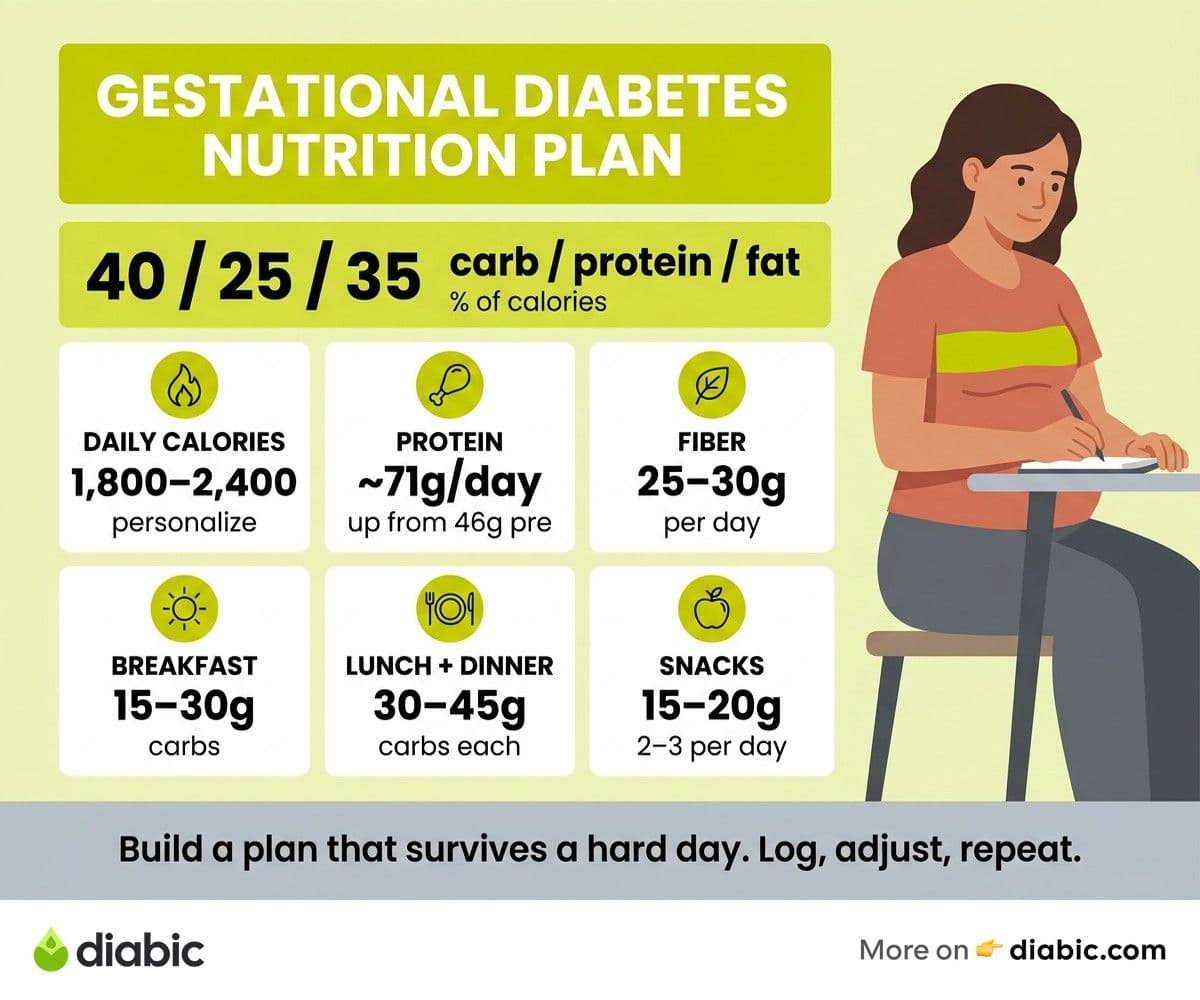
For most people, daily intake during pregnancy lands somewhere between 1,800 and 2,400 calories, depending on pre-pregnancy weight, activity level, and stage of pregnancy. Your dietitian will personalize this. Within that calorie range, a useful starting split is roughly:
- 40-45% of calories from carbohydrates
- 20-25% from protein
- 30-35% from healthy fats
Carbohydrate amounts are usually expressed in grams per meal and snack rather than percentages, because timing matters as much as the daily total. A common framework is:
- Breakfast: 15-30g carbs (often the lowest, because morning insulin resistance is highest)
- Lunch: 30-45g carbs
- Dinner: 30-45g carbs
- Snacks: 15-20g carbs each, with 2-3 snacks per day
The eating rhythm matters as much as the numbers. Three meals plus 2-3 snacks spread roughly every 2-3 hours keeps blood sugar steadier than larger, less frequent meals. A bedtime snack with protein helps prevent overnight drops or fasting morning highs. If you want a full week mapped out, our 7-day gestational diabetes meal plan puts these targets into practice with real meals.
From my experience: After 14 years of managing diabetes, I have learned that a plan only works if it survives a hard day. The best nutrition framework is one you can fall back on when you are nauseated at 7am, swamped at 2pm, and tired at 9pm. Build it for your worst day, not your best one. That is when the structure earns its keep.
Essential Nutrients for Gestational Diabetes
A meal plan for pregnancy with diabetes has to do double duty. It needs to keep your blood sugar steady and supply the nutrients your baby needs to grow. The good news is that whole-food eating handles most of this naturally, but a few nutrients deserve special attention. The American College of Obstetricians and Gynecologists outlines pregnancy nutrient needs in detail.
Protein. Pregnancy raises protein needs to roughly 71 grams per day for most people, up from about 46 grams pre-pregnancy. Protein supports your baby's tissue growth, your blood volume expansion, and steady blood sugar. Lean meats, fish, eggs, dairy, beans, lentils, tofu, and Greek yogurt are reliable sources. Aim for a serving at every meal and snack.
Iron. Iron needs roughly double during pregnancy because your blood volume increases. Lean red meat, poultry, fish, beans, lentils, spinach, and fortified whole grains are good sources. Pairing iron-rich plant foods with vitamin C (a squeeze of lemon, peppers, strawberries) helps absorption.
Folate. Folate supports your baby's neural tube development and is usually covered through prenatal vitamins, leafy greens, beans, and fortified grains. Skipping breakfast cereal because of carbs is fine; there are plenty of other sources.
Calcium and vitamin D. Calcium supports your baby's bone development without pulling from your own stores. Plain Greek yogurt, cottage cheese, milk, fortified plant milks, sardines, and leafy greens cover most of the need. Vitamin D often comes from a prenatal vitamin and modest sun exposure.
Omega-3 fatty acids. Salmon, sardines, and trout supply DHA, which supports baby's brain and eye development. Two servings of low-mercury fish per week is a common recommendation. Walnuts, chia seeds, and flaxseed offer plant-based omega-3s.
Fiber. Fiber slows digestion and softens blood sugar response, which is exactly what you want with gestational diabetes. Vegetables, berries, beans, and whole grains carry the load. Aim for 25-30 grams per day.
If you want a deeper food-by-food breakdown, our healthy diet for gestational diabetes post groups foods by category and explains how each one fits.
Sample Nutrition Plan for Gestational Diabetes Day
Putting all of this into a real day is where diabetes nutrition management gets practical. The framework below shows one possible day at roughly 2,000 calories with carbohydrates spread across meals and snacks. Use it as a starting point, then personalize.
Morning (6-8am): Protein-forward breakfast with controlled carbs
Two scrambled eggs, half an avocado, and one slice of whole-grain toast. This combination front-loads protein and fat to soften the carb response, which is helpful when morning insulin resistance is at its peak. About 25g carbs.
Mid-morning snack (10am): Balanced and small
Plain Greek yogurt with a sprinkle of chia seeds and a few berries. About 18g carbs and 12g protein.
Midday (12-1pm): Balanced lunch with vegetables and healthy fats
Grilled chicken salad with mixed greens, cucumbers, peppers, olives, half a cup of chickpeas, and an olive oil dressing, plus a small whole-grain pita on the side. About 35g carbs.
Afternoon snack (3pm): Protein-anchored
Apple slices with a tablespoon of natural almond butter. About 20g carbs and useful fat to keep you full through dinner prep.
Evening (6-7pm): Lean protein with non-starchy vegetables
Baked salmon, roasted broccoli and zucchini, and half a cup of quinoa. About 25g carbs, plenty of fiber, and a serving of omega-3s.
Bedtime snack (9-10pm): Protein with a small carb
String cheese with four whole-grain crackers or a small handful of nuts. About 15g carbs. This snack is important: it helps prevent overnight lows and morning fasting spikes.
The exact portions and food choices can rotate. What stays constant is the structure, which is the actual point of a nutrition plan. Our gestational diabetes diet what to eat guide shows how to swap items within each meal type while keeping the structure intact.
Adjusting Your Plan Based on Blood Sugar Readings
A nutrition plan is a living document, not a fixed prescription. Your glucose meter is the feedback system that tells you what is working. The CDC's gestational diabetes resources emphasize this self-monitoring approach as the foundation of management.
Most people check fasting blood sugar in the morning and 1-2 hours after each meal. Target ranges are set by your provider but commonly look something like under 95 mg/dL fasting and under 140 mg/dL one hour after a meal, or under 120 mg/dL two hours after. Your numbers tell a story if you know how to read them.
If a specific meal causes a high reading more than once, the meal needs adjusting, not your willpower. Common fixes include:
- Shrinking the carb portion by a quarter or third
- Adding more protein or fat to that meal
- Splitting the carbs across the meal and a snack 90 minutes later
- Swapping a higher-glycemic carb (white potato, white rice) for a lower one (sweet potato, quinoa, brown rice)
- Walking for 10-15 minutes after the meal, which can blunt the spike
If your fasting numbers run high, the bedtime snack is usually the lever. Try a snack with more protein and a small complex carb, eaten closer to bedtime. If breakfast is consistently spiky, lower the breakfast carbs further and add another snack mid-morning.
A registered dietitian can read your glucose log alongside you and spot patterns you might miss. If you have access to a certified diabetes care and education specialist or a dietitian who works with pregnant patients, use them. They are usually covered by insurance with a gestational diabetes diagnosis and can save you weeks of trial-and-error.
FAQ
How to create a nutrition plan for gestational diabetes?
Start by understanding your daily carb targets, which often land at 30-45 grams per meal and 15-20 grams per snack. Build each meal around a lean protein, add non-starchy vegetables, and include a controlled portion of complex carbs. Track your blood sugar after meals to see what is working, and adjust portions or food choices for the meals that consistently push your numbers higher than your targets. A registered dietitian can personalize the framework to your weight, activity level, and stage of pregnancy.
What nutrients are most important for gestational diabetes?
Protein, fiber, iron, folate, calcium, vitamin D, and omega-3 fatty acids are all important during pregnancy with gestational diabetes. Focusing on nutrient-dense whole foods like lean meats, fish, eggs, dairy, beans, leafy greens, berries, nuts, and whole grains helps you meet these needs while keeping blood sugar in range. A prenatal vitamin covers gaps your diet may miss, but food-first eating remains the foundation.
A nutrition plan is less about restriction and more about giving yourself a steady path through the rest of pregnancy. With a clear framework, attentive use of your glucose meter, and a care team you can call when something does not add up, the day-to-day choices get easier. Start with the structure, trust your data, and remember that small consistent wins are what carry you through. The right nutrition plan for gestational diabetes is the one that fits your real life and keeps you and your baby well.
Dr. Rezwana Parvin Rumpa is an obstetrics and gynaecology specialist with clinical focus on gestational diabetes, PCOS, and fertility. She holds the MRCOG (Final Part) from the Royal College of Obstetricians and Gynaecologists in London, the MRCPI (Final Part) from the Royal College of Physicians of Ireland, and an MBBS from Shaheed Monsur Ali Medical College under Dhaka University. Dr. Rumpa serves as a Senior Medical Officer in the Obs and Gynae department at BRB Hospitals Ltd, where she has spent three years managing prenatal care, emergency obstetric cases, and women's-health surgery. On Diabic, she medically reviews content for women living with diabetes, with particular attention to pregnancy, PCOS, and reproductive-health intersections.
Medically reviewed by
Dr. Shanto Arian is an internal medicine physician now specializing in clinical and aesthetic dermatology, with a parallel academic focus on epidemiology and public health. He holds an MBBS, MPH, MSc (UK), MRCP (UK), MRCPI (Ireland), Diploma in Dermatology (UK), and Diploma in Aesthetic Medicine (USA). Dr. Arian trained in internal medicine, including hospital work on hematology cases such as graft-versus-host disease, before moving toward dermatology. Skin is one of the earliest places diabetes shows itself, from acanthosis nigricans and diabetic dermopathy to slow foot wound healing, and that intersection is where his clinical and Diabic-review work meet. On Diabic, Dr. Arian medically reviews content on diabetes diagnosis, complications, dermatologic manifestations, and pharmacotherapy, ensuring every claim aligns with current ADA, NICE, and peer-reviewed literature.
More from Diabetes Knowledge
View all
6 Safe Dessert for Gestational Diabetes Recipes You Can
Six dessert for gestational diabetes recipes that satisfy your sweet tooth without spiking blood sugar, with carb counts and pairing tips you can use.

8 High Fiber Foods That Help with Prediabetes
Add these 8 high fiber foods for prediabetes to slow glucose absorption, support steady blood sugar, and meet the daily fiber target most people miss.

Mediterranean Diet for Prediabetes: A Practical Guide
The mediterranean diet for prediabetes is one of the best-studied eating patterns for prevention. Here is what to eat, what to avoid, and how to start.
Clinician-reviewed habits, plain-language guides, and honest answers - the small shifts that make living with diabetes feel lighter, every day.