Diabetes Alert Dog vs CGM: Which Catches Lows First
Diabetes alert dog vs CGM: an honest look at accuracy, response time, cost, and lifestyle so you can decide which catches lows first for you.

In this article(11)
- How Diabetes Alert Dogs Detect Low Blood Sugar
- How a Continuous Glucose Monitoring System Catches Lows
- Accuracy: Diabetes Alert Dog vs CGM Head to Head
- Response Time: Which Warns You First?
- Cost Comparison and Insurance Coverage
- Lifestyle Considerations: Daily Life With Each Option
- Can You Use Both Together?
When your blood sugar drops dangerously low, every minute matters. The diabetes alert dog vs CGM debate is not just an interesting comparison; it is a practical decision that shapes how quickly you or your child gets warned about hypoglycemia. Some families spend tens of thousands of dollars on a trained dog. Others rely entirely on a sensor stuck to the back of an arm. Most of us want to know which actually catches lows first.
This piece is an honest look at how a trained alert dog and a continuous glucose monitor stack up on accuracy, response time, cost, and daily life. We walk through what the published research says, where each option earns its keep, and when pairing both makes sense.
How Diabetes Alert Dogs Detect Low Blood Sugar
Diabetes alert dogs are trained to detect a scent associated with hypoglycemia. Researchers believe that when blood sugar drops, the body releases volatile organic compounds, including isoprene, in breath and skin. Dogs have somewhere around 220 million scent receptors compared to our 5 million, so a well-trained dog can pick up changes that no human would notice.
Training is a long process. According to Assistance Dogs International, accredited programs spend 18 to 24 months training a service dog, with diabetes-specific scent work layered on top of public access skills. Certification standards vary by program, so families need to vet the trainer carefully. A dog that has not been properly socialized for restaurants, schools, or airplanes is not a true service animal, regardless of what the marketing says.
What an alert dog actually does during a low varies by training. Some paw at their handler. Others bring a designated alert object, like a bringsel cloth tube. A few are trained to fetch a juice box or wake a parent overnight. The point is that the alert is unmistakable, and most dogs will keep alerting until the person responds, which is something a beeping device cannot enforce.
How a Continuous Glucose Monitoring System Catches Lows
A continuous glucose monitoring system is a small sensor worn on the body that reads glucose levels in interstitial fluid every one to five minutes and sends those readings to a receiver, phone, or watch. When your number drops below a threshold you set, the device alarms. Some systems also send predictive low alerts when the trend suggests you will drop within the next 20 minutes.
CGMs do not measure blood glucose directly. They measure glucose in the fluid between your cells, which lags slightly behind blood. This is why a sensor reading and a fingerstick can differ during fast changes. The American Diabetes Association guidelines recommend CGM use as a standard of care for many people on insulin precisely because the alert system catches more lows than fingersticks alone, especially overnight.
If you are new to the technology, our explainer on what a continuous glucose monitoring system is and how it works covers the basics. For a deeper look at sensor options and where this category is heading, our roundup of best diabetes wearable devices in 2026 compares Dexcom, Libre, and Medtronic head to head.
Accuracy: Diabetes Alert Dog vs CGM Head to Head
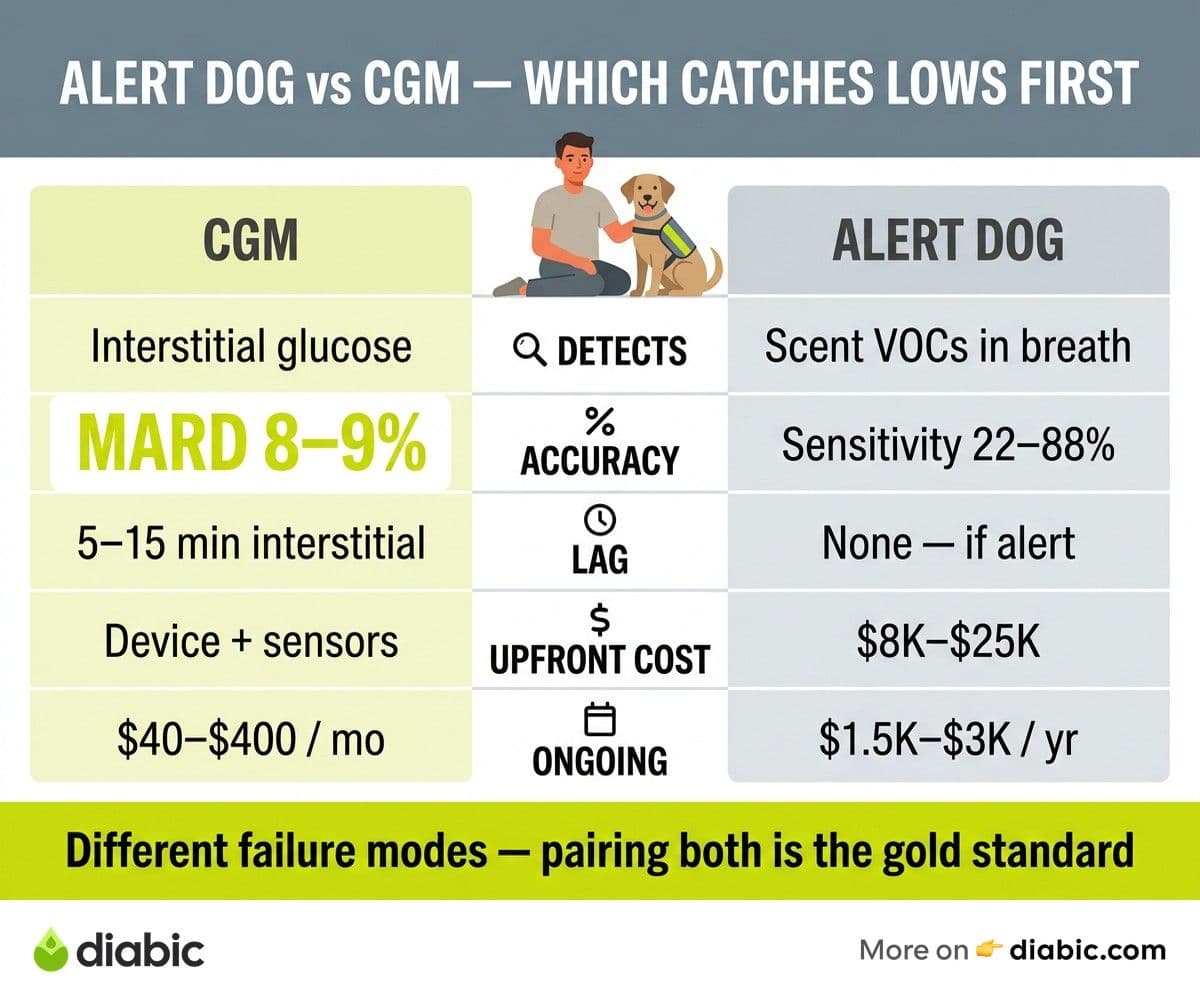
Accuracy is where this comparison gets interesting, because the two options are measuring different things. CGM accuracy is reported as Mean Absolute Relative Difference, or MARD. Modern sensors like the Dexcom G7 and Abbott Libre 3 report MARDs around 8 to 9 percent against lab values, which is close to fingerstick meter accuracy. Studies published in journals like Diabetes Care document these performance numbers in trials that include thousands of paired readings.
Diabetes alert dog accuracy is harder to pin down because the studies are smaller and the methods differ. A frequently cited BMJ Open Diabetes Research review reported that trained alert dogs detected hypoglycemia events with sensitivity ranging from roughly 22 to 88 percent across studies, with significant variation between dogs and handlers. The same body of research notes that dogs sometimes alerted before a CGM did, and other times missed events the sensor caught.
Here is how the two options compare across the factors families weigh most:
Neither column is the universal winner. The honest answer is that a top-performing CGM is more consistent night after night than even a well-trained dog, but a great dog catches certain events that a sensor can miss. False alerts happen on both sides. Sensors compress, fail, or read low after sleeping on them. Dogs alert on stress, illness, or because they want attention. Our piece on using a CGM for hypoglycemia detection digs into how to set thresholds that minimize false alarms without missing real lows.
Response Time: Which Warns You First?
Response time is the question that drives most families to consider an alert dog in the first place. CGMs have a known lag because they read interstitial fluid. During fast drops, the sensor can be 5 to 15 minutes behind your actual blood glucose, which means a low alert at 70 may already be a real glucose value of 55. Predictive low alerts help close this gap by warning you before the threshold is crossed.
Alert dogs are not bound by interstitial lag because they are reading scent compounds in breath. Some handlers report dogs alerting 15 to 30 minutes before a CGM, particularly during overnight lows. Others report the dog alerting at the same time, or after, the sensor. Variability is the rule, not the exception, and a dog's reliability depends on its training, age, current health, and whether it is sleeping deeply.
Nighttime is where this question becomes life or death for some families. A CGM with a loud, escalating alarm and a phone connected to a smart speaker is hard to sleep through, which is one reason CGM use has been shown to reduce severe overnight hypoglycemia. A dog that sleeps in the room can also catch overnight lows, but only if it is awake or trained to wake from a sound sleep when the scent appears. Many families with young children choose the CGM precisely because the alarm is mechanical and does not get tired.
Cost Comparison and Insurance Coverage
The cost gap between a CGM and an alert dog is significant. A continuous glucose monitor typically costs $100 to $400 per month out of pocket without insurance. With Medicare, Medicaid, or private insurance, many people pay $40 to $75 per month after coverage, and supplies continue at that rate as long as you wear the system. CGMs are often covered as durable medical equipment when prescribed for insulin-using diabetes.
A diabetes alert dog from an accredited trainer costs $8,000 to $25,000 or more upfront, with some programs running higher. Insurance does not cover service dogs in the United States, and the Americans with Disabilities Act gives a service dog access rights but no financial support. Some families fundraise. Others apply to nonprofit programs that place dogs at lower cost or for free. Breakthrough T1D, formerly JDRF, maintains resources on technology funding and links to organizations that support service dog placements for children with Type 1.
Ongoing costs for an alert dog include food, veterinary care, training refreshers, and travel gear, which run $1,500 to $3,000 per year for a typical service dog. Sensors are recurring, dogs are recurring in a different way, and only you can decide which ongoing cost fits your life better.
Lifestyle Considerations: Daily Life With Each Option
Daily life with each option is wildly different. A CGM is invisible under clothing, travels in a pocket, and works at a school or office without explanation. Sensor changes take five minutes every 10 to 15 days depending on the model. The trade-off is that a CGM cannot give you a hug, sense your stress, or respond to your tone of voice. Some people get tired of constant beeping and notifications, a real phenomenon called alarm fatigue.
A diabetes alert dog is a 24/7 commitment. The dog needs feeding, exercise, vet visits, grooming, and downtime. School districts and workplaces have to accommodate a service animal under the ADA, and travel involves planning. The upside is that the dog provides emotional support, an alerting partner, and a built-in motivator for outdoor activity. For some families, particularly those with hypoglycemia unawareness or a child who hides lows, the relationship is the point.
From my experience: I have lived with Type 1 diabetes for 14 years and have worn a CGM for the last decade. I have not used an alert dog, but I have spent time with families who do. What I have seen is that the families who get the most out of an alert dog tend to also use a CGM, not as a backup, but as a partner. The dog catches what the sensor misses, the sensor catches what the dog misses, and the human has two independent systems watching their back.
For families managing a child's diabetes, our guide to diabetes wearable devices for children walks through how kids actually use sensors at school, on sleepovers, and during sports.
Can You Use Both Together?
Pairing a diabetes alert dog with a continuous glucose monitor creates redundancy, and redundancy is the gold standard for life-threatening alerts. Each system has different failure modes. A CGM might fail because of a sensor error, a dead phone battery, or a Bluetooth dropout. A dog might miss an alert because it is asleep, sick, or distracted. Two systems running at the same time mean a single failure does not turn into an emergency.
Real-world scenarios where dual coverage helps include nighttime sleeping, intense exercise, illness, hormonal shifts, and travel across time zones. Parents of young children with Type 1 often pair both because the cost of missing an overnight low is too high. Adults with hypoglycemia unawareness, where the body no longer signals lows on its own, also benefit from layered alerts.
When using both makes the most sense is when you have already lived with one system and identified gaps. Start with a CGM if you do not have one, since insurance is more likely to cover it and the technology is easier to add. If you are still missing lows, particularly at night, that is the moment to look into a dog. The opposite order, dog first then CGM, also works for some families, but the CGM is usually the easier first step financially.
FAQ
Is a diabetes alert dog better than a CGM?
Neither is universally better. A CGM is more consistent, more affordable, and easier to integrate into work, school, and travel. A diabetes alert dog can detect some lows earlier, provides emotional support, and works without batteries, but it costs significantly more upfront and requires daily care. Many families find that using both, where possible, gives the most reliable coverage.
How accurate are diabetes alert dogs vs CGMs?
Modern CGMs report a Mean Absolute Relative Difference of around 8 to 9 percent against lab values. Diabetes alert dog studies report sensitivity to hypoglycemia ranging from roughly 22 to 88 percent depending on the dog, the training program, and the testing conditions. CGMs are more consistent on average, but a well-trained dog can catch certain events sensors miss.
How long does it take to train a diabetes alert dog?
A fully trained diabetes alert dog from an accredited program typically takes 18 to 24 months of training, including basic obedience, public access work, and scent-specific alert training. Self-training a pet dog to alert is possible but is not recognized as service dog training under most certifying bodies, and the reliability is generally lower than from a professional program.
The diabetes alert dog vs CGM question rarely has one clean answer for a single household. Some families thrive on the constant signal of a sensor, others need the second pair of eyes a trained dog provides, and many end up using both for the simple reason that two layers of protection beat one. Whichever direction you lean, the goal is the same, fewer severe lows and more confident sleep at night.
Dr. Shanto Arian is an internal medicine physician now specializing in clinical and aesthetic dermatology, with a parallel academic focus on epidemiology and public health. He holds an MBBS, MPH, MSc (UK), MRCP (UK), MRCPI (Ireland), Diploma in Dermatology (UK), and Diploma in Aesthetic Medicine (USA). Dr. Arian trained in internal medicine, including hospital work on hematology cases such as graft-versus-host disease, before moving toward dermatology. Skin is one of the earliest places diabetes shows itself, from acanthosis nigricans and diabetic dermopathy to slow foot wound healing, and that intersection is where his clinical and Diabic-review work meet. On Diabic, Dr. Arian medically reviews content on diabetes diagnosis, complications, dermatologic manifestations, and pharmacotherapy, ensuring every claim aligns with current ADA, NICE, and peer-reviewed literature.
Medically reviewed by
Dr. Rezwana Parvin Rumpa is an obstetrics and gynaecology specialist with clinical focus on gestational diabetes, PCOS, and fertility. She holds the MRCOG (Final Part) from the Royal College of Obstetricians and Gynaecologists in London, the MRCPI (Final Part) from the Royal College of Physicians of Ireland, and an MBBS from Shaheed Monsur Ali Medical College under Dhaka University. Dr. Rumpa serves as a Senior Medical Officer in the Obs and Gynae department at BRB Hospitals Ltd, where she has spent three years managing prenatal care, emergency obstetric cases, and women's-health surgery. On Diabic, she medically reviews content for women living with diabetes, with particular attention to pregnancy, PCOS, and reproductive-health intersections.
More from Devices & Technology
View all
Twiist Insulin Pump Release Date and Features
Latest Twiist insulin pump release date updates from Sequel Med Tech, expected features, and how it may compare to Tandem, OmniPod, and Medtronic.

Type 3 Diabetes: Symptoms, Causes, and Diagnosis
Type 3 diabetes describes the link between brain insulin resistance and Alzheimer's. Learn what research shows about symptoms, causes, and diagnosis.

Fasting vs Postprandial Glucose: What's the Difference
Fasting vs postprandial glucose readings tell different stories about your blood sugar. Learn what each number means and how to act on it.
Clinician-reviewed habits, plain-language guides, and honest answers - the small shifts that make living with diabetes feel lighter, every day.