What Is a Continuous Glucose Monitoring System? How it Works
A continuous glucose monitoring system tracks glucose 24/7 without finger pricks. See how it works, who benefits, accuracy, wear time, and how to choose.

In this article(30)
A continuous glucose monitoring system gives you a real-time window into your blood sugar without the constant finger pricks. If you have been relying on a few daily snapshots from a glucometer, a CGM fills in all the gaps between those readings and reveals patterns you would never catch otherwise.
The shift from periodic fingersticks to continuous data changes more than the number of pricks per day. It changes what you can see about your body's response to food, exercise, stress, sleep, and medication. People who start using a CGM often describe the experience as turning on the lights in a room they thought they already knew.
This post explains what a continuous glucose monitoring system actually is, how it works under the adhesive, who benefits most, what accuracy means in practice, and how to pick the right device for your situation. We also cover the practical questions, like sensor wear time, removal, and the daily routines that make CGM use easier.
What Is a Continuous Glucose Monitoring System
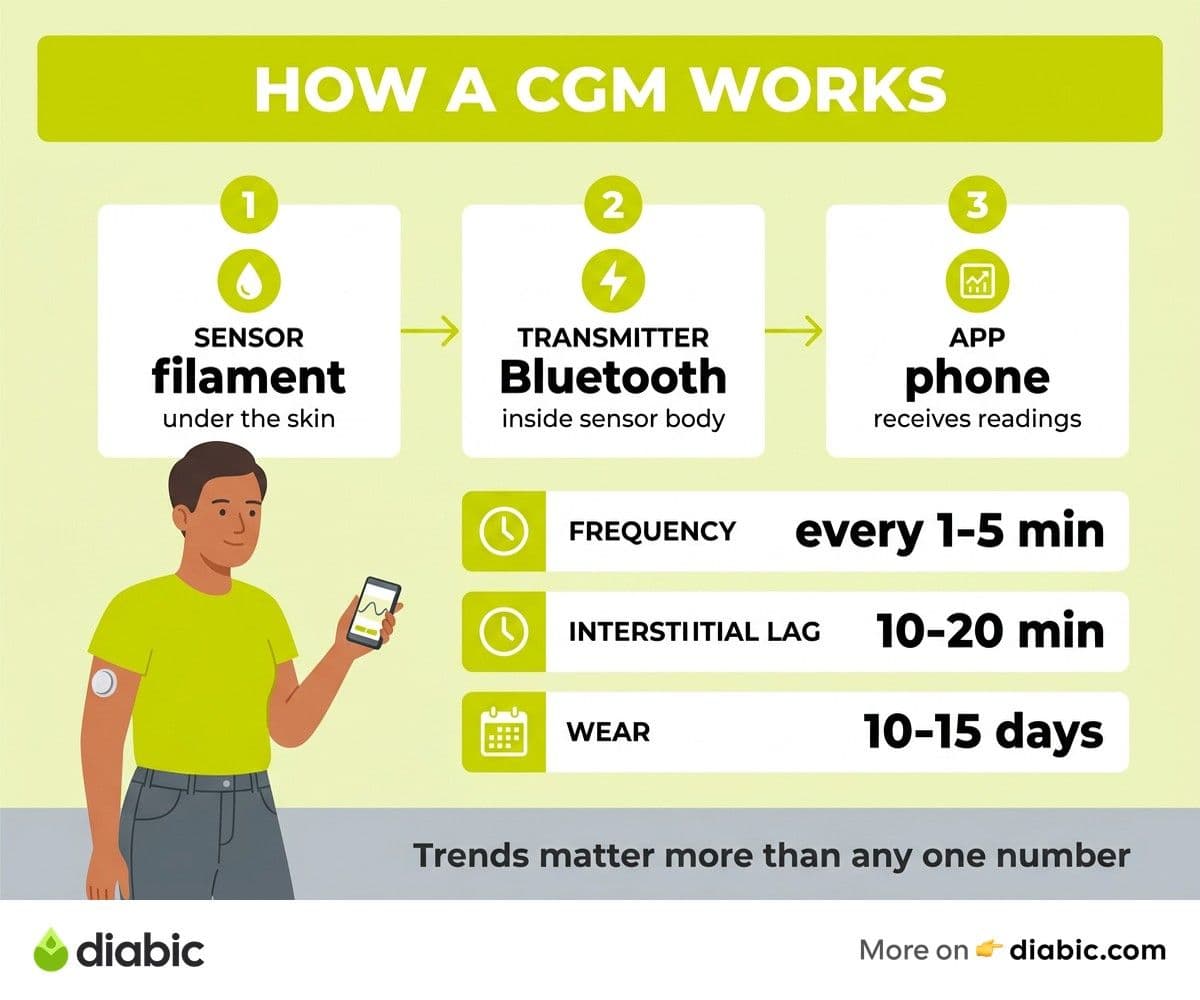
A continuous glucose monitoring system is a small wearable medical device that measures glucose in your body around the clock and shows the readings on a phone, smartwatch, or dedicated receiver. The system has three components: a sensor that sits just under the skin, a transmitter that sends the data wirelessly, and a display device that shows the numbers and trends.
The sensor itself is a thin, flexible filament about the width of a few human hairs, inserted under the skin with a spring-loaded applicator. The insertion is fast and most people describe it as a quick pinch, similar to a vaccine but smaller. The filament stays in place for the full sensor session, which lasts 7 to 15 days depending on the model.
A continuous glucose monitor for diabetes is approved for use across all types: type 1, type 2, gestational, and pre-diabetes screening in some clinical settings. It is also used by people without diabetes for general health monitoring, though the medical evidence is strongest for people who use insulin or other glucose-lowering medications.
How a CGM Differs From a Standard Glucose Meter
A traditional blood glucose meter (BGM) measures glucose in a small drop of blood from your fingertip and gives you one number at one moment in time. Most people on insulin check 4 to 8 times a day with a BGM, which means they are guessing at what is happening between checks.
A CGM measures glucose every 1 to 5 minutes and shows you a continuous curve. Over a 24-hour period, you go from 8 data points to 288 to 1,440. That density reveals patterns that fingersticks fundamentally cannot show: post-meal spikes, overnight drift, exercise responses, dawn phenomenon, and slow lows that happen between scheduled checks.
The clinical evidence for the value of this added information is strong. The Beck et al. JAMA 2017 trial showed CGM use reduced A1C by about 0.6 percentage points and increased time in range by 1.4 hours per day in adults with type 1 diabetes on multiple daily injections.
Who Benefits Most From a CGM
The strongest case for CGM use is in anyone who takes insulin, regardless of diabetes type. People with type 1 diabetes use CGMs to coordinate insulin dosing with real-time glucose data, often as part of an automated insulin delivery system. People with type 2 diabetes on insulin see similar benefits, particularly for overnight glucose control and post-meal management.
The Martens et al. JAMA 2021 MOBILE study showed CGM use reduced A1C by 0.4 percentage points in adults with type 2 diabetes on basal insulin alone, even without intensive insulin titration. Our best CGMs for type 2 diabetes post covers the type 2 case in more depth.
People with hypoglycemia unawareness benefit substantially from CGM low-glucose alerts. Pregnant women with gestational or pre-existing diabetes use CGMs to maintain tight glucose targets during pregnancy. Children with type 1 diabetes and their caregivers use share features so parents can see real-time data on their own phones.
For people with prediabetes or type 2 diabetes who are not on insulin, the case is less settled clinically but increasingly common in practice. CGM use can reveal post-meal patterns and motivate lifestyle changes, though the long-term outcome data is still developing.
How a Continuous Glucose Monitor Works for Diabetes
A continuous glucose monitor works by measuring glucose in interstitial fluid, the fluid that surrounds your cells just under the skin. Glucose moves from blood vessels into interstitial fluid by diffusion, so interstitial glucose tracks blood glucose closely but with a small lag.
The sensor filament contains an enzyme called glucose oxidase that reacts with glucose in the interstitial fluid. The reaction produces a tiny electrical current proportional to the glucose concentration, and the sensor electronics translate that current into a glucose reading. This electrochemical method has been the foundation of CGM technology since the first commercial systems launched in the early 2000s.
Modern systems like the Dexcom G7, FreeStyle Libre 3, and Medtronic Guardian all use variations of this enzymatic approach. The differences between brands are in sensor design, calibration requirements, wear duration, accuracy, and how the data flows to your phone or pump.
From Sensor to Phone
Once the sensor measures glucose, the data has to travel to a display device. Most current CGMs use Bluetooth Low Energy to send readings every 1 to 5 minutes from the on-body transmitter to a paired smartphone, dedicated receiver, or insulin pump.
Some sensors (FreeStyle Libre 2 in some markets) use NFC scanning, where you tap the phone or reader against the sensor to retrieve the data. Newer Libre 3 sensors stream automatically over Bluetooth like Dexcom and Medtronic. Our how to use your CGM app post walks through the phone-side experience in detail.
The transmitter is integrated into the sensor housing in most current systems. Older designs (Dexcom G6) had a separate reusable transmitter that snapped onto each new sensor. The newer integrated approach is more convenient but means the entire unit gets thrown away every wear cycle.
Calibration: Then and Now
The first CGM systems required users to calibrate the sensor with two or more fingerstick blood glucose readings per day. Modern factory-calibrated systems (Dexcom G7, FreeStyle Libre 3, Medtronic Guardian 4) do not require routine calibration. The sensor arrives pre-calibrated from the factory and runs accurately for the full wear period without fingerstick checks.
Optional calibration is still possible on most systems if you want to nudge the sensor accuracy when you suspect a discrepancy. The reasons to calibrate are usually first-day variability, an obvious mismatch between sensor and fingerstick, or sensor behavior that drifts over the wear cycle.
The Lag Between Blood and Interstitial Glucose
Interstitial glucose tracks blood glucose with a 5 to 15 minute lag, depending on how fast glucose is rising or falling. When blood glucose is stable, the two values are nearly identical. When blood glucose is rising fast (post-meal) or falling fast (after insulin or exercise), the CGM reading lags behind the actual blood number.
This lag matters in specific situations. If you are correcting a high or treating a low, the sensor may show one number while your actual blood glucose is already moving. Modern CGMs use trend arrows to communicate the direction and rate of change, which helps you interpret the lag. A flat arrow means the lag is small. A steep up or down arrow means the actual blood number may be significantly different from the displayed value.
For most everyday decisions, the lag is not a problem. For acute treatment of a low or high, a fingerstick confirmation may still be useful, especially in the first day of a new sensor.
What Makes a Wearable Continuous Glucose Monitor Different
The wearable continuous glucose monitor category is dominated by adhesive patch sensors that stick to the skin for 7 to 15 days. The Dexcom G7, FreeStyle Libre 3, and Medtronic Guardian 4 all fit this category, though they differ in size, wear time, and water resistance.
A separate category is implantable sensors. The Eversense E3 from Senseonics is implanted under the skin in a brief office procedure and lasts 180 days per insertion. It uses a fluorescent measurement method instead of the enzymatic approach used by patch sensors. Implantable sensors are less common but offer specific advantages around longer wear and freedom from adhesive issues.
For the rest of this post, we focus on patch sensors since they represent the vast majority of CGM use. Our Dexcom Stelo CGM review covers a specific over-the-counter option in more depth.
Wear Duration
Sensor wear time varies by brand:
- Dexcom G7: 10 days plus a 12-hour grace period
- FreeStyle Libre 3 Plus: 15 days
- Medtronic Guardian 4: 7 days
- Eversense E3 (implantable): 180 days
Longer wear time means fewer sensor changes and lower per-day cost, all else equal. Shorter wear time can mean more sensor changes but sometimes better accuracy across the wear cycle. Picking the right wear duration depends on how the cost and convenience trade-off feels to you.
Water Resistance
Most current CGMs are rated for showering, swimming, and sweating. Specific depth and duration ratings vary by manufacturer, but the general guidance is that you can shower normally, swim in a pool for typical durations, and not worry about sweat during exercise.
Hot tubs and saunas can be harder on adhesive bonding because heat softens the adhesive layer over time. Pool chemicals also degrade adhesives faster than fresh water. People who swim regularly often add an over-patch or tape to extend sensor wear in water.
How Often Do You Change a Continuous Glucose Monitor
You change a continuous glucose monitor based on the sensor wear duration: every 10 days for Dexcom G7, every 15 days for FreeStyle Libre 3 Plus, every 7 days for Medtronic Guardian 4. Set a reminder on your phone for the day before your sensor expires so you have time to start a new one without a data gap.
Implantable sensors like Eversense need a clinic visit to change, typically every 180 days, which is a different scheduling rhythm.
Key Benefits of a Continuous Glucose Monitor
The continuous glucose monitor benefits worth highlighting are not just clinical numbers like A1C reduction. They are the practical changes that make daily diabetes management easier and less stressful.
Real-time alerts for highs and lows are the most immediately valuable feature. Set a low alert at 70 mg/dL and the system warns you 5 to 10 minutes before you would have noticed symptoms, which gives you time to treat with juice or glucose tabs before the low gets severe. People with hypoglycemia unawareness rely on these alerts to prevent seizures and emergency department visits.
Trend arrows help you make smarter dosing decisions. If your glucose is 130 mg/dL with a flat arrow, that is very different from 130 with a fast-rising arrow. The first situation might need no action. The second might need a small bolus before a meal. Pattern recognition over weeks and months reveals food responses, exercise effects, and dosing patterns you can refine over time.
Better A1C outcomes are clinically validated. The Beck et al. JAMA 2017 trial in type 1 diabetes and the Martens et al. JAMA 2021 MOBILE study in type 2 diabetes both showed measurable A1C improvements with CGM use. The American Diabetes Association includes CGM as a standard recommendation in its Standards of Care 2026 for anyone on insulin.
Reduced Hypoglycemic Episodes
CGM use reduces the frequency and severity of low blood sugar episodes, particularly overnight. The continuous data plus alarms catch lows earlier and prevent the deep nighttime lows that fingerstick monitoring routinely misses.
For caregivers of children with type 1, the share features (Dexcom Share, Libre LinkUp, Guardian Connect Care) let parents see CGM data on their own phone in real time and get alerts when their child trends low. This is one of the most-cited reasons families with young children with T1D choose CGM systems.
Pattern Recognition With AGP Reports
The Ambulatory Glucose Profile (AGP) report, supported by all major CGM brands, summarizes 14 days of continuous data into a one-page visualization that shows your typical day, your variability, and your time-in-range breakdown. Clinicians use AGP reports during appointments to spot patterns that drive treatment decisions.
For self-management, learning to read your own AGP report is one of the highest-value skills a CGM user can develop. Our AGP report walkthrough explains the layout and how to interpret it.
How Accurate Is a Continuous Glucose Monitor
CGM accuracy is measured by Mean Absolute Relative Difference (MARD), which is the average percentage difference between sensor readings and reference blood glucose values across a wear cycle. Lower MARD means more accurate.
Modern CGMs report MARD values in the 8 to 11 percent range, depending on the model and the testing conditions. For comparison, fingerstick blood glucose meters have MARD values around 5 to 10 percent under FDA accuracy standards, so the better CGMs approach BGM accuracy in many situations.
A MARD of 9 percent means that on average, a sensor reading of 100 mg/dL differs from the actual blood glucose by about 9 mg/dL. That is good enough for most treatment decisions, especially when combined with trend arrows that tell you which direction the glucose is moving. The FDA 510(k) database tracks specific accuracy claims for cleared CGM devices.
Factors That Affect Accuracy
Several factors can shift CGM accuracy at specific moments:
- First-day variability: many sensors are less accurate in the first 12 to 24 hours of wear as tissue fluid stabilizes around the filament.
- Compression lows: lying on the sensor (sleeping on it, tight clothing pressure) can cause a falsely low reading that resolves when the pressure is removed.
- Dehydration: low fluid status can affect interstitial glucose readings, generally pushing them slightly higher than blood values.
- Rapid changes: during fast rises or falls, the lag between blood and interstitial glucose can make the CGM look 10 to 30 mg/dL off.
- High doses of vitamin C: very high vitamin C intake can cause falsely high readings on some sensors. Most users do not encounter this in practice.
- Acetaminophen: older Dexcom systems had interference from acetaminophen. The G6 and G7 do not have this issue.
When You Still Need a Fingerstick
A fingerstick confirmation is still useful in a few situations. Acute low blood sugar treatment decisions where you are not sure if the CGM is reading accurately. Suspected sensor malfunction where readings do not match how you feel. Unusual or surprising readings that do not fit your expected pattern. The first 12 hours of a new sensor if accuracy seems off.
A reasonable practical rule is: if a CGM reading would change a meaningful treatment decision and you are not confident in the sensor, check a fingerstick. Otherwise, trust the CGM.
How to Wear, Replace, and Remove Your CGM Sensor
CGM sensors are designed for self-application with a single-use applicator. Sensor placement varies by brand:
- Dexcom G7: back of the upper arm (adults), upper buttock (children 2 to 6)
- FreeStyle Libre 3 Plus: back of the upper arm
- Medtronic Guardian 4: back of the upper arm or abdomen
- Eversense E3 (implantable): inserted by a healthcare provider
Pick a site with at least an inch of clearance from the previous sensor location, away from scars, tattoos, moles, or areas where clothing rubs heavily. Wash your hands and clean the application site with an alcohol wipe before insertion. Let the alcohol dry fully (30 to 60 seconds) before applying the sensor. Insertion takes about 5 seconds with most modern applicators.
How Long Can You Wear a Continuous Glucose Monitor
You can wear a continuous glucose monitor for the full duration cleared by the manufacturer: 7 days for Medtronic Guardian 4, 10 days plus a 12-hour grace period for Dexcom G7, and 15 days for FreeStyle Libre 3 Plus. The Eversense E3 implantable sensor lasts 180 days per insertion. Wearing a sensor beyond its rated time produces unreliable readings and is not recommended.
Some users extend wear with adhesive patches or restart sensors using third-party methods. We do not recommend either practice. The clinical reliability of the data degrades, and the manufacturer warranty does not cover extended-wear behavior.
How to Remove a Continuous Glucose Monitor Safely
Remove a CGM sensor by lifting one corner of the adhesive and slowly peeling it off in the direction of hair growth. For stubborn adhesive, applying a few drops of mineral oil, baby oil, or a medical adhesive remover (Uni-Solve, Detachol) loosens the bond and reduces skin trauma.
Avoid yanking the sensor off quickly. Rapid removal often tears skin, especially after the sensor has been on for 10 to 15 days. Some users find that removing the sensor right after a warm shower is easier because the adhesive is softer.
After removal, wash the area with soap and water to remove residual adhesive. Apply a moisturizer or aloe gel to soothe any redness. If you have persistent redness or itching beyond a few hours, that may be an adhesive sensitivity worth talking to your provider about.
Skin Prep and Adhesive Tips
A small set of habits extends sensor wear and reduces irritation:
- Apply a barrier wipe (Skin-Tac, Skin Prep) after the alcohol dries and before sensor insertion. The wipe creates a thin protective layer that improves adhesive bonding.
- Avoid lotions, oils, or sunscreen on the application site for at least 24 hours before insertion.
- Add an over-patch (Simpatch, Skin Grip) for swimming, heavy exercise, or extended hot weather.
- Rotate sites in a planned pattern so no single area sees back-to-back use.
- For sensitive skin, a hydrocolloid dressing cut to fit around the filament can reduce direct adhesive contact.
If sensor insertion is painful or you are nervous about the first time, our does a CGM hurt post walks through what to expect in detail.
Choosing the Right CGM for Your Needs
Picking the right continuous glucose monitor depends on a few practical factors: what your insurance covers, what your insulin pump or smart pen supports, how long you want to wear each sensor, and which app ecosystem fits your phone and lifestyle.
Three CGM brands dominate the US market. The Dexcom G7 leads on broad insulin pump compatibility (Tandem t:slim X2, OmniPod 5, iLet, Twiist) and accuracy. The FreeStyle Libre 3 Plus offers the longest wear time (15 days) at typically lower cost. The Medtronic Guardian 4 is integrated specifically with Medtronic insulin pumps and is rarely chosen as a standalone CGM.
The over-the-counter category, including the Dexcom Stelo and the Abbott Lingo, is also growing. These devices are designed for people without a prescription and target a wider audience than traditional CGM users. Our Dexcom Stelo CGM review covers that segment in detail.
Quick Comparison of Major Systems
Insurance coverage often narrows the choice quickly. Many commercial plans cover one or two CGM brands but not all three, and Medicare Part B has specific durable medical equipment criteria. Talk to your endocrinology clinic about what your plan covers before getting attached to a specific brand.
Features to Compare
Beyond the brand-level differences, evaluate these features:
- Accuracy specifically in your typical glucose range (some sensors are more accurate at lows, others in normal range)
- Alert customization: which alerts can you silence, snooze, or differentiate between night and day?
- Smartphone compatibility with your specific phone model and operating system version
- Data export options to your endocrinologist's preferred platform (Glooko, Tidepool, Clarity, LibreView)
- Sensor warm-up time after insertion (30 minutes to 2 hours depending on model)
Insurance and Cost Considerations
CGM cost varies enormously based on insurance, prescription type, and pharmacy. With insurance, monthly out-of-pocket costs typically range from $0 to $200 for prescription CGM users on insulin. Without insurance, sensor costs run roughly $200 to $400 per month at retail.
Medicare Part B covers CGMs for people who use insulin or have a documented history of problematic hypoglycemia. State Medicaid programs vary widely. Manufacturer patient assistance programs can reduce costs for uninsured or underinsured users.
The over-the-counter Dexcom Stelo and Abbott Lingo are sold without prescription and bypass insurance entirely. These are typically less expensive per sensor than prescription CGMs but lack the alarms and integration features of the prescription versions.
From my experience: I have used 4 different CGM systems across 14 years with type 1, starting with the original Dexcom Seven Plus in 2010. The improvement in accuracy, wear time, and convenience over that period has been remarkable. The single change that made the biggest day-to-day difference for me was the move from fingerstick calibration to factory calibration. Removing those twice-daily checks dropped a small but constant cognitive load that I had stopped noticing until it was gone. If you have not used a CGM yet, the technology in 2026 is much better than what was available even 5 years ago, and the case for trying one is stronger than it has ever been.
FAQ
How accurate is a continuous glucose monitor?
A continuous glucose monitor is highly accurate for most everyday treatment decisions. Modern CGMs report MARD values (Mean Absolute Relative Difference) in the 8 to 11 percent range, which approaches blood glucose meter accuracy. For a sensor reading of 100 mg/dL, the actual blood glucose is typically within 8 to 11 mg/dL of the displayed number. Accuracy can drop in the first 12 to 24 hours of a new sensor and during very rapid glucose changes, but trend arrows help you interpret these situations. Confirm with a fingerstick if a reading does not match how you feel.
How often do you change a continuous glucose monitor?
You change a continuous glucose monitor based on the sensor wear period set by the manufacturer. Dexcom G7 sensors last 10 days plus a 12-hour grace period. FreeStyle Libre 3 Plus sensors last 15 days. Medtronic Guardian 4 sensors last 7 days. Eversense E3 implantable sensors last 180 days per insertion. Set a phone reminder for the day before your sensor expires so you can apply a new one without a data gap.
How long can you wear a continuous glucose monitor?
You can wear a continuous glucose monitor for the duration cleared by the manufacturer for that specific model: 7 to 15 days for adhesive patch sensors, and up to 180 days for implantable sensors like Eversense E3. Wearing a sensor beyond its rated time produces unreliable readings, and we do not recommend extending wear with workarounds. Talk to your doctor about the right sensor and wear schedule for your specific needs.
Can you shower or swim with a CGM?
Yes, you can shower and swim with a continuous glucose monitor. All major CGMs (Dexcom G7, FreeStyle Libre 3 Plus, Medtronic Guardian 4) are rated for normal showering and swimming. Specific depth and duration ratings vary by brand, so check your sensor's user guide for limits. Hot tubs, saunas, and pool chemicals can shorten adhesive life. Many regular swimmers add an over-patch (Simpatch, Skin Grip) to extend sensor wear in water.
A continuous glucose monitoring system is one of the most useful tools available for diabetes management in 2026, and the case for adopting one is stronger than ever. The technology is more accurate, more convenient, and more accessible than even five years ago. If you have been on the fence, talking to your endocrinologist about a continuous glucose monitor for diabetes is a worthwhile next step.
Dr. Shanto Arian is an internal medicine physician now specializing in clinical and aesthetic dermatology, with a parallel academic focus on epidemiology and public health. He holds an MBBS, MPH, MSc (UK), MRCP (UK), MRCPI (Ireland), Diploma in Dermatology (UK), and Diploma in Aesthetic Medicine (USA). Dr. Arian trained in internal medicine, including hospital work on hematology cases such as graft-versus-host disease, before moving toward dermatology. Skin is one of the earliest places diabetes shows itself, from acanthosis nigricans and diabetic dermopathy to slow foot wound healing, and that intersection is where his clinical and Diabic-review work meet. On Diabic, Dr. Arian medically reviews content on diabetes diagnosis, complications, dermatologic manifestations, and pharmacotherapy, ensuring every claim aligns with current ADA, NICE, and peer-reviewed literature.
Medically reviewed by
Dr. Rezwana Parvin Rumpa is an obstetrics and gynaecology specialist with clinical focus on gestational diabetes, PCOS, and fertility. She holds the MRCOG (Final Part) from the Royal College of Obstetricians and Gynaecologists in London, the MRCPI (Final Part) from the Royal College of Physicians of Ireland, and an MBBS from Shaheed Monsur Ali Medical College under Dhaka University. Dr. Rumpa serves as a Senior Medical Officer in the Obs and Gynae department at BRB Hospitals Ltd, where she has spent three years managing prenatal care, emergency obstetric cases, and women's-health surgery. On Diabic, she medically reviews content for women living with diabetes, with particular attention to pregnancy, PCOS, and reproductive-health intersections.
More from Devices & Technology
View all
Fasting vs Postprandial Glucose: What's the Difference
Fasting vs postprandial glucose readings tell different stories about your blood sugar. Learn what each number means and how to act on it.

Best Glucometer for Elderly and Low-Vision Users
Best glucometer for elderly and low-vision users: large displays, audio readouts, no-coding strips, and budget picks that make daily testing easier.

Online Diabetes Coaching: How to Choose a Good One
Online diabetes coaching can fill the gaps between doctor visits. Learn what credentials to check, red flags to avoid, and how to pick a quality program.
Clinician-reviewed habits, plain-language guides, and honest answers - the small shifts that make living with diabetes feel lighter, every day.