Using a Continuous Glucose Monitor for Hypoglycemia
A continuous glucose monitor for hypoglycemia can catch lows before symptoms hit. Learn how alerts, trends, and CGM data help prevent severe episodes.

In this article(9)
A continuous glucose monitor for hypoglycemia can be the difference between catching a low early and waking up on the floor. If you have ever had a 3 a.m. crash, missed an early warning sign, or watched a loved one get scared by a severe episode, you already know how unforgiving lows can be. This guide explains how a CGM finds hypoglycemia faster than fingersticks, why it matters for people who no longer feel their lows, and how to set up your alerts so they actually help.
A CGM is not a cure for hypoglycemia, and it will not replace good clinical judgment. But used well, it gives you something fingerstick testing simply cannot: a continuous look at where your glucose is heading, with seconds to spare instead of minutes.
How a Continuous Glucose Monitor Detects Hypoglycemia
A CGM measures glucose in the interstitial fluid just under your skin every one to five minutes, depending on the device. That stream of data is what lets it spot a falling pattern long before a fingerstick would. To understand the basics of how a CGM works, it helps to know that the sensor reads glucose continuously and sends those readings to your phone or receiver in real time.
Two features make a CGM especially powerful for catching lows. The first is the trend arrow, which shows the direction and speed of glucose change. A flat arrow at 90 mg/dL is reassuring, while a double down arrow at the same number tells you a low is coming fast. The second feature is the alert system, which lets you set thresholds that buzz, beep, or vibrate when glucose crosses a number you choose.
Compared to fingerstick testing, a CGM detects drops earlier in two ways. It catches glucose changes between meals and overnight when you would never test on your own. It also shows the rate of fall, so a glucose of 95 with a steady arrow is treated very differently than a 95 with a sharply dropping arrow. The American Diabetes Association recommends CGM use for most adults on insulin therapy partly because of this earlier detection (ADA Standards of Care 2024).
Symptoms of hypoglycemia, when you can feel them, often appear at glucose levels around 70 mg/dL or lower. By that point, a CGM has usually been showing a downward trend for ten to twenty minutes. That window is where most prevention actually happens.
Why a Continuous Glucose Monitoring System Matters for Hypoglycemia Unawareness
Hypoglycemia unawareness is a condition where your body stops producing the usual warning symptoms of a low. The shakiness, sweating, and racing heart that should kick in around 65 mg/dL fade or disappear entirely. According to the NIDDK, people most at risk are those with long-standing type 1 diabetes, frequent past lows, or autonomic neuropathy.
The danger is straightforward. Without symptoms, you cannot treat what you cannot feel. Severe lows that lead to confusion, seizure, or unconsciousness happen far more often in people with unawareness, and they are the events most likely to require emergency intervention.
Clinical research consistently shows that CGM use reduces hypoglycemic events. A landmark study published in The Lancet (Heinemann et al., 2018) found that adults with type 1 diabetes and impaired hypoglycemia awareness had a 72 percent reduction in time spent below 55 mg/dL after switching to CGM. Newer trials have shown similar benefits for people with type 2 diabetes on insulin and for older adults at higher risk of severe lows. If you live with type 2 specifically, our roundup of best CGMs for type 2 walks through which devices are most often recommended.
Beyond preventing immediate emergencies, CGM data may help restore some hypoglycemia awareness over time. By avoiding repeated lows, the body can slowly relearn its counterregulatory response. This is one of the more underappreciated continuous glucose monitor benefits, and it is something endocrinologists actively work toward when prescribing CGM for unawareness.
Key CGM Benefits for Preventing Lows
Continuous glucose monitor benefits stack up most clearly around the moments fingersticks miss. Sleep is the obvious one. A nighttime low can drop you to 50 mg/dL while you sleep through every internal warning sign. A CGM watches for you.
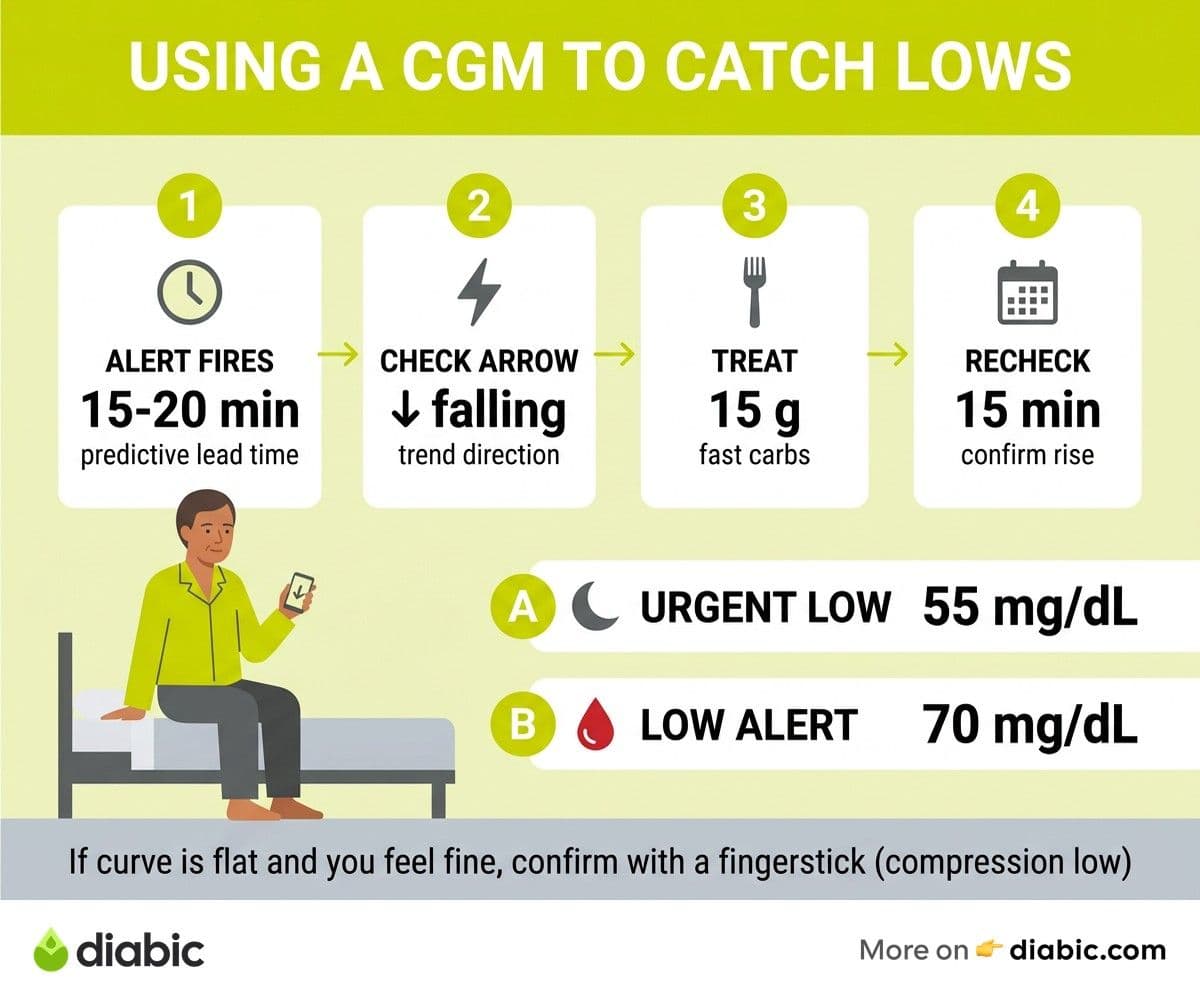
Predictive alerts take this further. Instead of waiting for glucose to actually cross a low threshold, devices like the Dexcom G7 can alert you when glucose is predicted to drop below 55 mg/dL within the next 20 minutes (Dexcom Urgent Low Soon feature). That extra time lets you treat with a small carb intake instead of a larger correction after the fact.
Sharing features extend the safety net beyond yourself. Dexcom Follow and the FreeStyle LibreLink share platforms let parents, partners, or caregivers see your glucose in real time on their own phones. For parents of kids with type 1, this is often the feature that finally lets them sleep. For adults living alone, it can be a lifeline during severe episodes.
Pattern reports add longer-term value. Most CGM apps generate weekly summaries showing when lows happen most often, which helps you and your provider find the recurring causes. Maybe lows always happen Tuesday afternoons after the gym, or in the early hours of Sunday mornings after Saturday night drinks. Patterns you would never spot from individual readings become obvious in two weeks of data.
From my experience: After 14 years with type 1, my hypoglycemia awareness faded to almost nothing in my late twenties. I would test a fingerstick of 48 mg/dL and feel completely normal. The first month with a CGM, I caught more low-trending readings before symptoms than I had in the previous five years combined. The alerts felt annoying at first. Now I think of them as the most reliable safety system in my routine.
Setting Up Your Continuous Glucose Monitor for Hypoglycemia Alerts
Default alert settings are a starting point, not a finish line. Most people benefit from adjusting them to match their own goals, sleep patterns, and how often they are willing to be interrupted. Setup takes about five minutes in the app and may need a few rounds of tweaking over the first week.
A common starting point looks like this:
- Urgent low alert: 55 mg/dL, on at all times, cannot be silenced
- Low alert: 70 mg/dL during the day, 80 mg/dL overnight
- Falling fast alert: on if your device offers it, especially if you experience post-meal lows
- Predictive low alert: on, set to warn 15 to 20 minutes before a predicted low
Overnight thresholds are often set higher than daytime ones because you cannot feel a low in your sleep. An 80 mg/dL alert at night may seem aggressive, but it gives you the chance to treat before glucose drops into a dangerous zone. The Abbott FreeStyle Libre 3 and Dexcom both let you set different day and night profiles for this reason.
Alarm fatigue is real. If your CGM alerts dozens of times a day, you may start ignoring them or turning them off entirely, which defeats the purpose. The fix is rarely to lower thresholds further. Often it is to address the underlying patterns, like adjusting basal insulin or pre-bolusing for meals, so your glucose stays in range more often. A CGM that beeps three times a week is one you actually pay attention to. While we are on comfort and tolerability, our guide on whether a continuous glucose monitor hurts covers what setup actually feels like for new users.
Predictive alerts and threshold alerts work together, not as substitutes. A threshold alert tells you what your glucose is right now. A predictive alert tells you where it is heading. For hypoglycemia prevention specifically, the predictive alert is often the more useful of the two because it gives you time to act on a snack instead of glucose tablets.
What to Do When Your CGM Alerts You to a Low
The 15-15 rule is the foundation of low treatment. When your CGM alerts and you confirm a low (or trust the trend strongly enough to act), take 15 grams of fast-acting carbohydrate, wait 15 minutes, then recheck. If you are still below 70 mg/dL, repeat. The Endocrine Society and ADA both endorse this protocol as the standard approach for mild to moderate hypoglycemia (ADA hypoglycemia guidelines).
What counts as 15 grams of fast carbs:
- 4 glucose tablets for hypoglycemia
- 4 ounces (half a cup) of regular juice or soda
- 1 tablespoon of honey or sugar
- 1 tube of glucose gel
Glucose tablets are usually the cleanest option because the dose is precise, they raise glucose quickly, and they are unlikely to cause an overcorrection rebound. Juice works well in a pinch but it is easy to drink the whole bottle when you are scared, which leads to a high two hours later. Gel is useful for severe lows when chewing is hard or when you are treating someone else who needs help.
Trust your CGM but verify when the situation feels off. CGM accuracy can drop slightly during rapid glucose changes due to a small lag between blood glucose and interstitial fluid glucose. If your CGM reads 60 mg/dL but you feel completely fine, a fingerstick confirmation can be useful. If you feel symptomatic and your CGM reads 65 with a down arrow, treat first and verify later. The FDA-cleared accuracy data for modern CGMs is strong, but no device is perfect and clinical judgment still matters.
Severe hypoglycemia is a medical emergency. If someone with diabetes loses consciousness, has a seizure, or cannot safely swallow, do not give them food or liquid. Use injectable or nasal glucagon if available, then call emergency services. Ready-to-use glucagon options like Baqsimi (nasal) and Gvoke (auto-injector) have made rescue much easier than the older mixing kits.
After any meaningful low, document it. Most CGM apps let you log the event with a quick note (cause, treatment, recovery time). These notes are gold during your next provider visit because they show patterns your doctor can use to adjust your treatment plan.
FAQ
How accurate is a continuous glucose monitor during hypoglycemia?
Modern CGMs are generally accurate within roughly 9 to 11 percent of lab values, which is close enough for most clinical decisions. Accuracy may dip slightly during rapidly falling glucose due to the lag between blood and interstitial fluid. When in doubt, especially below 70 mg/dL, a fingerstick confirmation is reasonable. The bigger picture is that CGMs catch trending lows that fingersticks miss entirely, which matters more for prevention than precise individual readings.
How often do you change a continuous glucose monitor?
Sensor wear time depends on the brand. Dexcom G7 lasts 10 days, FreeStyle Libre 3 lasts 14 days, and the Eversense implanted CGM lasts up to 365 days. Most people set a phone reminder a day before sensor expiration, since changing on schedule helps avoid gaps in data and unexpected sensor failures.
Can a CGM prevent severe hypoglycemia?
Research suggests yes, especially when combined with proper alert setup and consistent use. Studies in adults with type 1 diabetes have shown reductions in severe hypoglycemic events of 50 percent or more after switching to CGM. The benefit comes from catching lows early, watching glucose overnight, and giving caregivers visibility into trending readings. CGM does not eliminate hypoglycemia risk, but it shifts most lows from "severe and unexpected" to "mild and treatable."
If you are new to continuous glucose monitoring or considering one for hypoglycemia specifically, talk to your doctor about whether a CGM is a good fit for your situation. Insurance coverage has expanded significantly in recent years for both type 1 and insulin-using type 2 diabetes, and prescription requirements vary by device.
The biggest takeaway from years of using a continuous glucose monitor for hypoglycemia is that the device only works as well as the alerts you set and the patterns you act on. Start with conservative thresholds, share your data with someone you trust, and bring two weeks of CGM reports to every appointment. Over time, the lows that used to feel random start to look like a small list of fixable causes, and that is where real safety lives.
Dr. Shanto Arian is an internal medicine physician now specializing in clinical and aesthetic dermatology, with a parallel academic focus on epidemiology and public health. He holds an MBBS, MPH, MSc (UK), MRCP (UK), MRCPI (Ireland), Diploma in Dermatology (UK), and Diploma in Aesthetic Medicine (USA). Dr. Arian trained in internal medicine, including hospital work on hematology cases such as graft-versus-host disease, before moving toward dermatology. Skin is one of the earliest places diabetes shows itself, from acanthosis nigricans and diabetic dermopathy to slow foot wound healing, and that intersection is where his clinical and Diabic-review work meet. On Diabic, Dr. Arian medically reviews content on diabetes diagnosis, complications, dermatologic manifestations, and pharmacotherapy, ensuring every claim aligns with current ADA, NICE, and peer-reviewed literature.
Medically reviewed by
Dr. Rezwana Parvin Rumpa is an obstetrics and gynaecology specialist with clinical focus on gestational diabetes, PCOS, and fertility. She holds the MRCOG (Final Part) from the Royal College of Obstetricians and Gynaecologists in London, the MRCPI (Final Part) from the Royal College of Physicians of Ireland, and an MBBS from Shaheed Monsur Ali Medical College under Dhaka University. Dr. Rumpa serves as a Senior Medical Officer in the Obs and Gynae department at BRB Hospitals Ltd, where she has spent three years managing prenatal care, emergency obstetric cases, and women's-health surgery. On Diabic, she medically reviews content for women living with diabetes, with particular attention to pregnancy, PCOS, and reproductive-health intersections.
More from Devices & Technology
View all
Fasting vs Postprandial Glucose: What's the Difference
Fasting vs postprandial glucose readings tell different stories about your blood sugar. Learn what each number means and how to act on it.

Best Glucometer for Elderly and Low-Vision Users
Best glucometer for elderly and low-vision users: large displays, audio readouts, no-coding strips, and budget picks that make daily testing easier.

Online Diabetes Coaching: How to Choose a Good One
Online diabetes coaching can fill the gaps between doctor visits. Learn what credentials to check, red flags to avoid, and how to pick a quality program.
Clinician-reviewed habits, plain-language guides, and honest answers - the small shifts that make living with diabetes feel lighter, every day.