Fasting vs Postprandial Glucose: What's the Difference
Fasting vs postprandial glucose readings tell different stories about your blood sugar. Learn what each number means and how to act on it.

In this article(12)
You wake up, check your meter, and the number is higher than you expected. Two hours after lunch, the same meter reads lower. If that has ever confused you, you are not alone. The difference between fasting vs postprandial glucose is one of the most useful, and most misunderstood, parts of diabetes data.
A fasting reading reflects what your liver is doing overnight when no food is in the picture. A post-meal reading reflects how your body responded to the last thing you ate. These are two different stories, and they call for two different responses.
We wrote this guide because most blood sugar advice treats every number the same. It should not. Knowing which reading is out of range tells you, and your doctor, where to focus.
Fasting vs Postprandial Glucose: What Each Measures
Fasting glucose is the level in your blood after at least eight hours without food or caloric drinks. Most people check it first thing in the morning, before breakfast or coffee with sugar. The reading reflects how much glucose your liver has released overnight, balanced against whatever insulin your body or your medication has on board.
Postprandial glucose is the level measured after a meal, usually at the one-hour or two-hour mark. This number shows how well your body cleared the carbohydrates and other macronutrients you ate. It depends on the speed of digestion, the size and timing of your insulin response, your activity level, and even your stress that day.
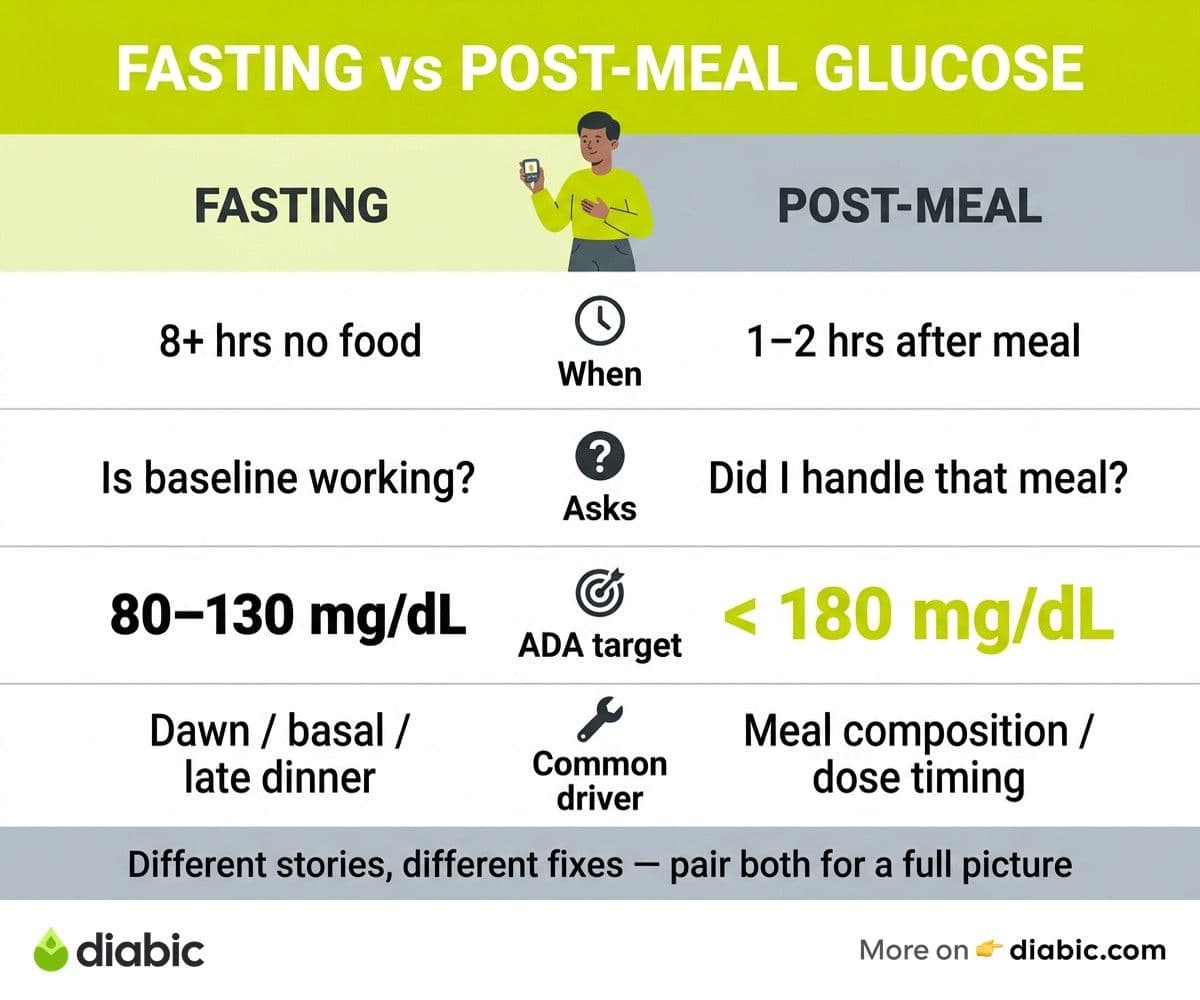
These two readings answer different questions. Fasting glucose asks, "Is my baseline working?" Postprandial glucose asks, "Did my body handle that meal?" Both feed into your overall A1C, which is roughly a weighted average of your glucose over the past two to three months. According to the CDC, fasting glucose testing is the most common screening method, but it does not catch every case of impaired glucose tolerance. That is why post-meal data matters too.
If you only check one number, you only see half the picture. Pairing both gives you and your provider better signals to work with. The best blood glucose meters for home testing make this dual-check routine simple, even if you do not wear a continuous glucose monitor.
Normal Ranges for Fasting and Post-Meal Glucose
The American Diabetes Association sets clear thresholds for diagnosis. For fasting glucose, below 100 mg/dL is normal, 100 to 125 mg/dL falls in the prediabetes range, and 126 mg/dL or higher on two separate tests indicates diabetes, according to the ADA's diabetes diagnosis criteria. For a two-hour glucose tolerance test, below 140 mg/dL is normal, 140 to 199 is prediabetes, and 200 or higher signals diabetes.
For people already living with diabetes, the targets shift toward management rather than diagnosis. The ADA Standards of Care suggest a fasting goal of 80 to 130 mg/dL for most non-pregnant adults, and a peak post-meal goal of less than 180 mg/dL one to two hours after the start of a meal. Pregnancy targets are tighter, and individual targets may be loosened for older adults or those at high risk of low blood sugar.
Notice that post-meal targets are wider than fasting targets. There is a reason. Even people without diabetes see a glucose rise after eating, especially after carb-heavy meals. The body is supposed to bring it back down within a couple of hours. The ADA target reflects what is realistic and protective, not what is "normal" in someone with perfectly tuned insulin.
Here is how the two readings compare side by side:
If only one column is consistently out of range, that points your provider toward a specific lever instead of a blanket medication change.
If your meter shows 90 fasting and 165 two hours after lunch, that is not failure. That is a body responding to food. The question is whether the rise comes back down, how fast, and how often it pushes past 180. This is where glucose variability becomes more useful than any single reading.
Why post-meal targets are wider
Insulin response takes time. Even rapid-acting insulin starts working in about 15 minutes and peaks around an hour. A meal that hits the bloodstream faster than insulin can match it will cause a temporary spike, and that is normal physiology. The goal is to prevent the spike from becoming a long plateau or pushing well past 180 mg/dL repeatedly.
If your one-hour post-meal reading is 200 but your two-hour reading is 130, your body is doing its job, just on a delay. If both readings are over 200, that is a different signal worth bringing to your doctor.
Why Your Fasting Glucose Might Be High
This is the question we hear most often. People say, "I did not eat anything for ten hours, so why is my morning number worse than my bedtime number?" The honest answer is that the liver is busy at night.
The most common cause is the dawn phenomenon. Between roughly 3 a.m. and 8 a.m., your body releases growth hormone, cortisol, and other hormones that wake you up. These hormones tell your liver to release glucose, getting your body ready for the day. In someone without diabetes, the pancreas matches that release with extra insulin. In someone with diabetes, the insulin response may not be enough, so fasting glucose climbs.
The Somogyi effect is rarer but worth knowing. If your blood sugar drops too low overnight, your body responds by dumping glucose into the bloodstream, and you wake up high. This is more common in people on insulin who took a large basal dose or skipped a bedtime snack. A CGM trace usually settles the question fast, since you can see whether you went low before the morning rise.
Other reasons your fasting number might be elevated include:
- A late-night meal or snack with refined carbs that kept your liver working overtime
- Inconsistent timing of basal insulin, metformin, or other medications
- Poor or short sleep, which raises cortisol and insulin resistance
- Stress, illness, or even a hard workout the evening before
- Alcohol earlier in the night, which can cause both highs and rebound lows
From my experience: I have lived with type 1 for fourteen years and used pumps and CGMs across most of that. The single biggest fasting-number win I ever got was tracking my basal rate at 4 a.m. on a CGM and adjusting it half a unit. Before that, I blamed dinner, then breakfast, then stress. The data was the only honest broker. If you can get a CGM trace of two or three full nights, your fasting puzzle usually solves itself.
Why Post-Meal Glucose Spikes Matter
Doctors used to focus almost entirely on fasting glucose and A1C. The thinking was simple: if those two numbers looked good, the patient was managing well. We now know that view missed something important.
The DECODE study, a large European analysis of glucose data, found that two-hour post-meal glucose was a stronger predictor of cardiovascular mortality than fasting glucose alone. Other research has linked repeated, sharp post-meal spikes to oxidative stress, endothelial dysfunction, and faster progression of diabetes complications. The takeaway is not to panic about every spike, but to recognize that flat is healthier than jagged.
Meal composition is the biggest lever you can pull. A bowl of white rice with no protein or fat will spike glucose far higher and faster than the same calories eaten as chicken, vegetables, and a smaller portion of rice. Fiber slows digestion. Protein and fat blunt absorption. Eating vegetables or protein first, then carbs, can shave 20 to 30 percent off your peak in some studies, even with the same total carbs.
Reactive hypoglycemia is the flip side. After a high-carb meal, some people overshoot their insulin response and crash low one to three hours later. If you have ever felt shaky and ravenous two hours after pasta, that may be why. The fix is usually to add protein and fat to the meal, not to eat more carbs to chase the low.
Tracking your time in range gives you a better post-meal story than any single reading. The percentage of time you spend between 70 and 180 mg/dL captures both the height and duration of spikes, which a single fingerstick can miss entirely.
How to Use Both Numbers to Improve Your Management
A simple testing schedule works well for most people who do not wear a CGM. Check fasting every morning at roughly the same time. Check post-meal selectively, rotating through breakfast, lunch, and dinner across the week so you cover each meal at least once. The goal is patterns, not perfection.
If you do wear a CGM, the work shifts. Instead of capturing single points, you watch the shape of the curve. A flat overnight line with a clean morning rise tells one story. A jagged 3 a.m. dip followed by a high wake-up tells another. Both are worth showing your provider.
Doctors use these two numbers differently when they adjust treatment. A high fasting number with normal post-meal numbers usually points toward basal insulin, long-acting medication, or overnight habits. A normal fasting number with high post-meal numbers points toward mealtime insulin, carb timing, or meal composition. A pattern of both being high may signal that overall medication needs to be revisited, or that an A1C normal range check is overdue.
Dietary strategies for each pattern
If your fasting number is your problem, look at what you eat after 7 p.m. Lower carb dinners, an earlier dinner, and a short post-dinner walk often help. Some people benefit from a small protein-and-fat snack at bedtime to prevent overnight lows that trigger morning rebounds.
If your post-meal numbers are your problem, focus on the next meal. Try eating vegetables and protein first, swapping refined carbs for whole grains or legumes, and adding a 10-minute walk after eating. The Mayo Clinic and ADA both note that light post-meal activity can lower one-hour post-meal glucose noticeably without any medication change.
If both numbers are high, that is a real conversation with your healthcare team, not a willpower problem. Medication adjustments, CGM data review, and sometimes a switch in eating pattern are usually on the table.
Frequently Asked Questions
What is the difference between fasting and postprandial glucose?
Fasting glucose is measured after at least eight hours without food and reflects your overnight baseline, primarily driven by the liver. Postprandial glucose is measured one to two hours after a meal and reflects how your body handled the food you ate. Both feed into your A1C, but they tell you about different parts of your day and respond to different interventions.
What should postprandial glucose be after eating?
For most non-pregnant adults with diabetes, the ADA suggests a peak postprandial glucose of less than 180 mg/dL when measured one to two hours after the start of a meal. People without diabetes typically stay below 140 mg/dL at the two-hour mark. Pregnancy and older-adult targets differ, so talk to your doctor about the right range for you.
Why is my fasting blood sugar higher than after eating?
The most likely culprit is the dawn phenomenon, where overnight hormones tell your liver to release glucose ahead of the day. The Somogyi effect, late-night eating, inconsistent medication timing, poor sleep, and stress can also raise fasting numbers. A CGM trace over two or three nights usually pinpoints the cause faster than any single fingerstick.
What to do next
If your fasting and postprandial glucose patterns have been confusing you, write them down for one week, breakfast through dinner, and bring them to your next appointment. Pair the data with what you ate, when you took medication, and how you slept. The story almost always shows up faster on paper than it does in your head.
You can also explore our guides on glucose variability and time in range to go deeper on what the patterns mean. Understanding fasting vs postprandial glucose is one of the most useful skills a person with diabetes can build, and you do not need a medical degree to do it well.
Shahriar P. Shuvo is the founder of Diabic. He has lived with diabetes for over 14 years, and built Diabic to deliver the practical, evidence-based self-management tools he wished existed when he was first diagnosed. By trade, Shahriar is a senior design and frontend engineer with 6+ years shipping products at Agora, Timescale (now Tiger Data), and ShareTrip. He writes from the intersection of lived diabetes experience and product craft, focused on what works in daily management rather than what sounds good in a textbook.
Medically reviewed by
Dr. Rezwana Parvin Rumpa is an obstetrics and gynaecology specialist with clinical focus on gestational diabetes, PCOS, and fertility. She holds the MRCOG (Final Part) from the Royal College of Obstetricians and Gynaecologists in London, the MRCPI (Final Part) from the Royal College of Physicians of Ireland, and an MBBS from Shaheed Monsur Ali Medical College under Dhaka University. Dr. Rumpa serves as a Senior Medical Officer in the Obs and Gynae department at BRB Hospitals Ltd, where she has spent three years managing prenatal care, emergency obstetric cases, and women's-health surgery. On Diabic, she medically reviews content for women living with diabetes, with particular attention to pregnancy, PCOS, and reproductive-health intersections.
More from Devices & Technology
View all
Best Glucometer for Elderly and Low-Vision Users
Best glucometer for elderly and low-vision users: large displays, audio readouts, no-coding strips, and budget picks that make daily testing easier.

Online Diabetes Coaching: How to Choose a Good One
Online diabetes coaching can fill the gaps between doctor visits. Learn what credentials to check, red flags to avoid, and how to pick a quality program.

Diabetes App Comparison: 5 Tested Picks 2026
A hands-on diabetes app comparison of MyNetDiary, MySugr, Glucose Buddy, Diabetes M, and One Drop, with pros, cons, pricing, integrations, and a feature.
Clinician-reviewed habits, plain-language guides, and honest answers - the small shifts that make living with diabetes feel lighter, every day.