Best Diabetes Wearable Devices Worth Buying in 2026
The best diabetes wearable devices in 2026, compared honestly. CGMs, pumps, smart pens, and smartwatches with real prices and trade-offs.
In this article(25)
The best diabetes wearable devices in 2026 do more than they did even two years ago, but they are not magic. CGMs are smaller, pumps are smarter, smart pens finally feel mature, and smartwatches can finally show your glucose trend at a glance. None of them, on any wrist or arm, can read your blood sugar without a sensor under the skin yet. We will get to that.
This roundup is for people who want a clear, honest comparison before they spend money or argue with insurance. We focus on what each device actually does, what it costs in the United States this year, and where it fits in real life. These tools are not solutions, and the best one is the one you will actually use every day.
How We Picked the Best Diabetes Wearable Devices in 2026
We looked at four wearable categories that matter most for daily diabetes management: continuous glucose monitors, insulin pumps, smart insulin pens, and smartwatches that integrate with diabetes data. For each device we considered FDA clearance status, accuracy data published by the manufacturer or in peer-reviewed studies, comfort during real-world wear, app and ecosystem integration, and cost with and without insurance coverage.
The wearable landscape has expanded because evidence keeps showing that more data and more automation lead to better outcomes. The ADA Standards of Care 2026 recommend CGM use for nearly everyone on insulin, and increasingly recommend automated insulin delivery for people with type 1 diabetes. That is the backdrop for every recommendation here.
A wearable is worth buying when three things line up: your provider supports it, your insurance can be navigated, and the device fits your routine without becoming a second job. If any one of those is missing, even the most advanced product will sit in a drawer. The ADA's diabetes devices and technology hub gives a useful overview of the categories, what each does, and where they fit in a care plan.
Best CGMs as Wearable Devices
Continuous glucose monitors are the most universally useful diabetes wearables. They replace fingersticks for most decisions, show trend arrows that fingersticks cannot, and feed data into pumps, smart pens, and apps. If you only buy one wearable this year, this is usually the one. Our deeper guide on what a CGM is walks through the basics, including how the sensor reads interstitial fluid rather than blood directly.
Dexcom G7: best for real-time alerts and pump integration
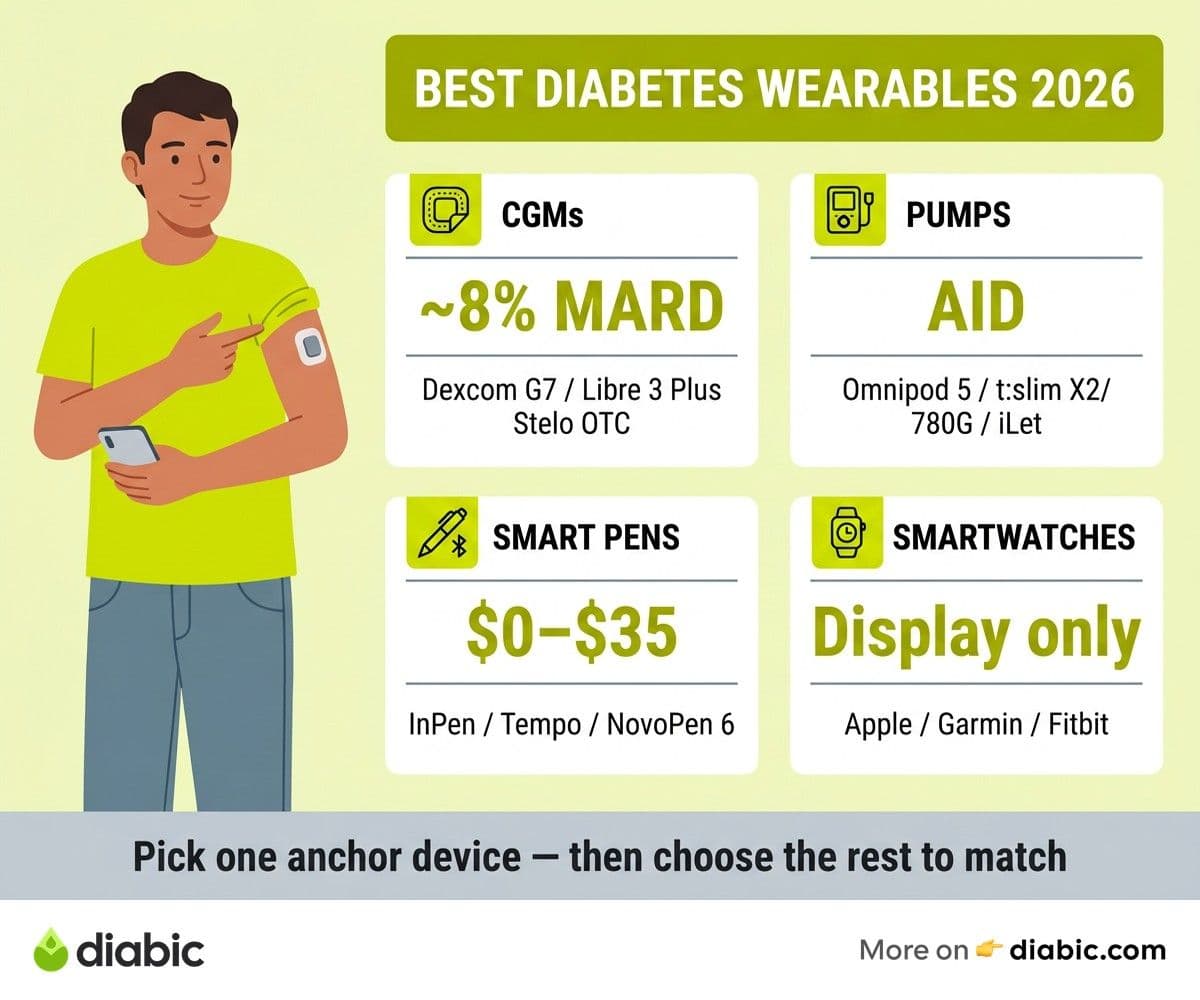
The Dexcom G7 is the current best-in-class for type 1 users on insulin who need accurate alerts and tight pump integration. It is FDA-cleared for ages two and up, has a 10-day wear time plus a 12-hour grace period, and reports a mean absolute relative difference (MARD) around 8 percent in published data. It pairs with the Tandem t:slim X2, OmniPod 5, iLet, and Apple Watch directly.
Pros: high accuracy, no fingerstick calibrations, fast warm-up, strong app and Apple Watch support. Cons: sensor cost without insurance is roughly $400 to $500 per month at retail, the adhesive can struggle with sweat or swimming for some users, and predictive alerts can feel noisy until you tune them. With most US insurance and DME coverage, monthly out-of-pocket cost lands closer to $20 to $80 depending on plan.
FreeStyle Libre 3 Plus: best for affordability and pharmacy access
The Libre 3 Plus from Abbott is the easiest CGM to start with. It is available at most pharmacies, often without going through DME, and the Abbott FreeStyle app is straightforward. The sensor lasts 15 days and is the smallest CGM on the market in 2026.
Pros: pharmacy benefit access keeps cash prices in many cases under $75 per sensor, no calibration needed, very small profile, optional alerts. Cons: pump integration is more limited than Dexcom, the data-sharing flow with caregivers is less polished, and the sensor needs a smartphone with the right NFC and Bluetooth specs.
Dexcom Stelo: best OTC option for type 2 and prediabetes
The Dexcom Stelo was the first FDA-cleared over-the-counter CGM in the United States and remains the simplest entry point for adults with type 2 diabetes not on insulin, or for people exploring prediabetes. Wear time is 15 days, and it costs roughly $89 per sensor or $99 for a monthly subscription as of early 2026.
Pros: no prescription needed, simple app focused on glucose patterns rather than alarms, great for behavior change. Cons: not labeled for use with insulin dosing decisions, no urgent low alerts, not pump-compatible. Our full Dexcom Stelo review digs into where it fits and where it does not.
Abbott Simplera: next-gen option for discreet wear
Abbott Simplera is Abbott's newer, smaller, integrated CGM aimed at the broader type 2 market and at integration with automated insulin delivery partners. It is available in expanding US markets through 2026 and offers an even smaller profile than Libre 3 Plus.
Pros: discreet form factor, simple insertion, expected pharmacy pricing similar to Libre. Cons: still ramping availability and integration with pumps, so check what your specific pump supports before committing.
Best Insulin Pumps as Wearable Devices
Insulin pumps are the most automated diabetes wearables. The four below dominate the US market in 2026 and all support some form of automated insulin delivery (AID), where the pump and CGM work together to adjust insulin in real time.
OmniPod 5: best tubeless wearable pump
The OmniPod 5 from Insulet is the leading tubeless pump and the most popular pump for people new to AID. Each pod lasts up to three days, sticks to your body, and delivers insulin without tubing. It works with Dexcom G7 and the Abbott Libre 2 Plus.
Pros: no tubing, waterproof, simple controller via your phone or supplied PDM, robust automated mode. Cons: pods are single-use so monthly cost without insurance is high, the algorithm is conservative compared to some competitors, no manual bolus from the pod itself. Our OmniPod review has setup details.
Tandem t:slim X2 with Control-IQ: best tubed pump with closed-loop
The Tandem t:slim X2 with Control-IQ is the longest-running closed-loop system in the US and remains the gold standard for many endocrinologists. It pairs with Dexcom G7, has a touchscreen, and offers both an exercise mode and a sleep mode.
Pros: mature algorithm, automatic correction boluses, screen-based control. Cons: tubing, daily charge habit, infusion set replacement every two to three days, software updates can be slow to roll out.
Medtronic MiniMed 780G: best for Medtronic ecosystem users
The MiniMed 780G uses Medtronic's SmartGuard algorithm with the Guardian 4 or Simplera Sync sensor. It has the most aggressive automatic correction strategy of the major pumps and is well suited to people who run high overnight.
Pros: aggressive AID with frequent micro-corrections, Medtronic ecosystem support including the InPen for backup. Cons: requires Medtronic sensors, which some users find less accurate than Dexcom or Libre, and the form factor is larger than competitors.
iLet bionic pancreas: simplest automated delivery
The iLet by Beta Bionics takes a different approach. You enter your weight, and the algorithm handles everything else with no carb counting. You announce meals as small, usual, or large.
Pros: no carb counting, very fast onboarding, ideal for people overwhelmed by traditional pump math. Cons: less granular control if you want it, fewer customization options, and meal-time accuracy depends on how predictable your portions are.
Smart Insulin Pens Worth Considering
Smart pens are the underrated category. For people on multiple daily injections (MDI) who do not want a pump, smart insulin pens add dose memory, timing reminders, and CGM-linked dose suggestions to a familiar injection routine.
InPen by Medtronic
The InPen is the most established smart pen in the US, owned by Medtronic after acquiring Companion Medical. It accepts Humalog, Novolog, and Fiasp cartridges, includes a built-in dose calculator in its app, and integrates with Guardian and Simplera CGMs. It is FDA-cleared and now widely covered as a pharmacy benefit.
Pros: full dose calculator with active insulin tracking, CGM integration, durable hardware. Cons: works with three specific insulin brands, app polish lags some competitors.
Lilly Tempo Pen
The Lilly Tempo Pen with the Tempo Smart Button is Eli Lilly's connected pen system. The Smart Button attaches to the pen and logs each dose, syncing to the Tempo app and integrating with Dexcom G7. It works with Lilly's insulins including Humalog and Lyumjev.
Pros: clean integration with Dexcom, simple form factor, supported by Lilly's ecosystem. Cons: locked to Lilly insulins, fewer dose-calculator features compared to InPen at the time of writing.
Novo Nordisk NovoPen 6 and Echo Plus
The NovoPen 6 and Echo Plus are Novo Nordisk's connected pens. The Echo Plus offers half-unit dosing for precision, and both pens use NFC to sync dose history to compatible apps including Glooko.
Pros: half-unit dosing, durable build, works with Novo Nordisk insulins. Cons: more limited US availability and CGM integration compared to InPen and Tempo as of 2026.
Smartwatches and Fitness Trackers for Diabetes
This is where we have to be honest. There is no FDA-cleared non-invasive glucose monitor on any smartwatch in 2026. Not on Apple Watch, not on Galaxy Watch, not on Fitbit. The widely reported "Apple Watch glucose monitor" rumored for years has not arrived. What smartwatches do well is display your CGM data, track activity, and remind you to move.
Apple Watch: the strongest CGM display ecosystem
The Apple Watch shows live Dexcom and Libre data through native and third-party apps and complications. Watch faces can show your current glucose and trend arrow, and you can set alerts that vibrate on your wrist before your phone pings. For pump users on OmniPod 5 or Tandem, the Apple ecosystem has the cleanest companion experience. Our Apple Watch diabetes features overview covers what the watch can and cannot do this year.
Pros: best-in-class CGM display, ECG and atrial fibrillation detection, fall detection, rich activity data that pairs well with diabetes management. Cons: no built-in glucose sensor, requires iPhone, daily charging.
Fitbit and Galaxy Watch: solid for activity context
Fitbit (now part of Google) and Samsung Galaxy Watch both display glucose from Dexcom or Libre via apps, with varying levels of polish. Their strength is sleep tracking, heart rate, and activity logging that helps explain glucose patterns. Galaxy Watch users on Android have the most native experience.
A smartwatch is worth adding when you already have a CGM and want glanceable data, alerts off your phone, or activity tracking that ties into your diabetes patterns. It is redundant if you already check your phone constantly and do not value the wrist alerts.
Diabetes Wearables for Children
Parents have a slightly different shopping list. For children, we look first at CGM accuracy and remote monitoring, then at pump form factor and waterproofing. The Dexcom G7 with the Dexcom Follow app remains the most-used remote-monitoring setup in the US for kids on insulin. The OmniPod 5 is the most common pump for children new to AID because it is tubeless and easy to swap. The iLet is gaining traction for newly diagnosed kids whose families do not want carb-counting from day one.
Insurance coverage for pediatric devices is generally stronger than for adults because the clinical case is well established. If you are starting from scratch, ask your child's endocrinologist which devices the practice supports best, since clinic familiarity affects how smoothly setup goes.
How to Choose the Right Diabetes Wearable
Start by asking what you actually need. If you are not on insulin, a CGM alone may be the right entire kit. If you are on MDI and tired of guessing your doses, a smart pen plus a CGM is often more impactful than jumping to a pump. If you are already on MDI with a CGM and your A1C or time in range is not where you want it, that is when a pump conversation makes sense.
From my experience: I have used a tubed pump, a tubeless pump, MDI with a smart pen, and four different CGMs over fourteen years with type 1. The biggest lesson is that the right device is the one you will not fight every day. I switched off a pump for a year during a period of heavy travel and went back to MDI with InPen. My A1C did not budge, and my stress dropped. Two years later I went back to a pump with closed-loop. There is no permanent right answer, only the right answer for this season of your life.
Insurance is its own project. In the US, CGMs and most pumps are usually covered under DME for type 1 and for type 2 on insulin, with smart pens often on pharmacy benefit. Coverage for type 2 not on insulin has expanded but is not universal. Call your insurer with the specific HCPCS or NDC codes from your provider, ask about prior authorization, and ask whether the device falls under DME or pharmacy. The answer changes monthly cost dramatically.
Ecosystem matters more than people expect. A Dexcom G7 with an iPhone, OmniPod 5, and Apple Watch will mostly just work. A mismatched stack creates friction. Pick one anchor, usually the CGM or the pump, and choose the other devices to match.
Frequently Asked Questions
What are the best wearables to buy in 2026?
For most adults on insulin, the best diabetes wearable devices in 2026 are a CGM (Dexcom G7 or FreeStyle Libre 3 Plus), an automated insulin pump (OmniPod 5 or Tandem t:slim X2 with Control-IQ), or a smart pen (InPen or Tempo Pen) for those on MDI. People with type 2 not on insulin or with prediabetes often find Dexcom Stelo to be the simplest starting point.
Which wearable is best for daily use?
A CGM is the wearable with the broadest daily benefit. It removes most fingersticks, gives trend data that fingersticks cannot, and integrates with pumps, smart pens, and smartwatches. If you can only wear one device every day, a CGM that fits your insurance and lifestyle is usually the right choice.
Do you need a prescription for diabetes wearable devices?
Most diabetes wearables, including pumps, smart pens, and the Dexcom G7 and Libre 3 Plus CGMs, require a prescription in the US. Dexcom Stelo is the exception, available over the counter for adults not using insulin. Apple Watch and most smartwatches do not require a prescription, but the CGM data they display does.
What to do next
Pick one anchor device, not three. Talk to your endocrinologist or diabetes educator about which CGM, pump, or smart pen has the best support in your clinic, then run the insurance question before you fall in love with a specific brand. The best wearable is the one your provider can troubleshoot with you and your insurance will pay for.
If you are weighing a pump versus injections, our companion guides on smart insulin pens and pumps are a good next read. The diabetes wearable devices market in 2026 has more good options than ever, which means less reason to stick with something that is not serving you.
Shahriar P. Shuvo is the founder of Diabic. He has lived with diabetes for over 14 years, and built Diabic to deliver the practical, evidence-based self-management tools he wished existed when he was first diagnosed. By trade, Shahriar is a senior design and frontend engineer with 6+ years shipping products at Agora, Timescale (now Tiger Data), and ShareTrip. He writes from the intersection of lived diabetes experience and product craft, focused on what works in daily management rather than what sounds good in a textbook.
Medically reviewed by
Dr. Shanto Arian is an internal medicine physician now specializing in clinical and aesthetic dermatology, with a parallel academic focus on epidemiology and public health. He holds an MBBS, MPH, MSc (UK), MRCP (UK), MRCPI (Ireland), Diploma in Dermatology (UK), and Diploma in Aesthetic Medicine (USA). Dr. Arian trained in internal medicine, including hospital work on hematology cases such as graft-versus-host disease, before moving toward dermatology. Skin is one of the earliest places diabetes shows itself, from acanthosis nigricans and diabetic dermopathy to slow foot wound healing, and that intersection is where his clinical and Diabic-review work meet. On Diabic, Dr. Arian medically reviews content on diabetes diagnosis, complications, dermatologic manifestations, and pharmacotherapy, ensuring every claim aligns with current ADA, NICE, and peer-reviewed literature.
More from Devices & Technology
View all
Fasting vs Postprandial Glucose: What's the Difference
Fasting vs postprandial glucose readings tell different stories about your blood sugar. Learn what each number means and how to act on it.

Best Glucometer for Elderly and Low-Vision Users
Best glucometer for elderly and low-vision users: large displays, audio readouts, no-coding strips, and budget picks that make daily testing easier.

Online Diabetes Coaching: How to Choose a Good One
Online diabetes coaching can fill the gaps between doctor visits. Learn what credentials to check, red flags to avoid, and how to pick a quality program.
Clinician-reviewed habits, plain-language guides, and honest answers - the small shifts that make living with diabetes feel lighter, every day.