Diabetes Wearable Devices for Children: A Parent's Guide
Compare CGMs, insulin pumps, and smartwatches built for kids. A parent's guide to diabetes wearable devices for children, covering safety, school plans.

In this article(21)
Choosing diabetes wearable devices for children means balancing medical accuracy with the reality of active, growing kids who do not want to feel different from their classmates. As a parent, you face a crowded market of continuous glucose monitors, insulin pumps, and smartwatches, each with trade-offs that matter more when the user is six years old at recess. Sensor adhesion, alarm volume, water resistance, and remote monitoring are not optional extras for your family. They decide whether you can sleep through the night and whether your child can join a sleepover without worry.
This guide walks through what actually works for families managing pediatric Type 1 and Type 2 diabetes. We focus on FDA-cleared options, real-world fit for young bodies, and the support systems schools and caregivers need to keep a child safe.
Why Diabetes Wearable Devices for Children Matter More
Children with diabetes face a different set of risks than adults. A toddler cannot say "I feel shaky" before a low. A second grader may forget to test before lunch because recess ran long. A teenager may skip a finger stick because checking in front of friends feels embarrassing. Wearables close those gaps by sending data automatically, freeing your child to be a child while you and the care team watch for trouble.
The American Diabetes Association notes that continuous glucose monitor use in pediatric populations is linked with better time in range and fewer severe lows, especially when paired with remote sharing. A 2022 study published in Diabetes Care found that children using CGM with parental remote monitoring had reduced hypoglycemia overnight compared with finger stick testing alone. The mental load of pediatric diabetes is real, and devices that share data with a phone change how a family lives.
Wearables also reduce the friction of school days, sports practices, and sleepovers. You can glance at your watch face during a meeting and know your child is sitting at 142 mg/dL. That single change may be the difference between letting your child go to summer camp and holding back. If you are still mapping out which devices to consider, our roundup of the best diabetes wearable devices in 2026 is a good starting point for adults and kids alike.
Best CGMs for Children: What Parents Should Know
Continuous glucose monitors are the single most common entry point for pediatric diabetes technology. They replace most finger sticks, alert on highs and lows, and feed data to insulin pumps and parent phones. Two FDA-cleared options dominate the pediatric market.
Dexcom G7 for Ages 2 and Up
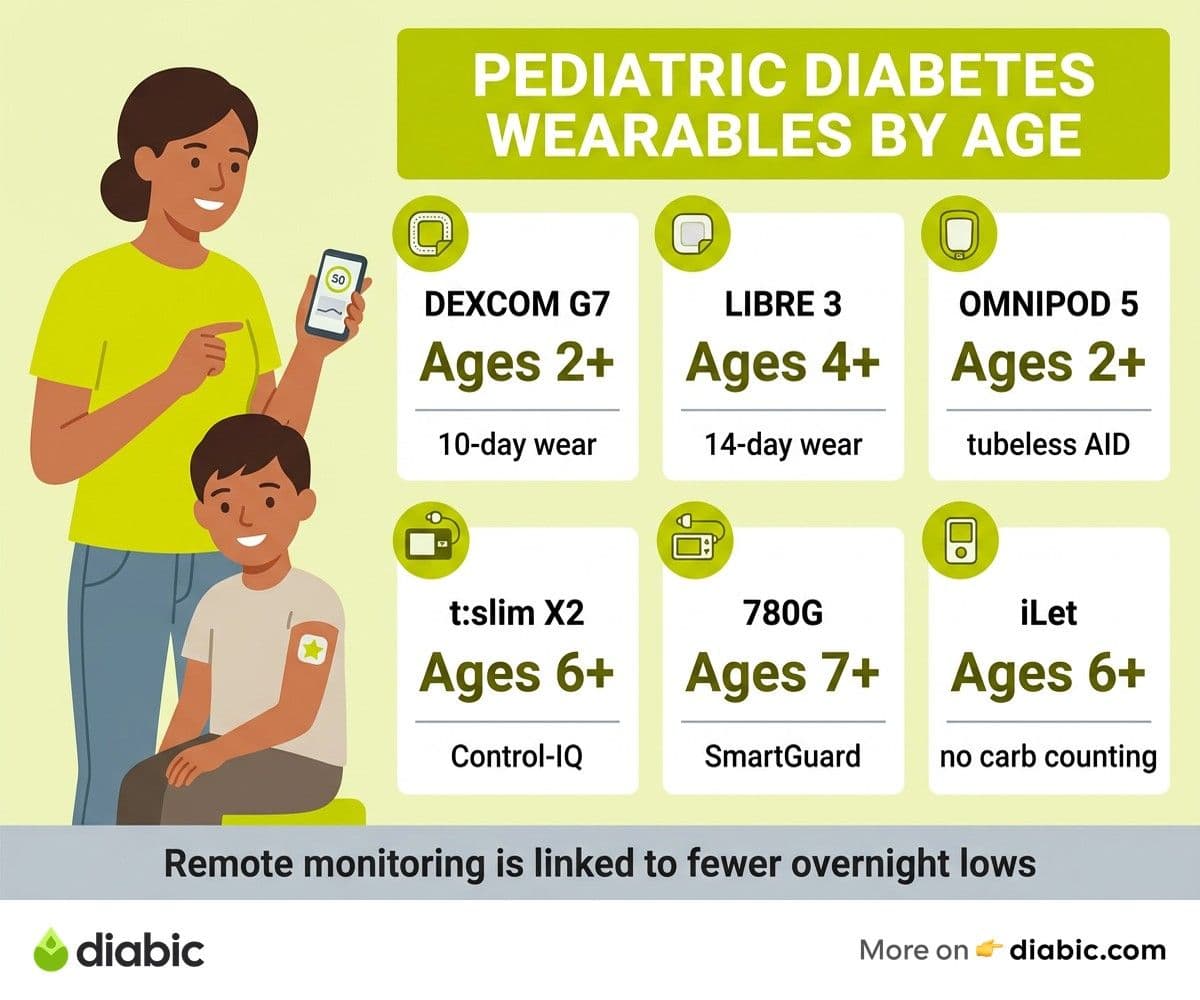
The Dexcom G7 is FDA-cleared for children ages 2 and older, including pregnant users. It uses a small all-in-one sensor and transmitter worn on the upper arm or upper buttock for younger kids, with a 10-day wear period and a 30-minute warmup. The sensor profile is roughly 60 percent smaller than the previous G6, which matters when a four-year-old keeps catching it on a t-shirt sleeve.
Dexcom Follow lets up to ten people, parents, grandparents, school nurses, see real-time numbers and alerts on their own phones. Customizable alarm thresholds help you avoid alarm fatigue while still catching dangerous lows. For families considering the technology, our piece on how a continuous glucose monitoring system works explains the underlying sensor technology in plain language.
Abbott FreeStyle Libre 3 for Ages 4 and Up
The Abbott FreeStyle Libre 3 is FDA-cleared for ages 4 and up. It is the smallest CGM on the market, about the size of two stacked pennies, and lasts 14 days. Libre 3 sends a glucose reading every minute and offers optional high and low alarms.
Abbott's LibreLinkUp app provides remote monitoring for caregivers, though the alert system is less customizable than Dexcom Follow. Some families prefer Libre 3 for its longer wear and lower cash price. Others choose Dexcom for the integration with closed-loop pumps and the wider follower network.
Sensor Adhesion and Comfort on Small Bodies
A device only helps if it stays on. Children swim, fall on playgrounds, and sleep in damp pajamas. Many families use overpatches like Skin Tac wipes, Simpatch, or Pump Peelz to keep sensors in place for the full wear cycle. Rotating insertion sites prevents skin breakdown, especially on smaller arms with less subcutaneous tissue. The U.S. FDA maintains a list of cleared CGMs with their specific age indications, which is worth bookmarking before any device decision.
Insulin Pumps Designed for Younger Users
Insulin pumps deliver basal insulin continuously and bolus doses for meals or corrections. For your child, the right pump depends on age, activity level, sensitivity to tubing, and your family's comfort with technology. Closed-loop systems, where a CGM and pump talk to each other and adjust insulin automatically, are now the standard of care for many pediatric Type 1 patients.
Tubeless Pumps: Omnipod 5
The Omnipod 5 is the only FDA-cleared tubeless automated insulin delivery system, approved for ages 2 and older. The pod sticks directly to the skin and pairs with a Dexcom G6 or G7 to adjust basal insulin every five minutes. Many parents of toddlers and active grade-schoolers prefer Omnipod because there is no tubing to snag during play, and the pod is fully waterproof.
Pods are changed every three days and cost can vary based on insurance coverage. Some children find the pod's footprint bulky on a slim arm, but the lack of tubing is often worth the trade.
Tubed Pumps: Tandem t:slim X2 and Medtronic MiniMed 780G
The Tandem t:slim X2 with Control-IQ technology is FDA-cleared for ages 6 and older and pairs with Dexcom G6 or G7. Its touchscreen interface feels familiar to kids who grew up with smartphones, and the Control-IQ algorithm adjusts insulin to target a range with sleep and exercise modes built in.
The Medtronic MiniMed 780G is cleared for ages 7 and up and pairs with Medtronic's Guardian sensor or, more recently, third-party CGMs. It uses an algorithm called SmartGuard that adjusts basal insulin every five minutes and delivers automatic correction boluses. Tubed pumps offer larger reservoirs and quicker site changes, which some teens prefer.
iLet Bionic Pancreas
The Beta Bionics iLet is a newer option cleared for ages 6 and up that simplifies pump setup. It uses only the child's body weight to start, removing the need for traditional carb counting in favor of meal announcements like "breakfast, usual." For families overwhelmed by traditional pump math, iLet may help reduce daily decision fatigue. Our deeper insulin pump guide for type 1 diabetes covers each system's pros and cons in detail.
From my experience: When I started on a pump as a teenager 14 years ago, the technology felt clunky and obvious under clothes. The pumps my younger family members wear today are smaller, smarter, and far less stigmatizing. The single biggest change for kids has not been the algorithm. It has been the ability for a parent to glance at their phone and trust the system enough to let go a little.
Smartwatches and Companion Devices for Pediatric Diabetes
A smartwatch is not a medical device, but it can change how a child interacts with their CGM data. Seeing a glucose reading on the wrist removes the awkward step of pulling out a phone in class.
Apple Watch and CGM Integration
Apple Watch pairs natively with Dexcom G7 and shows real-time glucose with trend arrows on the watch face. For children with their own iPhone, this is often the most polished experience. Apple Watch SE is a more affordable entry point and still supports the Dexcom complication. Parents can also receive Dexcom Follow alerts on their own Apple Watch without the child needing one.
Garmin and Android Wear Options
Garmin watches integrate with Dexcom through the Garmin Connect IQ store, and some models include kid-friendly battery life that stretches to a week. Android Wear watches paired with Dexcom or Libre apps offer similar features at varying price points. Battery life matters more than feature lists when a 10-year-old forgets to charge.
GPS and Emergency Features
Some families pair a CGM with a GPS-enabled smartwatch like the Garmin Bounce or Apple Watch with Family Setup. These devices let a child contact a parent during a low and let the parent locate the child if needed. They are particularly useful for kids walking home from school or attending camps.
Helping Your Child Adjust to Wearing a Device
The hardest part of pediatric diabetes technology is rarely the technology itself. It is convincing your child that wearing something visible is okay. Resistance is normal and rarely permanent.
Younger children often respond to making the device fun. Decorative overpatches with cartoon characters, glitter pump skins, and naming the pump or sensor turn a medical device into a personality accessory. Older children may want the opposite, a low-profile sensor placement and a plain skin-tone overpatch. Both responses are valid.
Honest, age-appropriate conversations matter more than scripts. A six-year-old can understand that the pump helps their body do what it cannot do alone. A twelve-year-old may need to hear that everyone in middle school is self-conscious about something, and that their pump is not the thing classmates will fixate on. Peer support, through camps run by Breakthrough T1D or local diabetes connections, often does more than any parent talk.
Insurance, Cost, and Getting Devices Covered
Pediatric coverage for diabetes wearables can differ from adult coverage in ways that may catch you off guard. Most commercial insurance plans and Medicaid cover CGMs and insulin pumps when they are medically necessary, but documentation requirements vary.
Prior authorization usually requires a recent A1C, a logbook or CGM data showing current control, and a letter of medical necessity from the prescribing endocrinologist. Pediatric endocrinology offices often have a dedicated technology coordinator who handles this paperwork. Ask early in the diagnosis process whether such a person exists at your clinic.
Manufacturer assistance programs are worth knowing about. Dexcom, Abbott, Tandem, Insulet, Medtronic, and Beta Bionics all run patient assistance programs with sliding scale pricing or free starter kits if your family qualifies. Breakthrough T1D, formerly JDRF, maintains a financial resources page that lists grants for families covering deductibles, supplies, and travel to specialty clinics. Calling the manufacturer's patient services line directly often yields information that is not on the website.
Working With Schools and Caregivers
A device only helps at school if the people around your child know what to do with it. A 504 plan is the legal mechanism in U.S. public schools that ensures a child with diabetes receives the accommodations they need. Your plan should name the devices used, list authorized caregivers, set out alarm response steps, and identify who can administer glucagon.
Training the school nurse, classroom teachers, and PE staff on CGM alerts is non-negotiable. Many parents create a one-page summary with a photo of the device, a glucose target range, and a simple flowchart for treating highs and lows. The Centers for Disease Control and Prevention and the American Diabetes Association both publish school management resources that can be shared as is with school staff.
Sleepovers, sports tournaments, and travel days require their own playbooks. Walk through scenarios with caregivers ahead of time so they are not improvising during a low at 2 a.m. Our piece on traveling with diabetes devices covers airport security, time zone shifts, and supply packing for trips of any length.
Picking the Right Setup for Your Family
There is no single best setup among diabetes wearable devices for children, and that is part of what makes the choice feel hard. A four-year-old swimmer with active siblings may thrive on Omnipod 5 and Dexcom G7 with parents on Dexcom Follow. A nine-year-old who plays travel hockey may prefer the Tandem t:slim X2 paired with an Apple Watch. A teenager who drives may want the simplicity of iLet so they can focus on school instead of carb math.
Talk with your pediatric endocrinology team about device demos. Most clinics keep loaner pumps and CGM samples that families can try before committing. Insurance churn, life changes, and growing kids mean today's right answer may not be next year's, and that is fine. The goal is not the perfect device. The goal is a child who feels safe, supported, and like a kid.
Frequently Asked Questions
What is the best diabetes wearable for kids?
There is no single best device. For most families, a Dexcom G7 or FreeStyle Libre 3 paired with a closed-loop pump like Omnipod 5 or Tandem t:slim X2 covers the broadest set of needs. The right combination depends on the child's age, activity level, sensitivity to tubing, and family preferences for remote monitoring. Pediatric endocrinology teams can recommend specific pairings based on insurance coverage and clinical fit.
Are CGMs safe for children with diabetes?
Yes. The Dexcom G7 is FDA-cleared for children ages 2 and older, and the FreeStyle Libre 3 is FDA-cleared for ages 4 and older. Research suggests CGM use in pediatric populations is associated with better time in range, fewer severe hypoglycemic events, and reduced parental stress compared with finger stick testing alone. Talk to your child's endocrinologist about which CGM matches your family's needs.
At what age can a child start using an insulin pump?
It depends on the pump. Omnipod 5 is FDA-cleared for ages 2 and up, Tandem t:slim X2 with Control-IQ for ages 6 and up, and Medtronic MiniMed 780G for ages 7 and up. Some children start pump therapy as toddlers when their care team and family feel ready. Diabetes wearable devices for children are most effective when the family is willing to learn the system together.
Shahriar P. Shuvo is the founder of Diabic. He has lived with diabetes for over 14 years, and built Diabic to deliver the practical, evidence-based self-management tools he wished existed when he was first diagnosed. By trade, Shahriar is a senior design and frontend engineer with 6+ years shipping products at Agora, Timescale (now Tiger Data), and ShareTrip. He writes from the intersection of lived diabetes experience and product craft, focused on what works in daily management rather than what sounds good in a textbook.
Medically reviewed by
Dr. Rezwana Parvin Rumpa is an obstetrics and gynaecology specialist with clinical focus on gestational diabetes, PCOS, and fertility. She holds the MRCOG (Final Part) from the Royal College of Obstetricians and Gynaecologists in London, the MRCPI (Final Part) from the Royal College of Physicians of Ireland, and an MBBS from Shaheed Monsur Ali Medical College under Dhaka University. Dr. Rumpa serves as a Senior Medical Officer in the Obs and Gynae department at BRB Hospitals Ltd, where she has spent three years managing prenatal care, emergency obstetric cases, and women's-health surgery. On Diabic, she medically reviews content for women living with diabetes, with particular attention to pregnancy, PCOS, and reproductive-health intersections.
More from Devices & Technology
View all
Fasting vs Postprandial Glucose: What's the Difference
Fasting vs postprandial glucose readings tell different stories about your blood sugar. Learn what each number means and how to act on it.

Best Glucometer for Elderly and Low-Vision Users
Best glucometer for elderly and low-vision users: large displays, audio readouts, no-coding strips, and budget picks that make daily testing easier.

Online Diabetes Coaching: How to Choose a Good One
Online diabetes coaching can fill the gaps between doctor visits. Learn what credentials to check, red flags to avoid, and how to pick a quality program.
Clinician-reviewed habits, plain-language guides, and honest answers - the small shifts that make living with diabetes feel lighter, every day.