Gestational Diabetes After Birth: What Comes Next
What gestational diabetes after birth looks like, from postpartum testing to long term type 2 risk and planning future pregnancies with confidence.

In this article(30)
Once your baby arrives, it is tempting to assume gestational diabetes after birth simply disappears the moment the placenta does. For most parents, blood sugar does return to normal within days to weeks, which is genuinely good news. The story does not end at delivery, though, and we want you to leave the hospital with a clear sense of what to expect in the months and years ahead.
This guide covers the practical postpartum stretch: the recommended glucose test at 6 to 12 weeks, what your numbers mean, why your long term type 2 risk is slightly higher, and how to plan if you want to be pregnant again. Our goal is to give you the same calm orientation we gave you at diagnosis, this time looking forward rather than back.
Does Gestational Diabetes Go Away After Delivery
For most parents, yes. Blood sugar normally drops within hours of delivery because the placenta and its insulin blunting hormones are gone. By the time you leave the hospital, most parents no longer need to check blood sugar. A small percentage continue to have elevated numbers, which usually means they had pre existing prediabetes or type 2 diabetes that was first detected during pregnancy screening.
If you want a fuller picture of the condition itself, our calm guide to gestational diabetes covers diagnosis, daily life, and what the experience looks like start to finish.
How blood sugar typically normalizes within weeks of delivery
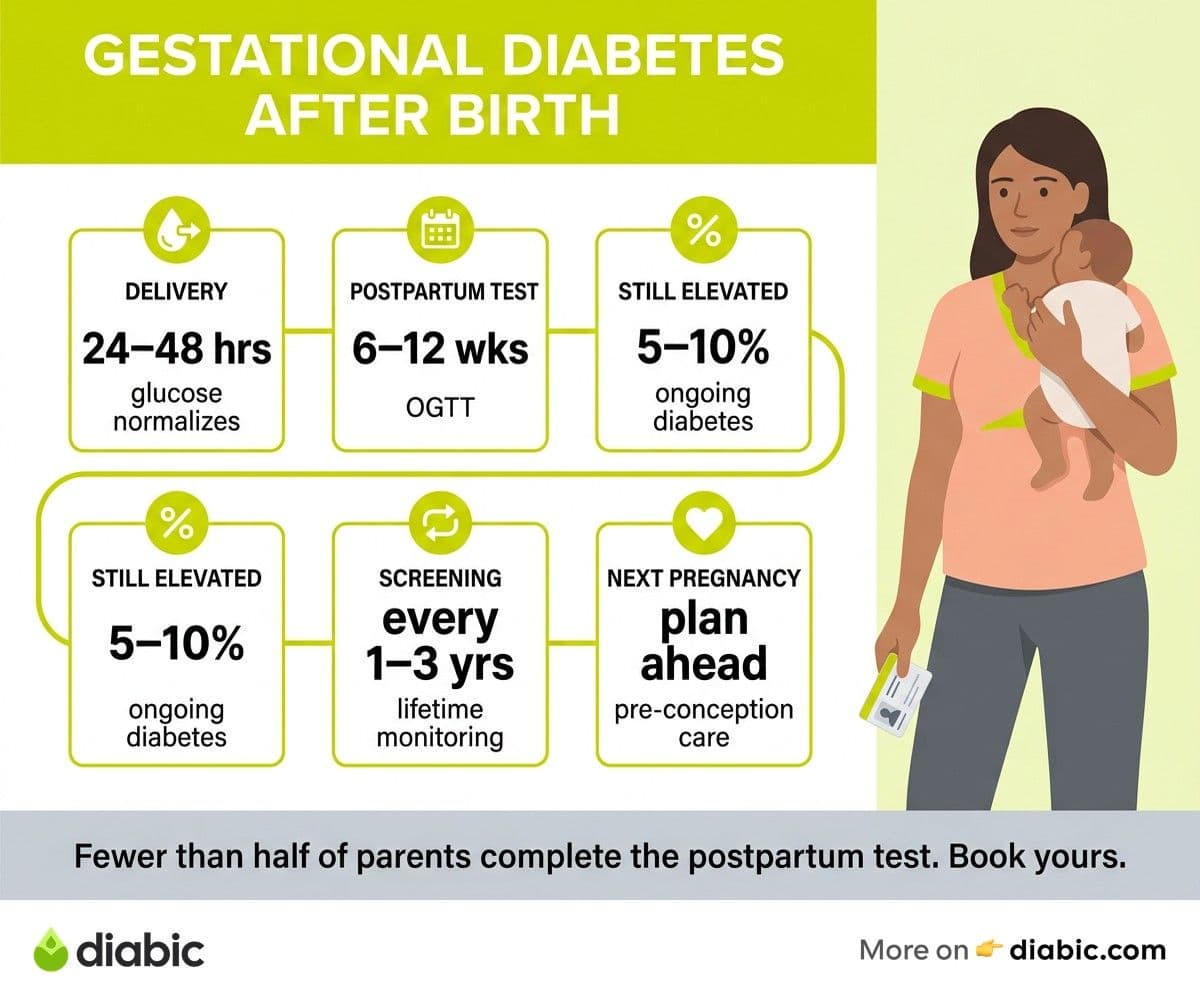
The drop after delivery is sudden. Within hours of the placenta being delivered, the hormones that drove gestational diabetes are gone, and most parents see blood sugar settle into a normal range within 24 to 48 hours. Many hospital teams stop blood sugar checks within a day. By 6 weeks postpartum, most parents have a glucose profile that looks the way it did before pregnancy.
Why some women still have elevated blood sugar postpartum
Not everyone snaps back. About 5 to 10 percent of parents with gestational diabetes are found to have ongoing diabetes when they are tested at 6 to 12 weeks. In most of these cases, they had undiagnosed prediabetes or type 2 diabetes before pregnancy that the screening simply uncovered. Identifying it now means earlier care, which is a good outcome even though the news may feel hard.
The difference between resolution and ongoing monitoring needs
Even when gestational diabetes resolves cleanly, the story is not closed. Lifetime risk of type 2 diabetes is meaningfully higher in parents who had gestational diabetes, which is why ongoing screening every 1 to 3 years is part of the standard recommendation. Resolution at 12 weeks is not the same as a clean slate forever, and that distinction shapes the rest of this guide.
Gestational Diabetes After Birth: Postpartum Blood Sugar Testing
Postpartum testing is the most concrete piece of gestational diabetes after birth care, and it is also the piece most often missed. Studies consistently find that fewer than half of parents with gestational diabetes complete the recommended postpartum test. We want to make it easier to plan for, not harder.
The American Diabetes Association lays out postpartum screening recommendations in its Standards of Care, and most US clinics follow this guidance closely.
When to get tested (6-12 weeks postpartum)
The standard recommendation is a glucose test 6 to 12 weeks after delivery. The window matters: testing too early can show artificially low numbers because of pregnancy related changes that have not fully reset, and testing much later means more time without information about your status. Most parents schedule this test alongside their postpartum visit with their obstetrician.
What tests are used (fasting glucose, OGTT, A1C)
The preferred test is a 75 gram oral glucose tolerance test, sometimes called OGTT. You fast overnight, your fasting blood sugar is checked, you drink a glucose solution, and your blood sugar is checked again 2 hours later. This is the same logic as pregnancy screening, scaled to a non pregnant body.
A fasting glucose alone or an A1C are sometimes used in place of the OGTT, especially when the OGTT is hard to schedule. They are less sensitive at this stage, so the OGTT remains the preferred option when feasible.
Understanding your postpartum results
Possible outcomes:
- Normal range: fasting below 100 mg/dL and 2 hour below 140 mg/dL. You return to routine screening every 1 to 3 years.
- Prediabetes: fasting 100 to 125 mg/dL or 2 hour 140 to 199 mg/dL. Lifestyle changes and possibly medication, with annual follow up.
- Diabetes: fasting at or above 126 mg/dL or 2 hour at or above 200 mg/dL on confirmed testing. Treatment plan with your provider.
Whatever the result, more information is better than less. If you land in the prediabetes range, why catching prediabetes early matters walks through what to do next.
Can Gestational Diabetes Lead to Type 2 Diabetes
This is the question most parents quietly carry. The answer is honest and not as scary as headlines suggest: yes, the risk is meaningfully higher, and you have real tools to lower it. Awareness is the first tool. Acting on awareness is the second.
The elevated long-term risk (up to 50% within 5-10 years)
Multiple studies have followed parents with gestational diabetes for years after delivery. A widely cited Lancet Diabetes & Endocrinology meta analysis found that about half of parents with gestational diabetes develop type 2 diabetes within 10 years, with the highest risk in the first 5 years. The number sounds large, and it is. It also leaves a meaningful chunk of parents who do not develop type 2 diabetes, and behavior in the postpartum years strongly influences which group you land in.
Why ongoing annual screening matters
Annual or every other year screening with fasting glucose or A1C catches changes early. Early prediabetes can often be reversed with modest lifestyle changes. Type 2 diabetes that is caught at diagnosis is far easier to manage than type 2 diabetes that has been simmering for years undetected.
Factors that influence whether type 2 develops
Several factors push risk up: family history of type 2 diabetes, body weight in the years after pregnancy, sedentary lifestyle, and very high blood sugar during pregnancy. Other factors push risk down: weight maintenance or modest weight loss, regular activity, breastfeeding for at least 3 months, and a dietary pattern rich in vegetables, whole grains, and lean protein. None of these are magic. Together they shift the odds in a real, measurable way.
Managing Your Health After Gestational Diabetes
Postpartum life is not the time for a strict overhaul. It is the time for habits that survive sleep deprivation. The most useful changes are the ones you can keep doing on a hard week, not the ones that look impressive in week one.
If you want a refresher on the broader treatment principles you used during pregnancy, many of them carry forward. Gestational diabetes treatment options covers the same lifestyle pillars in pregnancy form. Postpartum life looks different, but the principles rhyme. And if you are curious about how baby risks shift over time, baby risks with gestational diabetes closes that loop.
Dietary habits that support long-term blood sugar health
The same plate model that worked during pregnancy works after. Half non starchy vegetables, a quarter lean protein, a quarter starchy or grain food, plus a small fat source. Sugary drinks are the single highest uses change for most people. Replacing them with water, sparkling water, or unsweetened coffee or tea is one of the highest impact things you can do for long term blood sugar health.
The role of physical activity in reducing type 2 risk
Activity does not need to be intense to matter. Walking 30 minutes a day, five days a week, is a benchmark used in many diabetes prevention studies, including the Diabetes Prevention Program. With a newborn, that often means a stroller walk in two or three short stretches rather than one block. The sum is what counts.
Once your provider clears you for more, gradually adding strength work two or three times a week makes a meaningful difference. Muscle tissue is a major site of glucose uptake, and more of it means better insulin sensitivity over time.
Breastfeeding and its potential benefits for blood sugar
Research suggests that breastfeeding for at least 3 months may modestly lower long term type 2 risk in parents who had gestational diabetes. Energy demands and hormonal effects both seem to play a role, and the CDC notes that breastfeeding can reduce a mother's risk of type 2 diabetes alongside other long term benefits. This is not a directive about how to feed your baby. Plenty of parents bottle feed for excellent reasons. We mention it because if you are considering breastfeeding, this is one quiet additional benefit.
From my experience: I have lived with diabetes for 14 years, and the postpartum window is one of the most overlooked moments in the whole arc of metabolic health. People who get a clear postpartum test and a real plan tend to stay healthier for decades. People who skip it tend to find out the hard way at age 45 that something has been drifting. That single visit is worth fighting your calendar for.
Gestational Diabetes Symptoms to Watch for Postpartum
Many gestational diabetes symptoms also overlap with normal postpartum recovery, which can make this stretch confusing. We want to give you a simple framework: most exhaustion, thirst, and frequent urination in the first weeks postpartum is normal. Some patterns are worth a call.
Signs that blood sugar may still be elevated
Possible signs of elevated blood sugar in the postpartum period include thirst that does not ease with hydration, urination that is heavier than expected even given fluid intake, blurred vision that lingers beyond a few days, slow healing of incisions or wounds, and recurrent yeast infections. None of these are diagnostic on their own. Together, they are reasons to move your postpartum glucose test up rather than wait.
When to contact your healthcare provider
Call your provider if symptoms feel disproportionate to typical postpartum recovery, if you had higher insulin needs at the end of pregnancy, or if your postpartum test is delayed and you are unsure where you stand. Providers expect these calls and would rather hear from you sooner.
Why some symptoms overlap with normal postpartum recovery
Hydration shifts, hormonal changes, and lack of sleep all create symptoms that look a lot like blood sugar issues. A finger stick or a quick A1C from your provider sorts the question definitively. Do not try to diagnose this from inside the fog of the fourth trimester. Use the test.
Planning Future Pregnancies After Gestational Diabetes
If you might want to be pregnant again, this section is the one we hope you bookmark. Preconception care is one of the most underused windows in modern obstetrics, and it makes a real difference for parents who had gestational diabetes the first time.
The American College of Obstetricians and Gynecologists discusses the importance of postpartum and interconception care for parents with a history of gestational diabetes.
The likelihood of gestational diabetes recurring
Gestational diabetes recurs in roughly 30 to 60 percent of subsequent pregnancies, depending on the population studied and on what changed between pregnancies. Recurrence is more likely if there was substantial weight gain between pregnancies, if the original case required insulin, or if the next pregnancy is closer in time to the previous one. Many parents have a second pregnancy without recurrence, especially when they enter pregnancy at a similar weight to before the first.
Steps to reduce risk before and during a subsequent pregnancy
Practical steps that may help:
- Confirm your postpartum glucose status before trying to conceive again.
- Reach a body weight you can maintain, then maintain it before pregnancy rather than chasing changes in early pregnancy.
- Build a steady activity routine you can carry into pregnancy.
- Discuss any prediabetes diagnosis with your provider and treat it actively before conceiving.
Working with your provider on preconception planning
Ask your obstetrician or primary care provider for a preconception visit specifically to plan for the next pregnancy. That visit usually covers your current glucose status, weight, blood pressure, medications, prenatal vitamins, and timing. It often includes earlier glucose screening in the next pregnancy, sometimes at the first prenatal visit rather than waiting until 24 to 28 weeks. Earlier screening means earlier treatment if needed, and that is exactly the lever that helps the most.
FAQ
Does gestational diabetes go away after delivery?
For most parents, blood sugar returns to normal within days to weeks of delivery. A glucose test at 6 to 12 weeks postpartum confirms whether levels have normalized. About 5 to 10 percent of parents are found to have ongoing prediabetes or type 2 diabetes at that test, which is why postpartum screening is recommended for everyone with gestational diabetes.
Can gestational diabetes lead to type 2 diabetes?
Yes. Research suggests that about half of parents with gestational diabetes develop type 2 diabetes within 5 to 10 years. Lifestyle factors including weight, activity, breastfeeding, and dietary pattern strongly influence whether type 2 develops. Annual or every other year screening helps catch changes early.
When should I get my postpartum glucose test?
Most providers recommend a glucose test at 6 to 12 weeks postpartum, ideally a 75 gram oral glucose tolerance test. Many parents schedule it alongside their postpartum visit with their obstetrician. If you missed that window, ask your primary care provider to schedule it now rather than waiting for the next pregnancy.
Does breastfeeding help with blood sugar after gestational diabetes?
Research suggests that breastfeeding for at least 3 months may modestly lower long term type 2 diabetes risk in parents with a history of gestational diabetes. The effect is real but not large, and it is one factor among several. If breastfeeding is right for your family, this is one of its quieter benefits.
Will I get gestational diabetes again in my next pregnancy?
Recurrence runs roughly 30 to 60 percent across studies. It is more likely if you required insulin in the first pregnancy or gained substantial weight between pregnancies. Preconception planning, steady activity, and confirming your glucose status before conceiving may help reduce the odds, and the way you handle gestational diabetes after birth this time often shapes how the next pregnancy starts.
Dr. Rezwana Parvin Rumpa is an obstetrics and gynaecology specialist with clinical focus on gestational diabetes, PCOS, and fertility. She holds the MRCOG (Final Part) from the Royal College of Obstetricians and Gynaecologists in London, the MRCPI (Final Part) from the Royal College of Physicians of Ireland, and an MBBS from Shaheed Monsur Ali Medical College under Dhaka University. Dr. Rumpa serves as a Senior Medical Officer in the Obs and Gynae department at BRB Hospitals Ltd, where she has spent three years managing prenatal care, emergency obstetric cases, and women's-health surgery. On Diabic, she medically reviews content for women living with diabetes, with particular attention to pregnancy, PCOS, and reproductive-health intersections.
Medically reviewed by
Dr. Shanto Arian is an internal medicine physician now specializing in clinical and aesthetic dermatology, with a parallel academic focus on epidemiology and public health. He holds an MBBS, MPH, MSc (UK), MRCP (UK), MRCPI (Ireland), Diploma in Dermatology (UK), and Diploma in Aesthetic Medicine (USA). Dr. Arian trained in internal medicine, including hospital work on hematology cases such as graft-versus-host disease, before moving toward dermatology. Skin is one of the earliest places diabetes shows itself, from acanthosis nigricans and diabetic dermopathy to slow foot wound healing, and that intersection is where his clinical and Diabic-review work meet. On Diabic, Dr. Arian medically reviews content on diabetes diagnosis, complications, dermatologic manifestations, and pharmacotherapy, ensuring every claim aligns with current ADA, NICE, and peer-reviewed literature.
More from Diabetes Knowledge
View all
Can Diabetics Eat Fruit? Yes, Best Picks and Tips
Can people with diabetes eat fruit? Yes. Here is how to choose the right fruits, manage portions, and pair them smartly to keep blood sugar steady.

Newly Diagnosed Type 2 Diabetes: Where to Start
Newly diagnosed type 2 diabetes feels overwhelming, but the first steps are simpler than you think. Get a clear, calm starting plan from day one.

Secondary Diabetes: When Another Condition Is the Cause
Secondary diabetes develops because of another medical condition or medication. Learn the causes, how it differs from type 2, and how it's managed.
Clinician-reviewed habits, plain-language guides, and honest answers - the small shifts that make living with diabetes feel lighter, every day.