Gestational Diabetes: A Calm, Clear Guide for Parents
A reassuring guide to gestational diabetes for parents. Learn symptoms, testing, daily management, and what it means for you and your baby.

In this article(35)
A gestational diabetes diagnosis can feel alarming when it lands in the middle of an already overwhelming season of life. The good news is that it is far more common than most parents expect, and with the right information and support, it is very manageable. We wrote this guide to walk you through what the condition is, why it happens, and what you can do day to day to have a healthy pregnancy and a healthy baby.
If you just received your diagnosis, the first thing we want you to know is that you did nothing wrong. The condition is largely driven by hormones your body is producing to support the pregnancy. The path forward is built on small, steady habits, not perfection.
What Is Gestational Diabetes Exactly?
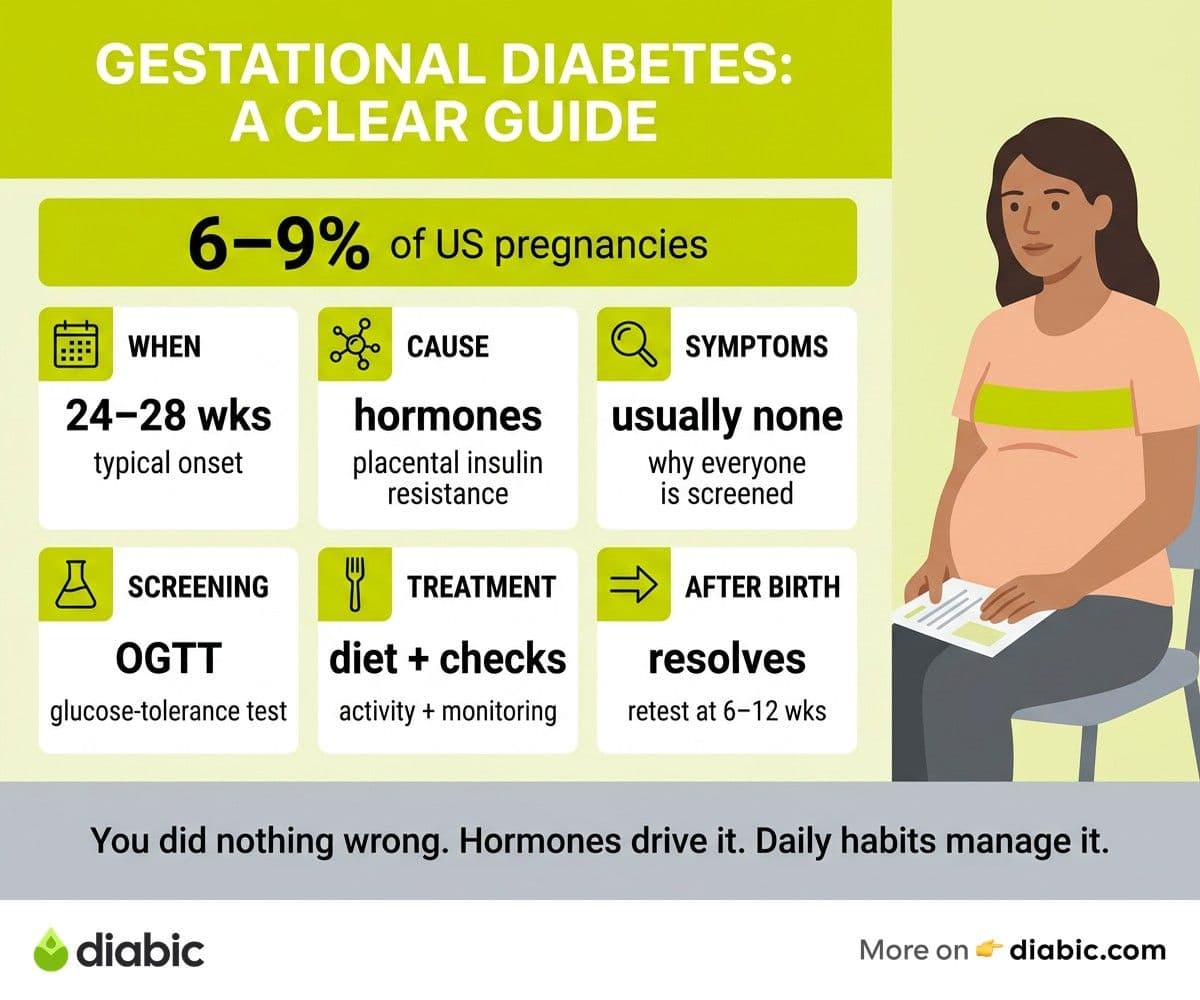
GDM, as clinicians often abbreviate it, is a form of diabetes that develops during pregnancy in someone who did not previously have it. It happens when the body cannot make enough insulin to keep up with pregnancy hormones, causing blood sugar to rise. According to the CDC's data on the condition, it affects roughly 6 to 9 percent of pregnancies in the United States, which means hundreds of thousands of parents face this each year.
It typically appears in the second or third trimester, around weeks 24 to 28, when placental hormones peak. Before that point, your body is usually able to manage glucose normally. The shift in pregnancy chemistry is the main driver, which is why a person with no diabetes risk factors at all can still develop it.
If you want a wider view of how this fits into the larger picture of glucose disorders, our explainer on what diabetes is at its core provides helpful context. Understanding how insulin and blood sugar normally interact makes the pregnancy-specific changes easier to grasp.
Symptoms to Recognize
The tricky thing about this condition is that most people do not have any symptoms. That is part of why universal screening exists. When symptoms do appear, they overlap heavily with normal pregnancy experiences, which is part of what makes them easy to overlook.
Common symptoms when they appear
Some parents notice increased thirst that does not ease with hydration. Others find they are urinating more often, even by pregnancy standards. Fatigue is another common report, though pregnancy itself causes plenty of fatigue, so this one is hard to separate.
A few people also notice blurry vision, recurrent yeast infections, or unusual hunger. None of these symptoms confirm the diagnosis on their own, but if you are noticing several together, mention them to your provider.
Why many women have no noticeable symptoms
Pregnancy hormones rise gradually, and the body adapts in real time. Blood sugar can sit above normal range without producing the dramatic thirst or urination that more advanced cases cause. Many parents are completely surprised by their result because they felt fine.
This is normal and not a reason for guilt. The absence of symptoms is exactly why doctors test everyone, regardless of how you feel. Our deeper look at symptoms most women miss walks through what to watch for in more detail.
The importance of routine screening rather than symptom-watching
Because symptoms are unreliable, the standard of care is to screen every pregnancy between 24 and 28 weeks. Some people are tested earlier if they have risk factors. Trusting the screening process matters more than trying to read your body for clues.
If your provider recommends earlier testing, it is not a sign that something is wrong. It usually means a risk factor warrants a closer look sooner.
What Causes the Condition and Who Is at Risk
Understanding the cause helps quiet the self-blame that often accompanies a diagnosis. The condition is rooted in pregnancy biology, not a personal failure. The hormonal shifts are doing exactly what they are supposed to do for the baby, and your body is just having trouble keeping up on the insulin side.
Hormonal changes during pregnancy and insulin resistance
The placenta produces hormones that support the baby's growth, including human placental lactogen, cortisol, and estrogen. These hormones partly block insulin so that more glucose stays available in your bloodstream for the baby. In most pregnancies, the pancreas compensates by making extra insulin.
When the pancreas cannot keep up with the increased demand, blood sugar rises. That is the diagnosis in one sentence. It is a supply-and-demand mismatch driven by the pregnancy itself.
Risk factors that raise the odds
Several factors make this condition more likely. These include being over 25, having a family history of type 2 diabetes, having had GDM in a previous pregnancy, having polycystic ovary syndrome (PCOS), or having a higher body mass index. Belonging to certain ethnic groups, including Black, Hispanic, Native American, Asian American, and Pacific Islander, also raises baseline risk.
For a more detailed breakdown, our piece on causes and risk factors for the condition walks through each one and what the research actually says.
Why it can happen to anyone
About half of all diagnoses happen in people without obvious risk factors. The placental hormone surge is universal, and individual sensitivity to it varies. This is why the screening is universal too.
If you have no risk factors and were diagnosed anyway, this is not unusual. It does not mean anything went wrong with how you cared for yourself before or during pregnancy.
How the Diagnosis Is Made
Testing is the only reliable way to know. The process is straightforward, even if the wait for results can feel long. The American College of Obstetricians and Gynecologists provides clear guidance for providers on screening protocols, summarized in their practice bulletin on screening.
The glucose screening test (one-hour)
This is usually the first test, given between 24 and 28 weeks. You drink a sugary glucose solution, and a blood sample is taken one hour later to measure how your body processed it. You do not need to fast beforehand for this version.
If your one-hour result is below the threshold your provider uses (often 140 mg/dL, sometimes 130 or 135), no further testing is needed. If it is above, you move on to the next step.
The glucose tolerance test (three-hour)
The three-hour glucose test pregnancy protocol is more involved. You fast overnight, get a baseline blood draw, drink a stronger glucose solution, and have blood drawn at one, two, and three hours after. If two or more values are above the cutoffs, you are diagnosed.
It is normal to feel queasy or shaky during this test. Bring water, a magazine, and patience. The whole appointment usually takes around three and a half hours.
What the numbers mean and what comes next
A diagnosis is not a verdict on the rest of your pregnancy. It is the start of a management plan. Your care team will likely refer you to a diabetes educator or dietitian, give you a glucose meter, and walk you through how to check your blood sugar at home.
Many parents start with diet and lifestyle changes alone and do well. Some need oral medication or insulin. None of these paths is better or worse than the others, and the right one depends on your numbers, not your effort.
Managing It During Pregnancy
The day-to-day work is built on small habits. The ADA's guidelines outline the core pillars: monitoring, nutrition, activity, and medication when needed. Most parents find a routine within a few weeks.
Blood sugar monitoring basics
You will likely check your blood sugar four times a day: once fasting in the morning and once after each main meal. The targets your provider gives you are usually under 95 mg/dL fasting and under 140 one hour after eating, or under 120 two hours after, depending on the protocol they use.
Tracking patterns matters more than any single reading. A higher number after a particular meal is information, not failure. Over time, you and your team will spot what foods, portion sizes, or times of day need adjustment.
Dietary adjustments and meal timing
Most people with this diagnosis do well eating three smaller meals and two or three snacks throughout the day. Pairing carbohydrates with protein and fat slows glucose absorption and reduces spikes. Whole grains, vegetables, lean proteins, dairy, and healthy fats form the backbone of most plans.
You do not need to eliminate carbs. Pregnancy needs carbohydrates, and so does the baby. The work is more about timing, portion, and pairing than restriction.
A registered dietitian who works with pregnancies is one of the most helpful people you can have on your team. If your insurance covers it, take the appointment.
When medication or insulin becomes necessary
If diet and activity are not enough to keep blood sugar in target range, your provider may recommend metformin or insulin. Insulin is often preferred during pregnancy because it does not cross the placenta. This is not a sign you failed at managing on your own. It is a sign your body needs more support, and the medication is doing exactly what it should.
Many parents who start on insulin in pregnancy stop needing it the moment the baby is born, when the placental hormones leave. Talk to your doctor about which option fits your situation best.
Working with your healthcare team
Your team usually includes your obstetrician, possibly a maternal-fetal medicine specialist, a diabetes educator, and a dietitian. Bring questions to every appointment. Ask what your numbers mean, what to expect at the next visit, and how delivery planning may shift.
Gentle, consistent movement also helps. A 10 to 15 minute walk after meals is one of the most effective ways to lower post-meal blood sugar. It does not need to be intense or long.
From my experience: I do not have this diagnosis, but I have lived with diabetes for 14 years and walked a few friends through their pregnancies after a positive screen. The single most useful thing I shared was this: the meter is not a judge. It is a flashlight. Every reading is just information about what your body did with that meal, that morning, that walk. The parents who do best are the ones who stop attaching guilt or pride to numbers and start treating them like weather data, useful for deciding what to do next.
What It Means for the Baby
This is the question on most parents' minds, and we want to answer it honestly without catastrophizing. Symptoms that go unmanaged can affect the baby, but well-managed pregnancies typically result in healthy outcomes for both parent and baby.
Potential risks with proper context
When blood sugar runs high, the extra glucose crosses the placenta and the baby produces more insulin to handle it. This can lead to higher birth weight (sometimes called macrosomia), low blood sugar in the baby right after delivery, and a slightly higher chance of needing a cesarean. There is also some increased risk of preterm birth and respiratory challenges.
These risks are real, but they are also significantly reduced by good management. Reading them in a list can feel scary. The numbers in a well-managed pregnancy look much closer to a typical pregnancy than to a list of complications.
How good management reduces these risks substantially
Studies consistently show that keeping blood sugar in target range during pregnancy lowers the rates of these outcomes. The combination of monitoring, diet, activity, and medication when needed is highly effective. Most parents who follow their care plan have births that look like any other.
Your baby will also be monitored closely toward the end of pregnancy. Extra ultrasounds and non-stress tests are common and not a sign anything is wrong.
Reassurance grounded in medical evidence
The research is clear that this condition, when treated, leads to outcomes very similar to pregnancies without it. The key is partnership with your care team and consistency in the small daily habits. This is one of the conditions where the work you do really does change the outcome.
Try not to read worst-case scenarios online late at night. Most online discussions amplify the rare and skip past the common, well-managed reality.
Does It Go Away After Pregnancy?
For most parents, yes. Once the placenta delivers and pregnancy hormones drop, the body's insulin needs return to baseline and blood sugar usually normalizes within days. That said, the diagnosis carries some long-term meaning that is worth understanding.
How blood sugar typically normalizes after delivery
Many parents stop checking blood sugar within a day or two of birth. If you were on insulin during pregnancy, it is often stopped at delivery. Your body shifts back to its pre-pregnancy state quickly.
Breastfeeding may help with blood sugar regulation in the postpartum period and is associated with a lower long-term risk of type 2 diabetes. If breastfeeding works for your family, this is one more reason to give it a try, with the help of a lactation consultant if needed.
Postpartum screening recommendations
Your provider will recommend a follow-up glucose test, typically a two-hour oral glucose tolerance test, around 6 to 12 weeks after delivery. This confirms that blood sugar has returned to normal. It is easy to skip this appointment in the blur of newborn life, but please make it a priority.
After the postpartum test, regular screening every one to three years is recommended.
Long-term monitoring for type 2 diabetes risk
Having had this condition raises your lifetime risk of developing type 2 diabetes. Roughly half of people who had it go on to develop type 2 within 10 to 20 years, though this is not inevitable. Lifestyle factors, especially regular activity and balanced eating, significantly lower that risk.
This is information, not a sentence. Knowing your risk is a tool. It lets you screen earlier, act sooner, and protect the long arc of your health.
Taking It One Step at a Time
A diagnosis like this can feel like one more thing in a season already full of doctor's appointments, body changes, and big emotions. We want to reframe what this means and how to carry it.
Why a diagnosis is not a failure
You did not cause this. Pregnancy hormones did. Carrying guilt into the work of management slows you down and adds emotional weight that does not help anyone. The most useful posture is curiosity and consistency, not perfection or self-blame.
People who eat thoughtfully, exercise daily, and have no risk factors still get diagnosed. People with every risk factor sometimes do not. The biology is bigger than any single behavior.
Building a support system during pregnancy
Tell your partner, a close friend, or family member what you are navigating. Ask your provider to connect you with other parents who have walked this road. Online communities can also help, especially for late-night moments when you have a question and your provider's office is closed.
A diabetes educator or dietitian appointment can be one of the most useful single hours of your pregnancy. If access is a barrier, ask your obstetrician's office for any resources they can share.
Resources for ongoing education and support
Reliable information is your friend. Stick to sources like the ADA, ACOG, CDC, and your own care team. Skip the diet trends and miracle stories.
Diabic exists for this kind of moment, and we have more posts on every part of this experience, from screening to postpartum recovery. Bookmark the ones that resonate and come back as new questions arise.
FAQ
What is gestational diabetes and is it dangerous?
Gestational diabetes is a form of diabetes that develops during pregnancy due to hormonal changes that interfere with insulin function. With proper monitoring and management, most people have healthy pregnancies and healthy babies. The key is early detection through routine screening and consistent care with your healthcare team.
Does it go away after pregnancy?
In most cases, yes. Blood sugar levels return to normal after delivery once the placenta and its hormones are no longer in play. Your healthcare provider will recommend postpartum testing around 6 to 12 weeks after birth, since the diagnosis does increase the long-term risk of developing type 2 diabetes later in life.
Can I still have a vaginal delivery with this diagnosis?
Yes, many parents with well-managed pregnancies have vaginal deliveries. The decision depends on the baby's estimated size, your overall pregnancy course, and your provider's recommendations. A cesarean is more common when the baby is significantly larger than average, but it is not a default outcome.
What should I eat?
Most plans focus on balanced meals built around vegetables, lean proteins, healthy fats, and moderate portions of whole grains and fruit. Pairing carbohydrates with protein and fat helps slow glucose absorption. A registered dietitian who works with pregnancy can tailor a plan to your preferences, culture, and lifestyle, which is far more useful than a generic list.
A gestational diabetes diagnosis can feel heavy in the moment, but the work itself is built on small daily acts of care. Walks after dinner, balanced plates, gentle attention to numbers, and honest conversations with your team add up to the kind of pregnancy you and your baby deserve. Take it one day at a time, and be as kind to yourself as you would be to a friend in the same situation.
Dr. Rezwana Parvin Rumpa is an obstetrics and gynaecology specialist with clinical focus on gestational diabetes, PCOS, and fertility. She holds the MRCOG (Final Part) from the Royal College of Obstetricians and Gynaecologists in London, the MRCPI (Final Part) from the Royal College of Physicians of Ireland, and an MBBS from Shaheed Monsur Ali Medical College under Dhaka University. Dr. Rumpa serves as a Senior Medical Officer in the Obs and Gynae department at BRB Hospitals Ltd, where she has spent three years managing prenatal care, emergency obstetric cases, and women's-health surgery. On Diabic, she medically reviews content for women living with diabetes, with particular attention to pregnancy, PCOS, and reproductive-health intersections.
Medically reviewed by
Dr. Shanto Arian is an internal medicine physician now specializing in clinical and aesthetic dermatology, with a parallel academic focus on epidemiology and public health. He holds an MBBS, MPH, MSc (UK), MRCP (UK), MRCPI (Ireland), Diploma in Dermatology (UK), and Diploma in Aesthetic Medicine (USA). Dr. Arian trained in internal medicine, including hospital work on hematology cases such as graft-versus-host disease, before moving toward dermatology. Skin is one of the earliest places diabetes shows itself, from acanthosis nigricans and diabetic dermopathy to slow foot wound healing, and that intersection is where his clinical and Diabic-review work meet. On Diabic, Dr. Arian medically reviews content on diabetes diagnosis, complications, dermatologic manifestations, and pharmacotherapy, ensuring every claim aligns with current ADA, NICE, and peer-reviewed literature.
More from Diabetes Knowledge
View all
6 Safe Dessert for Gestational Diabetes Recipes You Can
Six dessert for gestational diabetes recipes that satisfy your sweet tooth without spiking blood sugar, with carb counts and pairing tips you can use.

8 High Fiber Foods That Help with Prediabetes
Add these 8 high fiber foods for prediabetes to slow glucose absorption, support steady blood sugar, and meet the daily fiber target most people miss.

Mediterranean Diet for Prediabetes: A Practical Guide
The mediterranean diet for prediabetes is one of the best-studied eating patterns for prevention. Here is what to eat, what to avoid, and how to start.
Clinician-reviewed habits, plain-language guides, and honest answers - the small shifts that make living with diabetes feel lighter, every day.