Gestational Diabetes Baby Risks: What to Know
A clear look at gestational diabetes baby risks, what they mean, and how good management protects your baby from diagnosis through delivery.

In this article(32)
Reading about gestational diabetes baby risks in the days after a diagnosis can feel like staring at a list of worst case scenarios. We want to offer a different frame. Knowledge is one of the most useful tools you have right now, and the data on gestational diabetes is far more reassuring than most search results suggest. With proper management, the vast majority of pregnancies affected by gestational diabetes result in healthy babies and uneventful deliveries.
This guide walks through what researchers actually see in the data, why each risk happens, and how monitoring and treatment reduce most of these risks substantially. Our goal is to give you a calm, accurate map so you can ask your provider better questions and stop spiraling at 2 a.m. on a search engine.
How Does Gestational Diabetes Affect the Baby
The phrase "gestational diabetes baby risks" covers a small set of well studied outcomes. Most are tied to one biological mechanism: when the parent's blood sugar runs high, extra glucose crosses the placenta to the baby, and the baby's pancreas works overtime to produce insulin in response. That extra insulin drives extra growth, which drives most of what providers watch for. The good news is that consistent blood sugar management addresses the root mechanism directly.
The American College of Obstetricians and Gynecologists summarizes the main fetal effects in its practice bulletin on gestational diabetes. Each one is meaningful, but each one becomes much less likely with active treatment.
Macrosomia (larger birth weight) and why it happens
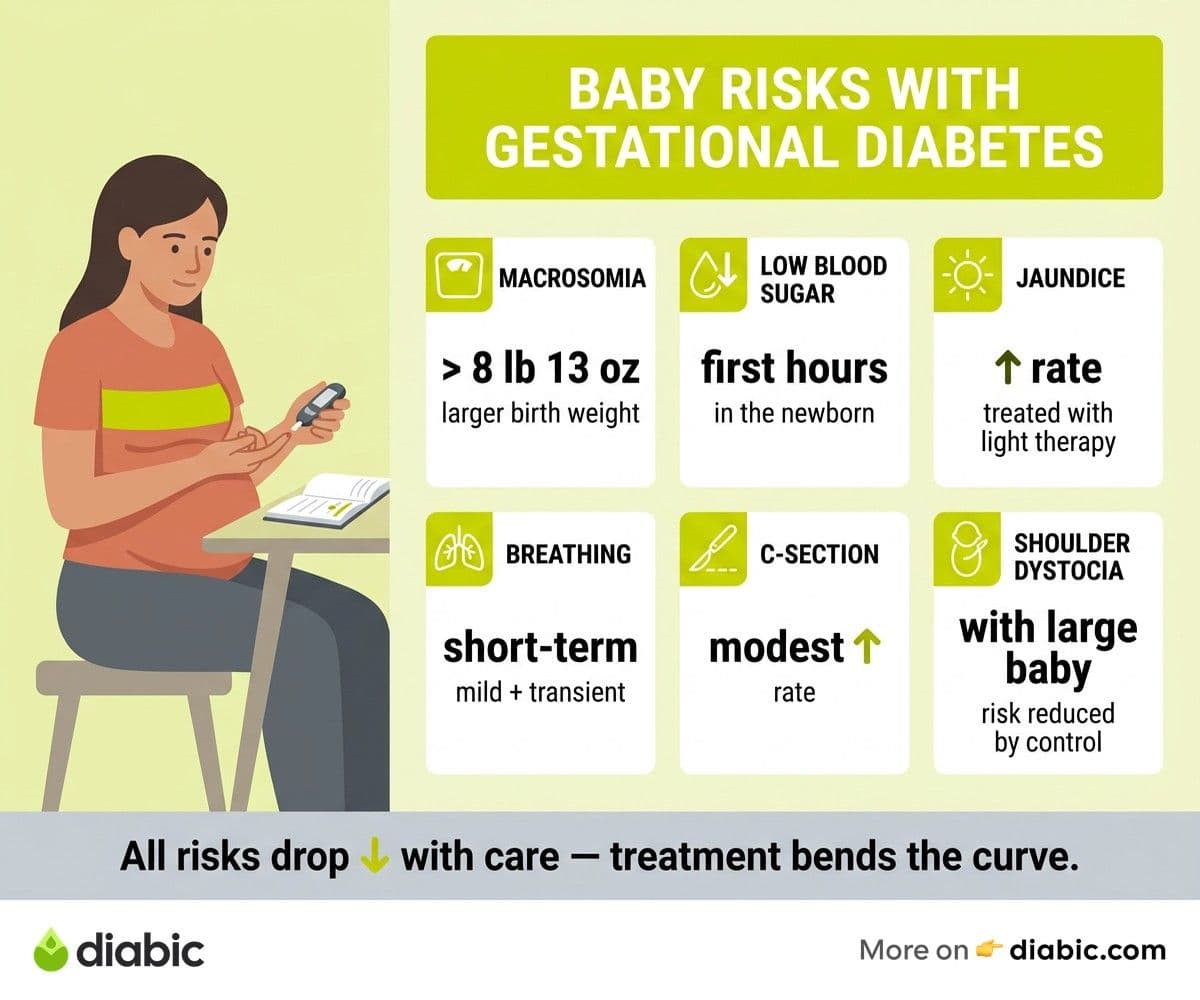
Macrosomia is the medical term for a baby born weighing more than 8 pounds 13 ounces, or about 4 kilograms. It is the most common concern raised in gestational diabetes pregnancies. The mechanism is straightforward: extra glucose from the parent crosses the placenta, the baby's pancreas releases extra insulin, and insulin acts as a growth signal. Babies with prolonged exposure to higher blood sugar tend to be larger, especially through the trunk and shoulders.
When blood sugar is well managed, macrosomia rates drop substantially. In the landmark HAPO study, babies of mothers with even mildly elevated blood sugar were more likely to be large for gestational age, but the effect was strongly dose dependent. Lower blood sugar means lower risk. Treatment is the lever that bends the curve.
Neonatal hypoglycemia after delivery
After birth, the baby is suddenly cut off from the placenta but still has a pancreas geared up for higher glucose. The first few hours of life can include low blood sugar, called neonatal hypoglycemia. This is the most common immediate effect and is one reason hospitals check blood sugar in babies of mothers with gestational diabetes shortly after birth.
Most cases resolve quickly with a feeding or, occasionally, IV glucose for a short period. It is treatable, expected by the staff, and not associated with long term harm in most cases. Skin to skin contact and early breastfeeding both help.
Increased risk of jaundice and breathing difficulties
Babies of parents with gestational diabetes have slightly higher rates of jaundice and short term breathing difficulties in the first days of life. Jaundice is common in newborns generally and is treated with phototherapy when needed. Breathing difficulties are usually mild and short lived. Both risks are reduced when blood sugar is well managed in the third trimester.
Context: these risks are significantly reduced with good management
We want to underline this point because it is the part most articles bury. Treatment works. Multiple large studies show that diet, monitoring, and medication when needed reduce the rates of macrosomia, neonatal hypoglycemia, and birth complications. The risks listed above describe what untreated or poorly controlled gestational diabetes looks like. Most parents reading this are doing the work that is already changing those numbers.
Can Gestational Diabetes Cause Birth Complications
Yes, and being honest about that lets us also be honest about how much management reduces those numbers. The risks are real, but they sit on top of strong protective factors: routine ultrasounds, glucose monitoring, and a care team that adjusts plans as you go.
Higher likelihood of C-section delivery
Cesarean delivery rates are modestly higher in gestational diabetes pregnancies, in part because larger babies sometimes do not progress through labor as easily. The increase is real, but most parents with well managed gestational diabetes deliver vaginally at term. The decision is made closer to delivery, based on baby size, your pelvis, and how labor unfolds.
Shoulder dystocia risk with larger babies
Shoulder dystocia is when a baby's shoulder gets stuck briefly behind the parent's pubic bone during delivery. It is more likely with larger babies, which is part of why providers track fetal growth carefully in gestational diabetes pregnancies. Most cases are resolved with specific maneuvers in the delivery room. Severe outcomes are uncommon and become less common when blood sugar has been well managed throughout pregnancy.
Premature birth and when induction may be recommended
Some pregnancies with gestational diabetes end in induction at 39 to 40 weeks if blood sugar control has been difficult or the baby is measuring very large. Spontaneous premature birth is also slightly more common, though rates are not dramatically different from the general population. Your provider will explain the timing logic if induction comes up.
How monitoring reduces complication rates
The HAPO study and a long line of clinical trials since make a clear case: tighter blood sugar control during pregnancy translates to fewer birth complications. The original HAPO study in NEJM showed a continuous, dose dependent relationship between glucose and outcomes. The lower your numbers, the lower the risks. That is exactly what gestational diabetes treatment is built to do.
If you want to see how treatment is structured day to day, gestational diabetes treatment options walks through diet, monitoring, and medication in detail.
Understanding Gestational Diabetes Baby Risks and Biology
To understand why blood sugar management matters so much, it helps to understand the basic biology. Gestational diabetes is a form of diabetes that develops during pregnancy because placental hormones blunt the parent's response to insulin. Glucose then runs higher than it should, and that has knock on effects for the baby.
If you want a fuller orientation to the condition, our calm guide to gestational diabetes lays it out from the beginning, including testing, daily life, and what the diagnosis really means.
How elevated blood sugar crosses the placenta
The placenta lets nutrients pass from parent to baby, including glucose. Insulin, on the other hand, does not cross meaningfully. So when the parent's blood sugar runs high, the extra glucose passes through, but the parent's insulin does not. The baby is left to handle the glucose load on their own.
The baby's response: producing extra insulin
The baby's pancreas, which is fully working by mid pregnancy, ramps up insulin production to clear the extra glucose. Insulin is a powerful growth signal, especially for fat tissue. That is why babies of parents with poorly managed gestational diabetes tend to be larger, with more body fat. After birth, that extra insulin is still circulating in the baby for a while, which is why the early hours can include low blood sugar.
Why blood sugar management directly protects the baby
Every step in this chain runs on glucose. If the parent's glucose stays in a normal range, the baby is not flooded with extra sugar, the baby's pancreas does not overproduce insulin, and growth proceeds along the normal curve. This is why a meal plan and a finger stick four times a day are not paperwork. They are the lever that protects the baby.
From my experience: I have lived with diabetes for 14 years, and one thing has stayed constant: blood sugar numbers are not a grade. They are signals. In pregnancy, the signals get even more practical. A 130 reading after lunch is not a failure. It is a hint about the next lunch. That reframe took years to land for me, and I wish I had heard it sooner.
Gestational Diabetes Treatment and Risk Reduction
Gestational diabetes treatment is the most important variable in your baby's outlook. The American Diabetes Association reviews the evidence in its Standards of Care chapter on diabetes in pregnancy, which most US clinics follow. The headline is that consistent management reduces the risk of every outcome listed earlier.
How diet, monitoring, and medication lower baby risks
Each piece of treatment targets the same mechanism. A balanced meal plan keeps post meal blood sugar from spiking. Monitoring tells you and your provider how the plan is working. When numbers stay above target, insulin is added because it works on you while leaving the baby unaffected. The combined effect is that less excess glucose reaches the baby across the pregnancy.
The importance of keeping blood sugar within target ranges
Targets in pregnancy are tighter than in non pregnancy diabetes for a reason. Even mildly elevated numbers can affect the baby over weeks and months. Common targets are below 95 mg/dL fasting and below 140 mg/dL one hour after meals. Hitting those numbers most of the time is a strong protective factor.
Working closely with your healthcare team throughout pregnancy
Care teams adjust treatment as pregnancy progresses, especially in the third trimester when hormones surge. The care plan you start at 28 weeks is rarely the plan you finish with at 38 weeks. Frequent check ins, growth ultrasounds, and conversations about insulin doses are signs that your team is doing its job, not signs that something is wrong.
Gestational Diabetes Symptoms and Early Detection
Early detection is one of the strongest protections against gestational diabetes baby risks. The earlier the diagnosis, the more weeks you have to bring blood sugar into range before the baby's growth curve is affected.
Why early screening catches gestational diabetes before complications develop
Universal glucose screening at 24 to 28 weeks exists because gestational diabetes symptoms are often absent or easy to miss. Many parents feel completely fine at the time of diagnosis. Catching it through screening rather than waiting for symptoms is the whole point.
The role of routine glucose testing in pregnancy
The standard screening in the US is the one hour glucose challenge test, followed by a three hour test if the first comes back high. Other countries use a single step two hour test. The format differs by region, but the goal is the same: identify gestational diabetes early enough to act on it.
How earlier detection means more time for effective management
Treatment that starts at 26 weeks has 12 to 14 more weeks to work than treatment that starts at 36 weeks. That is a meaningful window. Diet adjustments, exercise habits, and insulin doses all work better with more runway.
Long-Term Health Outlook for the Baby
Parents often ask whether gestational diabetes affects the child's long term health, beyond delivery. Researchers are studying this question carefully, and the answers are nuanced.
Does gestational diabetes affect the child's future health
Children born to parents with gestational diabetes have a modestly higher risk of childhood obesity and type 2 diabetes later in life. The risk is not large in any individual case, but it shows up consistently in big cohort studies. Genetics, family eating patterns, and early life environment all factor in alongside the in utero exposure.
Research on childhood obesity and diabetes risk in offspring
The HAPO Follow Up Study tracked children of parents in the original HAPO cohort and found small but real increases in childhood adiposity and impaired glucose tolerance. The takeaway is that good blood sugar management in pregnancy may have benefits well beyond delivery day.
What parents can do to support their child's long term health
The most useful interventions are also the most ordinary: family meals built around vegetables, lean protein, and whole grains. Daily movement that includes the kids. Limiting sugary drinks. Modeling a relaxed, non shaming relationship with food. These habits help every child, and they especially benefit children with a slightly higher metabolic risk profile.
For your own health postpartum, what comes after birth with gestational diabetes covers the screening schedule and habits that lower your future risk of type 2 diabetes.
FAQ
How does gestational diabetes affect the baby?
The most common effects are a higher birth weight, temporary low blood sugar in the hours after delivery, and slightly higher rates of jaundice and short term breathing issues. With consistent blood sugar management, most of these risks are reduced substantially. The vast majority of pregnancies with treated gestational diabetes result in healthy babies.
Can gestational diabetes cause birth complications?
Unmanaged or poorly managed gestational diabetes raises the risk of cesarean delivery, shoulder dystocia, and induction before 40 weeks. Active treatment, monitoring, and growth ultrasounds reduce these risks meaningfully. Most parents with well managed gestational diabetes deliver safely at term.
Will my baby be born with diabetes if I have gestational diabetes?
No. Babies are not born with diabetes because of gestational diabetes. They may have temporary low blood sugar in the first hours of life, which resolves quickly. Their lifetime risk of type 2 diabetes and obesity is slightly higher, which is why family lifestyle habits matter over time.
Does gestational diabetes mean I will need a C-section?
Not automatically. Cesarean rates are modestly higher in gestational diabetes pregnancies, mostly when babies are measuring very large. Many parents with gestational diabetes deliver vaginally without any complications.
How much do gestational diabetes baby risks decrease with treatment?
Studies consistently show that active treatment, including diet, monitoring, and insulin when needed, reduces the rates of macrosomia, shoulder dystocia, neonatal hypoglycemia, and cesarean delivery. The exact reduction depends on baseline severity, but the direction is clear: treatment works, and the earlier it starts, the better.
Dr. Rezwana Parvin Rumpa is an obstetrics and gynaecology specialist with clinical focus on gestational diabetes, PCOS, and fertility. She holds the MRCOG (Final Part) from the Royal College of Obstetricians and Gynaecologists in London, the MRCPI (Final Part) from the Royal College of Physicians of Ireland, and an MBBS from Shaheed Monsur Ali Medical College under Dhaka University. Dr. Rumpa serves as a Senior Medical Officer in the Obs and Gynae department at BRB Hospitals Ltd, where she has spent three years managing prenatal care, emergency obstetric cases, and women's-health surgery. On Diabic, she medically reviews content for women living with diabetes, with particular attention to pregnancy, PCOS, and reproductive-health intersections.
Medically reviewed by
Dr. Shanto Arian is an internal medicine physician now specializing in clinical and aesthetic dermatology, with a parallel academic focus on epidemiology and public health. He holds an MBBS, MPH, MSc (UK), MRCP (UK), MRCPI (Ireland), Diploma in Dermatology (UK), and Diploma in Aesthetic Medicine (USA). Dr. Arian trained in internal medicine, including hospital work on hematology cases such as graft-versus-host disease, before moving toward dermatology. Skin is one of the earliest places diabetes shows itself, from acanthosis nigricans and diabetic dermopathy to slow foot wound healing, and that intersection is where his clinical and Diabic-review work meet. On Diabic, Dr. Arian medically reviews content on diabetes diagnosis, complications, dermatologic manifestations, and pharmacotherapy, ensuring every claim aligns with current ADA, NICE, and peer-reviewed literature.
More from Diabetes Knowledge
View all
Can Diabetics Eat Fruit? Yes, Best Picks and Tips
Can people with diabetes eat fruit? Yes. Here is how to choose the right fruits, manage portions, and pair them smartly to keep blood sugar steady.

Newly Diagnosed Type 2 Diabetes: Where to Start
Newly diagnosed type 2 diabetes feels overwhelming, but the first steps are simpler than you think. Get a clear, calm starting plan from day one.

Secondary Diabetes: When Another Condition Is the Cause
Secondary diabetes develops because of another medical condition or medication. Learn the causes, how it differs from type 2, and how it's managed.
Clinician-reviewed habits, plain-language guides, and honest answers - the small shifts that make living with diabetes feel lighter, every day.