Weight Loss for Prediabetes: What Works
Weight loss for prediabetes does not require extreme diets. See what the research shows works, the 5-7% target, and practical strategies that stick.

In this article(20)
FAQ
- How much weight do you need to lose to reverse prediabetes?
- Can losing weight prevent prediabetes from becoming diabetes?
- How long does it take to lose 5-7% of body weight?
- What is the best diet for weight loss with prediabetes?
- Should I take medication for prediabetes if lifestyle changes are not working?
Weight loss for prediabetes does not require dramatic transformations or crash diets. Research shows that losing just 5 to 7% of your body weight can significantly lower your risk of progressing to type 2 diabetes. For someone weighing 200 pounds, that is 10 to 14 pounds, an amount that is achievable for most people with the right approach.
The challenge is figuring out what actually works and sticks. Weight loss advice is everywhere, most of it contradictory, and a lot of it built around plans that produce fast results followed by faster regain. That cycle is especially unhelpful when you are trying to change a metabolic trajectory rather than fit into a wedding dress.
This guide walks through what the research actually supports, why modest weight loss has outsized benefits in prediabetes, and the practical strategies that hold up over months and years.
How Weight Loss for Prediabetes Reverses Risk
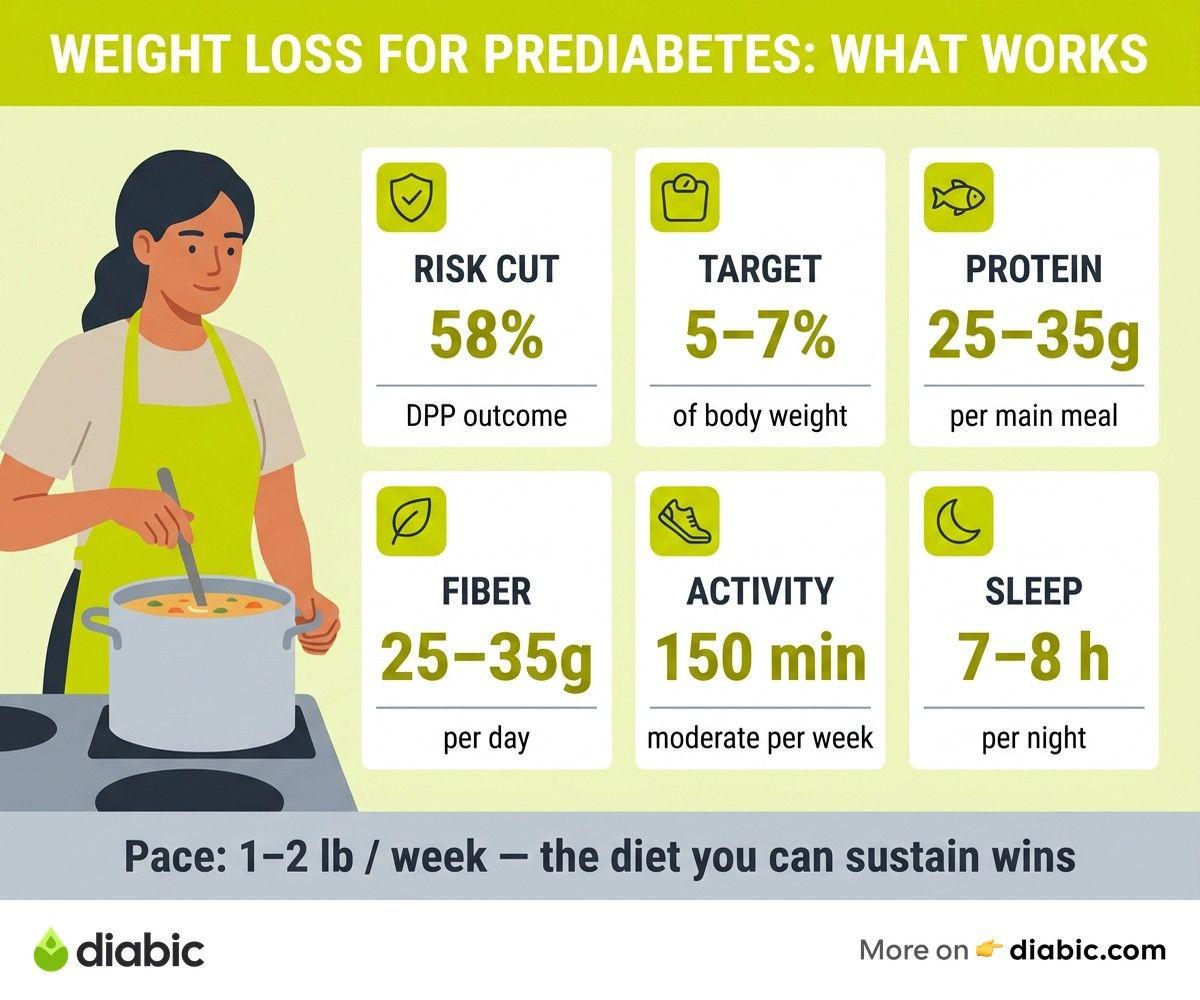
The strongest evidence on weight loss for prediabetes comes from the Diabetes Prevention Program (DPP), a landmark study run by the National Institutes of Health that followed thousands of adults with prediabetes over several years. Participants who lost 5 to 7% of their body weight through dietary changes and 150 minutes of weekly physical activity reduced their risk of developing type 2 diabetes by 58%. That number jumped to 71% for participants over 60.
The mechanism is mostly about insulin sensitivity. Excess fat, particularly around the abdomen and inside the liver, drives the kind of inflammation and metabolic dysfunction that produce insulin resistance. Losing some of that fat lets your cells respond to insulin again, which lowers blood sugar and reduces the load on your pancreas.
Modest weight loss often produces outsized metabolic benefits because the fat that disappears first tends to be the visceral fat that was causing the most problems. You do not need to reach an "ideal" weight to see improvements. You just need to start losing some of the fat that has accumulated where it does the most metabolic damage.
For a fuller look at what reversal actually means in this context, our guide to whether prediabetes can be reversed covers what to expect realistically. Reversal does not mean the underlying tendency goes away. It means blood sugar markers return to a non-prediabetic range and stay there with continued lifestyle changes.
The 5-7% target and what it looks like in real numbers
Translating percentages into pounds makes the goal feel concrete. At 150 pounds, a 5 to 7% loss is 7 to 10 pounds. At 180 pounds, it is 9 to 13 pounds. At 220 pounds, it is 11 to 15 pounds. These are not extreme amounts, and most people can reach them in three to six months with steady, sustainable changes.
The pace matters. Aiming for one to two pounds per week is consistent with what the DPP showed worked best. Faster weight loss is usually less sustainable, and it tends to come with more muscle loss, which is the opposite of what you want for long-term metabolic health.
Diet Approaches That Support Weight Loss with Prediabetes
Multiple dietary approaches show similar success when it comes to weight loss for prediabetes. Mediterranean, DASH, lower-carb, and balanced moderate-calorie patterns have all produced meaningful results in trials. The best diet is the one you can sustain, not the one that scores highest on a magazine list.
The American Diabetes Association supports a flexible approach to nutrition for people with prediabetes, emphasizing dietary patterns built around vegetables, lean proteins, whole grains, legumes, fruits, and healthy fats, with minimized added sugars, refined grains, and ultra-processed foods. There is no single magic ratio of macronutrients that wins for everyone.
Our prediabetes diet guide covers the food-level details. Here we focus on the higher-level patterns that consistently support sustainable weight loss.
Calorie awareness without obsessive counting
You do not need to count every calorie to lose weight, but you do need some awareness of how much you are eating. The most successful approaches in long-term weight loss research combine portion awareness, food quality changes, and reduced intake of liquid and ultra-processed calories.
A practical starting point is the plate method. Half your plate non-starchy vegetables, a quarter lean protein, a quarter higher-fiber carbs, with a small serving of healthy fat. This naturally controls calories without the mental load of weighing food.
For people who like data, a brief period of calorie tracking (two to four weeks) can build useful intuition about portion sizes and where calories actually come from in your diet. Most people are surprised by how much liquid calories and snacks add up.
Prioritizing protein and fiber for satiety
Higher protein intake (roughly 25 to 30% of calories, or about 25 to 35 grams per main meal) helps with both satiety and preserving muscle during weight loss. Higher fiber intake (25 to 35 grams per day from vegetables, legumes, fruits, and whole grains) slows digestion, supports gut health, and reduces appetite between meals.
These two together are the foundation of most evidence-based weight loss plans. Diets that ignore them tend to produce fast initial losses followed by regain, because hunger eventually wins.
Reducing liquid calories and processed foods
Sugary drinks, juice, sweetened coffee drinks, and alcohol are common sources of calories that do not register the way solid food does. Cutting these alone can produce meaningful weight loss for many people without any other dietary changes.
Ultra-processed foods (the kind with long ingredient lists, designed to be hyper-palatable) drive overeating in ways that whole foods do not. Multiple studies show that people eat hundreds of extra calories per day on ultra-processed diets compared to matched whole-food diets, even when given the same amount of available food.
Why sustainable approaches beat rapid weight loss
Crash diets work in the short term and fail in the long term. The data on rapid weight loss is consistent across decades: most people regain most of the weight within one to three years, and the regain often overshoots the starting point. Slower, more sustainable approaches produce smaller initial losses but much better five-year outcomes.
The way you lose weight is the way you have to keep eating to maintain it. If the approach is one you cannot live with for years, the weight will come back when you stop.
Exercise for Weight Loss with Prediabetes
Exercise plays two roles in weight loss for prediabetes. It supports the calorie deficit that drives weight loss. More importantly, it improves insulin sensitivity directly, independent of any weight change. The pre diabetes diet and exercise combination consistently outperforms either approach alone in research.
The CDC's National Diabetes Prevention Program uses 150 minutes of moderate-intensity activity per week as its core target, the same number that came out of the original DPP study. That is 30 minutes a day, five days a week, of activity that gets your heart rate up but still lets you carry on a conversation. Walking absolutely counts. So does cycling, swimming, dancing, gardening that involves real effort, or any other activity you will actually do.
Adding strength training two or three times a week amplifies the benefit. Muscle is your body's largest glucose sink, and resistance training builds muscle that pulls glucose out of the bloodstream more effectively. Even bodyweight exercises at home count.
For practical guidance on building a sustainable activity routine, our pre diabetes diet and exercise plan walks through how to structure the week. The specific approach for people whose insulin resistance is already pronounced is covered in our guide on losing weight with insulin resistance.
How movement improves insulin sensitivity independent of weight loss
This is one of the most encouraging findings in the prediabetes literature. People who add regular physical activity see improvements in insulin sensitivity within weeks, before they have lost any meaningful amount of weight. Exercise effectively makes your existing body better at handling glucose, even before any visible change.
That means the benefits of movement start showing up almost immediately. You do not have to wait for the scale to move to see metabolic improvements.
Building movement into a normal day
Structured workouts work for some people. For others, breaking activity into smaller chunks throughout the day is more sustainable. A 15-minute walk in the morning, a few flights of stairs at work, and another walk after dinner adds up to plenty of movement without requiring a gym membership or a free hour.
Post-meal walks are particularly useful for people with prediabetes. Even 10 minutes of walking after a meal blunts the post-meal glucose spike noticeably, which over time helps move A1C in the right direction.
Practical Strategies That Help You Stay Consistent
Knowing what to do and actually doing it for months are two different problems. The strategies that consistently separate successful long-term weight loss from short-term efforts are mostly about systems and support, not willpower.
Set realistic weekly goals instead of distant targets. Losing one pound this week, walking 30 minutes today, eating vegetables at lunch are all goals you can act on right now. "Lose 30 pounds this year" is not a goal you can act on directly. Breaking the larger target into the next concrete step makes consistency much easier.
Track progress beyond the scale. Energy levels, sleep quality, fasting blood sugar, post-meal numbers, how clothes fit, how you feel after exercise: all of these give you signal about whether your plan is working. The scale is one metric and a noisy one. Bodies do not lose weight in straight lines, and a week of slow progress on the scale can hide real progress in other markers.
Build a support system. The original DPP achieved its results partly through structured group support. People who try to make significant lifestyle changes alone, with no accountability or encouragement, struggle more than people who have a doctor, dietitian, friend, family member, or community pulling for them.
Handling plateaus without giving up
Weight loss almost always slows after the first few weeks. Your metabolism adapts, your starting bursts of motivation level off, and the pounds come off more slowly. This is normal and expected. The most common mistake at this point is giving up because the rate has slowed.
Plateaus often resolve themselves with patience and consistency. When they do not, small adjustments help: tightening up portion sizes, adding 10 to 15 minutes to daily activity, getting more sleep, or reviewing whether liquid and snack calories have crept back in.
From my experience: After 14 years of living with diabetes, I have learned that the weeks I make the most progress are not the dramatic, motivated weeks. They are the boring, consistent ones. Walks after meals, vegetables on the plate, regular sleep, no big speeches. The week I "go all in" with a new plan tends to be followed by the week I quietly fall off it. The slower path turned out to be the faster one because it never stopped.
When Weight Loss Alone Is Not Enough
Lifestyle changes are the first-line approach for prediabetes, and they work for most people. For some people, though, weight loss alone does not bring blood sugar back into a normal range, or the lifestyle changes are very difficult to sustain. In those situations, additional support may be appropriate.
Metformin is the medication most often discussed for prediabetes. The DPP also tested metformin and found that it reduced the progression to type 2 diabetes by 31%, less than the 58% reduction from intensive lifestyle changes but still meaningful. For some people, especially those who are younger, more obese, or have higher fasting glucose, the Mayo Clinic and other major medical centers note that metformin is a reasonable option to discuss with a provider.
Other health conditions can affect weight loss. Hypothyroidism, polycystic ovary syndrome, sleep apnea, certain medications, and depression all influence how easily someone can lose weight. If you are doing the right things and the scale is not moving, a workup with your provider for underlying issues is worthwhile.
When to talk to your doctor about additional support
If you have been making consistent lifestyle changes for three to six months and your A1C, fasting glucose, or weight are not moving in the right direction, that is a reasonable trigger for a conversation. Your doctor may suggest additional testing, a referral to a registered dietitian or diabetes educator, medication options, or evaluation for newer weight loss medications that have shown strong results in clinical trials.
Asking for help is not failure. Diabetes prevention is a team effort, and the most successful people are usually the ones who use every resource available to them.
The bigger picture with weight loss for prediabetes is that it does not need to be perfect to work. Small, consistent changes done over months produce results that crash diets cannot match, and those changes leave you in a better place not just on the scale but on every metabolic marker that matters.
FAQ
How much weight do you need to lose to reverse prediabetes?
The Diabetes Prevention Program showed that losing 5 to 7% of body weight significantly reduces the risk of type 2 diabetes. For someone weighing 200 pounds, that is 10 to 14 pounds. Even smaller amounts of weight loss can improve blood sugar levels.
Can losing weight prevent prediabetes from becoming diabetes?
Yes. Research consistently shows that weight loss combined with regular physical activity is one of the most effective strategies for preventing prediabetes from progressing to type 2 diabetes. The DPP showed a 58% reduction in risk for participants who hit the 5 to 7% weight loss target with 150 minutes of weekly activity.
How long does it take to lose 5-7% of body weight?
At a sustainable pace of one to two pounds per week, most people reach 5 to 7% weight loss in three to six months. Faster loss is possible but is usually less sustainable and may include more muscle loss.
What is the best diet for weight loss with prediabetes?
There is no single best diet. Mediterranean, DASH, lower-carb, and balanced moderate-calorie patterns all show meaningful results when built around whole foods and sustained over time. The best approach is the one you can stick with for years.
Should I take medication for prediabetes if lifestyle changes are not working?
For some people, especially those who are younger, more obese, or have higher fasting glucose, metformin can be a reasonable addition to lifestyle changes. This is a decision to make with your doctor based on your individual risk factors and how you have responded to lifestyle approaches.
The honest summary on weight loss for prediabetes is that the math does not require perfection. A 5 to 7 percent change, held in place for years, beats a 15 percent loss that bounces back in nine months. Pick one diet pattern you can live with, add a daily walk you actually enjoy, and let the small wins compound.
Shahriar P. Shuvo is the founder of Diabic. He has lived with diabetes for over 14 years, and built Diabic to deliver the practical, evidence-based self-management tools he wished existed when he was first diagnosed. By trade, Shahriar is a senior design and frontend engineer with 6+ years shipping products at Agora, Timescale (now Tiger Data), and ShareTrip. He writes from the intersection of lived diabetes experience and product craft, focused on what works in daily management rather than what sounds good in a textbook.
Medically reviewed by
Dr. Shanto Arian is an internal medicine physician now specializing in clinical and aesthetic dermatology, with a parallel academic focus on epidemiology and public health. He holds an MBBS, MPH, MSc (UK), MRCP (UK), MRCPI (Ireland), Diploma in Dermatology (UK), and Diploma in Aesthetic Medicine (USA). Dr. Arian trained in internal medicine, including hospital work on hematology cases such as graft-versus-host disease, before moving toward dermatology. Skin is one of the earliest places diabetes shows itself, from acanthosis nigricans and diabetic dermopathy to slow foot wound healing, and that intersection is where his clinical and Diabic-review work meet. On Diabic, Dr. Arian medically reviews content on diabetes diagnosis, complications, dermatologic manifestations, and pharmacotherapy, ensuring every claim aligns with current ADA, NICE, and peer-reviewed literature.
More from Diabetes Knowledge
View all
Can Diabetics Eat Fruit? Yes, Best Picks and Tips
Can people with diabetes eat fruit? Yes. Here is how to choose the right fruits, manage portions, and pair them smartly to keep blood sugar steady.

Newly Diagnosed Type 2 Diabetes: Where to Start
Newly diagnosed type 2 diabetes feels overwhelming, but the first steps are simpler than you think. Get a clear, calm starting plan from day one.

Secondary Diabetes: When Another Condition Is the Cause
Secondary diabetes develops because of another medical condition or medication. Learn the causes, how it differs from type 2, and how it's managed.
Clinician-reviewed habits, plain-language guides, and honest answers - the small shifts that make living with diabetes feel lighter, every day.