Marijuana and Diabetes: What Research Actually Says
What research says about marijuana and diabetes, including effects on blood sugar, insulin sensitivity, appetite, and safety considerations to discuss.

In this article(9)
The conversation around marijuana and diabetes is loud, confident, and often far ahead of the actual science. Walk into any dispensary or scroll a wellness forum and you will hear bold claims about cannabis improving insulin sensitivity, calming inflammation, or even reversing metabolic disease. The research base is much thinner than the marketing suggests, and the studies that do exist often contradict each other.
We wrote this piece because people living with diabetes deserve a clear-eyed look at what cannabis researchers have actually shown and what questions to bring to their healthcare team. If you partake, are curious, or are trying to make sense of the headlines, the goal here is information, not judgment.
From my experience: Living with type 1 for about 14 years, I have watched plenty of friends try edibles for sleep or anxiety and then text me at 2am asking why their CGM is showing a flat 220. The answer is almost always the late-night snack the THC pulled them toward, not some direct effect on their pancreas. The most useful thing I learned was to keep my Dexcom alerts on even on the rare occasions I tried it, because a blunted low signal at 60 mg/dL is not something I want to find out about from a paramedic.
Marijuana and Diabetes: The Current State of Research
Most of what we know about marijuana and diabetes comes from observational studies and small clinical trials, not the large randomized experiments that would settle the question. Some early epidemiological work, including a frequently cited paper in the American Journal of Medicine, reported that current cannabis users had lower fasting insulin, lower insulin resistance, and smaller waist circumference than non-users. Findings like that generated a lot of optimistic coverage, but the authors themselves cautioned that observational data cannot prove cause and effect.
Subsequent reviews have painted a more complicated picture. Research summarized by the National Institute on Drug Abuse shows that cannabis affects multiple body systems through the endocannabinoid system, which influences appetite, energy storage, and glucose metabolism. The endocannabinoid system has receptors in the pancreas, liver, and fat tissue, so it is biologically plausible that cannabis could shift metabolic markers. Plausibility, however, is not the same as a proven clinical benefit.
It also matters which compound you are talking about. Cannabis contains dozens of cannabinoids, but THC and CBD get the most attention, and their effects differ. THC is psychoactive and tends to stimulate appetite, while CBD does not produce a high and has been studied for inflammation and seizure disorders. There is not yet a high-quality body of evidence to support cannabis as a diabetes treatment for either type 1 or type 2.
How Marijuana Affects Blood Sugar
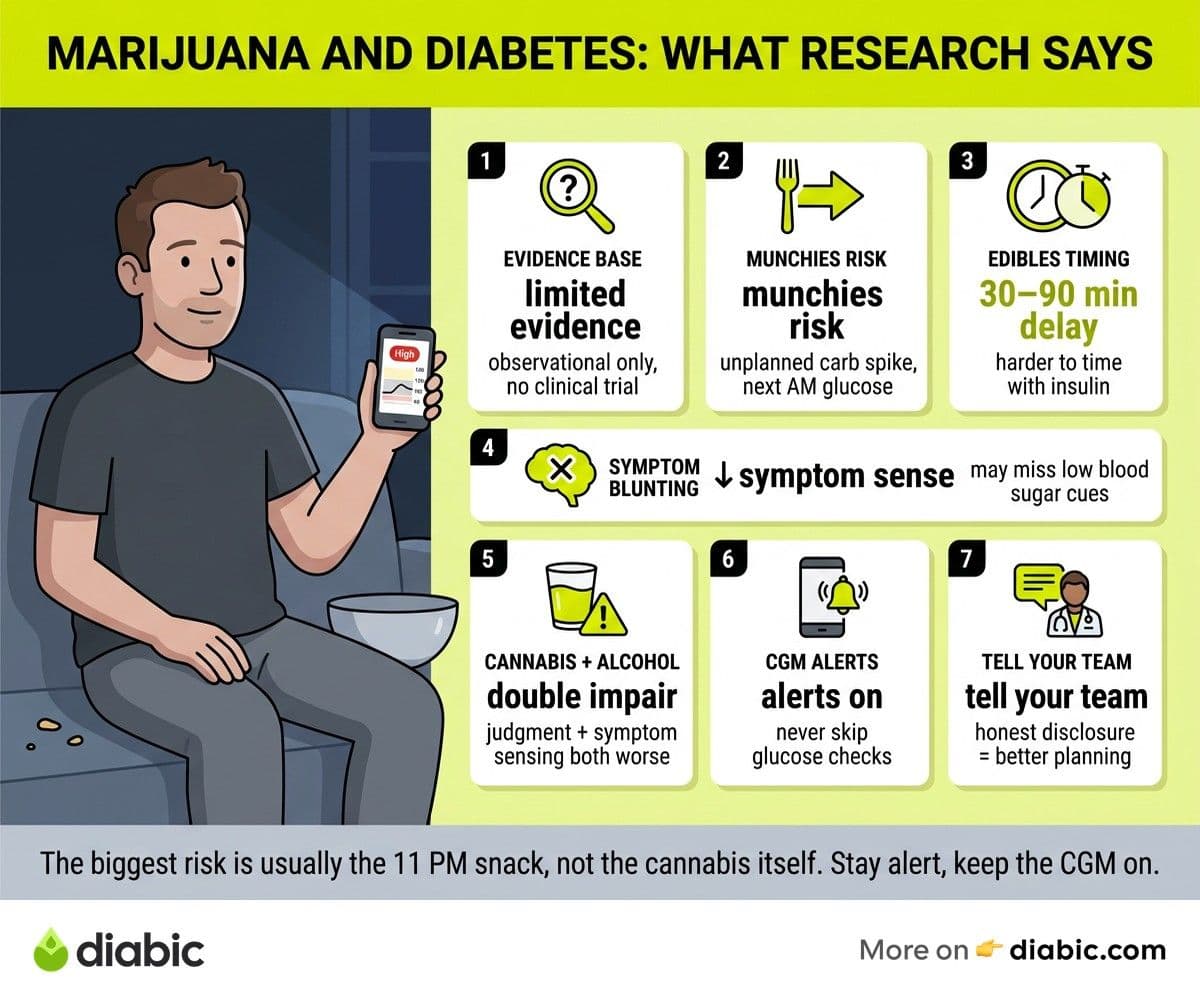
The most consistent way cannabis affects blood sugar is indirect, through appetite. THC reliably increases hunger, which is the well-known "munchies" effect, and people often reach for high-carb, high-fat snacks when that hunger hits. For someone managing diabetes with insulin or oral medications, an unplanned 600-calorie snack at 11 p.m. can easily produce a spike that shows up the next morning as an elevated fasting reading. If you have ever wondered why your numbers drift on weekends, this pattern is worth examining honestly.
Direct effects on glucose are more variable. Some studies in the Diabetes Care journal and related publications have explored substance use and glycemic outcomes, finding that heavy cannabis use is associated with worse glycemic measures and higher rates of diabetic ketoacidosis in people with type 1. Other small studies have found neutral or slightly favorable effects on insulin sensitivity in non-diabetic populations. The discrepancy likely reflects differences in dose, frequency, route of administration, and study design.
The route of administration matters more than people realize. Smoking flower delivers THC to the bloodstream within minutes, peaks fast, and fades within a few hours. Edibles are absorbed through the gut, taking 30 to 90 minutes to kick in and lasting much longer, which can complicate timing around meals and medication. Tinctures and vape products fall somewhere in between. Each route produces a different pharmacokinetic curve, and that curve interacts with insulin action in ways the science has not fully mapped. If you smoke, you should also read about how smoking affects blood sugar, since the combustion-related risks apply regardless of what is being burned.
Marijuana, Alcohol, and Diabetes: Comparing Risks
People often compare cannabis to alcohol when thinking about social use and diabetes, and the risk profiles are genuinely different. Alcohol can directly suppress the liver's ability to release glucose, which is why drinking on an empty stomach raises the risk of delayed hypoglycemia, sometimes hours after the last drink. Cannabis does not have the same liver mechanism, but it can blunt your awareness of low blood sugar symptoms, which is its own kind of danger if you take insulin or sulfonylureas. Our guide to alcohol and diabetes covers the alcohol side in depth.
Combining cannabis and alcohol amplifies the impairment of both. Judgment, coordination, and the ability to recognize hypoglycemia all degrade further when the two are mixed. If you cannot reliably notice that you are sweaty, shaky, or confused, you cannot reliably treat a low. People who use both substances together also tend to forget medication doses, skip blood glucose checks, and make food choices that complicate the next morning's numbers.
Legal status complicates the conversation in a frustrating way. Because cannabis remains a Schedule I substance under U.S. federal law, many clinicians are cautious or vague when patients ask about it, and research funding has historically been restricted. The National Conference of State Legislatures tracks the patchwork of state medical cannabis programs, and qualifying conditions vary widely. Diabetes itself is rarely a qualifying condition, but related issues like neuropathy or chronic pain sometimes are. None of this is a reason to hide cannabis use from your doctor. If anything, the legal awkwardness makes honest disclosure more important so your care team can plan around it.
Diabetes Anxiety, Stress, and Whether Cannabis Helps
Living with a chronic condition is exhausting, and diabetes anxiety and stress are real drivers of why some people turn to cannabis. The hope is that a low dose will take the edge off without the next-day fog of alcohol or the side effects of prescription anti-anxiety medications. There is some short-term evidence that low-dose THC or CBD can reduce situational anxiety, but higher doses of THC often do the opposite and can trigger panic, paranoia, or racing thoughts.
For people with diabetes, the bigger concern is what cannabis can mask. Anxiety and the early symptoms of low blood sugar overlap significantly: shakiness, sweating, fast heartbeat, and a vague sense that something is wrong. If you smoke or vape to calm those feelings without checking your glucose first, you may delay treating an actual hypoglycemic episode. Over time, frequent cannabis use has also been linked to reduced motivation and a flattening of mood that can look a lot like depression, which is already more common in people with diabetes. The way diabetes anxiety and stress affect blood sugar is worth understanding before you self-medicate.
There are stress-management approaches with stronger evidence and fewer trade-offs. Cognitive behavioral therapy, mindfulness-based stress reduction, regular aerobic exercise, and structured peer support all have data supporting their use in chronic illness populations. None of them are as immediately gratifying as smoking a joint, and we are not going to pretend otherwise. They do, however, tend to produce more durable improvements in both mental health and glycemic outcomes. If anxiety is driving your cannabis use, that is a signal to talk with your healthcare team about mental health support.
Safety Considerations for People with Diabetes
A few specific safety issues deserve attention. Cannabis can interact with medications metabolized by the liver, including some statins and certain blood pressure drugs, by competing for the same enzyme pathways. The interactions are not always dramatic, but they can shift drug levels in either direction. Your pharmacist is often the most knowledgeable person in your care team about these interactions and will not judge you for asking.
Cardiovascular risk is the second concern, and it is underappreciated. Smoking anything irritates the airways and raises short-term heart rate and blood pressure, both of which add load to a cardiovascular system already working harder because of diabetes. Long-term heavy cannabis use has been associated with an elevated risk of cardiovascular events in some studies, though the evidence is not as solid as it is for tobacco. If you have known heart disease, hypertension, or are over 50, this is a real conversation to have with your cardiologist.
A third issue is cannabinoid hyperemesis syndrome, a relatively rare but serious condition in heavy long-term users that causes cyclic vomiting and abdominal pain. For someone with type 1 diabetes, repeated vomiting is a fast track to dehydration, missed insulin doses, and diabetic ketoacidosis. Finally, impaired judgment and reaction time affect day-to-day diabetes self-management and driving safety, especially for people prone to hypoglycemia unawareness. Operating a vehicle while high and low at the same time is a worst-case combination.
Talking to Your Doctor About Cannabis Use
Disclosure is the single most useful thing you can do, and it is also the step people most often skip. Your endocrinologist is not going to call the police, and most clinicians have heard far more candid health histories than yours. What they need to know is the form you use, roughly how often, and whether you are using THC, CBD, or a mix. With that information, they can adjust insulin advice, watch for medication interactions, and screen for issues like hyperemesis or cardiovascular changes earlier than they otherwise would.
A few practical questions to bring to the appointment: Could cannabis be affecting my blood sugar patterns? Are any of my medications likely to interact with THC or CBD? Should I adjust how I check for lows on days I use? Is there evidence that medical cannabis would help any of my other conditions, like neuropathy or sleep issues? What signs of cannabinoid hyperemesis or cardiovascular problems should I watch for? These questions move the conversation from awkward to useful in about thirty seconds.
If you live in a state with a medical cannabis program, ask whether any of your conditions qualify and what the certification process looks like. Medical programs typically come with more dosing guidance, lab-tested products, and the option of a clinician who is more comfortable discussing cannabis specifically. Safe use, if your doctor supports it, generally means starting with the lowest effective dose, avoiding high-THC concentrates, never combining with alcohol, and always checking blood glucose before and after use until you understand your personal pattern. The honest answer to whether marijuana and diabetes can coexist is "sometimes, with care, and only with your care team in the loop."
Frequently Asked Questions
Does marijuana affect blood sugar in people with diabetes?
Research results are mixed. Some observational studies have suggested cannabis users have lower fasting insulin and better insulin sensitivity, while other research links heavy use to worse glycemic outcomes and higher rates of diabetic ketoacidosis in type 1. The most consistent indirect effect is appetite stimulation from THC, which can lead to high-carb snacking and post-meal spikes. Method of consumption, dose, and the THC-to-CBD ratio all play a role.
Is marijuana safe to use with diabetes?
There is not enough high-quality research to give a universal yes or no. Cannabis can interact with diabetes-related medications, blunt your awareness of low blood sugar symptoms, increase appetite in ways that complicate management, and stress the cardiovascular system. Talk to your healthcare provider before using marijuana, especially if you take insulin or sulfonylureas, so you can plan around the risks together.
Shahriar P. Shuvo is the founder of Diabic. He has lived with diabetes for over 14 years, and built Diabic to deliver the practical, evidence-based self-management tools he wished existed when he was first diagnosed. By trade, Shahriar is a senior design and frontend engineer with 6+ years shipping products at Agora, Timescale (now Tiger Data), and ShareTrip. He writes from the intersection of lived diabetes experience and product craft, focused on what works in daily management rather than what sounds good in a textbook.
Medically reviewed by
Dr. Shanto Arian is an internal medicine physician now specializing in clinical and aesthetic dermatology, with a parallel academic focus on epidemiology and public health. He holds an MBBS, MPH, MSc (UK), MRCP (UK), MRCPI (Ireland), Diploma in Dermatology (UK), and Diploma in Aesthetic Medicine (USA). Dr. Arian trained in internal medicine, including hospital work on hematology cases such as graft-versus-host disease, before moving toward dermatology. Skin is one of the earliest places diabetes shows itself, from acanthosis nigricans and diabetic dermopathy to slow foot wound healing, and that intersection is where his clinical and Diabic-review work meet. On Diabic, Dr. Arian medically reviews content on diabetes diagnosis, complications, dermatologic manifestations, and pharmacotherapy, ensuring every claim aligns with current ADA, NICE, and peer-reviewed literature.
More from Living with Diabetes
View all
Flying with Diabetes Supplies: TSA Rules Explained
Wondering what can I bring on plane diabetes supplies? Here's exactly what TSA allows, how to pack, and how to breeze through screening.

Retirement Planning with Diabetes: Costs to Know
Retirement planning with diabetes means budgeting for insulin, Medicare gaps, and rising supply costs. Here is a clear framework to prepare your finances.

Napping and Blood Sugar: What the Research Actually Says
Napping and blood sugar have a complicated relationship. Short naps may help, long naps may raise type 2 diabetes risk. Here is what research shows.
Clinician-reviewed habits, plain-language guides, and honest answers - the small shifts that make living with diabetes feel lighter, every day.