Smoking and Blood Sugar: Why Quitting Matters With Diabetes
Smoking and blood sugar interact in ways that worsen diabetes outcomes. Here is what changes when you quit, plus practical resources to help.

In this article(12)
Smoking and blood sugar have a relationship that most people with diabetes underestimate, yet cigarettes actively work against nearly every aspect of diabetes management. If you have been putting off quitting, understanding exactly how smoking sabotages your blood sugar may be the push you need. We are not here to lecture you, because we know quitting is one of the hardest things a person can do, especially while juggling glucose checks, medication timing, and the daily mental load of life with diabetes.
What we want to share is the honest science of what nicotine does inside your body, what genuinely shifts after your last cigarette, and where to find help that actually fits your situation. The research here is consistent, and the practical takeaways are encouraging. You do not have to do this alone, and the first weeks are not the rest of your life.
How Smoking and Blood Sugar Are Connected
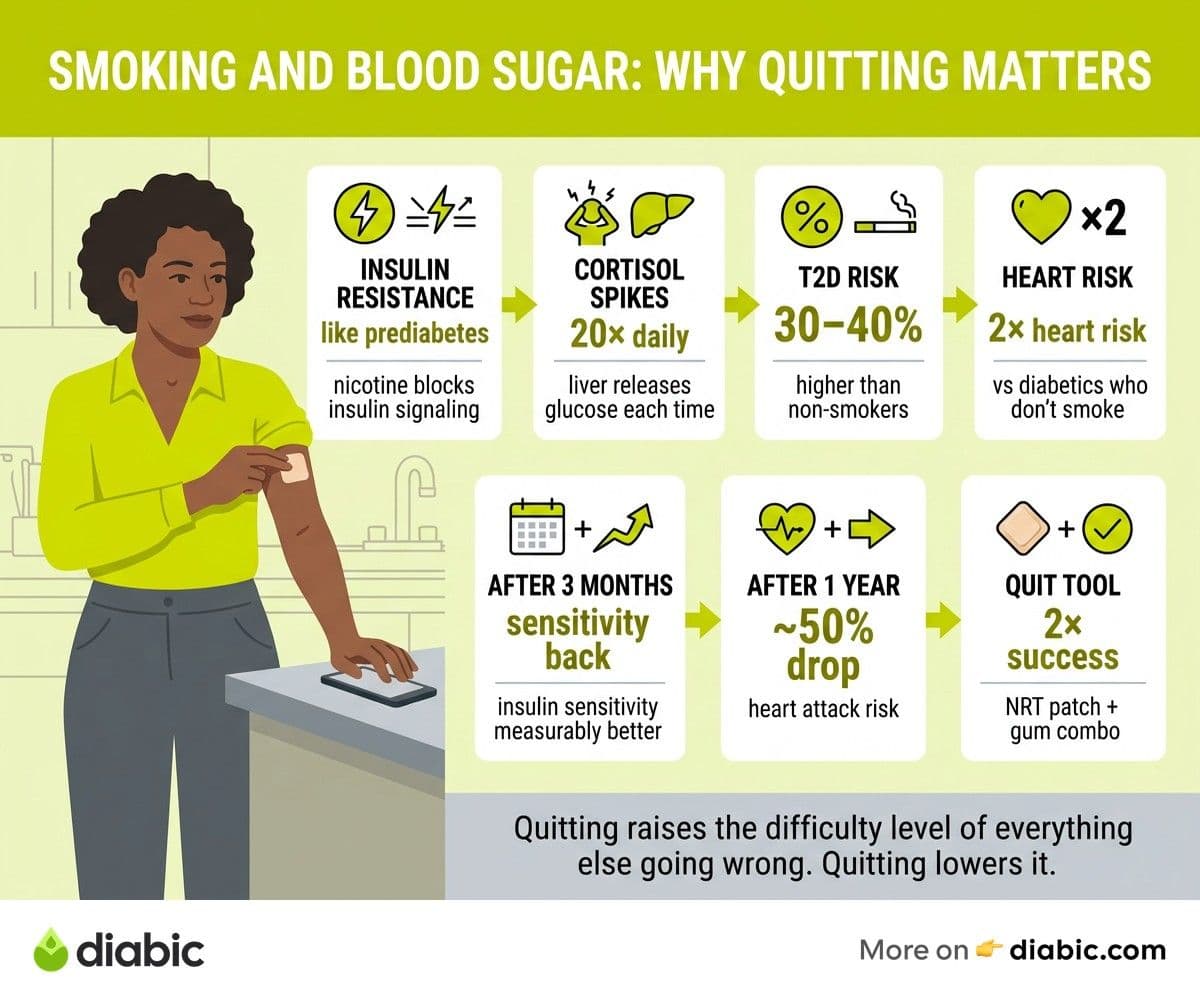
Nicotine raises blood glucose through several pathways at once, which is why people who smoke tend to have higher A1C readings than people who do not. The most important pathway is insulin resistance. Nicotine interferes with how your muscle and fat cells respond to insulin, meaning the same dose of insulin (whether your own or injected) clears less glucose from your bloodstream. A study published in the journal Diabetes Care and summarized by the American Diabetes Association shows that heavy smokers can have insulin resistance roughly comparable to someone with prediabetes, even when they are otherwise healthy.
Smoking also pushes up cortisol and adrenaline every time you light up. Those stress hormones tell your liver to release stored glucose, which is useful in a true emergency and unhelpful when it happens twenty times a day. Add in the inflammatory effect of tobacco smoke on blood vessels, and you have a setup where blood sugar runs higher and stays higher. Vascular damage compounds over time, narrowing the small blood vessels that feed your eyes, kidneys, feet, and heart.
The cumulative effect on A1C is not small. Research compiled by the Centers for Disease Control and Prevention consistently links smoking to higher A1C, more frequent hyperglycemia, and a 30 to 40 percent greater chance of developing type 2 diabetes in the first place. For people who already have diabetes, smoking essentially raises the difficulty level of every other thing you do to stay well.
Quitting Smoking With Diabetes: What to Expect
The first two to four weeks after your quit date can feel like a glucose roller coaster, and we want you to know that this is normal and temporary. Without nicotine pushing cortisol, insulin sensitivity starts to recover, which can mean lower readings than you are used to. If you take insulin or sulfonylureas, this is a real hypoglycemia risk, so we recommend telling your care team your quit date in advance and checking your blood sugar more often during the transition. You may also want to read our guide to alcohol and diabetes if you tend to pair drinks with cigarettes, since both habits often shift together.
Weight gain is the concern we hear most, and the average is about five to ten pounds in the first year. That number sounds intimidating, but the cardiovascular and glycemic benefits of quitting outweigh the risk associated with that modest weight change by a wide margin. Planning for it helps. Stocking the fridge with crunchy low-carb snacks (cucumbers, celery, cheese, jerky), keeping sugar-free gum nearby, and walking after meals can all blunt the bump.
Nicotine replacement therapy (patches, gum, lozenges) is generally safe for people with diabetes and does not significantly affect blood glucose at standard doses. Prescription options like varenicline and bupropion are also well studied, though varenicline has been associated with a small risk of hypoglycemia in some patients, which is worth flagging with your provider. Within a week of quitting, lung function and circulation begin to improve. Within three months, insulin sensitivity is measurably better. Within a year, your risk of heart attack drops by roughly half.
Diabetes Anxiety, Stress, and Smoking
Many people who smoke and live with diabetes describe cigarettes as the only reliable break in their day, a moment of quiet that the disease itself rarely allows. We hear this all the time, and there is nothing weak about it. Diabetes carries a real mental load, and the brain does what works. The trouble is that nicotine is a poor stress manager because it creates the very anxiety it then briefly relieves. The cycle of withdrawal, craving, smoke, brief calm, and rising withdrawal again drives both stress and blood sugar in the wrong direction.
Replacing the ritual matters more than replacing the chemical. A five-minute walk, a guided breathing app, a short call to a friend, even a cold glass of water at the same time of day, can fill the slot a cigarette used to occupy. Cognitive behavioral therapy has strong evidence for both quitting smoking and reducing diabetes distress, and many insurers cover it. If you want to go deeper on the emotional side, our piece on how diabetes anxiety and stress affect blood sugar walks through the physiology and the coping tools that hold up under research scrutiny.
The free SmokefreeTXT program from the National Cancer Institute (text QUIT to 47848 or visit smokefree.gov) sends short prompts at the moments people most often relapse. Quitlines like 1-800-QUIT-NOW connect you with a real coach in minutes. These are not flashy tools, but they are evidence-based and free, and they treat your time with respect.
Smoking and Diabetes Complications
The complications most associated with diabetes (heart disease, neuropathy, kidney disease, retinopathy) all share a common thread of small blood vessel damage, and smoking accelerates every one of them. Cardiovascular disease is the leading cause of death in people with type 2 diabetes, and smokers with diabetes face roughly double the risk compared with people who have diabetes but do not smoke. The interaction is multiplicative rather than additive, which is the technical way of saying that the two conditions amplify each other.
Neuropathy progresses faster in smokers because nicotine constricts the tiny vessels feeding peripheral nerves. People often notice numbness, tingling, or burning in the feet earlier and more severely than non-smoking peers. Kidney disease follows a similar pattern. Smoking raises blood pressure and damages glomerular filtration, the process your kidneys use to clean your blood, so smokers with diabetes are more likely to progress to advanced kidney disease and dialysis.
Retinopathy is the eye complication most influenced by smoking, with research suggesting smokers have a 40 to 50 percent higher risk of vision-threatening diabetic eye disease. None of this is meant to scare you. We share it because the same vessels respond when you stop. Within a year of quitting, blood pressure and circulation improve enough that complication risk begins to drop, and after five years it approaches the risk of someone who never smoked.
Other Substances and Diabetes: Broader Context
Smoking rarely lives alone, and pairing cigarettes with alcohol changes the math on smoking and blood sugar in ways that are worth naming. Alcohol can mask the early symptoms of low blood sugar, while smoking masks the early symptoms of cardiovascular distress, and the combination delays your body's warning system on two fronts. People who smoke and drink heavily have higher rates of pancreatitis and worse glycemic outcomes than people who do only one, according to research summarized by the National Institute on Alcohol Abuse and Alcoholism.
Vaping and e-cigarettes are sometimes pitched as a safer alternative, and the picture is genuinely mixed. They expose users to fewer combustion byproducts than cigarettes, but the nicotine is still active on insulin sensitivity, and long-term cardiovascular and pulmonary effects are still being studied. The American Lung Association does not currently consider vaping a safe cessation tool, though some clinicians use it as a harm-reduction step for adults who have failed other methods.
Smokeless tobacco (chew, dip, snus) delivers nicotine without smoke, but the insulin-resistance effect is similar, and oral cancers add a separate risk. If you are curious about other substances, our piece on what research says about marijuana and diabetes covers the much smaller body of evidence on cannabis. The reason healthcare providers ask about all of this is not judgment, but accurate planning. Each substance shifts how your body handles glucose, and your team can only help you within the picture you give them.
Practical Steps to Quit Smoking With Diabetes
A quit attempt that includes your diabetes team has roughly twice the success rate of a solo attempt, so we suggest starting there. Ask your endocrinologist or primary care provider to review your medication list before your quit date, particularly insulin doses, because you may need a small downward adjustment as insulin sensitivity returns. If you wear a continuous glucose monitor, the first few weeks of data will tell you a lot. If you do not, a few extra finger sticks per day during the transition is a reasonable compromise.
Medication options worth discussing include nicotine patches paired with shorter-acting gum or lozenges (a combination that doubles success rates over a single product), varenicline (Chantix), and bupropion (Zyban). Each has trade-offs, and your provider can match the right one to your other medications and history. Free counseling through state quitlines and apps like Smokefree's QuitGuide can supplement medication and address the behavioral side, which is where most relapses happen.
Cravings rarely last more than five to ten minutes, and that window is where having a plan matters. We suggest building a small toolkit ahead of time: a low-carb snack, a hand activity (a stress ball, a deck of cards, a knitting needle), a short walking route, and one person you can text. Reaching for sweets during cravings is common, and it is also the fastest way to turn a quit attempt into a blood sugar problem. Protein-forward snacks (a hard-boiled egg, a small handful of almonds, a stick of string cheese) hold up far better than candy.
Frequently Asked Questions
How does smoking affect blood sugar levels?
Smoking increases insulin resistance, meaning your cells respond less effectively to insulin. Nicotine also triggers the release of stress hormones (cortisol and adrenaline) that raise blood sugar by signaling the liver to release stored glucose. Over time, this combination leads to higher A1C levels and makes diabetes management noticeably harder. The vascular damage from tobacco smoke compounds the effect by impairing circulation throughout the body.
Does quitting smoking improve blood sugar control?
Yes. Research consistently shows that blood sugar management improves after quitting, though there can be temporary fluctuations in the first few weeks as insulin sensitivity returns. Long-term, quitting smoking reduces insulin resistance, lowers A1C, and significantly cuts the risk of diabetes-related complications including heart disease, kidney disease, and retinopathy. Most people see measurable improvement within three months of their last cigarette.
Will I gain weight if I quit smoking with diabetes?
Some weight gain is common, averaging five to ten pounds in the first year, though it varies widely. The cardiovascular and glycemic benefits of quitting far outweigh the risks associated with that modest gain. Planning ahead with low-carb snacks, daily walks, and protein-forward meals helps blunt the bump while you adjust.
Is nicotine replacement therapy safe for people with diabetes?
Generally yes. Patches, gum, and lozenges at standard doses do not significantly affect blood glucose and are considered safe for most people with diabetes. Combination NRT (a patch plus short-acting gum or lozenges) tends to work better than a single product. Always talk to your provider before starting, especially if you take insulin or other glucose-lowering medications.
A Final Word
Quitting smoking is one of the single most powerful things you can do for your diabetes, your heart, and your future. The link between smoking and blood sugar is one of the few places where the metabolic improvement shows up within weeks rather than years, which is why so many endocrinologists treat cessation as a frontline tool. It is also genuinely hard, and most people need more than one attempt to make it stick. Each attempt teaches you something, and the success rate climbs with experience. If today is not the day, that is okay. When the day comes, the resources are real, free, and waiting.
Shahriar P. Shuvo is the founder of Diabic. He has lived with diabetes for over 14 years, and built Diabic to deliver the practical, evidence-based self-management tools he wished existed when he was first diagnosed. By trade, Shahriar is a senior design and frontend engineer with 6+ years shipping products at Agora, Timescale (now Tiger Data), and ShareTrip. He writes from the intersection of lived diabetes experience and product craft, focused on what works in daily management rather than what sounds good in a textbook.
Medically reviewed by
Dr. Shanto Arian is an internal medicine physician now specializing in clinical and aesthetic dermatology, with a parallel academic focus on epidemiology and public health. He holds an MBBS, MPH, MSc (UK), MRCP (UK), MRCPI (Ireland), Diploma in Dermatology (UK), and Diploma in Aesthetic Medicine (USA). Dr. Arian trained in internal medicine, including hospital work on hematology cases such as graft-versus-host disease, before moving toward dermatology. Skin is one of the earliest places diabetes shows itself, from acanthosis nigricans and diabetic dermopathy to slow foot wound healing, and that intersection is where his clinical and Diabic-review work meet. On Diabic, Dr. Arian medically reviews content on diabetes diagnosis, complications, dermatologic manifestations, and pharmacotherapy, ensuring every claim aligns with current ADA, NICE, and peer-reviewed literature.
More from Living with Diabetes
View all
Flying with Diabetes Supplies: TSA Rules Explained
Wondering what can I bring on plane diabetes supplies? Here's exactly what TSA allows, how to pack, and how to breeze through screening.

Retirement Planning with Diabetes: Costs to Know
Retirement planning with diabetes means budgeting for insulin, Medicare gaps, and rising supply costs. Here is a clear framework to prepare your finances.

Napping and Blood Sugar: What the Research Actually Says
Napping and blood sugar have a complicated relationship. Short naps may help, long naps may raise type 2 diabetes risk. Here is what research shows.
Clinician-reviewed habits, plain-language guides, and honest answers - the small shifts that make living with diabetes feel lighter, every day.