How Diabetes Anxiety and Stress Affect Blood Sugar
Diabetes anxiety and stress can raise blood sugar without a single extra carb. Here is how the cortisol pathway works and what helps you respond.

In this article(8)
You ate the same lunch you eat every Wednesday, took the same dose, and walked the same loop after. Your numbers should be steady. Instead, your meter shows a reading that does not match anything you did. Before you blame the sandwich or your meter, consider that diabetes anxiety and stress can raise blood sugar all on their own, without a single extra carb on the plate.
This is one of the most under-recognized parts of life with diabetes. Most of us learn to count carbs and time our medication, but very few of us are taught what a tense morning meeting or a sleepless night does to our glucose. Once you understand the biology, the random highs start looking less random, and you can build responses that actually work.
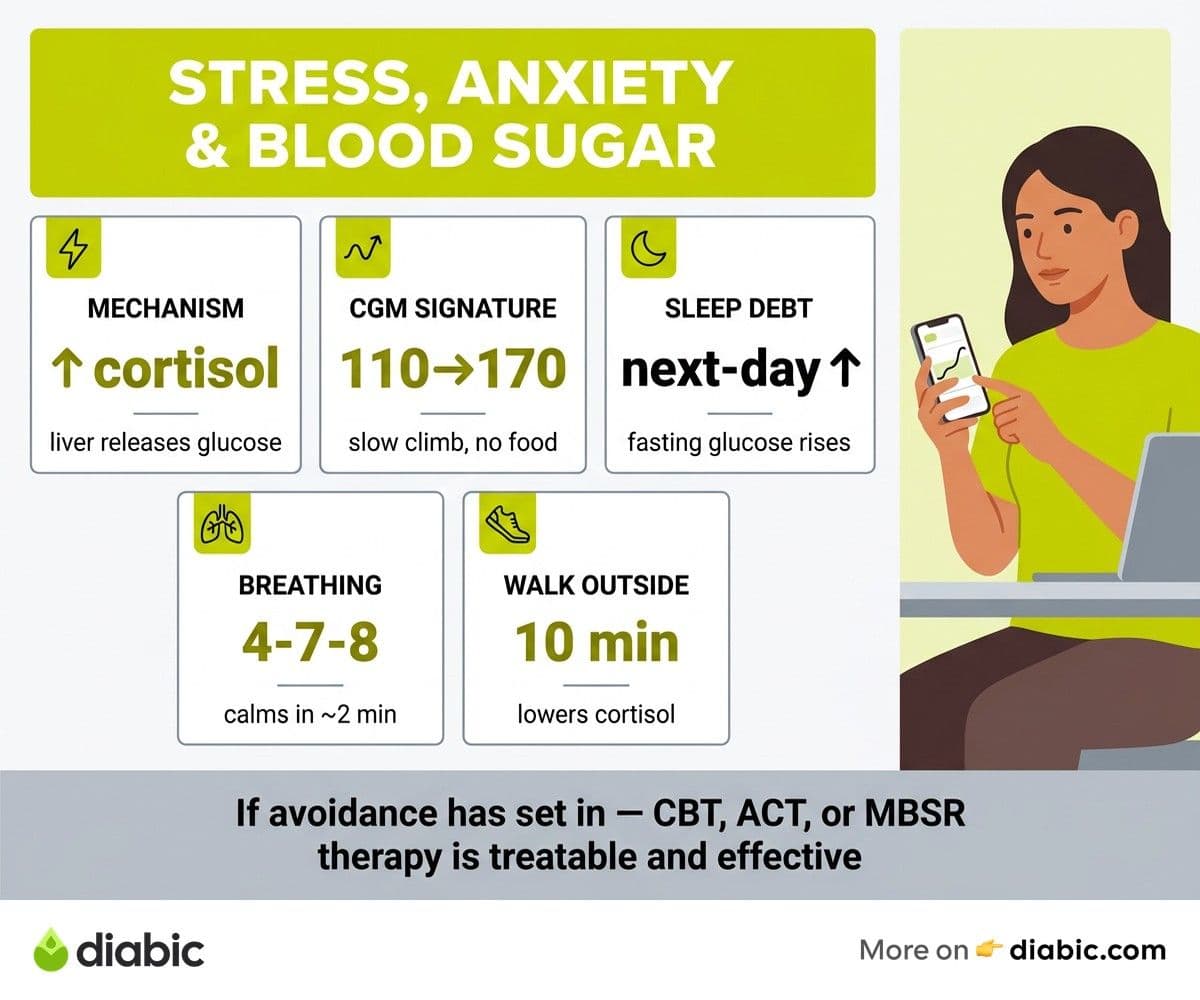
From my experience: The pattern I notice most often on my Dexcom is the slow climb during a high-stakes work call: no food, no insulin change, just my line drifting from 110 to 170 over 40 minutes and settling back down once the call ends. The first time I saw it clearly, around the time I switched to the G6, I stopped blaming a phantom snack and started planning insulin around my calendar instead of just my meals. That reframe has made stress feel like a variable I can work with rather than a mystery that ruins my day.
The Science Behind Stress and Blood Sugar
When your brain registers a threat, real or imagined, it kicks off the fight-or-flight response. Your adrenal glands release cortisol and adrenaline, two hormones whose job is to flood your bloodstream with quick fuel. They tell your liver to convert stored glycogen into glucose and release it for your muscles to use. If you were running from a bear, this would save your life. When the threat is a difficult email, the glucose still shows up, but you are sitting in a chair.
In someone without diabetes, the pancreas matches that glucose surge with extra insulin, and blood sugar stays in range. With diabetes, that automatic correction is missing or delayed, so the glucose lingers. The American Diabetes Association recognizes stress as a direct driver of high blood sugar and includes stress management in its standards of care. Research published in Diabetes Care has tracked how chronic cortisol elevation increases insulin resistance and pushes A1C up over time.
Acute stress and chronic stress hit differently. A single tense afternoon may give you one elevated reading and pass. Weeks of unrelenting pressure, on the other hand, keep cortisol elevated and create a baseline upward drift in your numbers. Many people see this most clearly in their fasting glucose, which can creep higher during stressful seasons even when nothing about food or activity has changed.
It is also worth knowing that not every stressor feels like stress. Excitement, anticipation, a hard workout, or even a heated conversation that ends well can trigger the same hormonal cascade. The body does not distinguish between threats and challenges as cleanly as we do. That is why your numbers might rise before a vacation flight or during a movie that grips you, and why pretending you are not stressed rarely helps your blood sugar.
How Anxiety Specifically Affects Diabetes Management
Anxiety is more than ordinary stress. It is a persistent, future-focused worry that often centers on the very thing you are trying to manage. Health anxiety in diabetes can take the form of fear of complications, fear of hypoglycemia, or dread before every A1C check. That fear itself triggers the cortisol pathway, which then nudges blood sugar up, which then feeds more fear. The loop is exhausting.
Anxiety can also shape behavior in ways that quietly undermine management. Some people start avoiding blood sugar checks because they cannot face another out-of-range number. Others skip doctor appointments after a rough quarter, which is exactly when an appointment would help most. Social anxiety around testing, injecting, or eating in public adds another layer, and the avoidance that follows is rarely about willpower. It is about a nervous system that has learned to associate diabetes tasks with distress.
Sleep is where mental health and blood sugar collide most clearly. Anxiety disrupts sleep onset and quality, and short or fragmented sleep raises fasting glucose and insulin resistance the next day. If your numbers spike on mornings after a restless night, you are not imagining it. That pattern is biology, not a personal failing.
Spotting Diabetes Anxiety and Stress in Your Blood Sugar Data
The good news about glucose data is that it tells the truth. If you keep checking and look for patterns, your meter or continuous glucose monitor can show you when stress is the most likely explanation for an unexpected reading. Look for highs that line up with deadlines, conflict, travel, or difficult conversations. Notice the mornings after poor sleep. Watch for spikes that show up when food and activity logs look completely ordinary.
Continuous glucose monitor data is especially useful here. A CGM trace during a stressful meeting often looks like a slow climb without the sharp peak you would expect from food. Once you have seen that shape on your own graph, you start recognizing it in real time. This is also where emotional eating and diabetes can compound the problem, because cortisol increases cravings for fast carbs at the exact moment your blood sugar is already drifting up.
A simple practice helps make these patterns visible. For two weeks, keep a brief stress journal alongside your blood sugar log. Each evening, rate your stress from one to ten and jot down two or three words about the day. When you compare that to your readings, the correlations often jump out. Bring the log to your next appointment so you and your provider can adjust your plan with stress treated as a real variable, not an afterthought.
Practical Stress Reduction Strategies
You do not need to overhaul your life to lower your stress load. Small, repeatable practices move the needle, and the science is consistent that even short interventions reduce cortisol. The American Psychological Association outlines stress management techniques that are cheap, evidence-based, and easy to fit into a normal day.
Breathing exercises are the fastest tool available. The 4-7-8 technique, in which you inhale for four counts, hold for seven, and exhale for eight, activates the parasympathetic nervous system in about two minutes. Box breathing, with equal counts on the inhale, hold, exhale, and hold, works well for people who find 4-7-8 too long. We have written more about breathing exercises for blood sugar if you want a starter sequence to try this week.
Movement is the second lever. A ten-minute walk outdoors lowers cortisol measurably and also helps your muscles take up glucose, so you get a double benefit. You do not have to run or hit a step target. The act of getting outside, ideally with some daylight on your face, is enough to shift your stress chemistry. Pair it with a short call to a friend or a podcast you like, and it stops feeling like a chore.
The slower-burning strategies matter too. Setting boundaries on overcommitment, building in unstructured time, and protecting sleep all reduce baseline cortisol over weeks. Mindfulness for diabetes is another practice with strong evidence, and even ten minutes a day of guided attention can lower stress reactivity over time. Pick one habit, do it for a month, and let your data tell you whether it is working.
When Stress or Anxiety Needs Professional Help
There is a point at which self-help is not enough, and recognizing that point is a sign of self-awareness, not weakness. If anxiety is interfering with your daily functioning, your relationships, or your ability to manage diabetes, it is time to bring in a professional. The National Institute of Mental Health describes anxiety disorders as highly treatable, and the same is true when anxiety co-occurs with diabetes.
A few signs are worth taking seriously. If you regularly avoid blood sugar checks, doctor visits, or medication because the act itself triggers panic, you need more than breathing exercises. If you feel chronically on edge, struggle to sleep most nights, or notice your world getting smaller because of worry, that pattern deserves real care. Persistent emotional exhaustion can also tip into diabetes burnout, which has its own recovery path.
Therapy options are broader than many people realize. Cognitive behavioral therapy helps you identify and respond to the thoughts that fuel anxiety. Acceptance and commitment therapy is particularly useful for chronic illness, because it focuses on living a meaningful life alongside the parts you cannot change. Mindfulness-based stress reduction has decades of research behind it. Medication may also be the right call, and using it does not mean you have failed at coping. It means you have used a tool that works.
Ask your diabetes care team for a referral, or look for a therapist who lists chronic illness or health psychology as a specialty. Many insurance plans now cover behavioral health visits at parity with medical visits, and telehealth has made access easier. Treating your mental health is part of treating your diabetes. The two are the same system.
FAQ
Can stress and anxiety raise blood sugar levels?
Yes, and the mechanism is well understood. Stress and anxiety trigger your body to release cortisol and adrenaline, which prompt your liver to release stored glucose into the bloodstream. Without diabetes, insulin handles that surge automatically. With diabetes, the glucose stays elevated longer, so stress shows up directly on your meter. Chronic stress also raises insulin resistance over time, which can push A1C higher even when your eating and activity are unchanged.
How does anxiety affect diabetes management?
Anxiety affects diabetes management in two ways. Biologically, it keeps cortisol elevated, which drives blood sugar up and disrupts sleep, both of which make numbers harder to predict. Behaviorally, anxiety often leads to avoidance of the very tasks that help, including checks, appointments, and medication. The combination can create a frustrating cycle in which fear about diabetes makes diabetes harder to manage. Recognizing that loop is the first step out of it. Working with a therapist who understands chronic illness can break the pattern, especially when paired with the everyday tools that calm your nervous system. Diabetes anxiety and stress respond to care, and treating them is part of treating the condition itself.
Shahriar P. Shuvo is the founder of Diabic. He has lived with diabetes for over 14 years, and built Diabic to deliver the practical, evidence-based self-management tools he wished existed when he was first diagnosed. By trade, Shahriar is a senior design and frontend engineer with 6+ years shipping products at Agora, Timescale (now Tiger Data), and ShareTrip. He writes from the intersection of lived diabetes experience and product craft, focused on what works in daily management rather than what sounds good in a textbook.
Medically reviewed by
Dr. Shanto Arian is an internal medicine physician now specializing in clinical and aesthetic dermatology, with a parallel academic focus on epidemiology and public health. He holds an MBBS, MPH, MSc (UK), MRCP (UK), MRCPI (Ireland), Diploma in Dermatology (UK), and Diploma in Aesthetic Medicine (USA). Dr. Arian trained in internal medicine, including hospital work on hematology cases such as graft-versus-host disease, before moving toward dermatology. Skin is one of the earliest places diabetes shows itself, from acanthosis nigricans and diabetic dermopathy to slow foot wound healing, and that intersection is where his clinical and Diabic-review work meet. On Diabic, Dr. Arian medically reviews content on diabetes diagnosis, complications, dermatologic manifestations, and pharmacotherapy, ensuring every claim aligns with current ADA, NICE, and peer-reviewed literature.
More from Living with Diabetes
View all
A Gentle Chair Yoga Routine for people with diabetes
A gentle chair yoga for people with diabetes routine with safe poses, modifications for neuropathy, retinopathy, and joint pain, plus tips for older.

Shift Work and Diabetes: Managing Irregular Hours
Shift work and diabetes is a tough combination. Learn how to manage meals, sleep, medication, and blood sugar when your hours rotate or flip overnight.

Dating with Diabetes: When to Tell a New Partner
Dating with diabetes brings unique disclosure questions. Here is when to tell a new partner, what to say, and how to handle the conversation with.
Clinician-reviewed habits, plain-language guides, and honest answers - the small shifts that make living with diabetes feel lighter, every day.