Napping and Blood Sugar: What the Research Actually Says
Napping and blood sugar have a complicated relationship. Short naps may help, long naps may raise type 2 diabetes risk. Here is what research shows.

In this article(11)
If you live with diabetes and reach for a midday nap, you have probably wondered whether that habit is helping you or quietly working against you. The science on napping and blood sugar is more nuanced than most articles suggest, and the answer depends on how long you sleep, what time you sleep, and why you feel tired in the first place. We pulled together what the peer-reviewed research says so you can make a more informed choice about your afternoon rest.
Fatigue is one of the most common complaints among people managing diabetes, and naps are the default response. Yet the data on whether naps protect or harm metabolic health are genuinely mixed, with some studies finding short naps neutral or beneficial and others linking longer naps to a meaningfully higher risk of type 2 diabetes. Understanding the difference can help you build a routine that supports both your energy levels and your glucose patterns.
From my experience: As a type 1 with a Dexcom G7 on my arm, I have run this exact experiment on myself enough times to trust the pattern. A 20-minute nap on my couch around 1 PM leaves my CGM trace nearly flat and I wake up feeling sharper. A 90-minute "I will just close my eyes" nap that creeps into late afternoon almost always shows me a 30 to 50 mg/dL rise on waking and a wrecked bedtime an hour later. The clearest moment was around 2023 when I started setting a strict 25-minute timer and stopped pretending the longer naps were helping.
What the Research Says About Napping and Blood Sugar
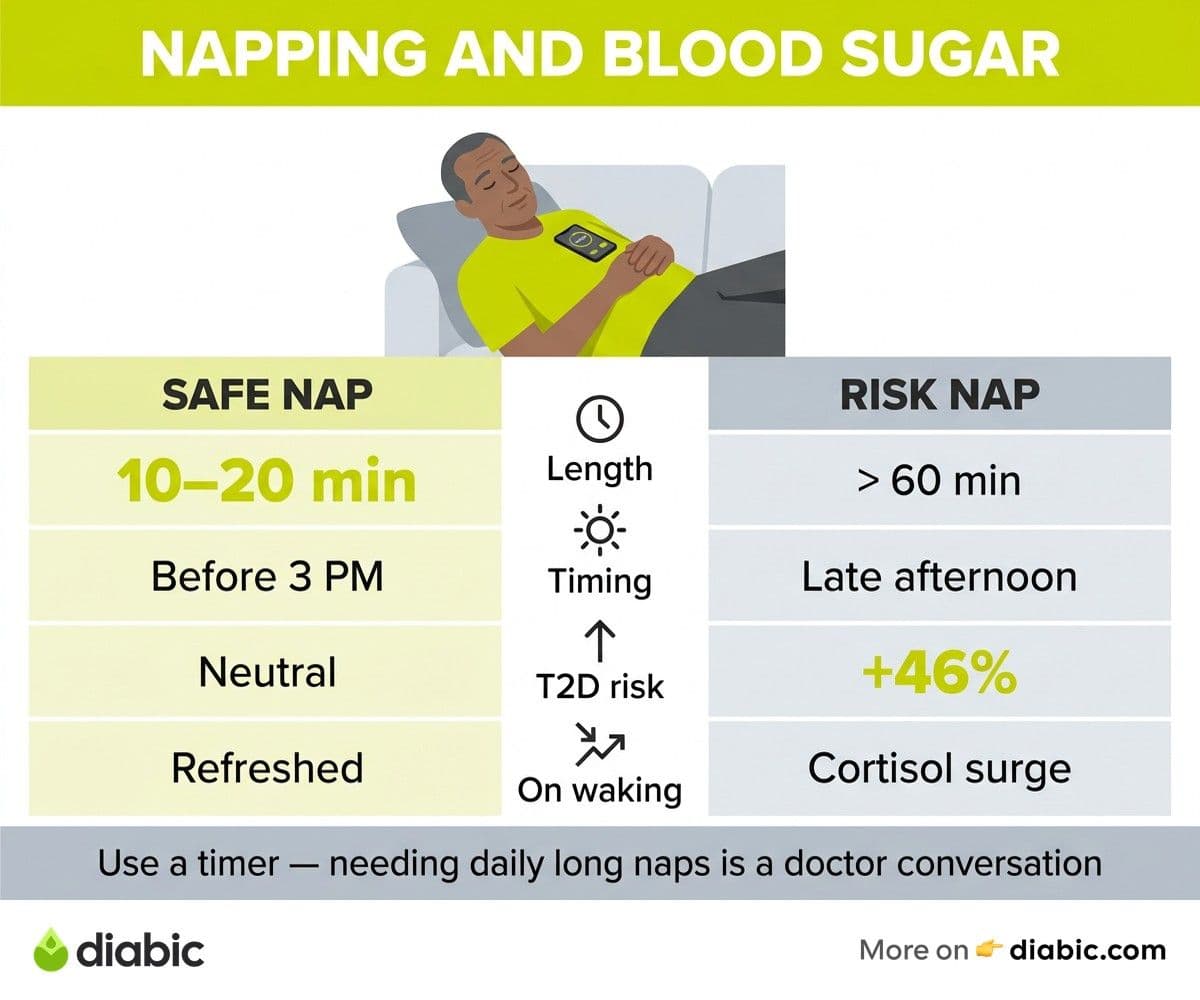
The phrase "napping and blood sugar" tends to bring up scary headlines, but the underlying evidence is more measured than the news suggests. A widely cited meta-analysis published in Sleep Medicine pooled data from over 250,000 adults and found that habitually napping more than 60 minutes per day was associated with roughly a 46 percent higher risk of type 2 diabetes. The same analysis suggested that naps under 30 minutes carried no significant added risk and may have been slightly protective in some subgroups.
Researchers writing in the American Diabetes Association's journal Diabetes Care have echoed this pattern across multiple cohorts. The relationship appears to follow a J-shaped curve, where very short naps and no naps look similar metabolically, while long naps stand out as a marker of higher risk. Whether the long naps cause the risk or simply reflect an underlying problem like sleep apnea, depression, or poor nighttime sleep is still debated.
Large-scale work from the UK Biobank, which tracked hundreds of thousands of participants, has also found associations between long daytime napping and a higher likelihood of metabolic issues including obesity, hypertension, and elevated fasting glucose. Researchers at the National Heart, Lung, and Blood Institute have noted that these findings do not prove that naps cause diabetes, but they do suggest that an unusual need for long naps deserves a closer look. The takeaway is that napping is neither a villain nor a hero on its own, and context shapes the effect.
Why Long Naps May Hurt Blood Sugar
Long naps tend to push you into deep sleep, also known as slow-wave sleep, and waking from that stage is what produces the heavy, foggy feeling called sleep inertia. That groggy state is not just unpleasant. It is accompanied by hormonal shifts that can complicate the sleep and blood sugar connection, including a temporary spike in cortisol and a blunted insulin response in the hour or two after waking.
Cortisol is one of the body's main counter-regulatory hormones, which means it pushes glucose up to give your brain and muscles fast fuel. Studies in the Journal of Clinical Endocrinology and Metabolism have shown that abrupt awakenings from deep sleep can produce measurable cortisol surges, and for someone with insulin resistance or type 2 diabetes, that surge translates into a higher reading on the meter. If you have ever finished a long nap and seen your numbers climb without eating anything, this is one likely explanation.
There is also a sleep architecture problem. Long afternoon naps eat into your sleep pressure, which is the biological drive that helps you fall asleep at night. When that pressure drops, you may struggle to fall asleep, sleep more lightly, or wake more often, and poor nighttime sleep is itself a strong driver of insulin resistance and morning hyperglycemia. In effect, a long nap can borrow energy from today and pay it back with worse sleep tonight and harder-to-manage glucose tomorrow.
A separate concern is what long naps may be hiding. Persistent daytime sleepiness is a common symptom of obstructive sleep apnea, which is far more prevalent in people with type 2 diabetes than in the general population. If naps are masking apnea, depression, or anemia, the rest itself is a coping tool rather than a cure, and the underlying condition keeps shaping your blood sugar in the background.
When Napping Can Actually Help
Napping is not inherently harmful, and short, well-timed rest can be genuinely useful for someone managing diabetes. After a rough night, a 10 to 20 minute nap can restore alertness, improve mood, and reduce the kind of stress that itself raises glucose. The Sleep Foundation describes this brief rest as a "power nap" and notes that it generally avoids deep sleep, which is exactly what protects you from the cortisol surge described above.
Power naps can also be a healthier response to a 3 PM energy crash than the usual workaround. Many people reach for a sugary snack or a second coffee in the afternoon, both of which can disrupt your glucose curve and your evening sleep. A short rest, ideally before 3 PM, can address the fatigue more directly without the metabolic side effects, and it pairs well with broader diabetes fatigue management habits like steady meals, hydration, and a brief afternoon walk.
For people working irregular schedules, naps may be more than a luxury. Research summarized by the American Academy of Sleep Medicine suggests that strategic napping can reduce errors and improve cognitive performance during night shifts, and the same logic applies to anyone navigating shift work and diabetes. A planned nap before a long shift can help your nervous system stay calmer, which in turn reduces the stress-driven glucose swings that often accompany sleep deprivation.
If you wear a continuous glucose monitor, you have a useful built-in test for whether your naps help or hurt. When your trace stays flat or trends gently during a short nap and your post-nap reading is stable, that is reassuring evidence that the rest is working with your body rather than against it. When you consistently see a sharp rise after waking, especially from longer naps, that is your cue to shorten the rest, move it earlier in the day, or talk with your care team about what else might be going on.
Practical Napping Guidelines for People with Diabetes
The practical rules for napping with diabetes are simple, even though the underlying biology is layered. The goal is to get the alertness benefit of brief rest without triggering the cortisol response, the sleep-inertia fog, or the disrupted nighttime sleep that come with longer naps. We find that a few clear guardrails make this much easier in real life.
- Keep most naps to 10 to 20 minutes, and use a timer so you do not drift into deep sleep.
- Aim to nap before 3 PM so your nighttime sleep pressure stays intact.
- Set up the room to make falling asleep easy, with a cool temperature, low light, and minimal noise.
- If you take insulin or sulfonylureas, check your blood sugar before lying down so a nap does not mask a low.
- Track how you feel and how your numbers move for a few weeks to learn your personal pattern.
If you find that you need a long nap nearly every day to function, treat that as data rather than a personal failing. Persistent daytime fatigue can point to sleep apnea and diabetes, thyroid issues, anemia, depression, medication side effects, or poorly managed glucose, and each of those has a different solution. Talk to your doctor about persistent daytime fatigue rather than relying on longer and longer naps to compensate, because the underlying cause usually responds well to treatment when it is identified.
It also helps to think of napping as one piece of a larger sleep routine rather than a standalone fix. Consistent bedtimes, morning light exposure, regular movement, and a wind-down ritual that does not involve scrolling all do more for tiredness and diabetes than a midday nap ever can. When the foundation is solid, naps become an occasional tool you reach for during stressful weeks rather than a daily survival mechanism.
How Nap Timing Interacts With Glucose Patterns
Timing matters because your circadian rhythm shapes how your body handles glucose at different points in the day. Insulin sensitivity is generally highest in the morning and declines into the evening, which is one reason late dinners and late naps tend to produce bigger glucose responses than the same activities earlier in the day. A short nap that lines up with the natural early-afternoon dip in alertness, roughly between 1 PM and 3 PM, tends to feel more refreshing and interferes less with nighttime sleep.
Napping too late in the day can flatten that circadian signal and make it harder for your body to enter deep sleep at night, which is the stage most strongly tied to overnight glucose stability. People who nap after 4 or 5 PM often report waking earlier, sleeping more lightly, and seeing higher fasting numbers the next day. Lying down right after a large or carb-heavy meal can also slow gastric emptying and reshape your post-meal glucose curve, so a short walk before resting often makes the nap feel more restorative.
FAQ
Does napping affect blood sugar levels?
Yes, napping can affect blood sugar, but the direction depends on the nap. Short naps under 30 minutes generally have little effect on glucose and may even reduce stress-related rises in some people. Long naps, especially those that pull you into deep sleep, are more likely to trigger a cortisol-driven rise on waking and to disrupt nighttime sleep, which can show up as higher fasting numbers the next morning.
Is it good or bad to nap with diabetes?
Napping with diabetes is not automatically good or bad. A brief power nap of 10 to 20 minutes, taken before mid-afternoon, is generally considered safe and can help with the kind of fatigue that comes from a poor night's sleep or a demanding day. Long, frequent naps are more concerning because they have been associated with higher type 2 diabetes risk in large studies and may signal an underlying issue like sleep apnea that deserves medical attention.
How long should a person with diabetes nap?
Most sleep researchers recommend keeping naps to roughly 10 to 20 minutes, which is long enough to feel refreshed without entering deep sleep. If you regularly need much more than that to function, the better step is to talk to your doctor about persistent daytime fatigue rather than to extend the nap.
Why do I feel tired after eating with diabetes?
Post-meal fatigue can come from a sharp glucose rise followed by a drop, dehydration, large carb portions, or insulin resistance making it harder for your cells to access fuel. Pairing carbs with protein and fiber, staying hydrated, and walking after meals often helps more than a long nap.
A Final Word on Napping and Blood Sugar
The honest answer to whether napping helps or harms is that it depends on the nap, the person, and the rest of the sleep picture. Short, intentional naps can be a quiet ally for managing energy, mood, and stress-driven glucose swings, while long daily naps may be a signal that something else needs attention. By treating naps as data and paying attention to how your body and your numbers respond, you can make this small daily decision work in favor of your blood sugar rather than against it. If naps have become a daily necessity, that is worth a conversation with your care team, since there is almost always a treatable reason behind persistent daytime fatigue.
Shahriar P. Shuvo is the founder of Diabic. He has lived with diabetes for over 14 years, and built Diabic to deliver the practical, evidence-based self-management tools he wished existed when he was first diagnosed. By trade, Shahriar is a senior design and frontend engineer with 6+ years shipping products at Agora, Timescale (now Tiger Data), and ShareTrip. He writes from the intersection of lived diabetes experience and product craft, focused on what works in daily management rather than what sounds good in a textbook.
Medically reviewed by
Dr. Shanto Arian is an internal medicine physician now specializing in clinical and aesthetic dermatology, with a parallel academic focus on epidemiology and public health. He holds an MBBS, MPH, MSc (UK), MRCP (UK), MRCPI (Ireland), Diploma in Dermatology (UK), and Diploma in Aesthetic Medicine (USA). Dr. Arian trained in internal medicine, including hospital work on hematology cases such as graft-versus-host disease, before moving toward dermatology. Skin is one of the earliest places diabetes shows itself, from acanthosis nigricans and diabetic dermopathy to slow foot wound healing, and that intersection is where his clinical and Diabic-review work meet. On Diabic, Dr. Arian medically reviews content on diabetes diagnosis, complications, dermatologic manifestations, and pharmacotherapy, ensuring every claim aligns with current ADA, NICE, and peer-reviewed literature.
More from Living with Diabetes
View all
Flying with Diabetes Supplies: TSA Rules Explained
Wondering what can I bring on plane diabetes supplies? Here's exactly what TSA allows, how to pack, and how to breeze through screening.

Retirement Planning with Diabetes: Costs to Know
Retirement planning with diabetes means budgeting for insulin, Medicare gaps, and rising supply costs. Here is a clear framework to prepare your finances.

Marijuana and Diabetes: What Research Actually Says
What research says about marijuana and diabetes, including effects on blood sugar, insulin sensitivity, appetite, and safety considerations to discuss.
Clinician-reviewed habits, plain-language guides, and honest answers - the small shifts that make living with diabetes feel lighter, every day.