Shift Work and Diabetes: Managing Irregular Hours
Shift work and diabetes is a tough combination. Learn how to manage meals, sleep, medication, and blood sugar when your hours rotate or flip overnight.

In this article(15)
Shift work and diabetes is a particularly difficult combination because everything diabetes management relies on, consistent meals, regular sleep, and predictable routines, gets disrupted by rotating or overnight schedules. If your job runs on irregular hours, your diabetes strategy needs to be built for that reality rather than borrowed from a nine-to-five template that does not fit your life.
Nurses, factory workers, first responders, truck drivers, and warehouse employees all face the same problem. The body expects food, rest, and activity to follow a roughly 24-hour rhythm, and shift work asks it to pretend that rhythm does not exist. For someone managing type 1 or type 2 diabetes, the friction shows up directly on the glucose meter, sometimes within a few hours of starting a new schedule. This guide covers what the research says about shift work and diabetes, what tends to go wrong, and what you can adjust at work, in the kitchen, and with your care team. None of it requires a perfect schedule, which is the point.
How Shift Work and Diabetes Affect Each Other
The body runs on a circadian clock that coordinates hormones, digestion, and insulin sensitivity across roughly 24 hours. Shift work asks the body to eat, sleep, and move at times the clock has not prepared for, and the metabolic costs add up quickly. Several large reviews, including a meta-analysis in the International Journal of Environmental Research and Public Health, have linked night and rotating shifts to a higher risk of type 2 diabetes.
The mechanism is not mysterious. Eating during the biological night, when insulin sensitivity naturally drops, produces higher post-meal glucose than the same meal at noon. A study in Diabetes Care on circadian misalignment found that healthy adults showed elevated glucose and insulin responses when their sleep and meal schedules were shifted by 12 hours. For someone already managing diabetes, that shift starts on top of an already imperfect glucose response.
The challenge of staying steady on rotating shifts is partly biological and partly logistical. Your usual playbook for meals, exercise, and dosing was built around the assumption that you wake, eat, and sleep at the same hours each day. Standard diabetes advice often quietly assumes a daytime schedule, which is why shift workers frequently feel that "follow a routine" advice does not apply to them. It does, but the routine has to be defined relative to your shift, not the clock on the wall.
Why Standard Advice Often Falls Short
Most diabetes education materials assume breakfast happens within an hour or two of waking and dinner happens before bed. For someone whose "morning" starts at 6 p.m., those landmarks still exist but happen at unusual clock times. Reframing the day around your shift makes most diabetes guidance translate cleanly. The harder problem is rotation, because cycling between days, evenings, and nights means your body never fully adapts, which is why the American Diabetes Association Standards of Care emphasize individualized planning.
Managing Diabetes at Work on Night Shifts
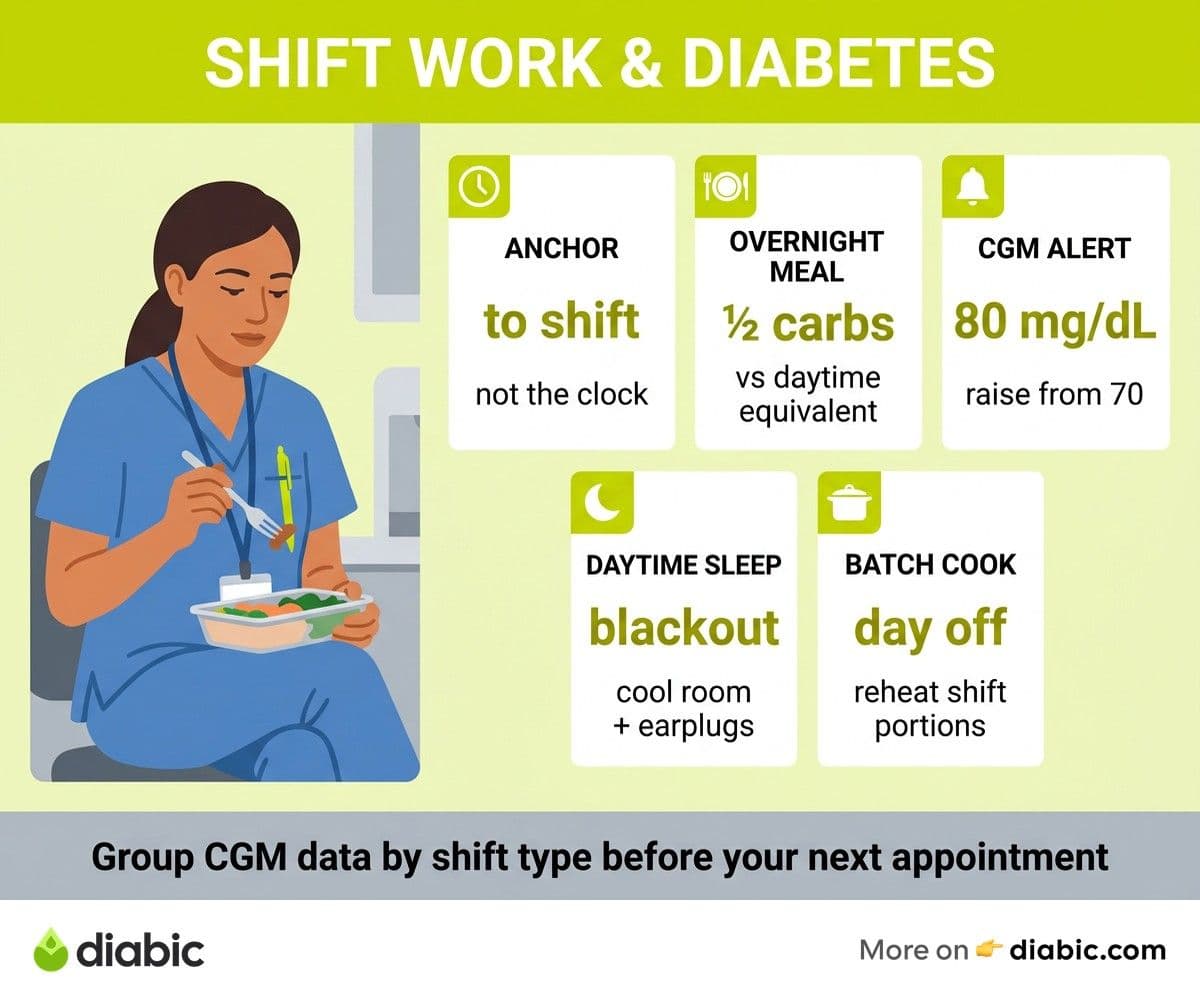
Managing diabetes at work on a night shift starts with food. The simplest framework is to anchor a "main meal" near the start of your shift, a smaller meal partway through, and a light snack near the end. This pattern keeps you fueled without piling carbohydrates into the hours when your insulin sensitivity is at its lowest, typically the small hours of the morning. Heavy meals at 3 a.m. tend to produce the kind of stubborn highs that linger past your shift end.
What you eat overnight matters as much as when. Meals that combine protein, fiber, and a moderate amount of slow carbohydrate tend to behave better at night than carb-heavy comfort food, so a chicken and quinoa bowl with vegetables beats a sandwich and chips. Many shift workers find their overnight meals do best with about half the carb load of their usual daytime equivalent, because the same insulin dose covers fewer carbs effectively at that hour.
Medication timing is the next puzzle. If you take long-acting insulin, oral diabetes medications, or any time-sensitive prescription, the hour you take them matters more than most people realize. Talk to your doctor about whether to anchor your dose to clock time or to your shift, because some basal insulins are forgiving about a few hours of variation and others are not. This is a conversation to have before your next rotation, not during it.
Keeping Supplies Organized for Long Shifts
A 12-hour shift demands a kit that does not run out. We recommend a small zippered bag in your locker or vehicle with your meter or CGM receiver, lancets and strips, fast-acting glucose tabs, an extra insulin pen if you carry one, and a couple of shelf-stable snacks. Restock on the same day each week so you never start a shift discovering you are out of strips, and if you wear a pump or CGM, keep a spare sensor or infusion set inside.
Bringing this same kit-thinking to meetings and longer tasks pays off too. Our guide to blood sugar management during long meetings covers how to plan for stretches when you cannot easily step away, which is a daily reality for many shift workers.
Sleep, Shift Work, and Blood Sugar
The sleep and blood sugar connection is one of the most underrated pieces of diabetes management, and it lands hardest on shift workers. Even one short or fragmented night of sleep measurably reduces insulin sensitivity, and the effect is more pronounced in people with diabetes. The Sleep Foundation and the CDC's NIOSH shift work training both highlight how chronic sleep debt drives metabolic risk over time.
In practical terms, protecting your daytime sleep is not optional after a night shift. Heavy blackout curtains, a cool room, white noise or earplugs, and a no-screens window before bed are the standard tools, and they work. Many shift workers also benefit from a consistent pre-sleep routine that signals "this is night, even though the sun is up."
Shift rotation is harder on sleep than steady night work, and the glucose data tends to reflect that. People who rotate often see wider band swings on their CGM during the days when they are flipping from nights back to days. You may notice your time in range drops on rotation days even when you do not feel especially tired, which is the metabolic cost of the flip showing up on the chart.
Naps, Caffeine, and Glucose
Strategic napping before a night shift is one of the simplest interventions with measurable benefits. A 20 to 90 minute nap in the afternoon can reduce alertness errors and stress hormone spikes overnight, both of which influence blood sugar. Avoid napping inside the four hours before you plan to sleep after the shift, because that tends to fragment your main sleep block.
Caffeine deserves a careful look. A coffee at shift start is unlikely to interfere with sleep eight to ten hours later, but caffeine in the second half of a night shift often does. Stress, dehydration, and caffeine all nudge glucose upward through cortisol and adrenaline pathways, so a fourth cup at 4 a.m. can be doing more than keeping you awake. Our piece on the sleep and blood sugar connection digs into why a missed night shows up on the meter the next day.
Blood Sugar Monitoring During Irregular Hours
A continuous glucose monitor changes the calculus of shift work because it removes the assumption that you have to be awake to know your numbers. For overnight shifts, set alerts that match the realities of your work. Many shift workers raise their low alert threshold slightly, for example to 80 mg/dL instead of 70, so they get a heads-up before a true low hits during a busy run of tasks.
Test or scan more often around shift transitions, not less. The first night of a stretch and the first day off afterward are both periods when patterns change, and capturing data through those windows helps you and your provider see what is happening rather than guessing. A simple log noting shift type, sleep hours, and main meals turns CGM data into a story your care team can read.
Sharing Shift-Work Data With Your Healthcare Team
When you bring data to an appointment, group it by shift type rather than by date. Two weeks of "night shifts" plotted together, two weeks of "day shifts" plotted together, and the rotation days in their own bucket make patterns far easier to see than a continuous timeline. Specific questions get specific answers, so try framing requests like, "On night shifts, my time in range drops about 15 percentage points and most of my time above range happens between 2 a.m. and 5 a.m. What would you adjust first?" That kind of question turns a 15-minute appointment into a working session.
Meal Planning for Shift Workers
Meal planning is where most shift workers either save themselves or sink themselves. The fast-food trap lives at the intersection of "I am tired," "the cafeteria is closed," and "the drive-through is open." Defeating it requires the food to already be in your bag before the shift starts, because decisions made in advance, when you are rested and have access to a kitchen, are almost always better than decisions made at hour ten of a hard shift.
Batch cooking on your day off is the foundation. Cook once, divide into shift-sized portions, and refrigerate or freeze. Sheet-pan proteins, slow-cooker stews, and grain bowls all hold up well for several days and reheat in a microwave. Pair each portion with a separately packed crunchy vegetable or piece of fruit, because monotony drives shift workers to vending machines more than any nutrition gap.
Portability matters as much as nutrition. Insulated lunch bags with a freezer pack keep proteins safe for 8 to 12 hours, and if your work has no fridge, lean on shelf-stable proteins like canned tuna or chicken pouches, jerky, hard cheeses, nut butter packets, and roasted chickpeas. None of these require refrigeration for a single shift and they all play nicely with steady glucose.
Timing Meals to Match Medications
If your medication regimen assumes meals at fixed clock times, your shift schedule may be quietly working against your insulin or pills. Pre-meal insulin doses, in particular, depend on the meal arriving when expected. Pack meals for the times you actually plan to eat them, and consider a phone alarm tied to your shift rather than to clock time so the cue lands consistently. For deeper tactics on the work piece of this puzzle, our overview of practical strategies for managing diabetes at work covers meeting timing, breaks, and disclosure decisions.
Managing Blood Sugar on Night Shifts
Managing blood sugar on night shifts is often a matter of expecting the highs rather than being surprised by them. The same dinner eaten at 7 p.m. and at 2 a.m. produces different numbers in most people, and the 2 a.m. version is usually higher and slower to come down. Knowing that pattern in advance lets you plan around it rather than chase it.
Some endocrinologists adjust basal insulin schedules for shift workers, particularly for people on multiple daily injections rather than pumps. Pumps offer more flexibility because basal rates can be programmed by the hour and shifted with a temporary basal adjustment when needed. Whatever your regimen, bring two weeks of CGM data filtered by shift type and ask specifically how to handle medication on shift days versus off days.
The transition between night shifts and days off is the most volatile period for many people. Your body is trying to flip back to a daytime rhythm, and glucose often runs unstable for 24 to 48 hours. Be patient with yourself during that window, eat lighter meals, and keep monitoring close until your pattern settles.
From my experience: living with type 1 for 14 years has taught me that the schedule you can sustain beats the schedule that looks ideal on paper. When I worked irregular hours on a contract project, I stopped mimicking my usual day routine on shifted hours and instead built a "shift day" plan with my endo. Same meals, same dose timing, but anchored to my shift start rather than the clock, and that single reframe cut my overnight highs in half within two weeks.
FAQ
How does shift work affect diabetes?
Shift work disrupts circadian rhythms, which directly affects insulin sensitivity and blood sugar regulation. Eating during your biological night produces higher glucose responses than the same meal during the day, and irregular sleep adds another layer of metabolic stress. Research summarized by the ADA links night and rotating shift work to a higher risk of type 2 diabetes, and people who already have diabetes tend to see more variable glucose patterns when their schedules rotate.
How can you manage blood sugar on night shifts?
Anchor your meals and medications to your shift rather than the clock, so a "breakfast" and "dinner" exist relative to when you wake up to work. Use a CGM with alerts tuned for overnight hours, prep meals in advance to avoid vending machines and fast food, protect your daytime sleep with blackout curtains, and work with your doctor to adjust medication timing for your shift pattern. Expect the transition days between night shifts and days off to be the hardest, and plan for them.
Are shift workers at higher risk for type 2 diabetes?
Yes. Multiple large studies have found that long-term night and rotating shift work is associated with an increased risk of type 2 diabetes, with the risk rising as the years on shift work go up. The likely drivers are circadian disruption, sleep loss, and irregular eating patterns. Targeted habits around meal timing, sleep protection, and movement can meaningfully reduce that risk, and the same habits help people who already have diabetes manage shift work better.
Shift work and diabetes will never be a perfect match, but they can absolutely coexist with a plan built for your real schedule. Bring your shift pattern, two weeks of glucose data, and a few specific questions to your next appointment, and talk to your doctor about adjusting medication timing if your numbers have been drifting on certain shifts. Small, repeatable habits beat heroic effort every time, especially on irregular hours.
Shahriar P. Shuvo is the founder of Diabic. He has lived with diabetes for over 14 years, and built Diabic to deliver the practical, evidence-based self-management tools he wished existed when he was first diagnosed. By trade, Shahriar is a senior design and frontend engineer with 6+ years shipping products at Agora, Timescale (now Tiger Data), and ShareTrip. He writes from the intersection of lived diabetes experience and product craft, focused on what works in daily management rather than what sounds good in a textbook.
Medically reviewed by
Dr. Rezwana Parvin Rumpa is an obstetrics and gynaecology specialist with clinical focus on gestational diabetes, PCOS, and fertility. She holds the MRCOG (Final Part) from the Royal College of Obstetricians and Gynaecologists in London, the MRCPI (Final Part) from the Royal College of Physicians of Ireland, and an MBBS from Shaheed Monsur Ali Medical College under Dhaka University. Dr. Rumpa serves as a Senior Medical Officer in the Obs and Gynae department at BRB Hospitals Ltd, where she has spent three years managing prenatal care, emergency obstetric cases, and women's-health surgery. On Diabic, she medically reviews content for women living with diabetes, with particular attention to pregnancy, PCOS, and reproductive-health intersections.
More from Living with Diabetes
View all
A Gentle Chair Yoga Routine for people with diabetes
A gentle chair yoga for people with diabetes routine with safe poses, modifications for neuropathy, retinopathy, and joint pain, plus tips for older.

Dating with Diabetes: When to Tell a New Partner
Dating with diabetes brings unique disclosure questions. Here is when to tell a new partner, what to say, and how to handle the conversation with.

Travel Insurance for people with diabetes: What's Covered
Travel insurance for people with diabetes often excludes pre-existing conditions. Learn what to look for, how to compare policies, and how to file a claim.
Clinician-reviewed habits, plain-language guides, and honest answers - the small shifts that make living with diabetes feel lighter, every day.