Diabetes Fatigue Management Tips That Actually Work
Practical diabetes fatigue management tips for energy budgeting, fueling, movement, sleep hygiene, and knowing when to call your doctor.

In this article(11)
- Why Diabetes Drains Your Energy in the First Place
- Energy Budgeting: The Single Most Underrated Tactic
- Fueling for Steady Energy, Not Just Numbers
- Movement and Pacing: Less Than You Think, More Often Than You Do
- Sleep Hygiene Basics That Actually Move the Needle
- Managing the Mental Load Without Quitting Your Life
- When Diabetes Fatigue Management Tips Are Not Enough: Talk to Your Doctor
You wake up tired, push through the morning on coffee, crash by 2 p.m., and wonder why your body refuses to cooperate even when your numbers look fine. If that pattern sounds familiar, you are not lazy and you are not imagining it. These diabetes fatigue management tips are built around the practical tactics we have seen help most: budgeting your energy, fueling steadily, moving in small doses, and protecting your sleep without overhauling your life in one weekend.
Fatigue is one of the most underestimated parts of living with diabetes, and it rarely has a single cause. We are going to walk through the tactics that move the needle, the order to try them in, and the signals that mean it is time to bring your care team in.
From my experience: Living with type 1 for 14 years, the tiredness was the part nobody warned me about. The 2 p.m. crash used to feel like a character flaw until I lined it up with my CGM trace and saw a sawtooth pattern from a high-carb lunch I was overcorrecting. Once I stopped treating the fatigue as a personal failing and started treating it as a problem with moving parts (the spike, the rebound, the mental load of catching both), I got most of my afternoons back.
Why Diabetes Drains Your Energy in the First Place
Before the tactics, a quick map of what you are actually fighting. Blood sugar swings, even modest ones, force your body to redirect resources and leave you feeling foggy on both sides of the curve. Chronic low-grade inflammation, which is common with both type 1 and type 2, interferes with how your cells produce energy at a basic level. Layered on top is the mental load of constant decisions about food, dosing, activity, and timing, which is real cognitive work that adds up across a day.
Research published in the journal Diabetes Care consistently identifies fatigue as a primary symptom across diabetes types, not just a secondary complaint. Common companions like sleep apnea, thyroid issues, anemia, and depression can also amplify everything, which we cover in the section on when to talk to your doctor. If you want a deeper look at the biology, our companion piece on why diabetes makes you tired breaks down the mechanisms in plain language. The point here is simple: fatigue is rarely about willpower, so the fix rarely is either.
Energy Budgeting: The Single Most Underrated Tactic
Most people with diabetes operate on a deficit by Wednesday because they spend Monday and Tuesday like they have unlimited reserves. Energy budgeting means treating your daily energy the way you treat any other limited resource. You decide what matters most, front-load the hardest tasks into your strongest hours, and build in recovery instead of waiting for your body to demand it.
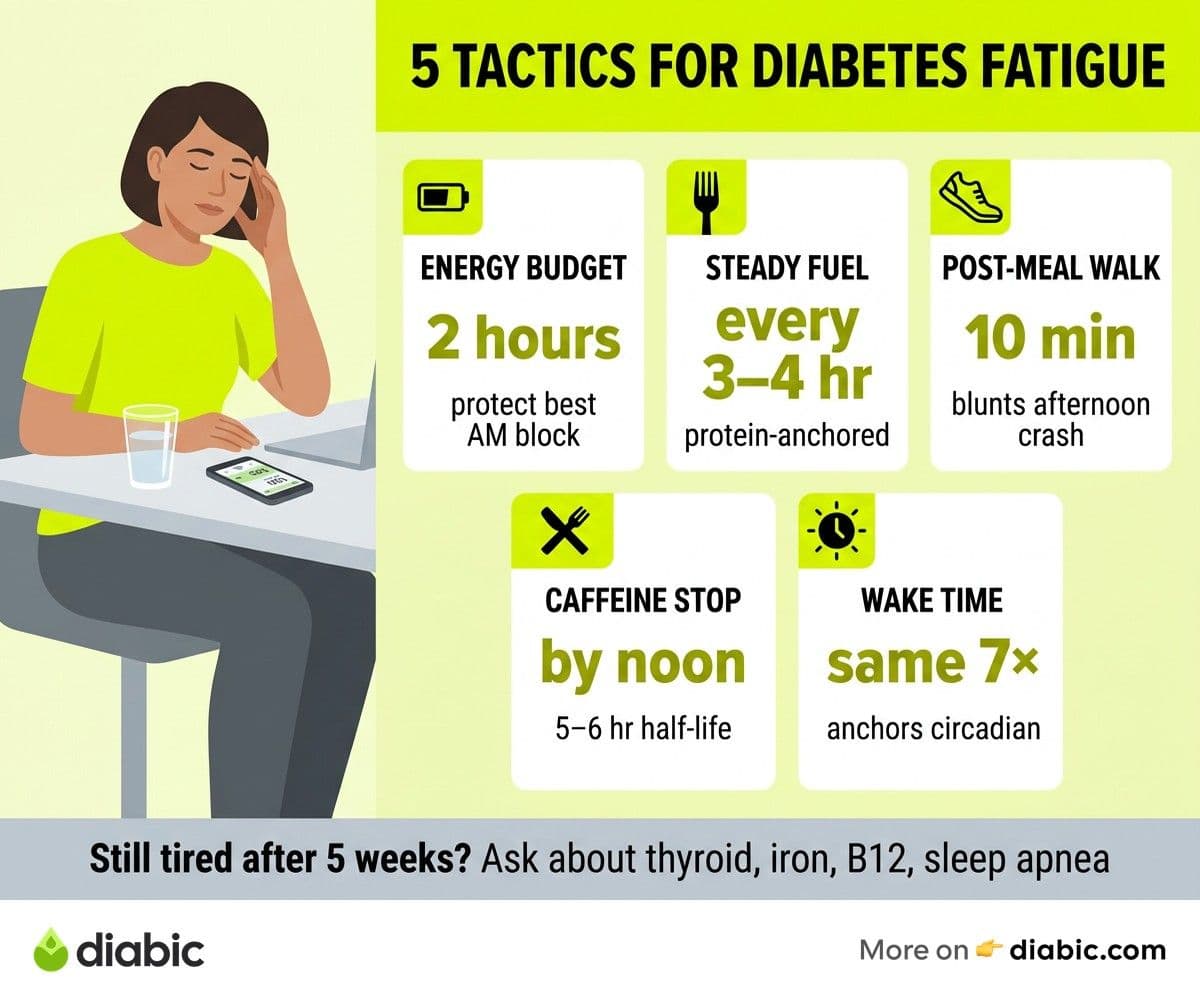
A practical version looks like this. Notice your two best hours of the day, usually mid-morning, and protect them for cognitively heavy work. Schedule errands, harder workouts, or emotionally draining conversations inside that window or right after a balanced meal. Pair every demanding block with a recovery block of ten to twenty minutes, even if recovery just means sitting outside without your phone.
The shift is small but powerful: you stop measuring a good day by how much you crammed in and start measuring it by how steady you felt while doing the things that mattered. People who try this for two weeks usually report fewer late-day crashes even before they change anything else.
Fueling for Steady Energy, Not Just Numbers
Food is the lever that affects fatigue fastest, and it is also where most advice gets too rigid to be useful. The principles that hold up across eating styles are straightforward. Eat something every three to four hours so your blood sugar does not drift too far in either direction. Anchor each meal with protein and fiber, because both slow digestion and blunt the spike-then-crash pattern that wrecks afternoons.
Hydration is the easiest win and the most ignored. Mild dehydration shows up as fatigue long before it shows up as thirst, and people with diabetes lose more fluid through urine when blood sugar runs high. The CDC suggests building water intake into existing routines rather than relying on thirst cues, which become less reliable as we age. Keep a bottle within arm's reach during your strongest hours, and refill it on the way to your next task.
Caffeine deserves its own note. It is fine in the morning for most people, but anything after noon shortens the deep sleep stages your body uses to recover, which feeds the next day's fatigue. If you rely on a 3 p.m. coffee to function, that is useful information about your sleep. Try shifting that cup to 11 a.m. for a week and see what happens to your evening energy.
Movement and Pacing: Less Than You Think, More Often Than You Do
Exercise reduces fatigue, which is one of those facts that feels insulting when you are exhausted on the couch. The catch is that the dose most people picture, a full workout, is not the dose that helps when you are already running low. Short, frequent movement is what breaks the cycle, especially when timed around meals.
A ten-minute walk after eating is the highest impact habit we recommend to almost everyone. It blunts the post-meal blood sugar rise tied to that heavy, want-to-nap feeling an hour later. Build from there toward the American Diabetes Association target of about 150 minutes of moderate activity per week, but treat that as a destination, not an entry fee. Two ten-minute walks already count.
On days when even a walk feels like too much, switch tools instead of skipping movement entirely. Gentle stretching, a few yoga poses, or five minutes of slow stair climbing all interrupt the stuck feeling of being motionless for hours. Our breakdown of yoga vs walking for diabetes digs into when each fits best. The honest rule of thumb: do the smallest version you will actually finish, then stop without guilt.
Sleep Hygiene Basics That Actually Move the Needle
Sleep is where your body does most of its glucose recovery, hormone balancing, and inflammation cleanup. Skip it and every other tactic in this post works at half power. The good news is that the basics are well established and do not require a perfect setup to start helping within a week.
A few habits do most of the work. Keep your wake time consistent, even on weekends, because your circadian rhythm anchors to the morning more than to the night. Get bright light, ideally outdoor light, within the first hour of waking, which sharpens that anchor. Cut screens or at least dim them an hour before bed, and keep your bedroom cool and dark enough that you would describe it as cave-like.
Nighttime blood sugar matters too. Highs disrupt sleep architecture and lows trigger adrenaline that wrecks the rest of the night, so steady evening numbers translate directly to deeper sleep. The Sleep Foundation has straightforward guidance worth reading once. If you snore, gasp, or wake up unrefreshed despite seven plus hours in bed, sleep apnea is worth ruling out.
Managing the Mental Load Without Quitting Your Life
Decision fatigue is the part of diabetes that gets the least credit and burns the most fuel. Every meal, every dose, every glance at your continuous glucose monitor is a small calculation, and your brain treats hundreds of small calculations like real labor. The fix is not to care less. It is to make fewer decisions per day by deciding once and reusing the answer.
Practical versions include rotating between three or four go-to breakfasts you already know how to dose for, prepping two or three lunches on Sunday, and using the same pre-walk routine every time so the activity becomes automatic. Automation tools help, whether that is an automated insulin delivery system, calendar reminders, or a sticky note in the same spot. A consistent daily self-care routine does more for mental energy than almost any single product.
Finally, give yourself permission to delegate or skip non-essential diabetes work some days. If your partner can pack the snack bag for the kids' soccer game, let them. Mental rest is not a luxury inside diabetes management, it is part of how you stay sustainable for the long run.
When Diabetes Fatigue Management Tips Are Not Enough: Talk to Your Doctor
Some fatigue is structural and no amount of self-care will resolve it without medical input. If you have applied these tactics consistently for four to six weeks and your energy is still low, that is signal, not failure. Talk to your doctor about a workup that looks beyond glucose. Common contributors that are easy to test for include thyroid dysfunction, iron deficiency or anemia, low vitamin D, B12 deficiency, and depression, all of which mimic or amplify diabetes-related fatigue.
Sleep apnea deserves a specific mention. The American Academy of Sleep Medicine recommends screening adults with type 2 diabetes for obstructive sleep apnea because the overlap is high and the symptoms are easy to dismiss as just being tired. A home sleep test is usually the first step and is much less involved than people expect. Our deeper post on sleep apnea and diabetes explains how the two conditions feed each other.
Medications matter too. Some diabetes drugs, blood pressure medications, statins, and antidepressants list fatigue as a known side effect, and timing or formulation tweaks sometimes help. A few situations warrant a faster call rather than a routine appointment: sudden, severe fatigue that came on within days, fatigue with chest discomfort or shortness of breath, fatigue alongside a fever or signs of infection, or new confusion. None of those are normal background tiredness, and they are worth a same-day call.
FAQ
How do I manage fatigue from diabetes every day?
Start with the three tactics that compound: eat balanced meals every three to four hours, take a ten-minute walk after at least one meal a day, and protect a consistent wake time so your sleep stabilizes. Add hydration as a default and shift caffeine earlier in the day. Most people feel a meaningful difference inside two weeks, which is usually enough motivation to keep going with the harder pieces like energy budgeting and the mental load fixes.
What are the best daily strategies for diabetes fatigue?
The best daily strategies pair steady fueling with short, frequent movement and protected sleep. In practice that means a protein-anchored breakfast, water within reach, a walk after lunch, a hard stop on caffeine by noon, and the same wake time seven days a week. If you do those five things consistently for a month and still feel exhausted, that is your cue to ask your doctor to screen for thyroid issues, anemia, sleep apnea, and medication side effects.
Will my fatigue go away if my A1C improves?
Better blood sugar stability usually helps, but A1C alone is not the whole picture. You can have a strong A1C and still feel drained if your day is full of swings, your sleep is shallow, or another condition is in play. Use these diabetes fatigue management tips alongside your numbers, not instead of them, and treat persistent tiredness as a separate problem worth its own attention.
Shahriar P. Shuvo is the founder of Diabic. He has lived with diabetes for over 14 years, and built Diabic to deliver the practical, evidence-based self-management tools he wished existed when he was first diagnosed. By trade, Shahriar is a senior design and frontend engineer with 6+ years shipping products at Agora, Timescale (now Tiger Data), and ShareTrip. He writes from the intersection of lived diabetes experience and product craft, focused on what works in daily management rather than what sounds good in a textbook.
Medically reviewed by
Dr. Shanto Arian is an internal medicine physician now specializing in clinical and aesthetic dermatology, with a parallel academic focus on epidemiology and public health. He holds an MBBS, MPH, MSc (UK), MRCP (UK), MRCPI (Ireland), Diploma in Dermatology (UK), and Diploma in Aesthetic Medicine (USA). Dr. Arian trained in internal medicine, including hospital work on hematology cases such as graft-versus-host disease, before moving toward dermatology. Skin is one of the earliest places diabetes shows itself, from acanthosis nigricans and diabetic dermopathy to slow foot wound healing, and that intersection is where his clinical and Diabic-review work meet. On Diabic, Dr. Arian medically reviews content on diabetes diagnosis, complications, dermatologic manifestations, and pharmacotherapy, ensuring every claim aligns with current ADA, NICE, and peer-reviewed literature.
More from Living with Diabetes
View all
A Gentle Chair Yoga Routine for people with diabetes
A gentle chair yoga for people with diabetes routine with safe poses, modifications for neuropathy, retinopathy, and joint pain, plus tips for older.

Shift Work and Diabetes: Managing Irregular Hours
Shift work and diabetes is a tough combination. Learn how to manage meals, sleep, medication, and blood sugar when your hours rotate or flip overnight.

Dating with Diabetes: When to Tell a New Partner
Dating with diabetes brings unique disclosure questions. Here is when to tell a new partner, what to say, and how to handle the conversation with.
Clinician-reviewed habits, plain-language guides, and honest answers - the small shifts that make living with diabetes feel lighter, every day.