Type 2 Diabetes and Sugar Alcohol: Is It Safe
Type 2 diabetes and sugar alcohol explained: which polyols spike blood sugar, safe daily limits, and how to read labels for true carb impact.

In this article(11)
Type 2 diabetes and sugar alcohol is a pairing that shows up in nearly every "sugar-free" product on the shelf, yet most people have no idea how these sweeteners actually affect their blood sugar. The answer is more nuanced than the marketing suggests. Some sugar alcohols barely move the needle. Others spike glucose almost as much as table sugar.
Understanding which is which makes a real difference at the grocery store. So does knowing how much you can eat before the digestive side effects kick in. The label tells you most of what you need, once you know how to read it.
What Are Sugar Alcohols and How Do They Relate to Type 2 Diabetes?
Sugar alcohols (also called polyols) are a class of carbohydrates that taste sweet but are processed by the body differently from regular sugar. The name is misleading. They contain neither sugar in the usual sense nor alcohol of the kind you would drink. The chemistry simply produces a structure that resembles both at the molecular level.
Common sugar alcohols include erythritol, xylitol, sorbitol, maltitol, isomalt, and mannitol. Manufacturers add them to sugar-free candy, protein bars, chewing gum, baked goods, ice cream, and many keto-marketed products. They provide sweetness without the full calorie or glucose load of sucrose, which is why they are heavily marketed to people watching carbs.
The appeal for type 2 diabetes is real. Sugar alcohols deliver sweetness with a smaller blood sugar response than table sugar. They also tend to be lower in calories and do not cause cavities, which is why dentists recommend xylitol gum. The catch is that "smaller response" is not the same as "no response." Most sugar alcohols are partially absorbed, and some raise blood sugar nearly as much as the sugar they replaced. Our piece on the risks and limits of alcohol with type 2 diabetes covers actual ethanol; this article focuses on the polyol family that shares only the name.
How Alcohol Sugars Affect Blood Sugar
Alcohol sugar and diabetes interact through partial absorption. Regular sugar (sucrose, glucose) absorbs nearly 100 percent in the small intestine. Most sugar alcohols absorb partially. The unabsorbed portion travels to the colon, where bacteria ferment it. That fermentation produces gas and can pull water into the bowel, which is why sugar alcohols are notorious for digestive complaints.
The portion that does get absorbed still raises blood sugar. The glycemic index varies widely:
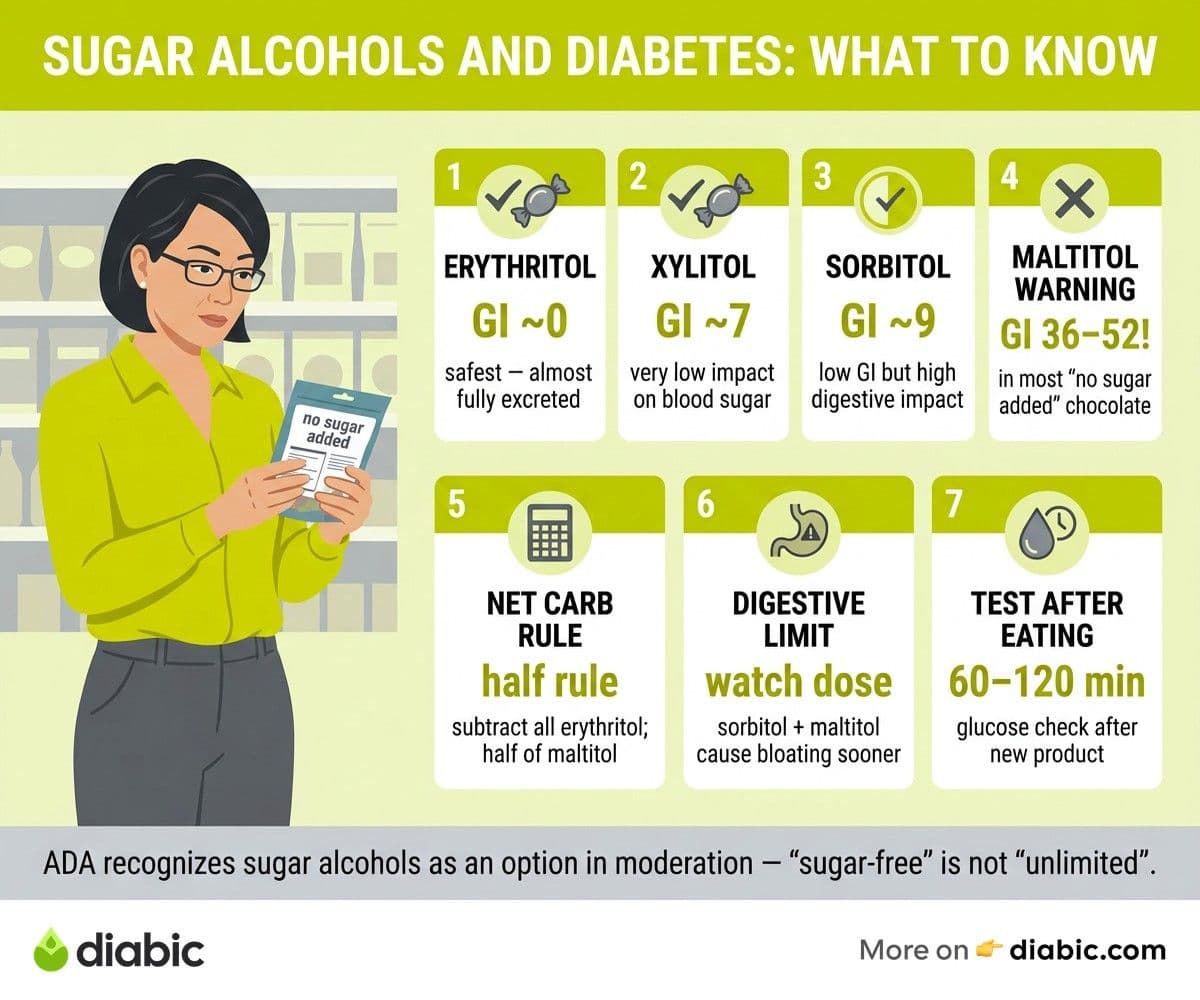
- Erythritol: GI ~0 (almost completely excreted unchanged)
- Xylitol: GI ~7 (very low)
- Mannitol: GI ~0-2 (very low)
- Isomalt: GI ~9 (low)
- Sorbitol: GI ~9 (low, but high digestive impact)
- Maltitol: GI ~36-52 (moderate to high, closer to sugar than to other polyols)
The big surprise on this list is maltitol. Many "no sugar added" chocolates and candies use maltitol because it tastes most like sugar and behaves like sugar in baking. It also raises blood sugar more than other polyols. People who switch to maltitol-sweetened products and assume they have free range often see real glucose spikes.
To calculate net carbs from a label, the FDA allows manufacturers to subtract sugar alcohols from total carbs. The math works like this: total carbs minus fiber minus sugar alcohols equals "net carbs" or "impact carbs." For people with type 2 diabetes who count carbs, the rule of thumb is to subtract the full grams of erythritol but only half the grams of maltitol or sorbitol. Some providers recommend subtracting nothing for maltitol because the response is too close to sugar to ignore. Our broader guide to how different foods affect blood sugar levels covers this kind of label math in more detail.
Individual response varies. The only reliable way to know how a specific product affects you is to test your blood sugar 60 to 120 minutes after eating it.
Type 2 Diabetes and Sugar Alcohol: Safety Profile
The American Diabetes Association recognizes sugar alcohols as one option among non-nutritive and reduced-calorie sweeteners for people with diabetes. Their position is that polyols can fit into a healthy eating pattern in moderate amounts, but should not be treated as freely consumable just because they are not regular sugar.
Sugar alcohol and diabetes 2 management runs into a practical limit before a safety one for most people. The digestive side effects (bloating, gas, abdominal cramps, and at higher doses, diarrhea) are well-documented. The threshold varies by person and by polyol. Sorbitol and maltitol tend to cause symptoms at lower doses than erythritol or xylitol.
Typical daily tolerance limits for adults:
- Sorbitol: about 10 grams before significant symptoms
- Maltitol: about 15-30 grams
- Xylitol: about 30-50 grams (warning: deadly toxic to dogs even in tiny amounts, keep away from pets)
- Erythritol: about 50 grams (best tolerance of the group)
A single regular-size sugar-free candy bar can contain 20-30 grams of sugar alcohol, which puts most people at or over their tolerance threshold. The sugar-free promise often comes with an unpleasant afternoon.
Long-term safety data is reasonable for the most-studied polyols (xylitol, erythritol, sorbitol, maltitol). A 2023 study did raise questions about higher levels of erythritol in blood and cardiovascular risk markers, though causation remains under investigation. Research published in the International Journal of Dentistry has documented xylitol's strong dental benefits, particularly in reducing cavity-causing bacteria. Most providers consider sugar alcohols safe in moderate amounts while watching the emerging research.
Common Sugar Alcohols Compared
Alcohol sugars and diabetes intersect differently depending on which polyol is in the product. Here is the comparison most worth knowing.
If your goal is the smallest blood sugar impact with the lowest digestive risk, erythritol leads the pack. If you want sweetness that bakes most like sugar, maltitol delivers, but with a meaningful blood sugar response and lower tolerance threshold. Xylitol earns a spot for dental health but should never enter homes with dogs (it causes life-threatening hypoglycemia in canines at very small doses).
From my experience: After more than a decade managing diabetes, the most reliable test I run with any new sugar-free product is to eat the recommended serving and check my blood sugar at 90 minutes. Maltitol-heavy products (lots of "no sugar added" chocolates) almost always push my reading higher than the label suggested. Erythritol-based products (most stevia-erythritol blends, monk fruit blends) usually do not move it much. Your body will tell you which is which.
Practical Tips for Reading Labels
Sugar alcohols appear in a few places on a US nutrition label. Look at the carbohydrate breakdown:
- Total Carbohydrate: Includes sugar, fiber, and sugar alcohols
- Sugars: Just the regular sugar component
- Sugar Alcohol: The polyol grams (sometimes broken out by name)
- Added Sugars: Sucrose, fructose, etc., that the manufacturer added
The FDA's labeling rules require sugar alcohol disclosure when products make sugar-related claims (sugar-free, no sugar added). Look at the ingredient list for the specific polyol name (erythritol, maltitol, xylitol, etc.) since the type matters more than the total amount.
Watch for the "sugar-free" trap. A product labeled sugar-free can still contain plenty of refined flour, butter, oil, and yes, sugar alcohols that raise blood sugar. Sugar-free chocolate cake is still mostly cake. The blood sugar impact comes from the whole product, not just the sweetener.
When trying a new sugar-free product, test your blood sugar at 60 to 120 minutes after eating the recommended serving. Compare to your typical post-meal reading. Patterns become clear after two or three trials with the same product.
Better Alternatives to Sugar Alcohol Products
Sugar alcohols are useful, but they are not the only option for managing sweet cravings with type 2 diabetes. Whole-food approaches often work better.
Stevia and monk fruit are zero-glycemic plant-based sweeteners with no significant blood sugar effect and no digestive trouble. Both have been studied for safety and approved for use by the FDA. They tend to taste slightly different from sugar, but blends with erythritol (a common pairing) get closer to sugar's flavor.
Whole foods that satisfy a sweet tooth. Berries with Greek yogurt, an apple with peanut butter, a square of 85 percent dark chocolate, or a small portion of fruit paired with a handful of nuts can scratch the same itch with much less impact on blood sugar than a sugar-free candy bar.
When sugar alcohols make sense: chewing gum (xylitol for dental benefits), occasional sugar-free candy in small amounts, or specific products you have personally tested and tolerated well. Erythritol-based baked goods can be a workable swap if your digestive system handles them.
When to skip them: maltitol-heavy products that raise blood sugar nearly as much as the sugar they replaced; large servings of any polyol that triggers digestive symptoms; products marketed as "free" that you end up eating in large amounts because they seem unrestricted. Our list of foods that will not spike your blood sugar gives more practical alternatives that work without the side effects.
FAQ
Are sugar alcohols safe for type 2 diabetes?
Sugar alcohols are generally safe in moderate amounts for people with type 2 diabetes. They have a lower glycemic impact than regular sugar but are not zero-impact. Digestive side effects (bloating, gas, diarrhea) can occur at higher doses. Erythritol and xylitol tend to be best tolerated; sorbitol and maltitol are most likely to cause symptoms.
Do sugar alcohols raise blood sugar?
Yes, but less than regular sugar. Most sugar alcohols are partially absorbed and raise blood sugar to some degree. Erythritol has the smallest impact (GI near 0); maltitol has the largest (GI 36-52, close to table sugar). Individual responses vary, so test your own blood sugar after trying a new product.
How do I count sugar alcohols in net carbs?
A common rule is to subtract the full grams of erythritol from total carbs but subtract only half the grams of maltitol or sorbitol. Some providers recommend subtracting nothing for maltitol because its blood sugar impact is too close to sugar to ignore. Test your response to specific products to refine your approach.
Which sugar alcohol is best for diabetes?
Erythritol is generally considered the best choice for diabetes due to its near-zero glycemic impact, lowest calorie content, and best digestive tolerance. Stevia and monk fruit (technically not sugar alcohols) are also strong choices when you want a zero-glycemic sweetener.
When you understand the differences between polyols, type 2 diabetes and sugar alcohol can coexist without surprises. Read the label, know which polyol is in the product, and let your blood sugar readings be the final judge of what fits your eating pattern.
Shahriar P. Shuvo is the founder of Diabic. He has lived with diabetes for over 14 years, and built Diabic to deliver the practical, evidence-based self-management tools he wished existed when he was first diagnosed. By trade, Shahriar is a senior design and frontend engineer with 6+ years shipping products at Agora, Timescale (now Tiger Data), and ShareTrip. He writes from the intersection of lived diabetes experience and product craft, focused on what works in daily management rather than what sounds good in a textbook.
Medically reviewed by
Dr. Shanto Arian is an internal medicine physician now specializing in clinical and aesthetic dermatology, with a parallel academic focus on epidemiology and public health. He holds an MBBS, MPH, MSc (UK), MRCP (UK), MRCPI (Ireland), Diploma in Dermatology (UK), and Diploma in Aesthetic Medicine (USA). Dr. Arian trained in internal medicine, including hospital work on hematology cases such as graft-versus-host disease, before moving toward dermatology. Skin is one of the earliest places diabetes shows itself, from acanthosis nigricans and diabetic dermopathy to slow foot wound healing, and that intersection is where his clinical and Diabic-review work meet. On Diabic, Dr. Arian medically reviews content on diabetes diagnosis, complications, dermatologic manifestations, and pharmacotherapy, ensuring every claim aligns with current ADA, NICE, and peer-reviewed literature.
More from Living with Diabetes
View all
Flying with Diabetes Supplies: TSA Rules Explained
Wondering what can I bring on plane diabetes supplies? Here's exactly what TSA allows, how to pack, and how to breeze through screening.

Retirement Planning with Diabetes: Costs to Know
Retirement planning with diabetes means budgeting for insulin, Medicare gaps, and rising supply costs. Here is a clear framework to prepare your finances.

Napping and Blood Sugar: What the Research Actually Says
Napping and blood sugar have a complicated relationship. Short naps may help, long naps may raise type 2 diabetes risk. Here is what research shows.
Clinician-reviewed habits, plain-language guides, and honest answers - the small shifts that make living with diabetes feel lighter, every day.