Online Diabetes Coaching: How to Choose a Good One
Online diabetes coaching can fill the gaps between doctor visits. Learn what credentials to check, red flags to avoid, and how to pick a quality program.

In this article(24)
Online diabetes coaching promises personalized guidance from certified experts without leaving your home. The quality varies wildly, from evidence-based programs staffed by certified diabetes care and education specialists to unqualified influencers selling meal plans on social media. Knowing how to tell the difference is the most important skill before you spend a dollar.
For people who feel like a 15-minute quarterly visit with their endocrinologist barely scratches the surface, coaching can be a real help. A good coach gives you a place to ask the questions that never quite fit into the visit, like how to handle exercise lows or what to do when your morning numbers drift. The catch is that "coach" is not a regulated title. Anyone can call themselves a diabetes coach. That is why the credentials behind the coaching matter more than the marketing.
This guide covers what this kind of coaching actually is, how to spot the red flags, what credentials to look for, and how the major platforms compare in 2026. The framing throughout is that coaching is a complement to your medical team, not a replacement for it.
What Is Online Diabetes Coaching
Online diabetes coaching is structured one-on-one or group support delivered through digital platforms, usually a mix of video calls, secure messaging, and an app. The goal is to help you build sustainable self-management habits between clinical appointments. Coaching focuses on behaviors, education, and motivation, while medical care from your endocrinologist or primary care provider handles diagnosis, prescriptions, and treatment changes.
It is worth being clear about how coaching differs from telemedicine for diabetes. Telemedicine is clinical care delivered remotely, where a licensed provider can prescribe medication, order labs, and adjust your treatment plan. Coaching is education and behavior support; coaches typically cannot prescribe or change your medical orders. A few hybrid programs offer both, with a clinician on the team and a coach as your day-to-day point of contact.
Types of Coaches You Will Encounter
Several different professionals work in this space. Their training varies a lot.
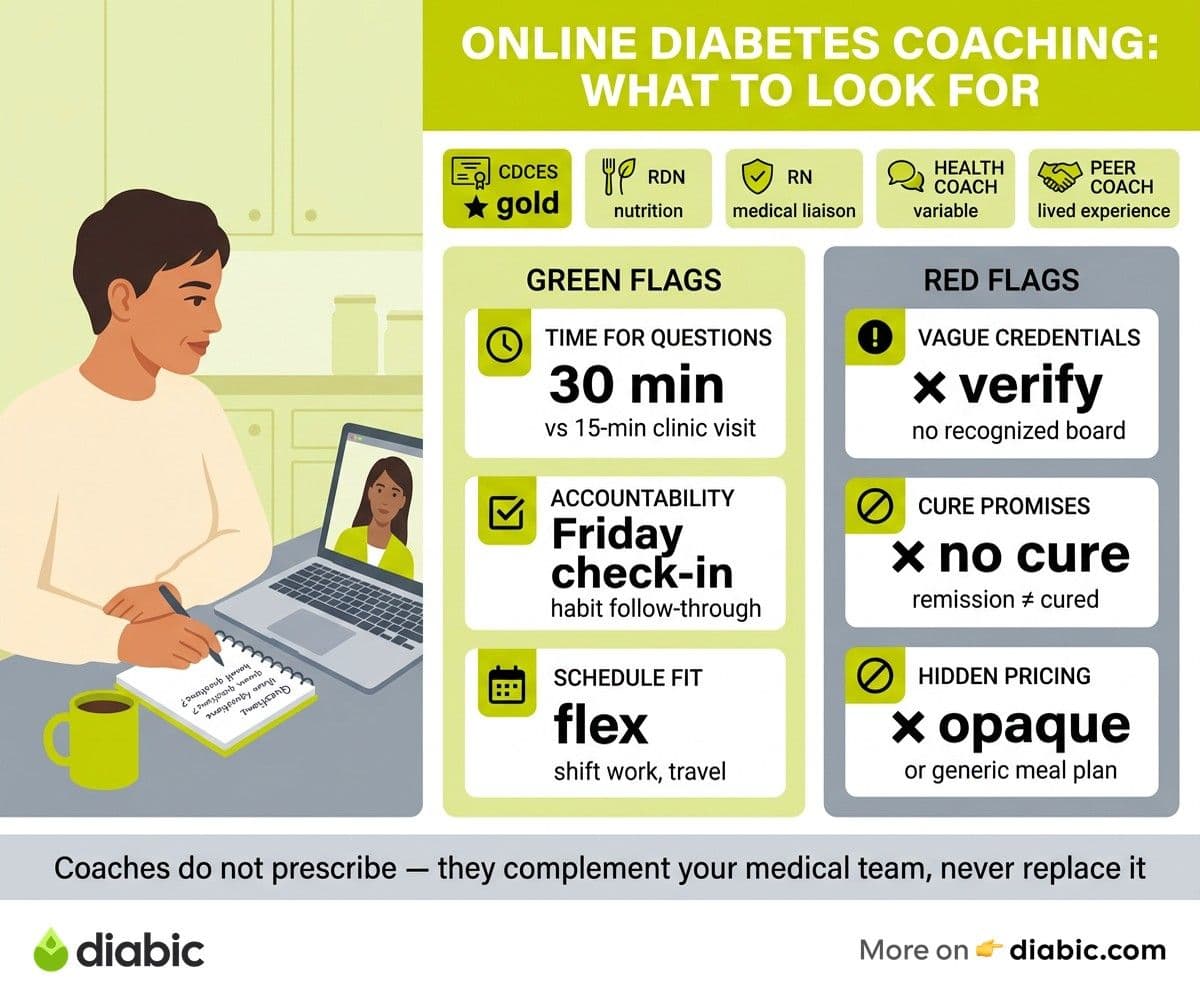
- Certified Diabetes Care and Education Specialists (CDCES) are the gold standard. The credential, awarded by the Certification Board for Diabetes Care and Education, requires a healthcare background (RN, RD, pharmacist, or similar), clinical hours with people with diabetes, and a national exam. The Association of Diabetes Care and Education Specialists maintains a searchable directory of CDCES providers.
- Registered Dietitian Nutritionists (RDN) focus on the nutrition side and are often part of multidisciplinary coaching teams. Many RDNs also hold the CDCES credential.
- Registered Nurses (RN) with diabetes experience work in many programs, often as the medical liaison who connects you to the prescribing clinician.
- Health coaches with general certifications may have completed a coaching program but do not have a healthcare license. Their training varies enormously, from rigorous to "I took a weekend course."
- Peer coaches are people living with diabetes who have completed a peer support training. They offer lived experience but are not clinicians and should not give medical advice.
The format of online coaching also varies. Some platforms run scheduled video sessions every two weeks. Others lean on asynchronous messaging, where you can text your coach anytime and get a response within a day. App-based programs add curriculum, habit tracking, and group classes. The right format depends on whether you want intensive accountability or background support.
For people newly diagnosed, coaching can pair well with reading on your specific type. If you are still sorting out the basics, our type 1 vs type 2 differences guide is a useful starting point.
Benefits of a Quality Coaching Program
The honest answer on coaching is that it works best for people who already have a medical plan and want help executing it. It is less useful as a replacement for clinical care.
Coaching can offer personalized attention that a quick clinical visit cannot. A 30-minute video call with a CDCES gives you time to ask about meal timing, exercise lows, sleep patterns, sick-day rules, and the dozens of other questions that fall through the cracks. Research suggests that diabetes self-management education and support, the formal version of much of what coaches do, may help improve A1C, time in range, and quality of life when delivered consistently.
Accountability is the other big benefit. Knowing that someone will check in on Friday makes it more likely you will actually log meals or wear your CGM consistently this week. The behavior science is straightforward: external accountability changes follow-through. For some people, just knowing a coach will see the data is enough motivation to keep doing the work.
Flexibility matters too. Online coaching fits around shift work, travel, and family schedules in a way that office visits often do not. And for anyone who lives in a rural area or whose local endocrinology wait time runs three to six months, an online program can fill in real gaps. Sharing data with a coach often uses the same workflow as sharing data with your doctor, so you can get value from the same setup.
The benefit ceiling, though, is real. Coaches do not write prescriptions, so they cannot adjust your insulin or oral medications directly. The good ones will encourage you to bring patterns to your endocrinologist and will message your provider on your behalf when needed. Programs that try to act like full clinical care without a clinician on staff are operating in a gray zone.
Red Flags to Watch Out For
This is the most important section. The coaching industry has plenty of well-meaning, well-trained professionals. It also has predators selling expensive programs to people in vulnerable health situations. Watch for these signs.
Coaches Without Recognized Credentials
If a coach's bio is full of "certified" labels you do not recognize, look up each certification. Real credentials trace back to a board with verifiable standards, exam requirements, and continuing education. Look specifically for CDCES, RDN, RN, NP, MD, or comparable licenses. If the coaching certification is from an online school you have never heard of, that is not necessarily disqualifying, but it should not be their only training.
Promises to Reverse or Cure Diabetes
This one is non-negotiable. Type 1 diabetes is an autoimmune condition with no cure. Type 2 diabetes can sometimes go into remission with significant lifestyle changes or weight loss, especially when caught early, but "remission" is not the same as "cured." Any program that promises to reverse, cure, or eliminate your diabetes should be treated with deep skepticism. The American Diabetes Association's Standards of Care reflect the current evidence: lifestyle interventions can be powerful, but they are part of management, not magic.
One-Size-Fits-All Meal Plans
Diabetes nutrition is highly individual. The right plan for a person with type 1 on an insulin pump is not the same as the right plan for a person with type 2 on metformin. If a coaching program sends you the same PDF meal plan as everyone else, you are paying for content that is essentially free elsewhere. Quality coaching customizes guidance based on your type, medications, lab results, food preferences, and goals.
No Transparency on Pricing or Cancellation
Subscription traps are common. Look for clear monthly or annual pricing on the website, a stated cancellation policy, and a refund window. Programs that hide pricing behind a "schedule a call" form often use high-pressure sales tactics. That is not how legitimate healthcare-adjacent services typically operate.
Coaches Who Discourage Medical Care
This is the biggest red flag of all. Any coach who tells you to stop seeing your doctor, skip prescribed medications, or rely on the program instead of your medical team is dangerous. A good coach reinforces the medical plan and helps you communicate with your providers. They never compete with them.
From my experience: Living with type 1 for 14 years, I have tried two coaching programs and watched friends try several more. The single best one I worked with was a small practice where my coach was a CDCES with 20 years of clinical experience. She never told me to change my insulin doses; she helped me see patterns and write better questions for my endocrinologist. The worst experience was a slick app where the "coach" was a wellness influencer with a weekend certificate. The advice was generic, the meal plan was the same one I saw on every fitness site, and the cancellation took three emails. The credential is not a guarantee of quality, but the absence of one is a warning.
What to Look for in a Quality Coaching Program
If you are considering signing up, here is the checklist worth running before you pay.
Credentials and Clinical Backing
The lead coach should hold a recognized clinical credential like CDCES, RDN, RN, or NP. The program should be either run by clinicians or have a clinical advisory board with named, verifiable members. If a medical doctor is on the team, verify that they are licensed in your state for any clinical interactions.
Evidence-Based Approach
Quality programs align their guidance with the ADA's Standards of Care or other recognized clinical guidelines. They should be able to point to peer-reviewed research that supports their methods. Be wary of programs that build their pitch around a single proprietary "method" not used by the broader diabetes care community.
Personalization
Look for programs that ask about your diabetes type, your medications, your A1C history, your lab results, your daily routine, and your goals before recommending anything. The first session should feel like an intake, not a sales pitch. The plan they give you should reference the things you actually told them.
Data Integration
A coach who can review your CGM data, app logs, or food tracker entries can give much better feedback than one working from your description alone. Check whether the program connects to Dexcom Clarity, LibreView, MySugr, or similar platforms. If you already use one of the best diabetes management apps, ask whether the coaching program reads from it.
Clear Pricing and Trial Periods
A reputable program publishes its pricing on the website. A 14- or 30-day trial period or money-back guarantee is a strong signal of confidence. Read the cancellation terms before you enter a credit card. Some programs auto-renew annually with a short cancellation window, which is worth knowing up front.
Communication Style and Availability
Ask how often you will hear from your coach, what response times look like for messages, and whether the same coach stays with you long-term. Continuity matters; switching coaches every month makes it hard to build the trust that good coaching depends on.
Insurance and Cost Coverage
Some programs are covered through employer wellness benefits or insurance plans. Diabetes self-management education and support (DSMES) is a covered benefit under Medicare and many private plans when delivered by an accredited program. Ask whether the coaching program is DSMES-accredited and whether they can bill your insurance. The American Diabetes Association maintains a list of recognized DSMES programs that meet quality standards.
Telehealth Coaching vs In-Person Programs
Online coaching has clear advantages, but in-person coaching still has a place. The trade-offs are worth thinking through.
Telehealth coaching gives you flexibility, a wider choice of coaches (you are not limited to who is local), and lower friction for short check-ins. It works best for people who are comfortable with apps and video calls and who can self-report data accurately. It does less well for hands-on skills like learning to give injections, calibrate a meter, or troubleshoot pump infusion sets, where being in the same room with someone helps a lot.
In-person programs at hospitals or diabetes centers offer the chance to meet a full team in one visit (CDCES, RDN, sometimes a social worker) and to do hands-on training with insulin pens, pump supplies, or blood pressure monitors. The downside is scheduling and travel. For many people, the best setup is a one-time in-person assessment followed by ongoing online coaching.
If you are unsure, ask your endocrinologist for a referral. Many large diabetes centers now offer hybrid models where the first session is in person and the rest are virtual.
Top Coaching Platforms to Compare in 2026
Several established platforms dominate the online coaching space. They are not the only options, but they are useful reference points for what a quality program looks like.
Virta Health is built around a clinician-led, low-carbohydrate approach for people with type 2 diabetes and pre-diabetes. They have published peer-reviewed research on their outcomes and offer telehealth medical care alongside coaching. Pricing is typically covered by employers or health plans rather than paid out of pocket.
Omada Health is a large digital health company with diabetes prevention and diabetes management tracks. The diabetes prevention program is CDC-recognized, which means it follows the structured curriculum tested in major prevention trials. Coaching is included along with a connected scale and a curriculum-driven app. Most users access Omada through their employer or insurance plan.
One Drop combines an AI-powered coaching app with access to certified diabetes coaches over chat. It is one of the more affordable consumer options and works for type 1, type 2, and pre-diabetes. The app also pairs with a Bluetooth glucose meter if you do not use a CGM.
Noom for Diabetes is a behavior-change-focused program with a heavy emphasis on psychology and habit formation. It uses certified coaches but is lighter on the clinical side than Virta or Omada. Best for people whose primary need is around eating habits and weight, with diabetes management as a secondary goal.
A growing number of independent CDCES-led practices also offer online coaching directly to consumers, often at lower cost than the large platforms. The trade-off is fewer features (no curriculum app, no connected devices) in exchange for personal attention. The ADCES directory linked above is the best place to find one.
Making the Choice
Pick the program that matches the gap you are trying to close. If you struggle with motivation between visits, a high-touch coach with weekly calls is a good fit. If you mainly need help with food and habits, a curriculum-driven program may be more useful. If you have type 2 and want a clinician-led approach with possible medication changes, Virta-style hybrid care fits best. If you are not sure where to start, a single appointment with a CDCES through your endocrinology clinic is often the most cost-effective first step. Many insurance plans cover a few hours of DSMES annually, regardless of which program you ultimately choose.
Whichever direction you go, keep your medical team in the loop. A good online diabetes coaching relationship is part of your support system, not a replacement for the people who actually treat your diabetes. Talk to your doctor about the gaps a coach could help you close, and choose a program with credentials that match the work you need.
FAQ
Is online diabetes coaching worth the cost?
It depends on what you need and which program you choose. Quality coaching with a CDCES can meaningfully help with self-management habits, motivation, and the questions that do not fit into a doctor visit. Lower-quality programs that lack credentialed coaches or evidence-based methods are usually not worth the cost. Check whether your insurance or employer covers a DSMES-accredited program before paying out of pocket.
What should you look for in an online diabetes coach?
Look for recognized clinical credentials (CDCES, RDN, RN, NP), an evidence-based approach aligned with ADA guidelines, personalization based on your diabetes type and medications, transparent pricing, and a clear stance that the coach supports rather than replaces your medical team. Avoid any program that promises to reverse or cure diabetes or that discourages you from seeing your doctor.
Does insurance cover diabetes coaching?
Some online diabetes coaching is covered. Diabetes self-management education and support (DSMES) is a covered benefit under Medicare and many private plans when delivered by an accredited program. Employer wellness benefits often cover programs like Virta, Omada, and One Drop. Independent coaching with a CDCES may or may not be covered depending on your plan; ask before signing up.
Shahriar P. Shuvo is the founder of Diabic. He has lived with diabetes for over 14 years, and built Diabic to deliver the practical, evidence-based self-management tools he wished existed when he was first diagnosed. By trade, Shahriar is a senior design and frontend engineer with 6+ years shipping products at Agora, Timescale (now Tiger Data), and ShareTrip. He writes from the intersection of lived diabetes experience and product craft, focused on what works in daily management rather than what sounds good in a textbook.
Medically reviewed by
Dr. Shanto Arian is an internal medicine physician now specializing in clinical and aesthetic dermatology, with a parallel academic focus on epidemiology and public health. He holds an MBBS, MPH, MSc (UK), MRCP (UK), MRCPI (Ireland), Diploma in Dermatology (UK), and Diploma in Aesthetic Medicine (USA). Dr. Arian trained in internal medicine, including hospital work on hematology cases such as graft-versus-host disease, before moving toward dermatology. Skin is one of the earliest places diabetes shows itself, from acanthosis nigricans and diabetic dermopathy to slow foot wound healing, and that intersection is where his clinical and Diabic-review work meet. On Diabic, Dr. Arian medically reviews content on diabetes diagnosis, complications, dermatologic manifestations, and pharmacotherapy, ensuring every claim aligns with current ADA, NICE, and peer-reviewed literature.
More from Devices & Technology
View all
Fasting vs Postprandial Glucose: What's the Difference
Fasting vs postprandial glucose readings tell different stories about your blood sugar. Learn what each number means and how to act on it.

Best Glucometer for Elderly and Low-Vision Users
Best glucometer for elderly and low-vision users: large displays, audio readouts, no-coding strips, and budget picks that make daily testing easier.

Diabetes App Comparison: 5 Tested Picks 2026
A hands-on diabetes app comparison of MyNetDiary, MySugr, Glucose Buddy, Diabetes M, and One Drop, with pros, cons, pricing, integrations, and a feature.
Clinician-reviewed habits, plain-language guides, and honest answers - the small shifts that make living with diabetes feel lighter, every day.