Best Diabetes Management Apps in 2026: Tested and Compared
We tested the best diabetes management apps in 2026 for CGM support, logging, reports, and pricing. See which apps actually deliver for type 1 and type 2.

In this article(14)
The best diabetes management apps in 2026 do far more than log a number once a day. They sync with your CGM, track meals and medications, generate reports your endocrinologist actually reads, and surface patterns you would never spot scrolling through a notes app. We spent six weeks testing the major options on real diabetes data to figure out which ones earn a spot on your home screen.
This is a hands-on review, not a feature-list summary. Every app here was used daily across logging, CGM integration, reports, and the parts of diabetes management that get tedious. Pricing reflects current rates from the App Store, Google Play, and the official sites at the time of writing. Talk to your doctor before relying on any app for dosing decisions.
What Makes a Great Diabetes Management App
A good diabetes app needs to do five things well, and most apps in the space only nail two or three.
The core is glucose logging that actually fits your routine. Manual entry should be quick. CGM and meter sync should happen in the background without forcing you into the app. Meal tracking should accept photos, barcode scans, or quick-add favorites without making you fill out a nutrition form for a piece of toast. Medication reminders should be flexible enough to handle once-weekly GLP-1 shots, daily basal, and bolus on demand without bending the schedule.
The next layer is integration. The app should talk to your CGM (Dexcom G7, FreeStyle Libre 3, Medtronic Guardian, Eversense), your pump if you have one, and ideally your meter. Apple Health and Google Fit support matters because that is where most fitness, sleep, and weight data already lives. Apps that wall-garden their data into proprietary formats are a pain when you eventually switch.
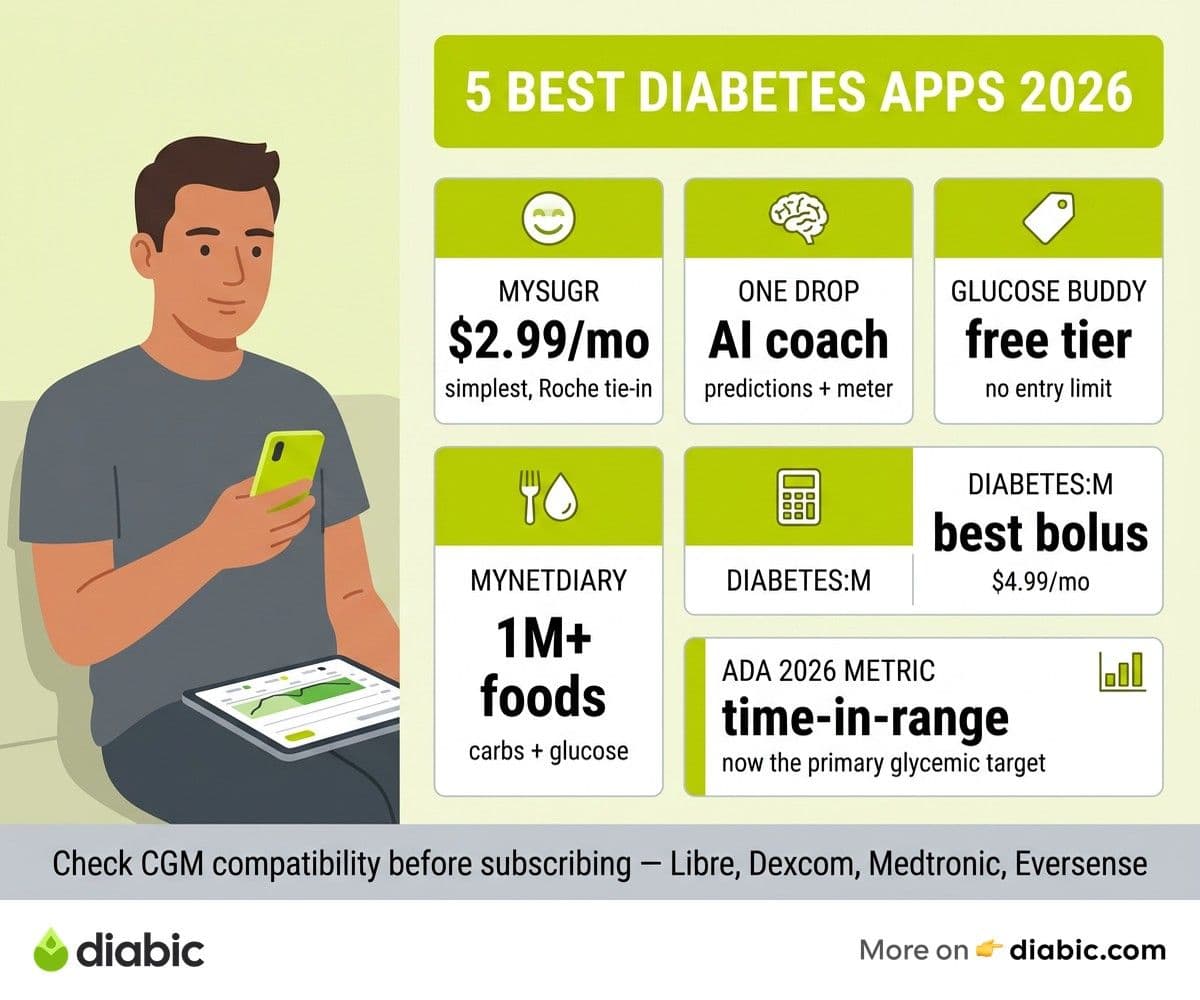
Reports and provider sharing decide whether the app pays off in your appointments. A good report shows time-in-range, glucose variability, average glucose, and meal or medication patterns clearly enough that your endocrinologist can scan it in 30 seconds. Per the ADA Standards of Care 2026, time-in-range is now the primary glycemic metric for most adults with diabetes, so the app's report should put it front and center.
Privacy and pricing close the loop. Your glucose data is HIPAA-sensitive in clinical settings but largely unregulated when it lives inside a wellness app. Read the privacy policy. Look for HIPAA-compliant cloud sharing, opt-in (not opt-out) data analytics, and clear deletion controls. On pricing, the gap between free tiers and premium can be huge, so it pays to test the free tier for a month before subscribing.
For more on how CGMs feed into these apps, see our how to use your CGM app walkthrough.
Best Diabetes Management Apps in 2026 Compared
Here is the diabetes tracking apps comparison at a glance, with the details below.
MySugr
MySugr is owned by Roche, which means deep Accu-Chek meter integration and a long track record. The interface is the friendliest in the category, with a "monster" mascot that gamifies daily logging without feeling childish. Manual logging takes seconds, photo meal entries are quick, and the PDF report is one of the cleanest you can hand a doctor.
CGM sync works directly with FreeStyle Libre and, in the United States, with Dexcom through Apple Health. Bolus calculator is included on the free tier, which is rare. The premium tier ($2.99 a month or $27.99 a year) adds unlimited PDF reports, reminders, and the strip reorder service in the US.
Pros: easy to learn, Accu-Chek pairing is seamless, premium is cheap. Cons: bolus calculator setup is not the most flexible, food database trails MyNetDiary, US Dexcom integration relies on Apple Health rather than direct.
One Drop
One Drop leans hardest into AI predictions and coaching. The forecast feature uses your past data to predict glucose trends a few hours out, and the coaching messages target both type 1 and type 2 routines. The interface is sleek, more like a fitness app than a medical one.
CGM integration is solid for Libre and Dexcom, with direct sync rather than relying on Apple Health. The premium tier ($9.99 a month or $69.99 a year) unlocks AI predictions, unlimited coaching messages, and a Bluetooth meter that ships with the subscription. Without premium, the app is largely a logger.
Pros: best predictive analytics in the category, coaching feels useful rather than canned, included meter is a nice touch. Cons: most features lock behind premium, type 1 users sometimes find the bolus tools simpler than Diabetes:M.
Glucose Buddy
Glucose Buddy wins the free-tier comparison. The free version covers manual glucose, carb, medication, exercise, weight, and blood pressure logging, with reports and Apple Health sync included. There is no daily entry limit and no nag to upgrade.
The Pro tier ($9.99 a month) adds Dexcom CGM streaming, advanced reports, and the AI insights feature. Pump integration is limited compared to Diabetes:M, and the food database is functional but not the largest.
Pros: most generous free tier, no feature gating on logging, simple and reliable. Cons: Pro is pricier than the value it adds, fewer CGM partners than One Drop, design feels older than newer entrants.
MyNetDiary Diabetes
MyNetDiary Diabetes is the pick for anyone whose diabetes management is also a weight or carb-counting project. The food database tops one million items, barcode scanning is fast, and the diabetes-specific layer adds glucose, A1C, insulin, and medication tracking on top of the calorie and macro work.
Premium ($8.33 a month billed annually or $9.99 monthly) unlocks CGM integration with Libre and Dexcom, advanced reports, and the personalized macro targets feature. The free tier is usable for logging but locks the more interesting analytics.
Pros: best food and carb database, weight and glucose in one place, strong reports. Cons: more screens to navigate, some type 1 features feel grafted on, premium pricing adds up over time. For deeper carb tracking discussion see our carb counting apps piece.
Diabetes:M
Diabetes:M is the power-user app, and the bolus calculator is the best in the category. You can set insulin-to-carb ratios that vary by time of day, target glucose ranges, active insulin curves, and correction factors with much more granularity than MySugr or One Drop. The web app version is a nice option for typing-heavy users.
CGM integration on Pro covers Libre, Dexcom, and Medtronic. Pump sync is more limited and depends on your model. Pro is $4.99 a month or $39.99 a year, which is fair for what you get.
Pros: most flexible bolus and ratio settings, web app option, excellent for tightly managed type 1 routines. Cons: interface is denser and steeper to learn, support is community-driven, free tier is more restricted than Glucose Buddy.
Best Diabetes App for Type 2
Type 2 diabetes management usually centers on meals, medications, and gradual A1C movement, so the right app needs to handle carb counting, GLP-1 and oral medication tracking, and trend reporting better than it handles bolus math.
MyNetDiary Diabetes Premium is the strongest type 2 pick. The food database is unmatched, barcode scanning makes meal logs fast, and the combined view of glucose, weight, and macros lines up with how most type 2 routines actually work. The CGM integration with Libre on Premium is useful for the growing number of type 2 users on the FreeStyle Libre 3.
One Drop is the runner-up, mainly because the AI coaching and predictions add real value if you are early in your type 2 journey and looking for a "what should I do next" voice. The included Bluetooth meter is a small but real perk for anyone still using paper logs.
Glucose Buddy is the best free pick for type 2 if your routine is already settled and you mostly need a reliable logger and report generator. The free tier covers nearly everything most users actually need.
From my experience: I have lived with type 1 diabetes for fourteen years and have moved through nearly every app on this list at some point. The one that finally stuck for me was Diabetes:M, mostly because the bolus calculator handles my changing insulin-to-carb ratios across the day better than anything else. For my mother, who has type 2 and hates fiddly settings, MySugr clicked on day one and she still uses it.
Best Diabetes App for Type 1
Type 1 needs are different. Bolus calculations, CGM streaming, basal and bolus log separation, and pump compatibility move to the top of the list. Carb tracking matters but for dosing, not weight loss.
Diabetes:M Pro is the best type 1 pick. The bolus calculator handles time-of-day-varying ratios, active insulin tracking, and target ranges in a way that mirrors what an endocrinologist would set up by hand. CGM integration with Dexcom and Libre is direct, and the reports separate basal from bolus cleanly.
MySugr Pro is the lighter-touch type 1 alternative, and a great fit if you use an Accu-Chek meter or want the simplest possible workflow. The Roche pairing means the meter, app, and PDF reports just work together.
One Drop is a strong choice for type 1 users who want predictive analytics and do not need the deepest bolus settings. The forecast feature is genuinely useful for spotting an overnight low or post-meal spike before it happens.
For type 1 users on a CGM, also see our how to use your CGM app walkthrough for getting the most out of Dexcom or Libre data.
How to Choose the Right Diabetes App for You
Three questions cover most of the decision.
What devices do you already use? If your meter is Accu-Chek or your CGM is Libre, MySugr is the path of least resistance. If you have a Dexcom and want predictive coaching, One Drop and Glucose Buddy Pro are stronger. If you have a pump and want fine bolus control, Diabetes:M is the pick.
What data matters most to you? Carb-and-weight users gravitate to MyNetDiary. Logger purists who want a free, reliable workhorse pick Glucose Buddy. Bolus tinkerers go to Diabetes:M. AI-curious users go to One Drop.
What is your budget? Glucose Buddy free is the best zero-dollar pick. MySugr Pro at $27.99 a year is the cheapest paid tier. Diabetes:M Pro at $39.99 a year is the best dollar-for-dollar paid value if you need the bolus tools. One Drop and MyNetDiary Premium are the most expensive but include features the cheaper tiers do not.
Test the free tier for a month before subscribing. Most diabetes data exports as CSV or PDF, so switching apps later is annoying but not impossible. Check the App Store and Google Play listings for current pricing, ratings, and recent update notes (a stale app on a CGM stack is a real problem). The ADA Standards of Care 2026 emphasizes that digital tools should support, not replace, the relationship with your care team. Pick an app that makes that relationship better.
Frequently Asked Questions
What is the best diabetes management app in 2026?
There is no single best diabetes management app for everyone. For type 1 users on a pump or with custom insulin ratios, Diabetes:M Pro is the strongest pick. For type 2 users focused on meals and weight, MyNetDiary Diabetes Premium leads. For users who want simplicity, MySugr is the easiest to learn. For free, full-featured logging, Glucose Buddy wins. For AI-driven coaching, One Drop stands out.
Which diabetes app is best for type 2?
MyNetDiary Diabetes Premium is the best type 2 pick because it combines the strongest food and carb database with diabetes-specific tracking for glucose, A1C, and medications. One Drop is the runner-up for type 2 users who want AI coaching, and Glucose Buddy is the best free option if your routine is already settled.
Are diabetes management apps free?
Most diabetes management apps offer a free tier, but the free version usually limits CGM integration, advanced reports, or AI features. Glucose Buddy has the most generous free tier, with full logging and basic reports at no cost. MySugr Pro is the cheapest paid tier at $27.99 a year. One Drop and MyNetDiary Premium are the most expensive at roughly $70 to $100 per year. Talk to your doctor about which app's reports they prefer to receive before subscribing to a paid tier.
The short answer to "what are the best diabetes management apps in 2026" is that the right one is the app you will actually open every day. Pick the one that matches your devices, your tracking style, and your budget, then stick with it long enough to see patterns. Six weeks of consistent logging in any app on this list will tell you more about your diabetes than two years of half-tracked data in three different apps.
Shahriar P. Shuvo is the founder of Diabic. He has lived with diabetes for over 14 years, and built Diabic to deliver the practical, evidence-based self-management tools he wished existed when he was first diagnosed. By trade, Shahriar is a senior design and frontend engineer with 6+ years shipping products at Agora, Timescale (now Tiger Data), and ShareTrip. He writes from the intersection of lived diabetes experience and product craft, focused on what works in daily management rather than what sounds good in a textbook.
Medically reviewed by
Dr. Shanto Arian is an internal medicine physician now specializing in clinical and aesthetic dermatology, with a parallel academic focus on epidemiology and public health. He holds an MBBS, MPH, MSc (UK), MRCP (UK), MRCPI (Ireland), Diploma in Dermatology (UK), and Diploma in Aesthetic Medicine (USA). Dr. Arian trained in internal medicine, including hospital work on hematology cases such as graft-versus-host disease, before moving toward dermatology. Skin is one of the earliest places diabetes shows itself, from acanthosis nigricans and diabetic dermopathy to slow foot wound healing, and that intersection is where his clinical and Diabic-review work meet. On Diabic, Dr. Arian medically reviews content on diabetes diagnosis, complications, dermatologic manifestations, and pharmacotherapy, ensuring every claim aligns with current ADA, NICE, and peer-reviewed literature.
More from Devices & Technology
View all
Fasting vs Postprandial Glucose: What's the Difference
Fasting vs postprandial glucose readings tell different stories about your blood sugar. Learn what each number means and how to act on it.

Best Glucometer for Elderly and Low-Vision Users
Best glucometer for elderly and low-vision users: large displays, audio readouts, no-coding strips, and budget picks that make daily testing easier.

Online Diabetes Coaching: How to Choose a Good One
Online diabetes coaching can fill the gaps between doctor visits. Learn what credentials to check, red flags to avoid, and how to pick a quality program.
Clinician-reviewed habits, plain-language guides, and honest answers - the small shifts that make living with diabetes feel lighter, every day.