Telemedicine for Diabetes: Benefits and Limitations
Telemedicine for diabetes can save time and improve access, but it has real limits. Here is what virtual care does well, what it cannot replace, and how.

In this article(31)
Telemedicine for diabetes has gone from a pandemic workaround to a permanent part of how many people manage their care. Endocrinologists who once saw every patient in person now run hybrid practices, certified diabetes educators meet families over video, and dietitians review food logs through screen-shared apps. If you are considering virtual appointments for your own diabetes care, the first question is whether the format will help your management or just shift it to a smaller screen.
This guide is an honest look at what works well, what does not, and how to get the most out of virtual visits. We will cover what telemedicine actually means for diabetes, where it shines, where it falls short, how to prepare, and when in-person care is still the right call.
We will lean on guidance from the American Diabetes Association, the Centers for Medicare and Medicaid Services, and peer-reviewed research so you can decide based on evidence rather than marketing. Diabetes care should fit your life, and for many people, telemedicine is now part of how it does.
What Is Telemedicine for Diabetes?
Telemedicine is the delivery of healthcare services using video, phone, or secure messaging instead of in-person visits. For diabetes specifically, that usually means meeting with an endocrinologist, certified diabetes care and education specialist (CDCES), primary care clinician, or registered dietitian remotely while sharing your glucose data digitally.
The ADA Standards of Care recognize telehealth as an effective option for routine diabetes management, especially when it is integrated with continuous glucose monitor data and clear care plans. The platform varies. Some clinics use full electronic health record portals like MyChart, others use video tools built into the practice website, and some run on standard video apps configured for clinical use.
For most readers, the experience feels close to a normal appointment. You log in at the appointment time, your clinician joins, and you talk through numbers, medications, and questions. The difference is the data flow, which works best when you have prepared in advance.
Who you can see virtually
A surprising range of diabetes care now happens remotely. Endocrinologists handle medication adjustments, insulin titration, and CGM reviews over video. CDCES sessions cover education on devices, technique, and lifestyle. Dietitians work through meal logs and carb counting. Mental health providers, who play an underrated role in diabetes management, are often easier to access virtually than in person.
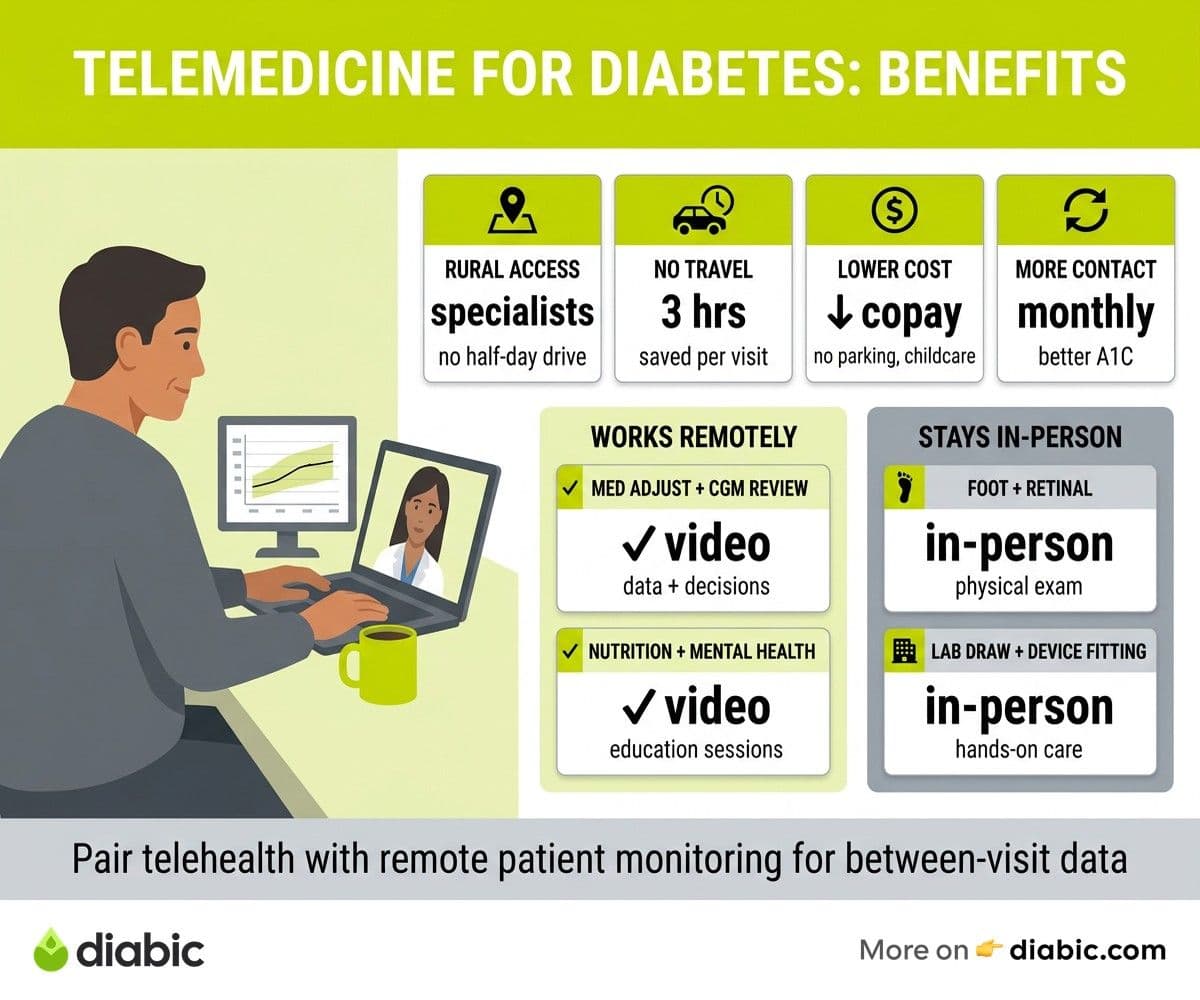
What stays in person is anything physical. Foot exams, injection-site checks, lab draws, retinal screening, and device fittings still require a visit. Most clinics now schedule those alongside annual or semi-annual in-person blocks and run the rest virtually.
How telemedicine platforms work
A typical visit uses a video link sent through a portal or text. You confirm identity, the clinician joins, and you talk for the scheduled time. Many platforms allow screen sharing, which is useful when reviewing a Dexcom Clarity AGP report, a Libre View snapshot, or app exports together.
Messaging-based "asynchronous" telehealth is also common for short questions, prescription refills, or quick adjustments. It does not replace appointments, but it shortens the gap between them and reduces phone tag.
Care that works well remotely
Medication adjustments based on glucose data, CGM and pump reviews, nutrition counseling, mental health support, and education sessions translate well to video. So do follow-ups after a recent in-person exam. The Association of Diabetes Care and Education Specialists publishes telehealth resources that map specific care activities to virtual delivery, and most match what well-run clinics already do.
Care that mostly does not work remotely includes initial diagnosis workups, complications evaluations, device starts that need hands-on training, and any visit where physical examination drives the decision.
Remote patient monitoring
Remote patient monitoring, or RPM, is a related service where your CGM, pump, or app data is shared with your clinic continuously rather than at visits. RPM is increasingly billable to insurance, and many endocrinology clinics now offer it. Pairing RPM with periodic telemedicine visits gives clinicians a clearer picture of what is happening between appointments. For more on the data side, our guide to the best diabetes management apps walks through which tools play nicely with clinical RPM workflows.
Benefits of Telemedicine for Diabetes Care
The benefits show up most for people whose biggest barrier to good diabetes management is access, not motivation. Geography, work schedules, caregiving, and travel all affect how often people make it to appointments. Telemedicine removes some of those barriers entirely.
Easier access for rural and underserved communities
Endocrinologists are concentrated in urban areas, and many rural counties have none. The Health Resources and Services Administration maps health workforce shortage areas, and the picture for specialty care is sobering. Virtual visits open the door to specialists hundreds of miles away without a half-day drive.
For people on insulin, that access can change outcomes. A 2017 review in Diabetes & Metabolism by Tchero et al. found telehealth interventions produced statistically significant A1C reductions for people with type 2 diabetes, with the effect strongest in studies that included regular contact and structured data sharing.
No travel time and lower per-visit cost
Even people who live near a clinic spend an outsized amount of time getting to appointments. A 30-minute visit can take three hours when you account for driving, parking, waiting, and getting back to work. Telemedicine compresses that to the actual appointment plus a few minutes of setup.
Out-of-pocket costs often drop too. No parking fees, no childcare gap, and in many plans the visit copay is the same or lower than an in-person visit. The CMS telehealth coverage guidance outlines what Medicare covers, and most private insurers extended similar policies after 2020.
More frequent check-ins between visits
Quarterly endocrinology visits leave long gaps where things can drift. With telemedicine, your clinic may offer brief 15-minute check-ins between full visits, or asynchronous messaging when you have a question. The cumulative effect is often better than two full visits a year, even if each contact is shorter.
This is also where peer-reviewed research lines up. Studies in JAMA Network Open on diabetes telehealth show stronger A1C improvement when virtual contact happens monthly rather than quarterly.
Real-time data review during visits
Sharing CGM data during a video visit is faster than sending a fax or printing reports. Your clinician opens your AGP and you talk through it together, which turns a number-heavy review into a real conversation. If you have not used standardized reports before, our AGP report walkthrough gives a primer on what each section means.
This matters for type 1 users especially, where pump settings and basal rates change based on patterns rather than single readings. Looking at a 14-day overlay together is far more productive than reciting numbers.
Continuity for travelers and people in transition
People who move, travel for work, or split time across cities often see continuity break down with in-person care. Telemedicine lets you keep the same clinician through life changes that would otherwise force you to start over with someone new.
That continuity also matters during transitions like pregnancy, college, or a new job, when missing a few months of care can have real consequences.
Limitations of Virtual Diabetes Care
Telemedicine is not a full replacement for in-person care, and pretending otherwise sets people up for disappointment. The honest framing is that virtual care handles a meaningful share of diabetes management while in-person visits remain essential for specific tasks.
Physical exams require in-person visits
Diabetes increases the risk of foot complications, neuropathy, and skin issues at injection sites. None of those can be evaluated through a camera. The ADA recommends at least an annual comprehensive foot exam for adults with diabetes, and your clinician needs to physically inspect, test sensation, and check pulses.
Retinal exams for diabetic retinopathy, dental cleanings, and lab draws likewise need physical presence. The good news is that most of these are annual or semi-annual, which is the same cadence many people already keep for in-person specialist visits.
Technology barriers
Reliable internet, a working camera and microphone, and basic comfort with apps are not universal. Older adults, people on rural connections, and households with limited data plans face real friction. Clinics that do telemedicine well offer phone-only options for people who cannot manage video, and some have tech support staff to walk new patients through the first visit.
If you are helping a parent or older relative, expect the first one or two visits to take longer while everyone gets used to the platform. After that, the experience smooths out.
Insurance coverage inconsistencies
Coverage expanded dramatically during the pandemic, but the rules have continued to shift. Medicare, Medicaid, and most private insurers now cover diabetes telemedicine, but specifics like originating site, audio-only allowances, and out-of-state licensing rules vary. Always confirm with your plan before assuming a visit is covered.
State licensure adds another wrinkle. Your clinician usually needs to be licensed in the state where you are physically located during the visit, not where the practice is based. If you travel often, ask in advance.
Relationship-building over video
Building rapport with a new clinician feels different over video. Some people connect easily, others find it harder to read body language or feel comfortable sharing concerns through a screen. If you are establishing care for the first time, an initial in-person visit followed by virtual follow-ups often works better than going fully remote from day one.
For those who do struggle with remote care, our guide on sharing diabetes data remotely offers ways to make virtual contact feel more grounded by leading with concrete data.
How to Prepare for a Telemedicine Diabetes Appointment
Preparation is what separates a useful virtual visit from a frustrating one. The pattern is simple. Share data ahead of time, write down your questions, test your tech, and set up a quiet space.
Share data before the appointment
If you wear a CGM, sync your data the morning of the visit so the latest two weeks are available in your clinic's portal. For Dexcom users, that means Dexcom Clarity with sharing turned on. For Libre users, LibreView with practice access. For pump users, follow your pump manufacturer's portal instructions.
If you log glucose manually, export a PDF or CSV from your app. Most of the apps in our diabetes tracking comparison can email a clinician-ready report in two taps.
Write down your questions
It is surprisingly easy to forget the question you most wanted to ask once a screen lights up. Write three or four questions in a notes app the day before, in priority order. Top-of-list issues get covered even if the visit runs short.
If you have noticed a pattern, like consistent overnight highs or dawn rises, describe what you see and bring up specific dates. The ADCES recommends this kind of structured pattern review for virtual visits.
Have your medications and labs ready
Keep a current medication list with doses and timing, plus your most recent A1C and any other relevant labs. Recent lab results help the clinician see whether trends are short-term or part of a longer arc. If you are not sure where to find them, your clinic's portal usually has the last six to twelve months.
Having the bottles physically next to you helps too. Reading off a label is faster than guessing dosage from memory.
Test your technology
Test your camera, microphone, and internet at least 15 minutes before the appointment. Most platforms offer a "test call" feature. If video fails, fall back to audio. Most clinicians can run an effective visit on phone alone if needed.
If you are using a phone, prop it on a stable surface so the clinician is not seasick from a moving camera. A simple phone stand transforms the experience.
Pick a quiet, private space
Diabetes visits cover personal information, and you want to speak openly. Find a room where you will not be interrupted and where background noise is low. Headphones improve audio for both sides and keep the conversation private.
If kids or pets are unavoidable, give them a snack or a project. Twenty minutes of quiet usually buys you the visit.
Is Telemedicine Right for Your Diabetes Care?
The honest answer depends on where you are in your diabetes management. Telemedicine is excellent for some scenarios and a poor fit for others.
When virtual visits work best
Stable management, routine follow-ups, CGM and data reviews, medication titrations, education sessions, and mental health support all translate well to virtual format. If you have an established relationship with your clinician and your goals are clear, most appointments can be remote without losing quality.
Online diabetes coaching also fits this category. Our guide on choosing online diabetes coaching goes deeper into what to expect from virtual coaching specifically.
When in-person visits are necessary
A new diabetes diagnosis, suspected complications, device starts, foot or skin concerns, and pregnancy all benefit from in-person care, at least at the start. Once those phases pass, you can typically shift to a hybrid schedule.
If you have not had a comprehensive in-person workup in the last 12 months, that is a good reason to schedule one even if you prefer virtual care otherwise.
The hybrid model
The pattern that works for most people I know with diabetes is a hybrid one. One or two in-person visits a year for physical exams, foot checks, lab draws, and any device fittings. Quarterly virtual visits in between. Asynchronous messaging for short questions.
From my experience: I have lived with type 1 diabetes for 14 years, and the year I switched to mostly-virtual endocrinology was the year my appointments became more useful, not less. The reason was simple. I stopped scheduling around traffic and started scheduling around when I had questions worth asking. Pre-sharing CGM data meant we spent the visit on patterns and decisions, not on catching up. The annual in-person check still matters, but the cadence in between is what moves the needle.
FAQ
Is telemedicine effective for diabetes management?
Yes, for routine management. Peer-reviewed studies, including a 2017 Diabetes & Metabolism review and ADA guidance, show telehealth produces meaningful A1C improvement, especially with regular contact and shared device data. Talk to your doctor about whether your current management style fits a virtual format.
How does telemedicine work for diabetes patients?
You log in to a video appointment through a portal, share recent CGM or app data with your clinician, and discuss medications, patterns, and goals. Many platforms allow screen sharing of reports. Asynchronous messaging supports the gaps between full visits.
Does insurance cover telemedicine visits for diabetes?
In most cases yes. Medicare, Medicaid, and most private insurers cover diabetes telehealth, with rules that vary by state and plan. The CMS telehealth page is the best starting point. Always confirm coverage before the visit.
Making your next visit count
Pick the kind of visit that matches what you actually need next. If you are due for a foot exam, schedule in person. If you have a CGM report and a few medication questions, book virtual. The best diabetes care meets you where you are, and for many people, that is now a quiet room with a laptop and two weeks of glucose data ready to share.
If you are looking for the right app to capture that data in the first place, our diabetes tracking apps comparison is a useful next stop. Telemedicine for diabetes care works best when you bring it real data and real questions, and the small habit of preparing fifteen minutes before each visit is what turns a quick screen call into a meaningful conversation with your provider.
Shahriar P. Shuvo is the founder of Diabic. He has lived with diabetes for over 14 years, and built Diabic to deliver the practical, evidence-based self-management tools he wished existed when he was first diagnosed. By trade, Shahriar is a senior design and frontend engineer with 6+ years shipping products at Agora, Timescale (now Tiger Data), and ShareTrip. He writes from the intersection of lived diabetes experience and product craft, focused on what works in daily management rather than what sounds good in a textbook.
Medically reviewed by
Dr. Rezwana Parvin Rumpa is an obstetrics and gynaecology specialist with clinical focus on gestational diabetes, PCOS, and fertility. She holds the MRCOG (Final Part) from the Royal College of Obstetricians and Gynaecologists in London, the MRCPI (Final Part) from the Royal College of Physicians of Ireland, and an MBBS from Shaheed Monsur Ali Medical College under Dhaka University. Dr. Rumpa serves as a Senior Medical Officer in the Obs and Gynae department at BRB Hospitals Ltd, where she has spent three years managing prenatal care, emergency obstetric cases, and women's-health surgery. On Diabic, she medically reviews content for women living with diabetes, with particular attention to pregnancy, PCOS, and reproductive-health intersections.
More from Devices & Technology
View all
Fasting vs Postprandial Glucose: What's the Difference
Fasting vs postprandial glucose readings tell different stories about your blood sugar. Learn what each number means and how to act on it.

Best Glucometer for Elderly and Low-Vision Users
Best glucometer for elderly and low-vision users: large displays, audio readouts, no-coding strips, and budget picks that make daily testing easier.

Online Diabetes Coaching: How to Choose a Good One
Online diabetes coaching can fill the gaps between doctor visits. Learn what credentials to check, red flags to avoid, and how to pick a quality program.
Clinician-reviewed habits, plain-language guides, and honest answers - the small shifts that make living with diabetes feel lighter, every day.