Diabetes Casserole Recipes for Easy Weeknight Dinners
Five diabetes casserole recipes for easy dinners. Lower-carb chicken, turkey, and vegetable bakes plus tips to make any casserole diabetes-friendly.

In this article(13)
Diabetes casserole recipes are the closest thing to a weeknight cheat code we know about. You toss everything into one dish, slide it in the oven, and walk away with a balanced family dinner plus leftovers for tomorrow's lunch. That second part matters as much as the first when you are managing blood sugar on a busy schedule.
The trick is in the build. A casserole becomes diabetes-friendly when protein and non-starchy vegetables carry most of the volume, and refined carbs play a supporting role instead of the lead. We will share five recipes below and the swap rules that make almost any old-school casserole work for you.
Why Casseroles Work for Diabetes
Diabetes casserole recipes are naturally suited to busy weeknights because they let you control the ratio of protein, vegetables, and starch in one dish. You decide how much rice, pasta, or potato goes in. You decide how much chicken, turkey, or cheese goes in. That kind of portion visibility is hard to get from takeout and harder still from heavily packaged frozen meals.
They are also easy to prep ahead. Most casseroles can be assembled the night before, refrigerated, and baked the next day. Leftovers reheat well, which means one Sunday session can cover two or three dinners during the week. If you are looking to expand your weeknight rotation, our chicken recipes for diabetes collection pairs nicely with the bakes below.
Portion control is the other reason casseroles shine. Cut the dish into clear sections so each serving contains a roughly equal amount of carbs, protein, and vegetables. The American Diabetes Association recommends a plate-method approach with half the plate in non-starchy vegetables, a quarter in lean protein, and a quarter in carbs, the same framework laid out in the CDC's diabetes meal planning guide. Casseroles let you bake that ratio in from the start.
Five Diabetes Casserole Recipes Worth Putting on Repeat
These diabetes friendly chicken recipes and vegetable bakes are built around lean protein and non-starchy vegetables. Carb counts are per serving, assuming each casserole is divided into six portions.
1. Chicken and Broccoli Casserole
Ingredients: 1.5 lb cooked diced chicken breast, 4 cups broccoli florets (steamed), 1 cup plain Greek yogurt, 1/2 cup low-sodium chicken broth, 1 cup shredded sharp cheddar, 1 tsp garlic powder, salt and pepper.
Instructions: Heat oven to 375 degrees F. Mix yogurt, broth, garlic powder, and half the cheese in a bowl. Combine with chicken and broccoli, transfer to a 9x13 baking dish, and top with remaining cheese. Bake 20 to 25 minutes until bubbly and golden.
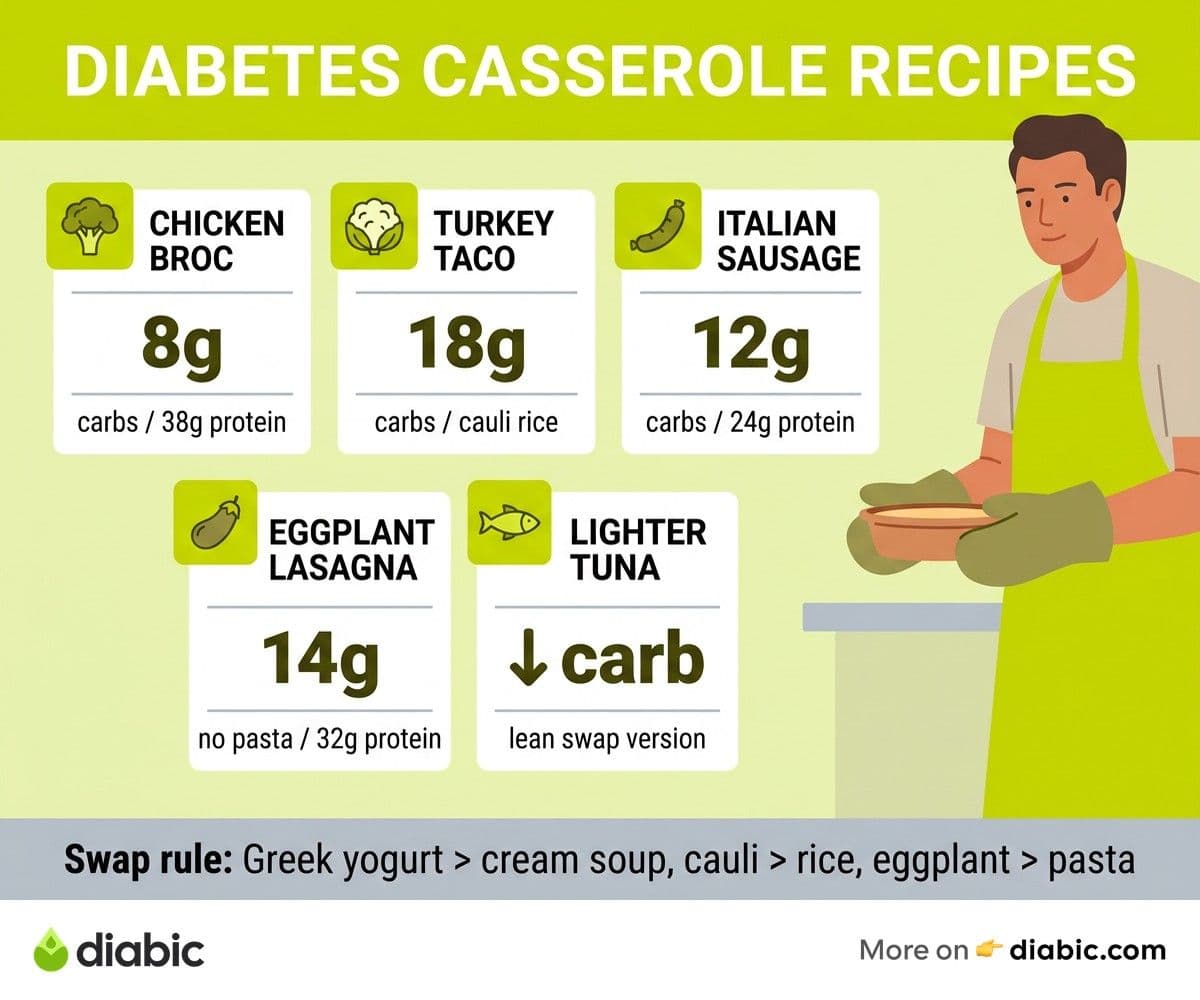
Why it works: About 8 grams of carbs and 38 grams of protein per serving. Greek yogurt replaces the usual cream-of-something soup, dropping carbs and added sodium without losing the creamy texture.
2. Turkey Taco Casserole with Cauliflower Rice
Ingredients: 1 lb ground turkey, 1 packet low-sodium taco seasoning, 4 cups cauliflower rice, 1 cup salsa (no added sugar), 1 cup shredded Mexican cheese, 1 can black beans (drained and rinsed).
Instructions: Heat oven to 375 degrees F. Brown turkey in a skillet, add taco seasoning per packet directions. Stir in cauliflower rice, beans, and salsa. Transfer to a baking dish, top with cheese, and bake 20 minutes until cheese is melted and edges are bubbling.
Why it works: Around 18 grams of carbs (mostly from the beans) and 28 grams of protein per serving. Cauliflower rice swaps in for white rice and saves roughly 30 grams of carbs per portion. Top with avocado and chopped cilantro to finish.
3. Italian Sausage and Vegetable Bake
Ingredients: 1 lb chicken Italian sausage (sliced), 1 zucchini (sliced), 1 yellow squash (sliced), 1 red bell pepper (chopped), 1 can crushed tomatoes (no sugar added), 1 tsp Italian herbs, 1/2 cup grated parmesan.
Instructions: Heat oven to 400 degrees F. Layer sausage and vegetables in a baking dish. Pour tomatoes over the top, sprinkle with herbs and parmesan. Bake uncovered 30 to 35 minutes until vegetables are tender.
Why it works: Roughly 12 grams of carbs and 24 grams of protein per serving. The vegetables take center stage, and the sausage provides flavor without the carb load of pasta. Excellent diabetes chicken recipes alternative on weeks you want a break from chicken.
4. Eggplant Lasagna (No Pasta)
Ingredients: 2 large eggplants (sliced 1/4 inch thick), 1 lb lean ground beef, 2 cups marinara (no sugar added), 15 oz part-skim ricotta, 1 egg, 2 cups shredded mozzarella, 1 tsp Italian herbs.
Instructions: Salt eggplant slices and let sit 20 minutes, then pat dry. Roast at 400 degrees F for 15 minutes. Brown the beef and stir in marinara. Mix ricotta with egg and herbs. Layer eggplant, beef sauce, ricotta, and mozzarella twice in a baking dish. Bake at 375 degrees F for 30 minutes, then rest 10 minutes before slicing.
Why it works: About 14 grams of carbs and 32 grams of protein per serving compared with 50-plus grams of carbs in a traditional pasta lasagna. Eggplant adds fiber, and the protein-fat ratio keeps blood sugar steady.
5. Lightened Tuna Noodle Casserole
Ingredients: 8 oz whole-wheat rotini, 2 cans tuna (drained), 2 cups frozen peas, 1.5 cups plain Greek yogurt, 1/2 cup low-sodium chicken broth, 1 cup shredded white cheddar, 1 tsp Dijon mustard.
Instructions: Cook pasta to al dente, drain. Whisk yogurt, broth, mustard, and half the cheese in a bowl. Combine with pasta, tuna, and peas. Transfer to a baking dish, top with remaining cheese, and bake at 375 degrees F for 20 minutes until golden.
Why it works: About 32 grams of carbs and 28 grams of protein per serving. Whole-wheat pasta keeps fiber up, and Greek yogurt replaces heavy cream. This is the highest-carb option on the list, so portion size matters more here than in the others.
For more weeknight-friendly options, browse our dinner recipes for diabetes collection. Hosting a holiday meal? Our Thanksgiving menu for diabetes includes a green bean casserole that fits this same framework.
From my experience: After 14 years of living with diabetes, the chicken and broccoli casserole above is my single most-cooked recipe in winter. It freezes in individual portions, it reheats without falling apart, and the Greek yogurt swap is the single change that took it from "fine" to "actually keeps my numbers flat." If you only try one recipe from this list, try that one.
How to Make Any Casserole Diabetes-Friendly
You do not have to abandon your grandmother's recipe to make it work. Most classic casseroles can be modified with three or four small swaps.
The biggest win is replacing white rice and refined pasta with cauliflower rice, riced broccoli, spiralized zucchini, or whole-grain alternatives. This single swap can drop the carb count of a casserole by 20 to 40 grams per serving. Cauliflower rice has come a long way and now bakes up surprisingly close to the original texture.
Cream-based sauces are the next target. Plain full-fat Greek yogurt, a splash of low-sodium broth, and a touch of mustard or lemon juice deliver the same creamy backbone with a fraction of the saturated fat and carbs. If a recipe calls for a can of cream-of-something soup, swap in 1 cup of Greek yogurt mixed with 1/2 cup of broth.
Load up on non-starchy vegetables. Broccoli, cauliflower, spinach, kale, mushrooms, zucchini, and bell peppers all bake well and stretch the dish without adding meaningful carbs. Aim for at least half the volume of the casserole to be vegetables.
Use cheese in moderation, not omission. A modest layer of sharp, flavorful cheese like aged cheddar or parmesan delivers more taste per gram than a thick blanket of mild cheese. The portion you actually need shrinks when the cheese itself is bolder.
FAQ
What casserole recipes are good for people with diabetes?
Casseroles built around lean protein, non-starchy vegetables, and modest amounts of whole-grain or low-carb starch tend to fit a diabetes-friendly eating pattern. Chicken and broccoli, turkey taco with cauliflower rice, eggplant lasagna, and Italian sausage with vegetables are strong options. Skip heavy cream sauces, large amounts of white pasta or rice, and cans of high-sodium condensed soup.
Can people with diabetes eat casseroles?
Yes. Casseroles can be very diabetes-friendly when you focus on protein and vegetables as the base. Use whole grain or vegetable-based substitutes for refined carbs, lighten sauces with Greek yogurt, and keep an eye on portion size. As always, your individual carb targets matter, so talk to your registered dietitian about what fits your meal plan.
How many carbs should be in a diabetes-friendly casserole serving?
Most adults with diabetes target 30 to 60 grams of carbs per meal, though your number may differ. Aim to keep a casserole serving in the 15 to 35 gram range so there is room for a side salad, a piece of fruit, or a small whole-grain roll. Your dietitian or care team can help you set targets that match your medications and goals.
Can I make these casseroles ahead of time?
All of the recipes above can be assembled the night before, covered, and refrigerated until you are ready to bake. Add 5 to 10 minutes to the bake time if going straight from the fridge. Most also freeze well, either fully baked and portioned or assembled and unbaked.
The right diabetes casserole recipes turn dinner from a daily decision into a once-a-week project, and steady routines are kind to blood sugar. Pick one to test this week, see how your numbers respond, and let that data shape your next round.
Shahriar P. Shuvo is the founder of Diabic. He has lived with diabetes for over 14 years, and built Diabic to deliver the practical, evidence-based self-management tools he wished existed when he was first diagnosed. By trade, Shahriar is a senior design and frontend engineer with 6+ years shipping products at Agora, Timescale (now Tiger Data), and ShareTrip. He writes from the intersection of lived diabetes experience and product craft, focused on what works in daily management rather than what sounds good in a textbook.
Medically reviewed by
Dr. Shanto Arian is an internal medicine physician now specializing in clinical and aesthetic dermatology, with a parallel academic focus on epidemiology and public health. He holds an MBBS, MPH, MSc (UK), MRCP (UK), MRCPI (Ireland), Diploma in Dermatology (UK), and Diploma in Aesthetic Medicine (USA). Dr. Arian trained in internal medicine, including hospital work on hematology cases such as graft-versus-host disease, before moving toward dermatology. Skin is one of the earliest places diabetes shows itself, from acanthosis nigricans and diabetic dermopathy to slow foot wound healing, and that intersection is where his clinical and Diabic-review work meet. On Diabic, Dr. Arian medically reviews content on diabetes diagnosis, complications, dermatologic manifestations, and pharmacotherapy, ensuring every claim aligns with current ADA, NICE, and peer-reviewed literature.
More from Diet & Fitness
View all
Simple Diabetes Exercise Routine for Beginners
A simple diabetes exercise routine for beginners with a 7-day plan, strength basics, and safety tips to help you move more without feeling overwhelmed.

Diabetes Friendly Smoothie Recipes: 5 No-Spike Picks
Five diabetes friendly smoothie recipes that balance protein, fat, and fiber to keep blood sugar steady. Includes a simple framework for building your own.

Can Exercise Prevent Diabetes? Research Says Yes
Can exercise prevent diabetes? Landmark studies show a 58% lower risk with regular activity. Here's how much you need and which workouts help most.
Clinician-reviewed habits, plain-language guides, and honest answers - the small shifts that make living with diabetes feel lighter, every day.