Can Exercise Prevent Diabetes? Research Says Yes
Can exercise prevent diabetes? Landmark studies show a 58% lower risk with regular activity. Here's how much you need and which workouts help most.

In this article(9)
Can exercise prevent diabetes? The short answer is yes, and the research backing it up is some of the strongest in lifestyle medicine. Regular physical activity lowers your risk of developing type 2 diabetes even when other risk factors, like family history or extra weight, are stacked against you.
That matters because more than 1 in 3 American adults has prediabetes, according to the CDC, and most do not know it. Exercise will not erase every risk factor, but it shifts the odds in a meaningful way. We want to walk you through what the studies actually say, how much movement you need, and where to start if you are not active right now.
Can Exercise Prevent Diabetes? What the Trials Show
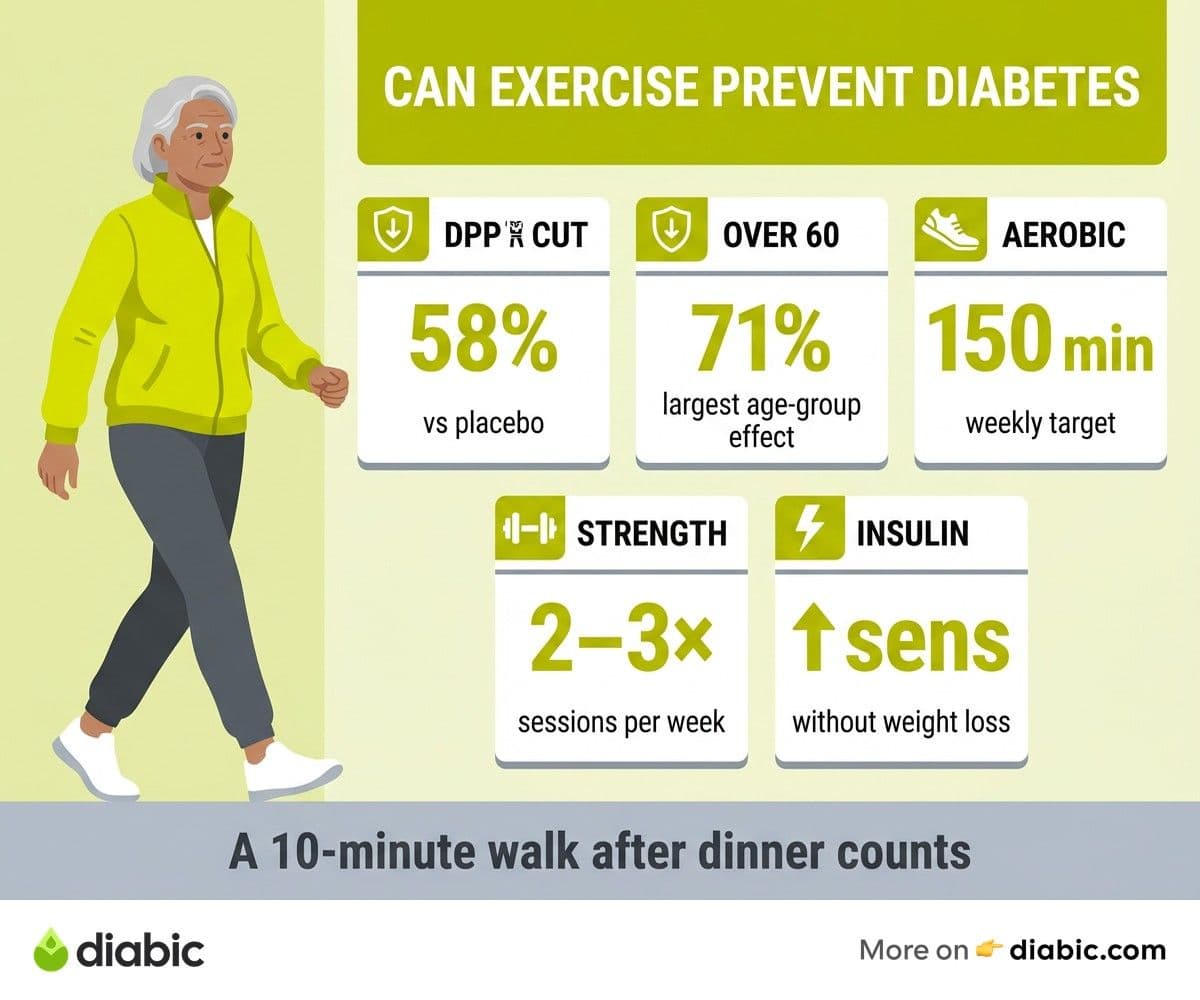
The clearest evidence on exercise and diabetes prevention comes from a U.S. trial called the Diabetes Prevention Program. Researchers followed more than 3,000 adults with prediabetes and assigned them to either a lifestyle group, a metformin group, or a placebo group. The lifestyle group focused on 150 minutes of weekly activity and modest weight loss.
The results were striking. The lifestyle group reduced their risk of developing type 2 diabetes by 58% compared with placebo, and the benefit was even stronger, around 71%, in adults over 60. You can read the original study summary on the NIH website. Lifestyle changes outperformed medication.
The Finnish Diabetes Prevention Study, published a few years earlier, found nearly identical numbers using a similar approach. Two large trials in two different populations, both pointing in the same direction. That kind of replication is rare in nutrition and exercise research, which makes the case for movement especially solid.
Exercise also improves insulin sensitivity in ways that are independent of weight loss. When your muscles contract, they pull glucose out of the bloodstream without needing as much insulin to do the job. This effect can show up within a single workout and builds with consistent training. If you are curious whether activity can do more than prevent disease, our piece on whether diabetes can be reversed by diet and exercise walks through the evidence on remission.
How Much Exercise Do You Actually Need
Most major health bodies land in the same range. The WHO physical activity guidelines recommend at least 150 to 300 minutes of moderate-intensity aerobic activity per week for adults, plus muscle-strengthening work on two or more days. The CDC's National Diabetes Prevention Program uses the same 150-minute target, which is the level that produced the 58% risk reduction in the trials.
Broken down, 150 minutes is about 30 minutes a day, five days a week. That is brisk walking pace, the kind where you can talk but not sing. You do not have to do it all at once. Three 10-minute walks count the same as one 30-minute walk for metabolic benefit, which is good news if you are squeezing movement around work and family. For people with elevated risk, our pre-diabetes diet and exercise plan shows how to combine the weekly target with food choices that support blood sugar.
Intensity matters less than most people think when prevention is the goal. Walking, cycling, swimming, dancing, gardening, and structured workouts all help. Higher-intensity work delivers benefits in less time, but moderate activity done consistently is what the prevention research actually measured. Exercise good for diabetes risk does not need to be extreme, it needs to happen often.
Consistency beats perfection here. A 20-minute walk you actually do five times a week is more protective than a 60-minute workout you skip half the time. We say that a lot, but the math really does favor people who show up.
Best Exercises for Diabetes Prevention
You do not need a gym membership or a fancy program. The activities below all show strong evidence for how exercise helps diabetes risk, and the best one is the one you will keep doing.
- Walking. The most accessible option. Brisk walking after meals helps blunt post-meal blood sugar spikes, which is one of the earliest signs that insulin sensitivity is starting to slip. A 10-minute walk after dinner is a small habit with real metabolic payoff.
- Resistance training. Lifting weights, using resistance bands, or doing bodyweight work like push-ups and squats builds muscle, and muscle is your largest reservoir for storing blood sugar. Two or three short sessions per week, even 20 minutes each, can meaningfully shift your metabolic numbers.
- Swimming and cycling. Both are easier on knees, hips, and ankles than running. If you have joint pain or are returning to activity after a long break, these let you build up volume without breaking down. Water aerobics counts too.
- Anything that raises your heart rate. Dancing in the kitchen, raking leaves, hauling groceries, playing with kids or grandkids. Your body does not know the difference between formal exercise and life-as-exercise, and the metabolic effects look similar.
From my experience: After 14 years of living with diabetes, the single most reliable habit I have found is a 15-minute walk after dinner. Not because it is heroic, but because it is short enough that I never have a real excuse to skip it. My post-meal numbers are noticeably better on the days I do it, and the stack of "small days" is what changed my long-term trends. If exercise feels too big to start, start with after-dinner walks.
If you are sitting somewhere on the prediabetes spectrum, exercise pulls double duty as both prevention and reversal. We dig into that in our guide on whether prediabetes can be reversed, which leans on the same trials referenced above.
Who Benefits Most from Exercise for Prevention
Exercise helps almost everyone, but the absolute risk reduction is largest for people who start with higher risk. That includes a few specific groups.
People with prediabetes see the strongest effect. Blood sugar levels in this range are still flexible, and the muscle and liver are still responsive to lifestyle changes. The Diabetes Prevention Program enrolled adults in exactly this position, and the 58% risk reduction was their result.
Those with a family history of type 2 diabetes also see meaningful gains. Genes load the gun, but lifestyle pulls the trigger, as the saying goes. Movement does not erase genetics, but research suggests it can offset a significant portion of inherited risk.
People carrying extra weight benefit too, even when weight loss is modest or nonexistent. Several studies show that fitness improvements protect against diabetes independent of the scale, which is worth repeating because so much messaging treats weight as the only target. Exercise improves how your cells respond to insulin regardless of whether the number on the scale moves.
It is also never too late to start. Older adults in the DPP saw the largest relative benefit of any age group. If you are reading this in your 50s, 60s, or beyond and worrying you missed the window, the data is on your side. Talk to your doctor about a starting point that matches your fitness and any existing conditions, then build from there.
FAQ
How much exercise do you need to prevent diabetes?
Research supports at least 150 minutes per week of moderate-intensity activity, like brisk walking, to meaningfully reduce diabetes risk. That is roughly 30 minutes on most days. Adding two or three short strength sessions per week provides added benefit by building muscle, which improves how your body handles blood sugar.
Does regular exercise lower the risk of type 2 diabetes?
Yes. The Diabetes Prevention Program showed that regular activity combined with modest dietary changes lowered the risk of developing type 2 diabetes by 58% over three years. Exercise improves insulin sensitivity, which helps your body move blood sugar out of the bloodstream and into muscle cells more efficiently.
Can exercise prevent diabetes if I have a family history?
It can reduce your risk, even with a family history. Genetics raise baseline risk, but lifestyle factors strongly influence whether that risk turns into a diagnosis. Consistent activity, even moderate walking, is one of the most reliable ways to shift the odds. Your doctor can help you understand your personal risk profile and screening schedule.
What kind of exercise is best for preventing diabetes?
The best exercise is the one you will do consistently. Walking, cycling, swimming, resistance training, and group classes all help. A mix of moderate aerobic activity and twice-weekly strength training is what most major health bodies recommend, and it lines up with the activity patterns used in the major prevention trials.
So can exercise prevent diabetes? For most people at risk, the honest answer is that it shifts the odds substantially in your favor, especially when paired with steady eating habits. Start where you are this week, even if "where you are" is a 10-minute walk after dinner, and let consistency do the rest.
Shahriar P. Shuvo is the founder of Diabic. He has lived with diabetes for over 14 years, and built Diabic to deliver the practical, evidence-based self-management tools he wished existed when he was first diagnosed. By trade, Shahriar is a senior design and frontend engineer with 6+ years shipping products at Agora, Timescale (now Tiger Data), and ShareTrip. He writes from the intersection of lived diabetes experience and product craft, focused on what works in daily management rather than what sounds good in a textbook.
Medically reviewed by
Dr. Shanto Arian is an internal medicine physician now specializing in clinical and aesthetic dermatology, with a parallel academic focus on epidemiology and public health. He holds an MBBS, MPH, MSc (UK), MRCP (UK), MRCPI (Ireland), Diploma in Dermatology (UK), and Diploma in Aesthetic Medicine (USA). Dr. Arian trained in internal medicine, including hospital work on hematology cases such as graft-versus-host disease, before moving toward dermatology. Skin is one of the earliest places diabetes shows itself, from acanthosis nigricans and diabetic dermopathy to slow foot wound healing, and that intersection is where his clinical and Diabic-review work meet. On Diabic, Dr. Arian medically reviews content on diabetes diagnosis, complications, dermatologic manifestations, and pharmacotherapy, ensuring every claim aligns with current ADA, NICE, and peer-reviewed literature.
More from Diet & Fitness
View all
Simple Diabetes Exercise Routine for Beginners
A simple diabetes exercise routine for beginners with a 7-day plan, strength basics, and safety tips to help you move more without feeling overwhelmed.

Diabetes Friendly Smoothie Recipes: 5 No-Spike Picks
Five diabetes friendly smoothie recipes that balance protein, fat, and fiber to keep blood sugar steady. Includes a simple framework for building your own.

5 Apple Cider Vinegar Recipes for Diabetes
Try 5 simple apple cider vinegar recipes for diabetes that may help support blood sugar response after meals, plus safety tips for daily use.
Clinician-reviewed habits, plain-language guides, and honest answers - the small shifts that make living with diabetes feel lighter, every day.