A Gentle Chair Yoga Routine for people with diabetes
A gentle chair yoga for people with diabetes routine with safe poses, modifications for neuropathy, retinopathy, and joint pain, plus tips for older.

In this article(7)
If you have ever scrolled past a yoga video and thought, "that is not for me", we want you to stay with us. People search for chair yoga for people with diabetes every day, and what they really need is the simple idea that you should not need a sticky mat, supple hamstrings, or a pain-free body to access the benefits of mindful movement. A sturdy chair, a few minutes, and a willingness to try is enough, and chair yoga for people with diabetes is built around exactly that idea.
We have spoken with plenty of readers who avoid floor-based exercise because of neuropathy, knee replacements, balance worries, or fatigue that makes getting up and down feel like a workout in itself. The chair removes that obstacle. It also removes a quiet source of shame that some people feel when traditional fitness spaces seem to assume everyone arrives healthy and capable.
In this article, we walk through why chair-based practice is a sound choice for many people with diabetes, share a 15-minute routine you can do in your living room, and cover modifications for common complications. The aim is a practice you will actually return to, not a perfect one.
From my experience: A few years ago, after a tough travel week left me too wiped to face anything resembling a real workout, I tried 12 minutes of seated stretching and breathing in a hotel desk chair. My Dexcom G7 line, which had been bouncy all morning, settled into a quiet flat curve over the next hour. It was not a workout in any traditional sense, but it was the first time I noticed gentle movement showing up clearly on my CGM, and that small data point changed how seriously I took the chair option on low-energy days.
Why Chair Yoga for People With Diabetes (and Anyone with Diabetes) Works
Chair yoga is yoga adapted to a seated or chair-supported position. Despite being gentler than a flowing mat practice, it engages the same muscle groups, supports circulation, and triggers the same parasympathetic shift that calms the stress response. For people managing diabetes, the combination of light muscle activity and lowered stress hormones can support steadier blood sugar through the day, particularly after meals.
The American Diabetes Association recommends regular physical activity for people with diabetes and notes in its Standards of Care that activity should be tailored to individual ability, with seated and supported options for those with mobility limitations. Research published in the Journal of Bodywork and Movement Therapies found that chair yoga programs improved balance, lower-body strength, and self-reported well-being in older adults with chronic conditions. These outcomes matter for fall prevention as well as glucose response.
We also like chair yoga because it lowers the activation cost of starting. When pain, diabetes fatigue, or low motivation make floor work feel impossible, ten minutes in a chair is still ten minutes of movement and breath. Consistency beats intensity by a wide margin in glucose data, and the chair makes consistency more achievable.
A final practical note. You want a chair that is sturdy, flat-seated, and free of wheels or arms that get in your way. Dining chairs work better than office chairs for most poses. A folded blanket on the seat can soften pressure on the tailbone if needed.
A 15-Minute Chair Yoga Routine
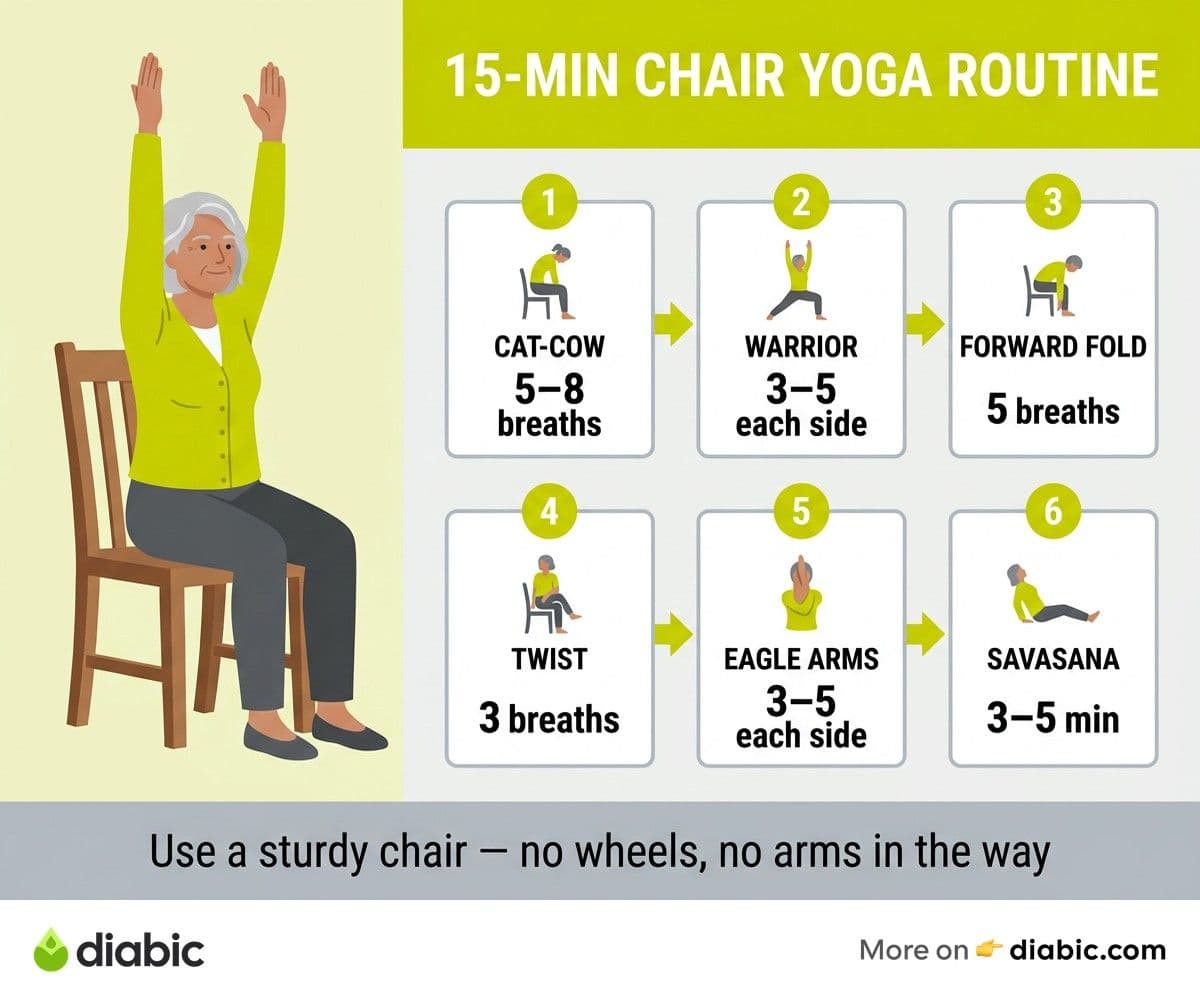
We have organized this sequence to warm up the spine, open the hips and shoulders, and end with deep relaxation. Move slowly, breathe through the nose when comfortable, and skip anything that hurts. Holding each pose for three to five breaths is a reasonable starting point. If the names sound unfamiliar, our guide to yoga poses for diabetes covers the foundations.
Seated Cat-Cow opens the practice and wakes up the spine. Sit toward the front of your chair with feet flat on the floor and hands resting on your knees. As you inhale, lift your chest and look slightly up, arching gently. As you exhale, round your back and tuck your chin. Repeat for five to eight breaths, keeping the movement small and easy.
Chair Warrior I builds leg strength without asking your knees to bear unpredictable loads. Turn to sit sideways on the chair so your right leg can extend behind you, with your left knee bent and foot grounded. Lift your arms overhead and hold for three to five breaths, then switch sides. If sitting sideways feels unstable, keep both feet on the floor and simply raise your arms.
Seated Forward Fold stretches the hamstrings and signals the nervous system to settle. With both feet flat and knees bent at 90 degrees, hinge gently from the hips and let your hands rest on your shins or the floor. Keep your spine long rather than rounding sharply, especially if you have any back concerns. Breathe slowly for five breaths, then roll up one vertebra at a time.
Chair Twist supports digestion and spinal mobility. Sit tall, plant your feet, and place your right hand on the back of the chair while your left hand rests on your right knee. Inhale to lengthen, exhale to gently turn toward the right. Hold for three breaths, return to center, and repeat on the other side.
Seated Eagle Arms releases the upper back and shoulders, which often carry tension from long days at a desk or wheel. Cross your right arm under your left at the elbows and try to bring the palms toward each other. Lift the elbows slightly and breathe for three to five breaths. Switch sides. If shoulders feel tight, simply hug your arms across your chest instead.
Chair Savasana ends the routine and is, in our experience, the most underrated pose. Sit back against the chair, place your hands on your thighs with palms up, close your eyes if comfortable, and let your breath find its natural rhythm. Three to five minutes here is where the nervous system absorbs the practice. Skipping savasana to save time is a false economy.
Adapting Chair Yoga for Common Diabetes Complications
If you live with retinopathy, your eye care team likely advised against postures that lower the head below the heart, since they can briefly raise pressure inside the eye. Skip seated forward folds in their full version and replace them with a seated mountain pose, where you sit tall with arms overhead and breathe into the side ribs. Ask your ophthalmologist about specifics if you have had recent treatment or surgery.
Peripheral neuropathy in the feet calls for a few small adjustments. Keep your shoes or supportive socks on if foot positioning feels uncertain, and check your feet before and after practice for any spots of pressure or skin change. Choose poses that emphasize the upper body, and avoid balancing on one foot. Our overview on diabetes in seniors covers complementary self-care habits worth pairing with movement.
Joint pain in the knees, hips, or shoulders responds well to reduced range of motion rather than skipped poses. Move only as far as the joint allows without sharp pain, and use breath to signal when to stop. A sensation of mild stretch is welcome. Pain that builds during the hold or lingers after practice is a sign to back off and rebuild more slowly. Talk to your physical therapist or doctor if joint pain is new or worsening.
Fatigue, which often shows up in waves with diabetes, deserves its own approach. On low-energy days, do half the routine or only the seated cat-cow and savasana. Showing up for five minutes is more useful than skipping a planned 15-minute session. Track how you feel before and after, and you will likely notice that gentle movement often raises rather than drains your energy.
Getting Started and Staying Consistent
The biggest predictor of whether a new movement practice sticks is whether you have anchored it to an existing routine. After lunch, before dinner, or as a wind-down before bed are all reliable cues. Pick one and try it for two weeks before deciding whether it works. The National Institute on Aging offers helpful guidance on exercise for older adults that complements anything you do in a chair.
We recommend starting with three sessions per week, not seven. A schedule that feels too aggressive tends to collapse into nothing, while a small commitment that you exceed builds quiet momentum. If you want video guidance, search YouTube for "chair yoga for seniors" or "chair yoga 15 minutes" and pick an instructor whose pacing feels right. Free resources are plentiful and just as effective as paid ones for a beginning practice. Readers looking for a floor-based progression can later try our yoga routine for type 2 as confidence grows.
Tracking adds a useful feedback loop. Note your blood sugar before and after sessions for the first two to three weeks, along with a one-line entry on how you felt. You may see clearer postprandial numbers when you practice after a meal, or steadier overnight numbers when you practice in the evening. The point is not to optimize against the data, just to learn how your body responds. Share what you find with your diabetes care team if anything stands out.
FAQ
Can you do yoga in a chair with diabetes?
Yes, and chair yoga is often a smart starting point for people with diabetes who deal with mobility limits, neuropathy, joint pain, balance concerns, or fatigue. Seated practice still engages major muscle groups, supports circulation, and lowers stress hormones, all of which contribute to steadier blood sugar. Begin with a sturdy, flat-seated chair, hold poses for three to five breaths, and stop any movement that triggers pain. Talk to your diabetes care team before starting if you have retinopathy, recent surgery, or significant heart concerns so they can flag any postures to avoid.
What are good chair yoga exercises for seniors with diabetes?
A simple starter set includes seated cat-cow for spinal mobility, chair warrior for leg strength, seated forward fold for the hamstrings, chair twist for digestion and core support, seated eagle arms for the upper back, and chair savasana for deep relaxation. Aim for 10 to 15 minutes, three times a week, and keep range of motion within the comfortable zone for your joints. Skip head-below-heart poses if you have retinopathy and stay seated rather than balancing on one foot if you have neuropathy. Older adults often benefit from a follow-along video, which removes the cognitive load of remembering sequences. If you came here searching for chair yoga for people with diabetes, this same starter set is exactly what we recommend.
Shahriar P. Shuvo is the founder of Diabic. He has lived with diabetes for over 14 years, and built Diabic to deliver the practical, evidence-based self-management tools he wished existed when he was first diagnosed. By trade, Shahriar is a senior design and frontend engineer with 6+ years shipping products at Agora, Timescale (now Tiger Data), and ShareTrip. He writes from the intersection of lived diabetes experience and product craft, focused on what works in daily management rather than what sounds good in a textbook.
Medically reviewed by
Dr. Shanto Arian is an internal medicine physician now specializing in clinical and aesthetic dermatology, with a parallel academic focus on epidemiology and public health. He holds an MBBS, MPH, MSc (UK), MRCP (UK), MRCPI (Ireland), Diploma in Dermatology (UK), and Diploma in Aesthetic Medicine (USA). Dr. Arian trained in internal medicine, including hospital work on hematology cases such as graft-versus-host disease, before moving toward dermatology. Skin is one of the earliest places diabetes shows itself, from acanthosis nigricans and diabetic dermopathy to slow foot wound healing, and that intersection is where his clinical and Diabic-review work meet. On Diabic, Dr. Arian medically reviews content on diabetes diagnosis, complications, dermatologic manifestations, and pharmacotherapy, ensuring every claim aligns with current ADA, NICE, and peer-reviewed literature.
More from Living with Diabetes
View all
Shift Work and Diabetes: Managing Irregular Hours
Shift work and diabetes is a tough combination. Learn how to manage meals, sleep, medication, and blood sugar when your hours rotate or flip overnight.

Dating with Diabetes: When to Tell a New Partner
Dating with diabetes brings unique disclosure questions. Here is when to tell a new partner, what to say, and how to handle the conversation with.

Travel Insurance for people with diabetes: What's Covered
Travel insurance for people with diabetes often excludes pre-existing conditions. Learn what to look for, how to compare policies, and how to file a claim.
Clinician-reviewed habits, plain-language guides, and honest answers - the small shifts that make living with diabetes feel lighter, every day.