Foods That Spike Blood Sugar (and What to Eat Instead)
Wondering what food spikes blood sugar the most? Get a clear list of trigger foods, the science behind them, and practical swaps for steadier glucose.

In this article(11)
Knowing what food spikes blood sugar is only half the equation. The real power comes from having a swap ready for every trigger food, so you are not standing in the kitchen at 7 a.m. trying to invent breakfast on the fly. The foods that cause the biggest spikes are often staples that people eat every day without noticing the pattern in their glucose readings.
This guide walks through the most common culprits, the sneaky foods that look healthy but behave like sugar, and a practical alternative for each one. We will also cover why fiber, fat, and cooking method change the story, and which fruits tend to push numbers higher than others.
From my experience: After 14 years of living with diabetes, I have learned that the foods I assumed were "safe" caused some of my biggest spikes. A bowl of cornflakes with skim milk hit me harder than a slice of buttered sourdough. The list below reflects both the research and the reality of what shows up on a continuous glucose monitor.
What Foods Spike Blood Sugar the Most
The biggest blood sugar spikes usually come from foods that are quickly digested into glucose with very little to slow them down. Refined carbohydrates strip out the fiber, fat, and protein that would normally moderate the rise, leaving sugar to flood the bloodstream within minutes.
The repeat offenders are familiar:
- White bread, white rice, and refined grains. These are starches stripped of their bran and germ, which means almost no fiber and a fast climb in glucose.
- Sugary breakfast cereals and most granola bars. Many cereals marketed as healthy contain 12 to 20 grams of added sugar per serving, which is comparable to a small candy bar.
- Fruit juice and sweetened beverages. Liquid sugar reaches your bloodstream faster than almost any solid food, with no fiber to buffer it.
- Potatoes prepared certain ways. Mashed potatoes and baked potatoes without the skin have a glycemic index in the 80s and 90s, higher than table sugar.
- Candy, pastries, and standard desserts. These pair fast sugar with refined flour, doubling the spike potential.
According to nutritional data from the USDA FoodData Central, a single cup of cooked white rice delivers around 45 grams of carbohydrate with under 1 gram of fiber. That is the carbohydrate equivalent of three slices of bread in one side dish.
Foods That Increase Blood Sugar: The Hidden Culprits
Not every food that increases blood sugar comes wrapped in candy paper. Some of the worst spikes come from foods that wear a health halo, which makes them harder to spot until you see the numbers afterward.
A green smoothie can contain 60 grams of carbohydrate from blended fruit, especially if a banana, mango, and orange juice are involved. Dried fruit looks like a snack-bag staple, but raisins and dates concentrate sugar into a small bite that hits fast. Honey, agave, and maple syrup are still simple sugars, regardless of their natural origin.
Condiments hide more sugar than most people expect. Two tablespoons of ketchup, barbecue sauce, or sweet chili sauce can add 8 to 14 grams of sugar to an otherwise reasonable plate. Bottled salad dressings, teriyaki sauce, and even some pasta sauces follow the same pattern.
Low-fat products often replace removed fat with sugar or refined starch to keep the texture and flavor. A low-fat flavored yogurt can carry more sugar than a small bowl of ice cream. Restaurant portions add a final layer of risk, since a "small" pasta bowl out can hold 100 grams of carbohydrate, double a typical home portion.
The glycemic index also tells only part of the story. Research published in the Diabetes Care journal shows that real-world glycemic load, which factors in portion size and what else is on the plate, predicts blood sugar response far better than the index of a single food eaten alone. This is why two people can eat the same banana and see different numbers.
Why What Food Spikes Blood Sugar Varies Person to Person
What food increase blood sugar comes down to a handful of variables: how fast carbohydrates break down into glucose, how much fiber is present, what the food is paired with, and how it was cooked. Two foods with the same carb count can produce very different curves on a glucose monitor.
Fiber slows digestion and flattens spikes. A whole apple with its skin and 4 grams of fiber raises blood sugar more gently than the same apple juiced. Fat and protein slow gastric emptying, which is why peanut butter on toast spikes less than toast alone.
Cooking method matters more than most people realize. A boiled potato cooled overnight forms resistant starch that behaves more like fiber. The same potato mashed and served hot has a much higher glycemic impact. Pasta cooked al dente spikes less than pasta cooked soft. Even toasting bread changes the starch structure slightly.
Individual response is real, too. Genetics, gut microbiome, sleep quality, stress, and time of day all shift how you process the same meal. This is part of why we cover blood sugar after food explained in detail, because your numbers are personal data, not a universal scoreboard.
For a deeper look at the science, Harvard Health maintains a useful glycemic index database that compares hundreds of common foods.
What Foods Cause High Blood Sugar
What food causes high blood sugar repeatedly, day after day, is usually a small set of habits rather than one single villain. Refined carbohydrates do the heaviest lifting, but added sugars, processed foods, and oversized portions stack the effect.
Refined carbohydrates are the primary driver. They digest into glucose almost as fast as table sugar. The American Diabetes Association notes in its nutrition therapy recommendations that swapping refined grains for whole grains is one of the highest-uses changes a person with diabetes can make.
Added sugars deserve their own category. The body processes added sugar from soda the same way it processes added sugar in flavored coffee creamer, even though one feels like a treat and the other feels like a small choice. Natural sugars in whole fruit come bundled with fiber and water, which changes the response.
Processed foods compound the effect. A frozen breakfast sandwich pairs refined bread, processed meat, and often a sugary sauce. Each ingredient nudges blood sugar, sodium, and inflammation in the wrong direction. For a fuller breakdown, see our piece on what food causes high blood sugar and why.
Portion size amplifies everything. A half-cup serving of pasta is rarely what lands on a plate. Doubling the portion roughly doubles the carbohydrate load and the glucose response.
Better Alternatives for Every Spike-Causing Food
Knowing what to eat instead is what makes any swap stick. A low glycemic diet for diabetes is built on these kinds of trades, where each upgrade keeps the meal you want while flattening the curve.
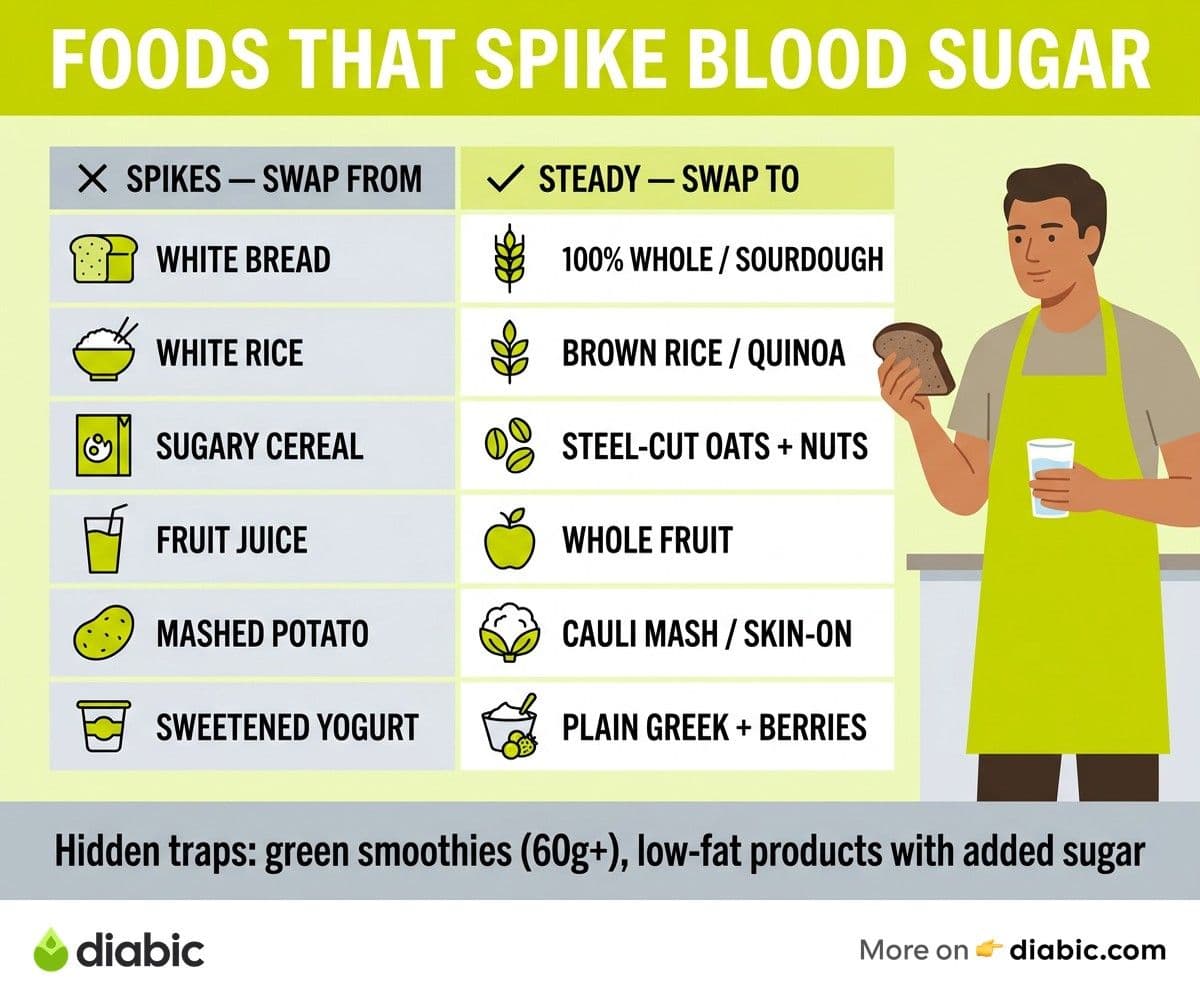
Here is a practical swap chart for the most common offenders:
- White bread → 100% whole grain, sprouted-grain, or true sourdough. Sourdough fermentation lowers the glycemic response of the same flour.
- White rice → cauliflower rice, brown rice, quinoa, or barley. Mixing half white and half cauliflower rice is an easy starter swap.
- Sugary cereal → steel-cut or rolled oats with nuts and berries. The fat and fiber transform the spike profile.
- Fruit juice → whole fruit, sparkling water with citrus, or cucumber-mint infused water. You keep the flavor signal without the sugar surge.
- Mashed potatoes → mashed cauliflower, or boiled-then-cooled potatoes with the skin. Cooling builds resistant starch.
- Sweetened yogurt → plain Greek yogurt with fresh berries and a drizzle of nut butter. You control the sugar and add protein.
- Granola bars → a small handful of almonds with an apple, or hard-boiled eggs. Real food beats most engineered snacks.
You do not have to overhaul every meal at once. Pick the food you eat most often and start there. One steady swap, repeated daily, produces a bigger A1C effect than three swaps you abandon by week two.
Which Fruits Spike Blood Sugar
Which fruits spike blood sugar the most is a fair question, because fruit is often pitched as a free pass when it is not quite that simple. Fruits range widely in their glucose impact, and the way they are prepared and paired matters as much as the fruit itself.
Higher-glycemic fruits include watermelon, pineapple, ripe bananas, mango, and most tropical fruits. They are not "bad," but the portion has to be honest. A whole mango is roughly 50 grams of carbohydrate, similar to two slices of bread.
Lower-glycemic options give you more room. Berries (blueberries, raspberries, strawberries, blackberries), cherries, apples, pears, kiwi, and citrus fruits tend to produce gentler curves. Berries in particular bring antioxidants and fiber with relatively little sugar.
Pairing fruit with protein or fat reduces the spike noticeably. An apple with peanut butter, berries with cottage cheese, or a pear with a few walnuts gives your glucose curve something to lean against.
Form matters too. Fresh fruit beats dried, and dried beats juice. A handful of fresh grapes is around 15 grams of carb. The same grapes dried into raisins shrink to a small handful with the same carbs but no water and less satiety. Juice removes the fiber entirely and acts close to soda inside the body.
FAQ
What foods should people with diabetes avoid to prevent blood sugar spikes?
Refined carbohydrates (white bread, white rice, sugary cereals), sweetened beverages, fruit juice, candy, and heavily processed snacks cause the biggest spikes. You do not need to eliminate them entirely. Replacing them with whole-grain, fiber-rich alternatives, and pairing carbs with protein or fat, makes a significant difference in day-to-day glucose stability.
Which fruits spike blood sugar the most?
Watermelon, pineapple, ripe bananas, and dried fruits tend to cause the biggest spikes. Berries, cherries, apples, and pears are generally better options. Eating fruit with protein or healthy fat, and choosing whole fruit over juice, helps moderate the glucose response.
Are bananas always bad for blood sugar?
Not necessarily. A small, slightly green banana paired with nut butter or Greek yogurt produces a much smaller spike than a large, ripe banana eaten alone. Ripeness changes the resistant-starch content, which changes the glycemic impact.
How long after eating does blood sugar peak?
For most people, blood sugar peaks 60 to 90 minutes after a meal, though refined carbs and liquids can peak faster. If you use a glucose monitor, checking at the 1-hour and 2-hour marks tells you which foods are spiking and which are stable.
The bigger picture is that what food spikes blood sugar in your body is partly universal and partly personal. The foods on this list are reliable culprits for most people, but your monitor and your healthcare team are the final word. Talk to your doctor or a registered dietitian about how to apply these swaps to your own plan, and give yourself credit for the small steady changes. Those are the ones that move A1C numbers over time.
Shahriar P. Shuvo is the founder of Diabic. He has lived with diabetes for over 14 years, and built Diabic to deliver the practical, evidence-based self-management tools he wished existed when he was first diagnosed. By trade, Shahriar is a senior design and frontend engineer with 6+ years shipping products at Agora, Timescale (now Tiger Data), and ShareTrip. He writes from the intersection of lived diabetes experience and product craft, focused on what works in daily management rather than what sounds good in a textbook.
Medically reviewed by
Dr. Shanto Arian is an internal medicine physician now specializing in clinical and aesthetic dermatology, with a parallel academic focus on epidemiology and public health. He holds an MBBS, MPH, MSc (UK), MRCP (UK), MRCPI (Ireland), Diploma in Dermatology (UK), and Diploma in Aesthetic Medicine (USA). Dr. Arian trained in internal medicine, including hospital work on hematology cases such as graft-versus-host disease, before moving toward dermatology. Skin is one of the earliest places diabetes shows itself, from acanthosis nigricans and diabetic dermopathy to slow foot wound healing, and that intersection is where his clinical and Diabic-review work meet. On Diabic, Dr. Arian medically reviews content on diabetes diagnosis, complications, dermatologic manifestations, and pharmacotherapy, ensuring every claim aligns with current ADA, NICE, and peer-reviewed literature.
More from Diet & Fitness
View all
Simple Diabetes Exercise Routine for Beginners
A simple diabetes exercise routine for beginners with a 7-day plan, strength basics, and safety tips to help you move more without feeling overwhelmed.
Diabetes Friendly Smoothie Recipes: 5 No-Spike Picks
Five diabetes friendly smoothie recipes that balance protein, fat, and fiber to keep blood sugar steady. Includes a simple framework for building your own.

Can Exercise Prevent Diabetes? Research Says Yes
Can exercise prevent diabetes? Landmark studies show a 58% lower risk with regular activity. Here's how much you need and which workouts help most.
Clinician-reviewed habits, plain-language guides, and honest answers - the small shifts that make living with diabetes feel lighter, every day.