8 Foods That Won't Spike Your Blood Sugar
Discover 8 foods that won't spike blood sugar, with the science behind each pick and easy ways to add them to meals you already love.

In this article(15)
- Why Some Foods Spike Blood Sugar and Others Do Not
- 1. Eggs
- 2. Nuts (Almonds, Walnuts, Pecans)
- 3. Leafy Greens (Spinach, Kale, Arugula)
- 4. Avocados
- 5. Greek Yogurt (Plain, Unsweetened)
- 6. Fatty Fish (Salmon, Sardines, Mackerel)
- 7. Berries (Blueberries, Strawberries, Raspberries)
- 8. Legumes (Lentils, Chickpeas, Black Beans)
- How to Build a Plate Around 8 Foods That Won't Spike Blood Sugar
Finding 8 foods that won't spike blood sugar can feel like solving a puzzle with missing pieces, especially when "healthy" foods like brown rice or banana smoothies still send your numbers climbing. The 8 foods that won't spike blood sugar in this guide keep glucose steady, taste good enough to eat regularly, and fit into the meals you already cook. No exotic ingredients, no extreme rules, no flavorless plates of plain chicken.
The list below pulls from research on glycemic load, fiber, and fat-protein balance, plus what works in real life when you have a job, a family, and a budget. Each food includes the why behind it and one practical way to use it tomorrow.
Why Some Foods Spike Blood Sugar and Others Do Not
Carbohydrate count is only part of the story. Two foods with the same number of carbs can produce wildly different blood sugar responses depending on fiber, fat, protein, processing, and even what you ate alongside them. Understanding the basics helps you build meals that hold steady instead of swing wildly.
The glycemic index (GI) ranks how quickly a food raises blood sugar compared to pure glucose. Glycemic load (GL) goes a step further by factoring in portion size, which is closer to how you actually eat. White rice and watermelon both have a high GI, but a normal serving of watermelon has a low GL. The American Diabetes Association recommends thinking about both GI and GL together, alongside total carb count.
Fiber, fat, and protein all slow glucose absorption. Fiber traps sugars in the gut so they enter the bloodstream more slowly. Fat delays stomach emptying. Protein triggers smaller insulin and glucagon responses that smooth out the curve. That is why an apple with peanut butter behaves differently than an apple alone, and why a piece of toast with avocado stays calmer than toast with jam.
Processing strips many of these natural buffers away. Whole oats are very different from instant oatmeal, just as a whole orange is very different from orange juice. The closer a food is to its natural form, the gentler it tends to be on glucose. For more strategies, our guide on 7 ways to prevent blood sugar spikes after meals builds on these basics.
One last note: individual responses vary. Continuous glucose monitor data shows that the same banana can spike one person 60 mg/dL and another 20 mg/dL. The list below holds up well across most people with diabetes, but always test your own response when you can.
1. Eggs
Eggs are about as close to zero-impact as a real food gets. A large egg has under 1 gram of carbohydrate, around 6 grams of protein, and 5 grams of fat. That combination keeps blood sugar after eating remarkably flat, even in larger portions.
Eggs also score high on satiety, meaning they keep you full longer than most breakfast options. A study published in the Journal of Nutrition found that protein-rich breakfasts reduce post-meal glucose spikes at lunch as well, an effect researchers call the "second-meal phenomenon."
Try them: scrambled with spinach and a slice of whole-grain toast, hard-boiled and grabbed from the fridge on busy mornings, or whisked into a quick veggie omelet. They are also one of the cheapest protein sources at the grocery store.
2. Nuts (Almonds, Walnuts, Pecans)
A handful of nuts is one of the most stable snacks you can eat. Almonds, walnuts, and pecans are low in net carbs, high in fiber and healthy fats, and packed with magnesium, which research links to better insulin sensitivity. A 1-ounce serving (about 23 almonds) has roughly 6 grams of carbs and 4 grams of fiber.
Nuts work especially well as a "buffer" alongside higher-carb foods. Eating a handful before fruit or with a piece of bread can flatten the spike that food alone would cause. They also travel well, which makes them ideal for [office snacks for people with diabetes](/diabetes-at-work/best-office-snacks-for-people with diabetes) and road trip snacks for diabetes when you need something stable on the go.
A word of caution: pre-roasted, salted, or honey-coated nuts often have added sugar or oils. Stick with raw or dry-roasted, unsalted versions when you can. Portion matters too. Calories add up fast, so measure out a handful instead of eating from the bag.
3. Leafy Greens (Spinach, Kale, Arugula)
Leafy greens are nutritionally dense and almost free of carbs. A full cup of raw spinach has about 1 gram of carbohydrate, most of it fiber. They add volume, color, and nutrients to meals without adding glucose load, which makes them a natural foundation for diabetes-friendly cooking.
Greens are also rich in magnesium, vitamin K, and folate. Higher leafy green intake has been associated with lower type 2 diabetes risk in observational studies, though correlation is not causation. Either way, they fill the plate with food that keeps blood sugar levels predictable.
Build them in: a handful of spinach in your morning eggs, arugula tossed onto sandwiches, kale massaged with olive oil for a sturdy salad base, or any green wilted into soup at the last minute. Frozen spinach is just as nutritious as fresh and lasts longer.
4. Avocados
Avocados earn their reputation. Half an avocado has about 6 grams of carbs, 5 of which are fiber, plus 7 grams of monounsaturated fat. That fat slows digestion, which directly blunts post-meal glucose spikes when paired with carbier foods.
Research suggests avocado consumption may improve markers of insulin sensitivity, though most studies are short-term. What is more practical is the everyday effect: spread on toast, layered into a sandwich, or sliced onto a grain bowl, avocado consistently softens the glucose response of the meal it joins.
Use them: mashed on a slice of sourdough with a fried egg, cubed into salads, blended into a creamy salad dressing with lime and yogurt, or eaten with a spoon and some salt straight from the peel.
5. Greek Yogurt (Plain, Unsweetened)
Plain Greek yogurt is one of the few dairy products that almost universally behaves well in people with diabetes. A 6-ounce serving has around 6 to 9 grams of carbs and a hefty 15 to 17 grams of protein. The straining process that makes it "Greek" removes much of the lactose and concentrates the protein.
Choose full-fat or 2% over fat-free. The fat helps slow glucose absorption further, and full-fat dairy has been associated with neutral or beneficial effects on type 2 diabetes risk in recent reviews. What you want to avoid is the flavored, fruit-on-the-bottom kind, which can pack 20+ grams of added sugar per cup.
Build it: top with berries and a sprinkle of nuts (suddenly you have three of these foods in one bowl), use it as a sour cream replacement on chili or tacos, or stir in cinnamon and a few drops of vanilla extract for a quick dessert.
6. Fatty Fish (Salmon, Sardines, Mackerel)
Fatty fish has zero carbs and an unusually positive metabolic profile. Salmon, sardines, mackerel, herring, and trout are loaded with omega-3 fatty acids (EPA and DHA), which the American Heart Association links to better cardiovascular health, a major concern for people with diabetes.
Beyond the heart benefits, fatty fish provides high-quality protein that keeps you full and supports stable blood sugar across the rest of the day. Two servings per week is the standard recommendation, but most people do not hit it.
Easy options: canned salmon mixed with Greek yogurt, lemon, and dill on a salad; sardines on whole-grain crackers (yes, really); or sheet-pan salmon with leafy greens and a drizzle of olive oil. Frozen fillets are inexpensive and cook in 15 minutes from frozen.
7. Berries (Blueberries, Strawberries, Raspberries)
Berries are the rare fruit category that consistently performs well for blood sugar. Their lower glycemic index, high fiber content, and concentrated polyphenols make them a smart pick. A cup of strawberries has about 11 grams of carbs and 3 grams of fiber. A cup of raspberries has 15 grams of carbs and 8 grams of fiber.
Polyphenols in berries (especially anthocyanins, which give them the deep red and blue color) are linked in research to improved insulin sensitivity and reduced inflammation. Berries also satisfy a sweet craving without setting off the spike that a banana, mango, or grapes can cause.
Use them: stirred into Greek yogurt, scattered on top of overnight oats, blended into a low-carb smoothie with spinach and almond butter, or eaten plain as dessert. Frozen berries work just as well and cost less.
8. Legumes (Lentils, Chickpeas, Black Beans)
Legumes are one of the most underrated foods for blood sugar stability. A half cup of cooked lentils has about 20 grams of carbs but also 8 grams of fiber and 9 grams of protein. That combination produces a slow, steady glucose curve, very different from the same number of carbs from white rice or bread.
Long-term studies suggest people who eat legumes regularly have lower fasting glucose and better A1C than those who do not. They are also one of the most affordable protein sources at the store, which makes them a cornerstone of affordable diabetes meal planning.
Easy ways in: lentil soup with greens and a squeeze of lemon, roasted chickpeas as a crunchy snack, black beans wrapped into a low-carb tortilla with avocado and salsa, or chickpea salad with cucumber and feta. Canned versions are fine; just rinse them to cut sodium.
From my experience: After 14 years with type 1 diabetes, my breakfast still looks almost the same as it did a decade ago: two scrambled eggs, spinach, half an avocado, and a few berries. It is not because I lack imagination. It is because that combination keeps my blood sugar between 90 and 130 every single morning, no fancy bolus calculations needed. When you find foods that work for your body, repeat them. Stable mornings make every other decision in the day easier.
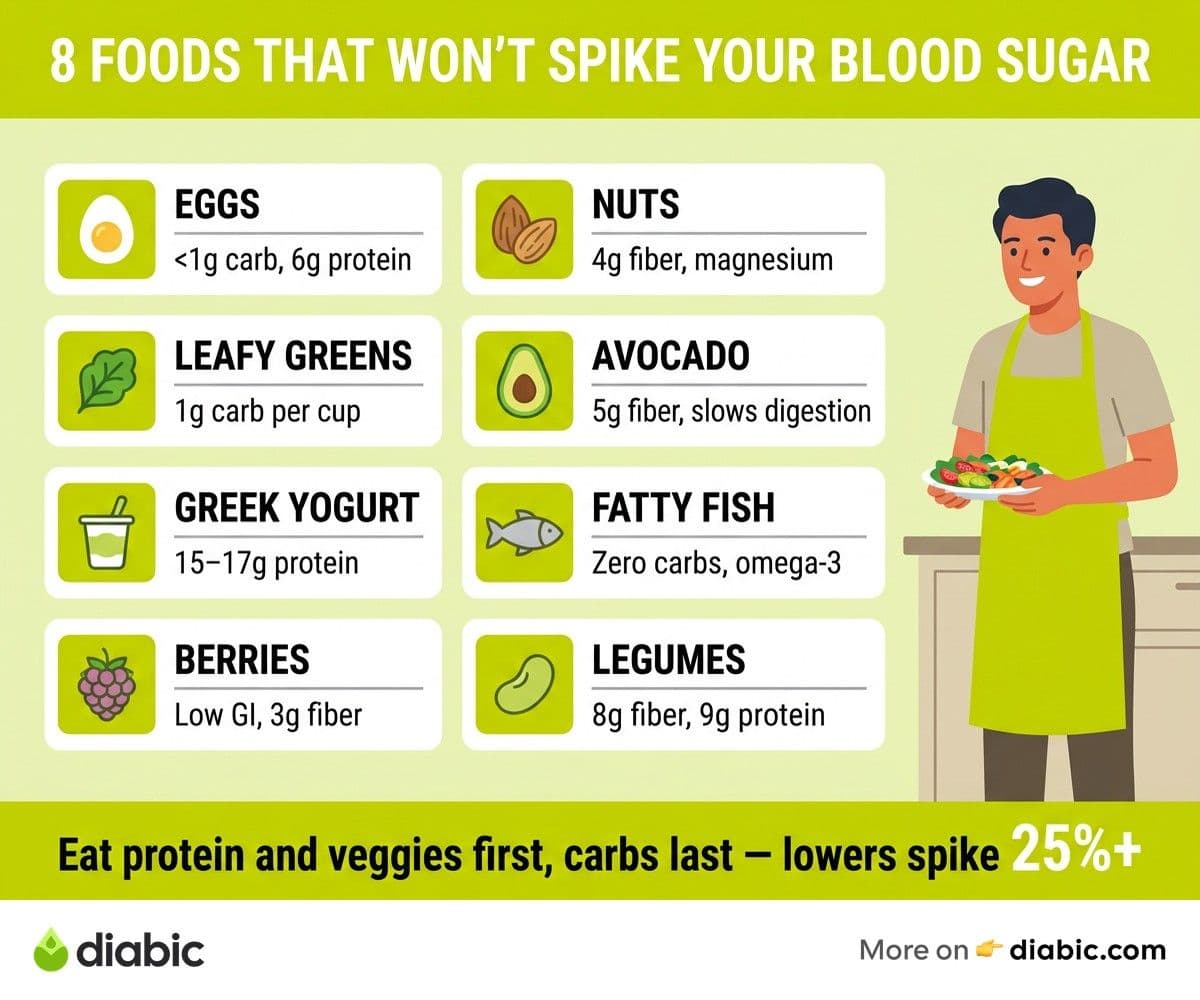
How to Build a Plate Around 8 Foods That Won't Spike Blood Sugar
Knowing the 8 foods that won't spike blood sugar is useful. Knowing how to combine them is what changes your daily numbers. The simplest framework is the plate method: half non-starchy vegetables (like leafy greens), a quarter lean protein (eggs, fish, Greek yogurt, legumes), and a quarter higher-quality carb (berries, beans, a small portion of whole grains), with a thumb of healthy fat (avocado, nuts, olive oil).
Eat the protein and veggies first, the carbs last. Research suggests this food order alone can lower post-meal glucose spikes by 25% or more. Add a 10-minute walk after meals when you can. Movement is one of the most powerful tools for keeping the curve flat.
You do not have to overhaul everything overnight. Pick one of these 8 foods that won't spike blood sugar and add it to one meal this week. Talk to your doctor or a registered dietitian about how each fits your medications and goals. See how your blood sugar responds and build from there. Small, repeatable choices outperform dramatic restarts every time.
Frequently Asked Questions
What foods do not spike blood sugar?
Foods that do not spike blood sugar are typically low in carbohydrates, high in fiber, and balanced with protein or healthy fats. Eggs, nuts, leafy greens, avocados, plain Greek yogurt, fatty fish, berries, and legumes are reliably steady choices. Combining these foods at meals (rather than eating high-carb foods alone) flattens the glucose curve even further.
What are the best foods to eat to keep blood sugar stable?
The best foods to eat to keep blood sugar stable share three traits: low to moderate carb count, meaningful fiber, and a buffer of protein or fat. Building meals around non-starchy vegetables, lean proteins, healthy fats, and small portions of high-fiber carbs (like berries or beans) gives you the steadiest day-to-day numbers. Eating protein and veggies before carbs, and walking for 10 minutes after meals, both add to the effect.
Are bananas bad for blood sugar?
Bananas are not "bad," but they can spike blood sugar more than berries because of their higher glycemic load, especially when ripe. A small or slightly green banana with peanut butter or Greek yogurt usually has a gentler effect than a large ripe banana eaten alone. Test your own response and adjust portions accordingly.
What snacks do not raise blood sugar?
Low-impact snacks pull from the same 8 foods that won't spike blood sugar covered above: a small handful of nuts, hard-boiled eggs, plain Greek yogurt with a few berries, sliced veggies with hummus, cheese with cucumber slices, or a spoonful of nut butter on apple slices. The pattern is the same: pair a small amount of carb with protein or fat, and keep the portion sensible.
Shahriar P. Shuvo is the founder of Diabic. He has lived with diabetes for over 14 years, and built Diabic to deliver the practical, evidence-based self-management tools he wished existed when he was first diagnosed. By trade, Shahriar is a senior design and frontend engineer with 6+ years shipping products at Agora, Timescale (now Tiger Data), and ShareTrip. He writes from the intersection of lived diabetes experience and product craft, focused on what works in daily management rather than what sounds good in a textbook.
Medically reviewed by
Dr. Shanto Arian is an internal medicine physician now specializing in clinical and aesthetic dermatology, with a parallel academic focus on epidemiology and public health. He holds an MBBS, MPH, MSc (UK), MRCP (UK), MRCPI (Ireland), Diploma in Dermatology (UK), and Diploma in Aesthetic Medicine (USA). Dr. Arian trained in internal medicine, including hospital work on hematology cases such as graft-versus-host disease, before moving toward dermatology. Skin is one of the earliest places diabetes shows itself, from acanthosis nigricans and diabetic dermopathy to slow foot wound healing, and that intersection is where his clinical and Diabic-review work meet. On Diabic, Dr. Arian medically reviews content on diabetes diagnosis, complications, dermatologic manifestations, and pharmacotherapy, ensuring every claim aligns with current ADA, NICE, and peer-reviewed literature.
More from Living with Diabetes
View all
A Gentle Chair Yoga Routine for people with diabetes
A gentle chair yoga for people with diabetes routine with safe poses, modifications for neuropathy, retinopathy, and joint pain, plus tips for older.

Shift Work and Diabetes: Managing Irregular Hours
Shift work and diabetes is a tough combination. Learn how to manage meals, sleep, medication, and blood sugar when your hours rotate or flip overnight.

Dating with Diabetes: When to Tell a New Partner
Dating with diabetes brings unique disclosure questions. Here is when to tell a new partner, what to say, and how to handle the conversation with.
Clinician-reviewed habits, plain-language guides, and honest answers - the small shifts that make living with diabetes feel lighter, every day.