Diabetic and Weight Loss: What Actually Works
Diabetic and weight loss advice usually misses the mark. See what the evidence shows actually works when insulin resistance and blood sugar are in the.

In this article(22)
You have tried the calorie-counting apps, the cardio routines, the smaller plates, and the scale will not budge the way the magazine articles promised. If you live with diabetes, that frustration is not a willpower problem. It is a metabolism problem, and the standard advice was not written with your body in mind.
Being diabetic and weight loss go-getter is harder than it should be, because insulin resistance, blood sugar swings, and certain medications quietly work against the very strategies most diet books recommend. The good news: there is a clear, evidence-based playbook for what actually works once you account for those realities.
This guide cuts the fluff. We will cover why standard advice falls short, the eating and movement strategies with the strongest evidence in people with diabetes, and how to work with your healthcare team so your medications support the goal instead of fighting it.
Why Standard Diabetic and Weight Loss Advice Falls Short
The classic advice, eat less and move more, is technically true but practically incomplete when you have diabetes. Insulin resistance changes how your body partitions fuel. Some diabetes medications increase appetite or promote fat storage. Aggressive calorie cuts can trigger blood sugar instability, which in turn drives cravings and binge cycles.
That is why diabetic loss weight strategies need to be built differently from the start. The goal is not just a calorie deficit. It is a calorie deficit that keeps blood sugar steady, preserves muscle, and works with your medications instead of against them.
How insulin resistance changes the rules
When your cells resist insulin, your pancreas pumps out more of it to compensate. Higher circulating insulin signals the body to store fat, particularly visceral fat around the abdomen, and makes it harder to access stored fat for energy. You can be in a calorie deficit and still feel like your body is hoarding every bite.
This is why eating patterns that lower insulin demand, such as reducing refined carbs, eating protein at every meal, and spacing meals appropriately, often outperform pure calorie counting in people with insulin resistance. You are addressing the hormonal driver, not just the math.
Why very-low-calorie diets can be dangerous with diabetes
Crash diets that drop calories below 1,000 per day can cause hypoglycemia in people on insulin, sulfonylureas, or some other diabetes medications. They can also worsen muscle loss, slow metabolism, and make rebound weight gain almost inevitable. Structured very-low-calorie programs do exist for diabetes (the DiRECT trial used one), but they require close medical supervision and active medication management.
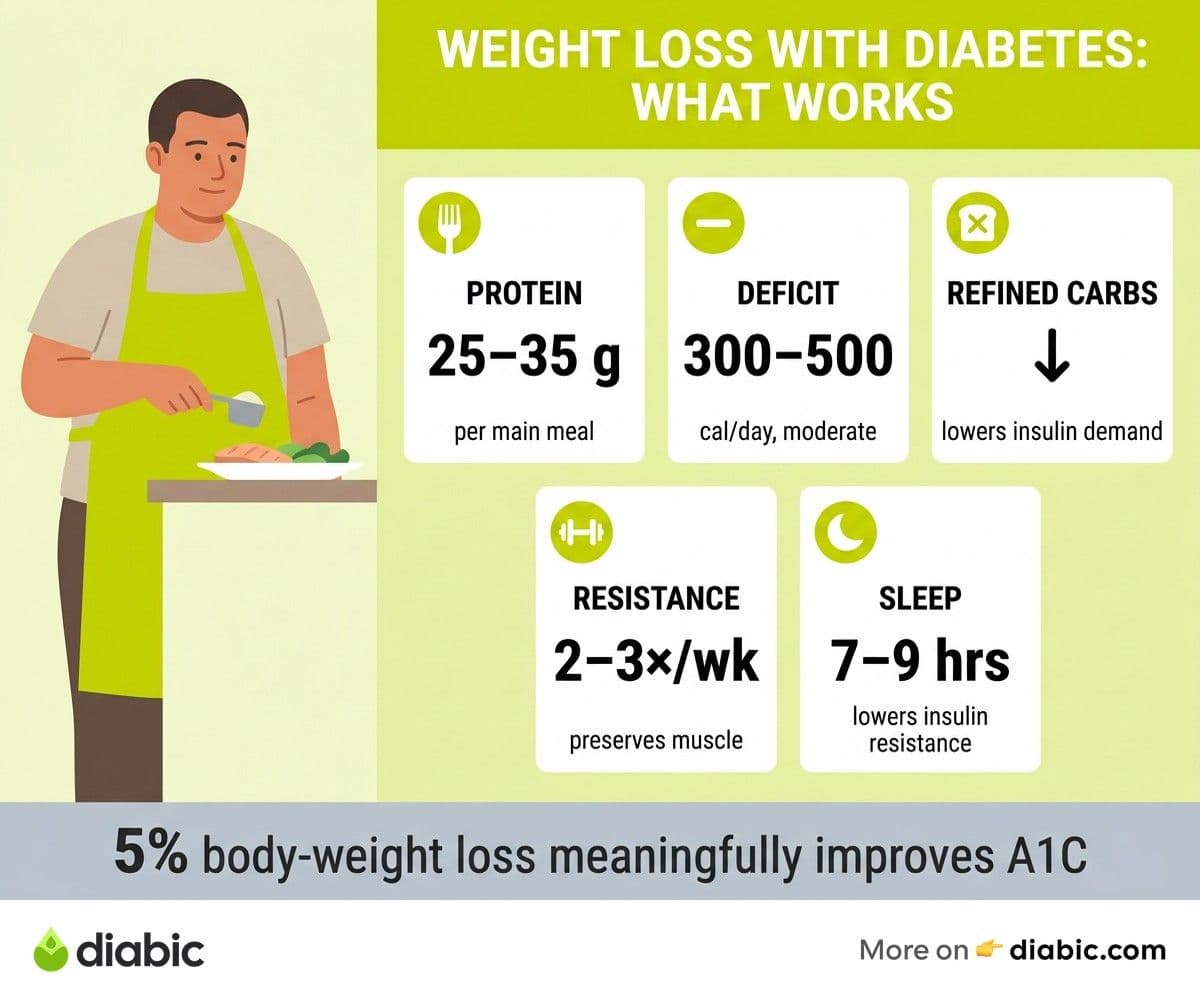
Without that supervision, slower is safer. A deficit of 300 to 500 calories per day, paired with adequate protein, is well-tolerated and produces sustainable loss without the risks.
The importance of blood sugar stability during weight loss
When blood sugar swings, hunger and cravings follow. Big spikes lead to bigger crashes, and crashes drive you toward fast carbs. This loop is one of the main reasons people with diabetes feel like they cannot stick to a plan.
Stable blood sugar is the prerequisite for everything else. Get the curve calmer first, through meal composition and timing, and the willpower demands of weight loss drop dramatically.
Strategies That Actually Work for Losing Weight with Insulin Resistance
Losing weight with insulin resistance is a different game than losing weight without it, but it is winnable. The strategies below have the strongest evidence in clinical trials and real-world use, and they share a common feature: they reduce insulin demand while supporting muscle, sleep, and recovery.
The American Diabetes Association treats weight management as a core part of diabetes care, and modern guidelines explicitly recommend approaches that combine nutrition, activity, behavior, and (when appropriate) medication.
Protein-forward eating
Aim for roughly 25 to 35 grams of protein at each main meal. Protein blunts post-meal glucose response, increases satiety hormones, and helps preserve muscle during weight loss. For someone targeting around 1,500 to 1,800 calories per day, that often translates to 100 to 130 grams of protein total.
Practical anchors: eggs or Greek yogurt at breakfast, a palm-sized portion of fish, chicken, tofu, or lean meat at lunch and dinner, and a protein-containing snack if you eat between meals. People who add protein to their existing meals, even before doing anything else, often see weight loss begin within weeks.
Reducing refined carbs while keeping complex carbs
Refined carbs (white bread, pastries, sugary drinks, most breakfast cereals, white rice) drive the sharpest glucose and insulin responses. Cutting these aggressively while keeping complex, fiber-rich carbs (legumes, oats, barley, quinoa, fruit, vegetables) tends to produce fast glycemic improvements and steady weight loss without leaving you depleted.
This is not the same as low-carb. You can absolutely eat carbs. The strategy is choosing carbs that come with fiber, protein, or fat, and reducing the ones that do not. Studies in Diabetes Care and other peer-reviewed journals consistently support this approach for sustained weight management in type 2 diabetes.
Strength training (not just cardio)
Most diabetic and weight loss content emphasizes cardio. Cardio matters, but strength training matters more for the metabolic problem you are solving. Muscle is the largest site of glucose disposal in the body, and adding muscle improves insulin sensitivity at rest, all day long.
Two or three sessions per week is enough to start, even with bodyweight or light dumbbells at home. Squats, hinges, presses, rows, and a core movement, eight to twelve reps, two to three sets. The compounding effect over six to twelve months on both blood sugar and body composition is substantial. For the broader picture on weight loss in type 2 diabetes, our deep dive on weight loss and type 2 diabetes covers the evidence in more detail.
Sleep and stress
Short sleep (under six hours) raises cortisol, increases insulin resistance, and drives hunger hormones the wrong direction. People who sleep less consistently eat more the next day, especially carbs. If you are working hard on diet and movement and the scale will not move, sleep is often the missing variable.
Stress works through the same hormonal channels. Chronic stress raises blood sugar even without eating more, and it makes the cravings sharper. Five-minute walks, breathing practices, and saying no to optional commitments are not wellness fluff. They are metabolic interventions for someone with insulin resistance.
Finding the Right Eating Pattern for Weight Loss and Type 2 Diabetes
There is no single best diet for weight loss and type 2 diabetes. There are several patterns with strong evidence, and the right one is the one you can sustain for years while keeping blood sugar in your target range. The 5 rules for a healthy diet for type 2 diabetes walks through the principles that apply across most of these patterns.
Mediterranean for long-term sustainability
The Mediterranean pattern (vegetables, legumes, fish, olive oil, nuts, whole grains, modest dairy and meat) has the longest track record for cardiometabolic health and is consistently easy for most people to maintain. It tends not to feel like a diet, which is the whole point. For people who hate restriction, this is often the best starting place.
Low-carb for faster blood sugar improvements
Reducing carbs to roughly 50 to 130 grams per day produces faster glucose improvements and often more rapid initial weight loss. Some people thrive on this approach, particularly those with high insulin resistance or significant cravings driven by glucose swings. The trade is that it requires more planning, and very low-carb (under 50 grams) needs medical guidance if you are on insulin or sulfonylureas because medication doses often need adjusting.
Intermittent fasting: potential benefits and cautions
Time-restricted eating, where you compress your eating window to 8 to 10 hours, has shown promise in small studies for improving insulin sensitivity and supporting modest weight loss. It works for some people because it naturally reduces calorie intake and gives the digestive system longer rest periods.
It is not for everyone with diabetes. If you take insulin, sulfonylureas, or certain other medications, fasting can cause dangerous lows. Talk to your provider before extending fasting windows beyond a normal overnight gap. Also, fasting is not magic. The eating you do during your window still has to be reasonable for results to follow.
Working with Your Healthcare Team
Weight loss with diabetes is one of the few areas where having a small, coordinated team genuinely changes outcomes. Going it alone is harder, slower, and riskier than it needs to be.
Why a dietitian who understands diabetes is valuable
A registered dietitian who specializes in diabetes can build a plan around your specific medications, your blood sugar patterns, your food preferences, and your real-life schedule. They translate the research into something you can actually do this week. Many insurance plans cover medical nutrition therapy for diabetes, and many people never use the benefit.
Ask your primary care provider for a referral. If your insurance covers it, the cost is often minimal, and even three or four sessions can change your trajectory.
Medication adjustments during weight loss
As you lose weight, your insulin sensitivity improves, which means medication doses may need to come down. Insulin and sulfonylureas in particular often need dose reductions to prevent lows. This is a good problem to have, but it requires active communication with your provider.
Some medications, like GLP-1 receptor agonists and metformin, support weight loss directly. If you are working hard on lifestyle change without much progress, ask whether your current regimen is appropriate. The realistic 2-month metformin weight loss results post covers what to actually expect from one of the most common starting medications.
Monitoring more closely during dietary changes
When you change how you eat, blood sugar patterns change too. Check more often during the first two to four weeks of any significant dietary shift, especially fasting and post-meal numbers. This data tells you what is working and flags lows before they become emergencies.
If you use a continuous glucose monitor, this is exactly the time to put the data to use. If you do not, more frequent fingersticks for a couple of weeks will earn their inconvenience.
From my experience: I have lived with diabetes for 14 years, and the single biggest unlock for my weight was protein at breakfast. For years I ate oatmeal, thought I was being healthy, and could not figure out why I was hungry by 10 a.m. and grazing all afternoon. Switching to two eggs and a piece of fruit changed the entire arc of my day, blood sugar smoother, hunger gone, evening snacking dropped almost on its own. The lesson was that the wrong "healthy" choice can quietly sabotage weeks of effort, and the fix was small, specific, and free.
FAQ
What is the best way for a person with diabetes to lose weight?
The strategy with the strongest evidence is a combination of protein-forward eating, reduced refined carbs (with complex carbs preserved), regular physical activity that includes both cardio and strength training, and adequate sleep. Pairing this with a medication review (some diabetes medications support weight loss, others cause gain) and ideally a session or two with a registered dietitian who specializes in diabetes is the most reliable path. There is no single best diet, but most successful approaches share these features.
Why is it hard for people with diabetes to lose weight?
Insulin resistance promotes fat storage and makes it harder to access stored fat for energy. Some diabetes medications, including insulin and sulfonylureas, can increase appetite or cause weight gain. Blood sugar swings drive cravings, particularly for fast carbs, which derails plans. Chronic stress and short sleep, both common with diabetes, further raise insulin resistance. Understanding these mechanisms helps explain why standard advice falls short and points toward strategies that address the underlying biology.
How fast can a person with diabetes lose weight safely?
A loss of 1 to 2 pounds per week is the range most clinicians recommend as both safe and sustainable. Faster loss is possible under medical supervision, particularly with structured low-calorie programs or weight-loss medications, but it requires close monitoring of blood sugar and medication doses. Loss faster than 2 pounds per week without supervision risks hypoglycemia, muscle loss, and rebound regain.
Should I count calories or carbs to lose weight with diabetes?
Both can work, and many people find a hybrid approach easier. Carb awareness directly addresses the blood sugar piece. Calorie awareness addresses the energy balance piece. A practical middle ground is to focus on plate composition (a palm of protein, a fist or two of vegetables, a cupped palm of carbs, a thumb of healthy fat) and let the math approximate itself. Track only what helps you, and stop when it stops being useful.
Diabetic and weight loss outcomes improve dramatically when the strategy is built for your metabolism instead of borrowed from someone else's. Pick one change this week, give it a fair chance for 30 days, and let the data guide what you adjust next.
Shahriar P. Shuvo is the founder of Diabic. He has lived with diabetes for over 14 years, and built Diabic to deliver the practical, evidence-based self-management tools he wished existed when he was first diagnosed. By trade, Shahriar is a senior design and frontend engineer with 6+ years shipping products at Agora, Timescale (now Tiger Data), and ShareTrip. He writes from the intersection of lived diabetes experience and product craft, focused on what works in daily management rather than what sounds good in a textbook.
Medically reviewed by
Dr. Shanto Arian is an internal medicine physician now specializing in clinical and aesthetic dermatology, with a parallel academic focus on epidemiology and public health. He holds an MBBS, MPH, MSc (UK), MRCP (UK), MRCPI (Ireland), Diploma in Dermatology (UK), and Diploma in Aesthetic Medicine (USA). Dr. Arian trained in internal medicine, including hospital work on hematology cases such as graft-versus-host disease, before moving toward dermatology. Skin is one of the earliest places diabetes shows itself, from acanthosis nigricans and diabetic dermopathy to slow foot wound healing, and that intersection is where his clinical and Diabic-review work meet. On Diabic, Dr. Arian medically reviews content on diabetes diagnosis, complications, dermatologic manifestations, and pharmacotherapy, ensuring every claim aligns with current ADA, NICE, and peer-reviewed literature.
More from Diet & Fitness
View all
Simple Diabetes Exercise Routine for Beginners
A simple diabetes exercise routine for beginners with a 7-day plan, strength basics, and safety tips to help you move more without feeling overwhelmed.

Diabetes Friendly Smoothie Recipes: 5 No-Spike Picks
Five diabetes friendly smoothie recipes that balance protein, fat, and fiber to keep blood sugar steady. Includes a simple framework for building your own.

Can Exercise Prevent Diabetes? Research Says Yes
Can exercise prevent diabetes? Landmark studies show a 58% lower risk with regular activity. Here's how much you need and which workouts help most.
Clinician-reviewed habits, plain-language guides, and honest answers - the small shifts that make living with diabetes feel lighter, every day.