Weight Loss and Type 2 Diabetes: What Helps
Weight loss and type 2 diabetes are deeply linked. Learn what actually works to lower A1C, improve insulin sensitivity, and stick with the change.

In this article(21)
You step on the scale, see a number you have seen for years, and wonder if any of this matters for your blood sugar. It does, and probably more than you have been told. The relationship between weight loss and type 2 diabetes is one of the most studied connections in modern medicine, and the news is genuinely encouraging.
Most people hear "lose weight" from their doctor and assume that means drop fifty pounds before A1C will budge. The science says something different. Even a modest, sustainable shift can change how your body handles glucose, sometimes within weeks. The hard part is figuring out what helps when standard advice keeps failing.
This guide walks through what the research shows about weight loss for people with type 2 diabetes, why some methods work better than others, and how to handle the real-world friction that gets in the way. We will be practical about medications, plateaus, and the days when motivation disappears.
How Weight Loss Improves Type 2 Diabetes
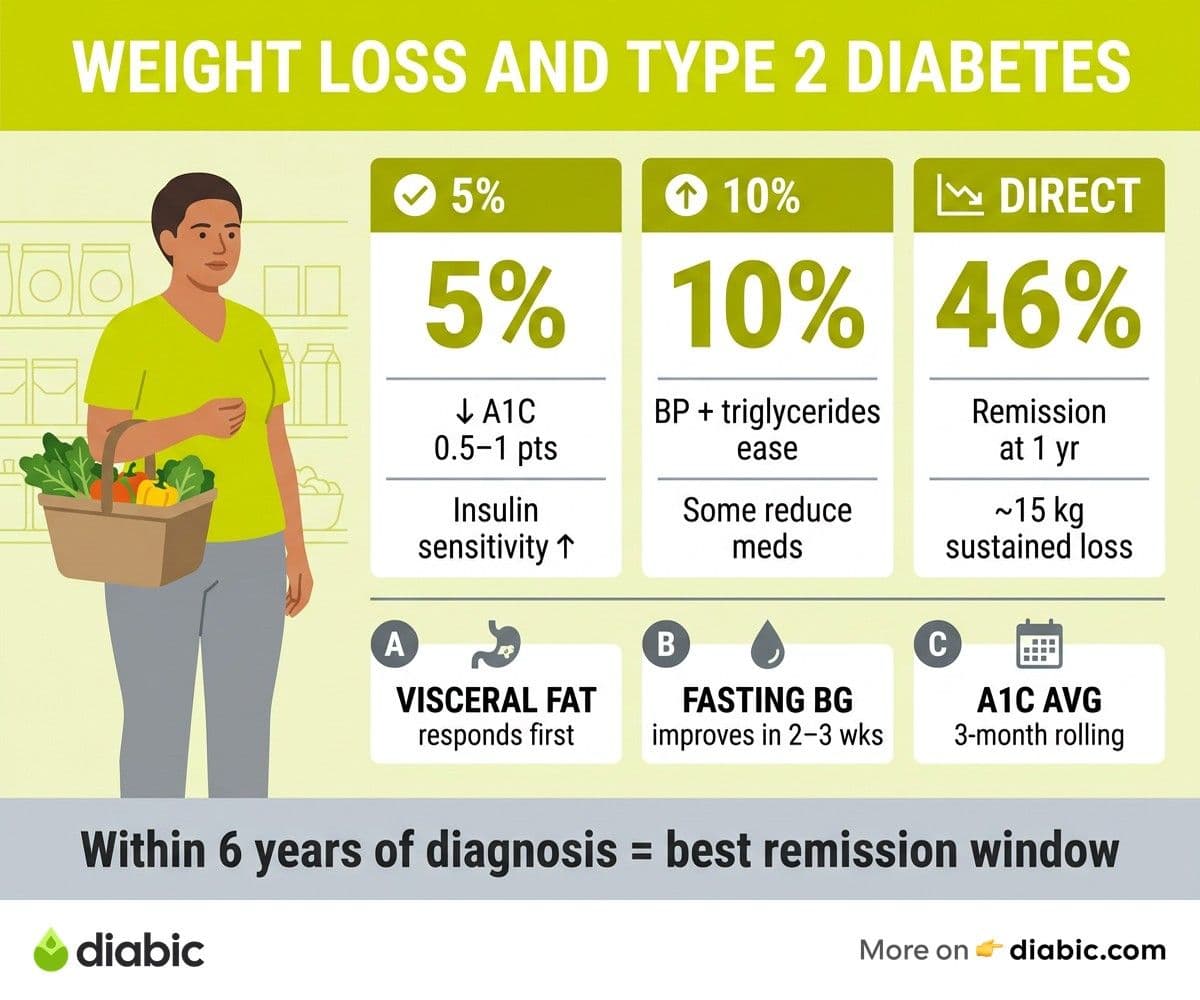
The single most useful number in this conversation is 5%. Losing five percent of your body weight, roughly 10 pounds for someone who weighs 200, is enough to meaningfully improve insulin sensitivity, lower fasting glucose, and reduce A1C in many people with type 2 diabetes. The American Diabetes Association builds this threshold directly into its standards of care because the evidence is consistent across decades of trials.
Push that number to 10% and the effects compound. Triglycerides drop. Blood pressure often eases. Some people reduce or stop certain diabetes medications, always with their provider's guidance. The fat that matters most here is not the kind you see in the mirror. It is visceral fat, the deep abdominal fat wrapped around the liver and pancreas, which appears to interfere with how those organs process insulin and glucose.
The 5-10% threshold and what it does to A1C
Studies tracking adults with type 2 diabetes show that a 5 to 7% weight loss is often associated with A1C reductions of around 0.5 to 1 percentage point. That is roughly the same effect size as adding a second oral medication. People who reach 10% loss tend to see larger improvements, though individual response varies based on how long someone has had diabetes, age, and starting insulin function.
A1C is a three-month average, so changes show up gradually. Many people see fasting numbers improve first, sometimes within two or three weeks of consistent eating changes. That early signal can be powerful motivation, even when the scale moves slowly.
How weight loss improves insulin sensitivity
Insulin resistance is the core driver of type 2 diabetes for most people. When fat accumulates inside muscle and liver cells, those cells stop responding well to insulin's signal to absorb glucose. Reducing that internal fat, even modestly, lets insulin do its job again.
This is why weight loss can feel like a reset. You are not just smaller. Your cells are listening to insulin again, your pancreas does less overtime work, and post-meal glucose spikes start to flatten.
Research on remission through weight management
The DiRECT trial, published in The Lancet, found that nearly half of participants with type 2 diabetes achieved remission after sustained weight loss through a structured low-calorie program. Among those who lost 15 kilograms or more, remission rates were even higher. Remission in the study meant an A1C below 6.5% without diabetes medications for at least six months.
This research reframed how many clinicians talk about type 2 diabetes. Remission does not mean cured, and weight regain typically brings the diabetes back. Still, the trial showed that significant, durable improvements are possible for many people, especially those within the first six years of diagnosis.
What Works for Weight Loss and Type 2 Diabetes
There is no single best diet for weight loss and type 2 diabetes, and anyone who tells you otherwise is selling something. What the evidence consistently shows is that several patterns work, as long as you can stick with them and they keep blood sugar steady. The right one is the one you can do for years, not weeks.
The shared thread across successful approaches is reduced refined carbohydrates, more fiber and protein, and consistent meal timing. Beyond that, personal preference and metabolic response matter more than the brand name on the diet.
Dietary approaches with evidence
The Mediterranean pattern, rich in vegetables, legumes, fish, olive oil, and whole grains, has the longest track record for both weight loss and cardiometabolic health in people with diabetes. Low-carb eating, where carbs are reduced to roughly 50 to 130 grams per day, often produces faster glucose improvements and may suit people who feel best on a higher-protein, higher-fat plate.
Calorie-aware eating without rigid macro rules also works, particularly when paired with a healthy diet for type 2 diabetes framework that emphasizes plate composition over precise tracking. If you have insulin resistance and feel stuck, our guide on losing weight with insulin resistance covers practical first steps that account for how your body responds to carbs.
Movement that makes a measurable difference
The standard recommendation, 150 minutes per week of moderate aerobic activity plus two or three sessions of strength training, exists because it is what the data supports. Aerobic work improves insulin sensitivity for up to 48 hours after a session. Strength training builds muscle, and more muscle means more glucose disposal at rest.
You do not need a gym to start. A 20-minute walk after dinner has been shown in multiple small studies to lower post-meal glucose by 20 to 30 mg/dL in people with type 2 diabetes. Stack two or three of those into your week and you are already on the board.
Behavioral strategies that quietly do the heavy lifting
Food logging, even imperfect logging, consistently shows up in research as one of the strongest predictors of weight loss success. The act of writing it down, photo or app or paper, slows the auto-pilot eating that sneaks calories in. Meal planning a few days ahead reduces decision fatigue, which is when most plans fall apart.
Support matters more than people admit. A weekly check-in with a friend, a diabetes educator, or an online community keeps you anchored when motivation fades. We see this in our own community: people who post their wins and stumbles last longer than those who try to do it alone.
How Diabetes Medications Affect Type 2 Diabetic Weight Loss
Type 2 diabetic weight loss is rarely just about food and movement. Your medications can quietly help or quietly work against you, and most people are never told which is which. Knowing where your prescriptions sit on this spectrum changes the conversation you have with your doctor.
Some medications support weight loss as a side effect of how they work. Others were designed when the priority was glucose control alone, and weight gain was an accepted trade. Modern guidelines increasingly favor agents that do both jobs.
Medications that may support weight loss
GLP-1 receptor agonists (semaglutide, liraglutide, dulaglutide and others) slow stomach emptying, blunt appetite, and consistently produce 5 to 15% body weight loss in trials. They have transformed how many providers approach type 2 diabetes management when weight is part of the picture.
Metformin, the most prescribed first-line medication, tends to be weight-neutral or modestly weight-reducing for most people. SGLT2 inhibitors (empagliflozin, dapagliflozin) cause the kidneys to excrete excess glucose, which results in modest weight loss along with cardiovascular benefits.
Medications that may cause weight gain
Insulin, sulfonylureas (glipizide, glyburide), and thiazolidinediones (pioglitazone) are associated with weight gain in many people. This does not mean they are bad medications. They control blood sugar effectively, and for some people they are the right choice. It does mean you should know about the trade and discuss alternatives if weight is a priority.
Never stop or adjust a diabetes medication on your own. Stopping insulin abruptly can be dangerous. The point of knowing this list is to walk into your next appointment ready to ask, "Are we on the best regimen for both my A1C and my weight goals?"
Talking to your doctor about medication and weight
Bring a short list. Your current weight, your A1C, your goal, and a question: are there changes that would support both? Many providers will appreciate the directness, and modern guidelines from the ADA explicitly support choosing weight-favorable medications when appropriate. If your provider seems unwilling to discuss it, asking for a referral to an endocrinologist or a certified diabetes educator is a reasonable next step. Pairing medication strategy with exercise for type 2 diabetes can amplify the benefit further.
Overcoming Common Weight Loss Challenges
The middle of any weight loss effort is harder than the start. The novelty wears off, the scale stalls, and life gets in the way. This is where most plans quietly die, and it is also where the people who succeed do something different.
What helps is not more willpower. It is a different mental frame and a few practical tools.
Plateaus and how to push through
Most plateaus are real and predictable. As you lose weight, your body needs fewer calories to function, so the same eating pattern that produced loss now produces maintenance. This is biology, not failure.
Three approaches tend to break stalls: a small additional reduction in calories or carbs, a meaningful increase in strength training to add muscle, and a planned diet break of one to two weeks at maintenance to let metabolic and hormonal signals reset. Pick one. Doing all three at once muddies the data and your sanity.
Emotional eating and stress
Cortisol raises blood sugar and drives cravings, especially for carb-rich comfort foods. Chronic stress can stall weight loss even when food and movement are dialed in. This is where sleep, breathing practices, and short walks earn their keep, not as wellness fluff but as legitimate metabolic interventions.
If emotional eating is a recurring pattern, a therapist who works with chronic illness or disordered eating can be genuinely useful. Many insurance plans cover this, and many people with diabetes never explore it.
Staying motivated when progress is slow
Track non-scale wins. Loosened jeans, easier stairs, lower fasting glucose, fewer afternoon slumps, a better sleep score. The scale lies on a daily basis. These signals do not.
The CDC recommends that people with diabetes build a small support team: primary care, a diabetes educator, a dietitian if available, and at least one peer. Accountability does not have to be intense. A weekly text exchange with a friend who is also working on something hard can carry you through months when the scale is uncooperative.
From my experience: I have lived with diabetes for 14 years, and the most useful thing I learned about weight loss is that the scale is the worst feedback tool you have. My A1C dropped a full point during a stretch where the scale moved less than three pounds, because I had finally gotten consistent with walking after dinner and stopped grazing in the evenings. The body responds to the pattern, not the snapshot. Trust the pattern.
FAQ
How much weight should a type 2 diabetic lose?
Research consistently shows that losing 5 to 10% of body weight produces meaningful improvements in blood sugar, insulin sensitivity, and overall risk profile. For someone weighing 200 pounds, that is 10 to 20 pounds. Some people see additional benefits at 15% or more, but the early gains arrive at the lower end. Your provider can help set a target that fits your starting point, medications, and other health conditions.
Does losing weight help control type 2 diabetes?
Yes, and the effect can be substantial. Weight loss is one of the most reliably effective ways to manage type 2 diabetes. Even modest loss improves insulin sensitivity, can lower A1C by half a point or more, and may reduce the dose or number of diabetes medications you need. For some people, especially those diagnosed within the past several years, larger weight loss has produced sustained remission in clinical trials.
How fast should I lose weight if I have type 2 diabetes?
A loss of 1 to 2 pounds per week is the range most clinicians and the ADA suggest as both safe and sustainable. Faster loss is possible under medical supervision, particularly with structured programs or medications, but rapid loss without monitoring can cause blood sugar swings, especially if you are on insulin or sulfonylureas. Slow and consistent beats fast and rebound nearly every time.
Can weight loss reverse type 2 diabetes?
Research, including the DiRECT trial, shows that significant weight loss can put type 2 diabetes into remission for many people, particularly those within the first six years of diagnosis. Remission means normal blood sugar without diabetes medications, not a cure. The diabetes can return if weight is regained, which is why long-term lifestyle support matters as much as the initial loss.
The relationship between weight loss and type 2 diabetes is not a quick fix or a moral test. It is a slow, evidence-backed process where small consistent changes produce real metabolic benefit, and where the right medical support and community can make the hard parts survivable. Pick one thing this week, do it for 30 days, and see what your body tells you.
Shahriar P. Shuvo is the founder of Diabic. He has lived with diabetes for over 14 years, and built Diabic to deliver the practical, evidence-based self-management tools he wished existed when he was first diagnosed. By trade, Shahriar is a senior design and frontend engineer with 6+ years shipping products at Agora, Timescale (now Tiger Data), and ShareTrip. He writes from the intersection of lived diabetes experience and product craft, focused on what works in daily management rather than what sounds good in a textbook.
Medically reviewed by
Dr. Rezwana Parvin Rumpa is an obstetrics and gynaecology specialist with clinical focus on gestational diabetes, PCOS, and fertility. She holds the MRCOG (Final Part) from the Royal College of Obstetricians and Gynaecologists in London, the MRCPI (Final Part) from the Royal College of Physicians of Ireland, and an MBBS from Shaheed Monsur Ali Medical College under Dhaka University. Dr. Rumpa serves as a Senior Medical Officer in the Obs and Gynae department at BRB Hospitals Ltd, where she has spent three years managing prenatal care, emergency obstetric cases, and women's-health surgery. On Diabic, she medically reviews content for women living with diabetes, with particular attention to pregnancy, PCOS, and reproductive-health intersections.
More from Diet & Fitness
View all
Simple Diabetes Exercise Routine for Beginners
A simple diabetes exercise routine for beginners with a 7-day plan, strength basics, and safety tips to help you move more without feeling overwhelmed.

Diabetes Friendly Smoothie Recipes: 5 No-Spike Picks
Five diabetes friendly smoothie recipes that balance protein, fat, and fiber to keep blood sugar steady. Includes a simple framework for building your own.

Can Exercise Prevent Diabetes? Research Says Yes
Can exercise prevent diabetes? Landmark studies show a 58% lower risk with regular activity. Here's how much you need and which workouts help most.
Clinician-reviewed habits, plain-language guides, and honest answers - the small shifts that make living with diabetes feel lighter, every day.