Diabetes Distress vs Depression: How to Tell the Difference
Diabetes distress vs depression can feel similar but need different help. Learn the key signs, screening tools, and when to talk to a professional.

In this article(10)
You stare at the glucose meter, see another number that does not match what you ate or did, and something inside you just sinks. Maybe you skip logging it. Maybe you cancel plans because the thought of explaining your routine to one more person feels heavier than the routine itself. If that scene feels familiar, you are not weak, and you are not alone.
Living with a chronic condition takes a real emotional toll, and the question of diabetes distress vs depression comes up for many people who feel that toll piling up. The two can look almost identical from the outside, yet they call for different kinds of support. Naming what you are feeling is the first step toward getting help that actually works.
We want to walk through the differences with you, share the screening tools clinicians use, and help you decide what to do next. None of this replaces a conversation with your care team, but it can help you start that conversation with more clarity.
From my experience: A few years back I hit a stretch where every Dexcom alarm at dinner felt like a small personal insult. I was convinced something was wrong with me, not with the data. A therapist who worked with chronic illness helped me see that what I was carrying was distress, not depression, and naming it that way changed how I responded to the next 200 mg/dL spike. The numbers were the same. My relationship to them was not.
What Is Diabetes Distress?
Diabetes distress is the emotional weight that comes specifically from living with and managing diabetes. It includes the frustration of unexpected glucose readings, the fear of long-term complications, the exhaustion of daily decisions about food and activity, and the worry about what other people think when they see your devices or hear your alarms. Researchers describe it as a normal psychological response to a demanding chronic illness, not a mental health disorder.
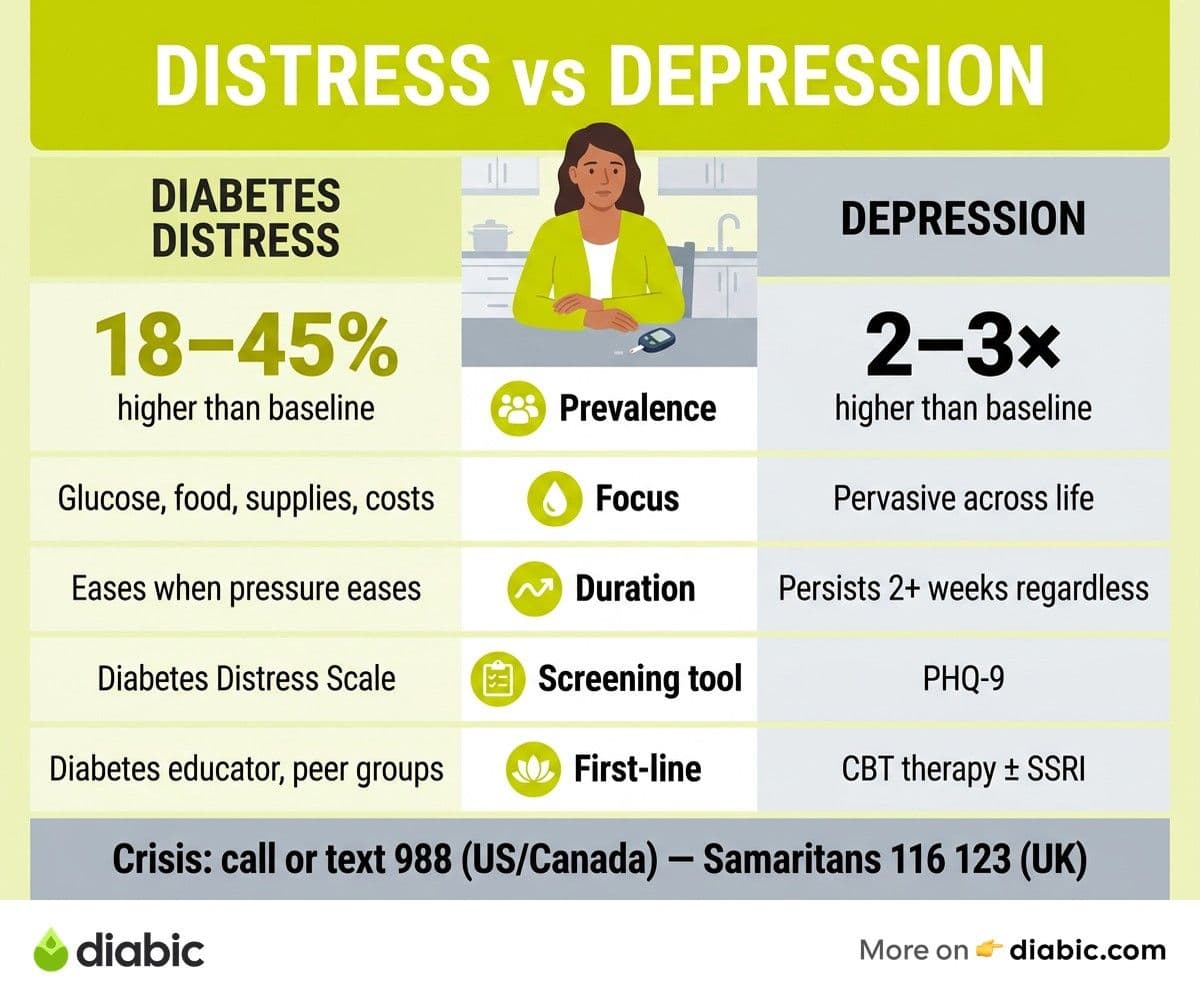
Studies cited in the American Diabetes Association Standards of Care suggest that diabetes distress affects roughly 18 to 45 percent of people with diabetes at any given time, with rates climbing during life transitions, after coping with diagnosis, or when complications appear. The numbers are even higher for adolescents, which is why we often talk about teen diabetes mental health as its own concern.
What makes distress recognizable is its focus. The hard feelings cluster around glucose numbers, food choices, supplies, costs, appointments, and the future of your health. When the diabetes pressure eases, even briefly, the heaviness usually eases too. That pattern is one of the clearest signals that what you are experiencing is distress rather than something deeper.
What Is Clinical Depression?
Clinical depression is a mood disorder that reaches into every corner of life, not only the parts touched by diabetes. The National Institute of Mental Health describes it as a persistent low mood or loss of interest that lasts most of the day, nearly every day, for at least two weeks, along with changes in sleep, appetite, energy, concentration, or self-worth. Some people also experience thoughts of death or suicide, which always warrant immediate professional support.
People with diabetes are about two to three times more likely to experience depression than people without it, according to long-running research published in journals like Diabetes Care. The reasons are layered and include the biological effects of glucose variability on mood, the cumulative stress of self-management, and the social isolation that chronic illness can bring. Type does not seem to protect anyone, and depression can appear at any stage of life with diabetes.
Unlike distress, depression does not lift when the diabetes side of life calms down. You can have a steady week of in-range numbers and still feel empty, slow, and detached. That persistence is what separates a mood disorder from situational distress, and it is one of the reasons depression usually needs clinical treatment rather than self-help alone.
Diabetes Distress vs Depression: Key Differences
The most useful way we have seen people sort out diabetes distress vs depression is to ask where the heaviness lives. Distress lives inside diabetes-related thoughts and tasks. Depression lives everywhere, including in things that have nothing to do with your health, like your hobbies, your relationships, your career, and your sense of who you are.
Another difference is responsiveness. Distress often improves with practical changes, like simplifying your routine, switching technology, joining a peer group, or working through diabetes burnout with a diabetes educator. Depression tends to persist regardless of those changes and usually responds better to therapy, medication, or both. A 2022 review in Diabetes Care found that untreated diabetes distress raises the risk of developing depression over time, which is why clinicians take it seriously even when it does not meet diagnostic criteria for a mood disorder.
The two conditions can also coexist, and that overlap is more common than people realize. You can carry chronic diabetes anxiety and stress about your numbers while also living with a depressive episode that has its own roots. Recognizing both is not over-pathologizing yourself; it is giving each part of your experience the attention it deserves.
Here is how the two compare at a glance:
The two can overlap, so a high score on one screener does not rule out the other. A clinician can help sort which pattern (or combination) fits you best.
How the symptoms can overlap
Fatigue is a good example of overlap. A person with distress might feel drained from the mental load of management. A person with depression might feel drained no matter what they do. A person with both feels both, and it can be hard to tell where one ends and the other begins without help.
Sleep changes show a similar pattern. Distress can keep you awake replaying the day's numbers or worrying about tomorrow. Depression can flatten sleep into too much or too little for weeks on end. A clinician can help untangle which pattern fits you best and what to do about it.
How to Assess What You Are Feeling
Two well-validated tools can give you and your provider a starting point. The first is the Diabetes Distress Scale, often shortened to DDS, developed by researchers at the Behavioral Diabetes Institute. It asks you to rate how bothered you have been by specific aspects of life with diabetes, like feeling overwhelmed by the demands of management or worrying about the future. Higher scores point toward elevated distress and suggest that targeted diabetes support could help.
The second is the PHQ-9, a nine-item depression screener used widely in primary care. It asks about mood, interest, sleep, appetite, energy, self-worth, concentration, movement, and thoughts of self-harm over the past two weeks. It is not a diagnosis on its own, but a moderate or higher score is a clear cue to talk to a mental health professional. Both tools are short, free, and available through your care team, and many clinics now use them at routine visits.
A simpler self-check can also be revealing. Ask yourself, is this about diabetes specifically, or is everything feeling heavy? If the answer is everything, depression is more likely in the picture. If it is mostly diabetes, distress is more likely the lead actor. Either way, sharing what you notice with your healthcare provider gives them the information they need to help.
Getting the Right Help for Each One
For diabetes distress, the most effective steps tend to be practical and connection-based. Working with a certified diabetes care and education specialist can ease the cognitive load by helping you simplify routines and troubleshoot specific patterns. Peer support also matters, and joining diabetes support groups can reduce isolation in a way that no clinical visit can match. The ADA Standards of Care now formally recommend psychosocial assessment as a routine part of diabetes management, so do not hesitate to bring up emotional load at your next appointment.
For depression, the path looks different. Evidence-based therapies like cognitive behavioral therapy have strong research support, and many therapists now specialize in chronic illness or health psychology. Medication, often a selective serotonin reuptake inhibitor, can help when symptoms are moderate to severe, and your provider can guide that decision based on your full health picture. Combining therapy and medication often works better than either alone for people with diabetes, according to studies summarized by the American Psychological Association.
If you are dealing with both at once, a care team that includes a mental health professional alongside your endocrinologist or primary care provider gives you the best shot at meaningful relief. Please do not dismiss what you are feeling as just part of having diabetes. Emotional symptoms are health information, and they deserve attention from someone trained to help.
When to reach out today
If you are having thoughts of harming yourself, please contact a crisis line right away. In the United States and Canada, you can call or text 988 to reach the Suicide and Crisis Lifeline. In the United Kingdom, Samaritans is available at 116 123. These services are free, confidential, and staffed by people who want to help.
If you are not in crisis but the heaviness has lasted longer than a couple of weeks, message your primary care team this week. A short note that says, I want to talk about how I am feeling emotionally, opens the door without requiring you to have all the answers first.
Frequently Asked Questions
What is the difference between diabetes distress and depression?
Diabetes distress is the emotional load tied specifically to managing diabetes, like frustration with numbers or fear of complications, and it eases when the diabetes pressure eases. Depression is a mood disorder that affects all areas of life, persists regardless of your glucose numbers, and usually requires therapy, medication, or both. The two can also coexist.
How do I know if I have diabetes distress or depression?
A useful first step is to ask whether your heavy feelings center on diabetes specifically or feel pervasive across everything. Validated screening tools like the Diabetes Distress Scale and the PHQ-9 can give you and your provider a clearer picture, and a conversation with your healthcare team or a mental health professional is the best way to confirm what you are experiencing and choose the right support.
If you remember one thing, let it be this: emotional symptoms count as real symptoms in diabetes care, and asking for help is a sign of good self-management, not failure. The work of sorting out diabetes distress vs depression is rarely something you finish in a single afternoon. It often unfolds across a few visits, a few honest conversations, and a willingness to try one supportive step before reaching for the next. Whatever the label turns out to be, you deserve support that fits the full reality of your life.
Shahriar P. Shuvo is the founder of Diabic. He has lived with diabetes for over 14 years, and built Diabic to deliver the practical, evidence-based self-management tools he wished existed when he was first diagnosed. By trade, Shahriar is a senior design and frontend engineer with 6+ years shipping products at Agora, Timescale (now Tiger Data), and ShareTrip. He writes from the intersection of lived diabetes experience and product craft, focused on what works in daily management rather than what sounds good in a textbook.
Medically reviewed by
Dr. Shanto Arian is an internal medicine physician now specializing in clinical and aesthetic dermatology, with a parallel academic focus on epidemiology and public health. He holds an MBBS, MPH, MSc (UK), MRCP (UK), MRCPI (Ireland), Diploma in Dermatology (UK), and Diploma in Aesthetic Medicine (USA). Dr. Arian trained in internal medicine, including hospital work on hematology cases such as graft-versus-host disease, before moving toward dermatology. Skin is one of the earliest places diabetes shows itself, from acanthosis nigricans and diabetic dermopathy to slow foot wound healing, and that intersection is where his clinical and Diabic-review work meet. On Diabic, Dr. Arian medically reviews content on diabetes diagnosis, complications, dermatologic manifestations, and pharmacotherapy, ensuring every claim aligns with current ADA, NICE, and peer-reviewed literature.
More from Living with Diabetes
View all
A Gentle Chair Yoga Routine for people with diabetes
A gentle chair yoga for people with diabetes routine with safe poses, modifications for neuropathy, retinopathy, and joint pain, plus tips for older.

Shift Work and Diabetes: Managing Irregular Hours
Shift work and diabetes is a tough combination. Learn how to manage meals, sleep, medication, and blood sugar when your hours rotate or flip overnight.

Dating with Diabetes: When to Tell a New Partner
Dating with diabetes brings unique disclosure questions. Here is when to tell a new partner, what to say, and how to handle the conversation with.
Clinician-reviewed habits, plain-language guides, and honest answers - the small shifts that make living with diabetes feel lighter, every day.