Coping with a Diabetes Diagnosis: the First 90 Days
Coping with a diabetes diagnosis in the first 90 days takes more than a meter. Here is a week-by-week guide to the emotional and practical work.

In this article(8)
The pamphlets are stacked on the kitchen counter, the phone is full of websites you half-read at 2 a.m., and the strange feeling sitting underneath all of it is that your body has been quietly rewritten without your permission. Coping with diabetes diagnosis news in those first hours can leave you scared, angry, oddly relieved to finally have an answer, or all three within the same hour. None of those reactions are wrong, and the steady work of the next three months is what turns that initial wave into a routine you can live with.
The first 90 days are the foundation everything else builds on. We wrote this piece as a steady, week-by-week orientation to what to expect emotionally and what is actually worth your attention right now. The goal is not to turn you into an expert in three months, it is to help you build a sustainable starting point you can keep refining for years.
From our founder: When I was diagnosed with type 1 diabetes 14 years ago, the part nobody warned me about was how lonely the first month felt, even with a supportive family in the same room. If you are in that fog right now, please know it lifts. Not all at once, and not on a tidy schedule, but it lifts.
Coping With Diabetes Diagnosis: the Emotional Stages
The emotional response to a chronic diagnosis tends to move through recognizable stages, though rarely in a clean order. Most people loop back through earlier ones, which is normal and not a sign that you are doing it wrong. Research published in Diabetes Care on psychological adjustment to diabetes shows that emotional processing typically takes between six months and two years, well beyond the medical learning curve.
The first stage is usually shock and denial, with thoughts like "this can't be right" or "they must have mixed up my labs." That reaction is not weakness, it is your nervous system buffering hard news. Anger and grief often follow, sometimes directed at your body, your family history, or simply the unfairness of it. Grieving the health you thought you had is real grief, and skipping over it tends to make it louder later.
Bargaining and anxiety show up next for many people, often as obsessive research, late-night spiraling, or catastrophizing every meal. Acceptance, when it comes, is quieter than people expect, more of a steady acknowledgment than a triumphant moment. If you find that the anxiety is not easing as the weeks pass, our guide on diabetes anxiety and stress explains the physiological feedback loop and what helps interrupt it.
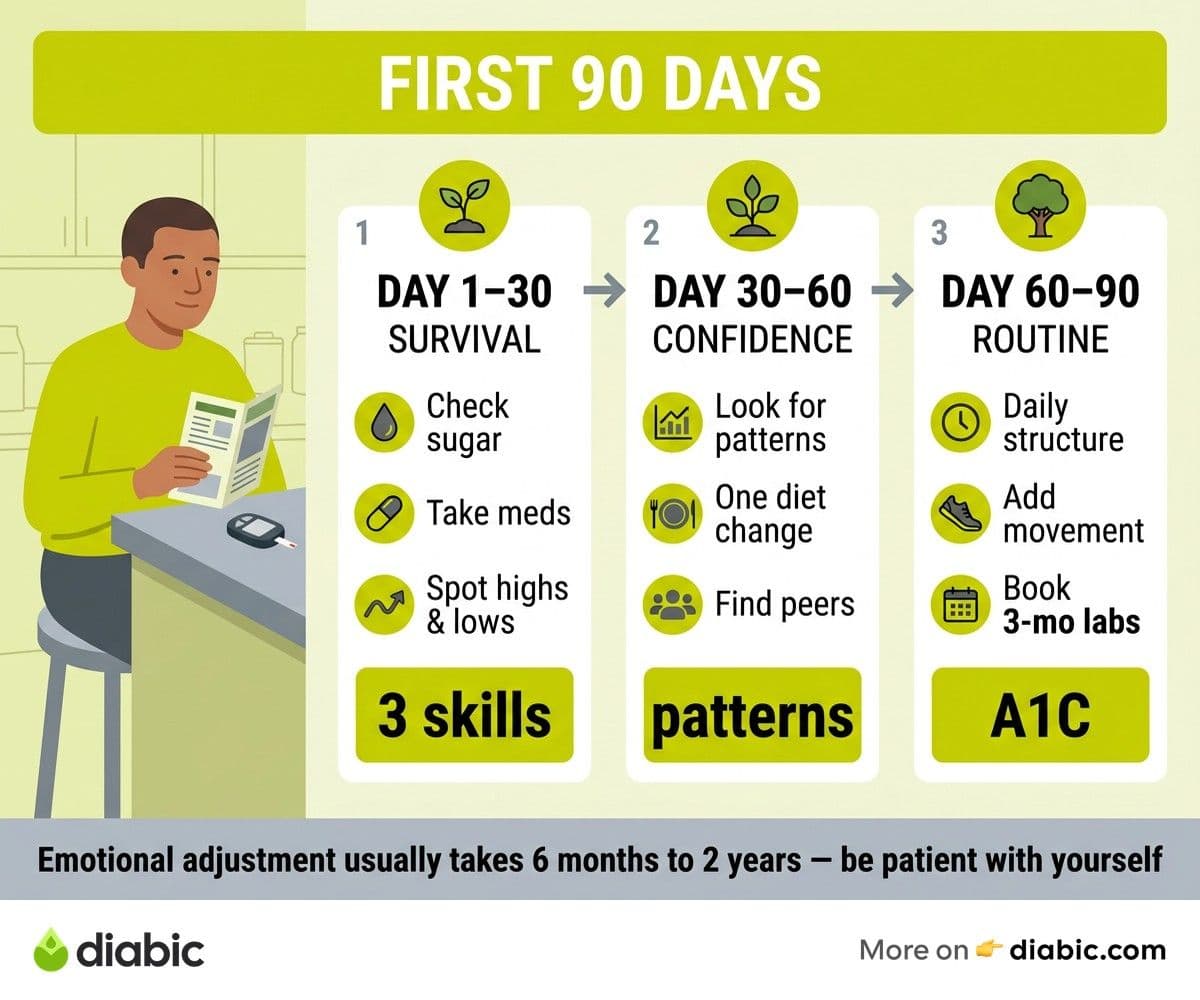
Your First 30 Days: Survival Mode
The first month is not the time to redesign your life. It is the time to learn the absolute basics and let yourself feel what you feel. We say this on purpose, because new patients are often handed a stack of materials that implies they should be doing everything right by week two.
Focus on three core skills only. Learn how to check your blood sugar correctly and what your meter is actually telling you, learn how to take any medication you have been prescribed safely, and learn to recognize the early signs of highs and lows in your own body. A simple normal blood sugar chart by age can give you an at-a-glance reference while the numbers are still abstract.
Resist the urge to overhaul your entire diet and exercise routine at once. The American Diabetes Association recommends starting with small, achievable changes for newly diagnosed patients, because dramatic overhauls almost always collapse within a few weeks and leave people feeling like failures. If you have type 1, the JDRF Newly Diagnosed Toolkit is an excellent starting point, with separate paths for adults, parents, and teens.
Ask your provider for a referral to a diabetes care and education specialist if one has not been offered. Diabetes self-management education is a covered benefit in most cases and is associated with better outcomes across nearly every measure that matters. And give yourself permission to grieve. People who try to skip the emotional work often delay their adjustment by months.
Days 30-60: Building Confidence
By the second month, the immediate panic usually softens, and you can start asking better questions. This is the stretch where confidence quietly grows, even when it does not feel like it from the inside.
Start looking at your blood sugar data for patterns rather than reacting to single numbers. Are mornings consistently higher than expected? Does a certain meal predictably spike you? Does stress at work change the picture? Patterns are far more useful than individual readings, and they are what your provider will want to discuss at your next visit.
Introduce one dietary change at a time, and lead with what to add rather than what to remove. Adding fiber, lean protein, or non-starchy vegetables to a meal tends to be more sustainable than building a list of forbidden foods, which usually backfires. The CDC living with diabetes guide is a practical resource for newly diagnosed patients and avoids the all-or-nothing framing that tends to make people quit.
This is also a great time to find your people. Connecting with diabetes support groups online or locally can change the experience entirely, because you start hearing stories that match yours. Peer support is associated with better adherence and lower distress, and it gives you somewhere to ask the small embarrassing questions you will not bring to a clinic visit.
Bring a written list of questions to your next appointment. Two months in, you will have collected a real backlog of "wait, is this normal?" moments, and getting them answered in one focused conversation is far more useful than firing them off one at a time.
Days 60-90: Finding Your Routine
By the third month, you are no longer reacting to diabetes, you are starting to live alongside it. The work in this stretch is making the routine fit your actual life, not somebody else's vision of an ideal patient.
Begin sketching out a consistent daily structure. When do you check your sugar? When do you take medication? When do you eat, and how predictable is that schedule? Small, repeatable patterns reduce the cognitive load enormously, which is why we wrote a separate piece on building a daily routine that fits messy real lives.
Add movement on purpose, even modestly. Daily walks, a short stretch session, gardening, or any activity you actually enjoy will do more than an ambitious gym plan you will abandon by week six. The goal in this window is consistency, not intensity, and your future self will thank you for choosing something boring and repeatable.
Schedule your follow-ups. An A1C check around the three-month mark, a baseline eye exam, and a foot exam are standard parts of the early plan, and getting them on the calendar early prevents the gap from stretching into half a year. The first time you walk out of an endocrinology visit with a number in hand that reflects 90 days of effort is a strange milestone, and it tends to recalibrate how much weight you give any single reading on the meter. Celebrate the progress you have made, even when it feels small, because building a foundation in 90 days while emotionally processing a diagnosis is genuine work.
This is also a good window to think about who else in your life needs information. A partner, a roommate, a close friend, or a coworker who sees you daily can be a real safety net if they know what a low looks like and how to help. You do not have to share with everyone, and you do not owe anyone an explanation, but choosing one or two trusted people to brief can take a surprising amount of weight off your shoulders.
What to Expect Emotionally After 90 Days
The intensity of the first three months fades, but you should expect occasional waves of frustration, sadness, or burnout, sometimes triggered by a single bad number or a comment from someone who does not understand. These waves are not a relapse, they are part of living with a chronic condition, and they pass faster as your nervous system trusts that you can handle them.
Diabetes management gradually becomes more automatic, which is one of the underrated rewards of staying with it. Tasks that felt overwhelming in week two will feel like brushing your teeth by month six, freeing up energy for the harder strategic decisions. If a sustained low mood, hopelessness, or exhaustion does set in, that may be diabetes burnout, and it deserves real support rather than a self-improvement push.
Setbacks are not failures. A high reading, a missed dose, a meal that surprises you, or a week where you barely engaged with your management are all normal parts of the long picture. The goal is not perfection, the goal is a life that includes diabetes without being defined by it.
Coping with diabetes diagnosis is not a project you finish, it is a relationship you keep building. The first 90 days are the hardest in many ways, because you are learning a new vocabulary, a new set of body signals, and a new emotional rhythm all at once. If the work feels heavy right now, that is because it is heavy, and the heaviness eases as the routine settles in and your confidence quietly grows. Be patient with yourself, lean on your care team, and remember that the people living well with diabetes a decade in were once exactly where you are.
FAQ
How do I cope with a new diabetes diagnosis?
Start with the basics, give yourself permission to feel a wide range of emotions, and resist the urge to overhaul your life in week one. Lean on diabetes self-management education, your care team, and people who have lived the same experience. Coping with diabetes diagnosis is gradual, and most people feel meaningfully better between months three and six.
What should I do in the first weeks after diabetes diagnosis?
Focus only on three skills in the first weeks: checking your blood sugar correctly, taking any prescribed medication safely, and recognizing the signs of highs and lows. Schedule your first diabetes education appointment, give your nervous system time to adjust, and avoid major dietary or exercise overhauls until you feel more settled. The early weeks are about building a stable foundation, not optimizing.
Shahriar P. Shuvo is the founder of Diabic. He has lived with diabetes for over 14 years, and built Diabic to deliver the practical, evidence-based self-management tools he wished existed when he was first diagnosed. By trade, Shahriar is a senior design and frontend engineer with 6+ years shipping products at Agora, Timescale (now Tiger Data), and ShareTrip. He writes from the intersection of lived diabetes experience and product craft, focused on what works in daily management rather than what sounds good in a textbook.
Medically reviewed by
Dr. Rezwana Parvin Rumpa is an obstetrics and gynaecology specialist with clinical focus on gestational diabetes, PCOS, and fertility. She holds the MRCOG (Final Part) from the Royal College of Obstetricians and Gynaecologists in London, the MRCPI (Final Part) from the Royal College of Physicians of Ireland, and an MBBS from Shaheed Monsur Ali Medical College under Dhaka University. Dr. Rumpa serves as a Senior Medical Officer in the Obs and Gynae department at BRB Hospitals Ltd, where she has spent three years managing prenatal care, emergency obstetric cases, and women's-health surgery. On Diabic, she medically reviews content for women living with diabetes, with particular attention to pregnancy, PCOS, and reproductive-health intersections.
More from Living with Diabetes
View all
A Gentle Chair Yoga Routine for people with diabetes
A gentle chair yoga for people with diabetes routine with safe poses, modifications for neuropathy, retinopathy, and joint pain, plus tips for older.

Shift Work and Diabetes: Managing Irregular Hours
Shift work and diabetes is a tough combination. Learn how to manage meals, sleep, medication, and blood sugar when your hours rotate or flip overnight.

Dating with Diabetes: When to Tell a New Partner
Dating with diabetes brings unique disclosure questions. Here is when to tell a new partner, what to say, and how to handle the conversation with.
Clinician-reviewed habits, plain-language guides, and honest answers - the small shifts that make living with diabetes feel lighter, every day.