Diabetes Burnout: Why It Happens and What Helps
Diabetes burnout is real, and it is not laziness. Learn why it happens, how to spot the signs, and what actually helps you recover and rebuild.

In this article(8)
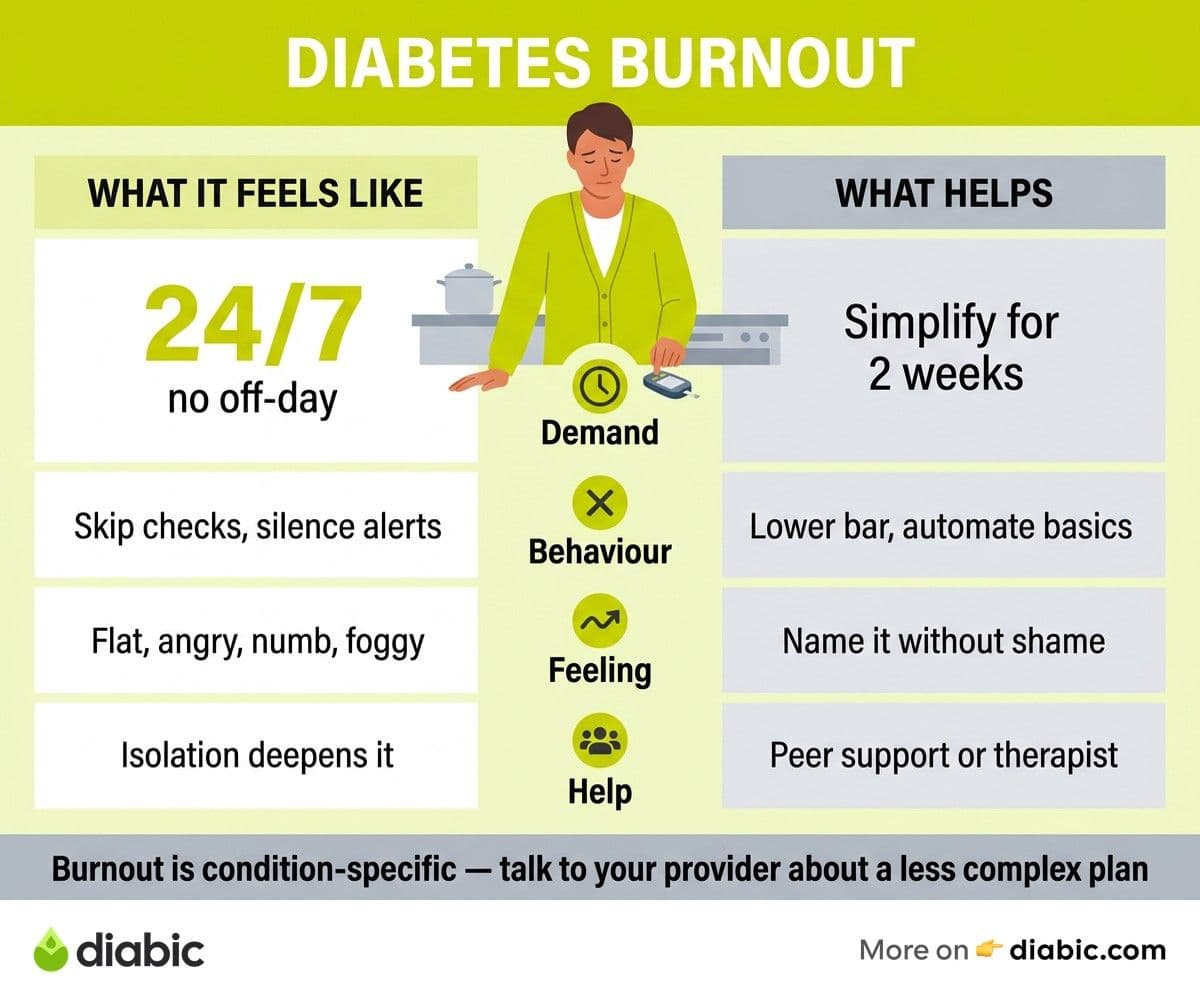
You used to log every meal, check before every drive, and rotate sites without thinking. Lately, the meter sits on the counter for days. The pump alarm gets silenced without a glance. You are not lazy and you have not given up. You are running into diabetes burnout, the emotional exhaustion that builds up after months or years of managing a condition that never takes a day off.
If you have ever thought "I just cannot do this anymore," you are not alone. Burnout shows up in some of the most dedicated people we know, often after a long stretch of trying their hardest. The first thing to understand is that this is not a character problem. It is a predictable response to an unrelenting workload, and there is a way through it.
From my experience: I have lived with type 1 for 14 years, and the worst stretch hit around year seven, the same year I was changing jobs and a parent was sick. My A1C had been steady forever and then I just stopped pre-bolusing for meals, silenced my CGM alerts at night, and let a pump site stay on for five days because changing it felt like one decision too many. Nothing dramatic happened on the outside, but the meter on the counter started to feel like a small accusation every time I walked past it. Naming it as burnout instead of laziness was the first thing that actually helped.
What Is Diabetes Burnout
It is a state of emotional, mental, and sometimes physical exhaustion that comes from the constant demands of diabetes management. It is more than a bad day or a frustrating week. It tends to settle in for weeks or months, and it can leave you feeling defeated, indifferent, or angry about a condition you cannot opt out of. The American Diabetes Association recognizes burnout as a real psychosocial concern and includes it in its standards of care for adults living with diabetes.
The shape of burnout varies from person to person. Some people stop checking blood sugar as often. Others miss doses or stop counting carbs. Many keep functioning at work and home while quietly disengaging from their care plan. It affects people with type 1, type 2, gestational diabetes, and pre-diabetes alike, and it can show up at any stage, from the first year after diagnosis to decades in.
What burnout is not is failure. It is not weakness, lack of discipline, or a sign that you do not care about your health. It is the predictable result of being on call for your own pancreas, twenty-four hours a day, with no vacation. Naming it accurately is the first step in addressing it, because you cannot fix a problem you keep blaming yourself for.
Why This Exhaustion Happens
The most fundamental reason burnout happens is the relentless nature of the condition. Diabetes management does not pause for holidays, illness, grief, or a bad week at work. Every meal, every workout, every change in stress level requires a small calculation, and the calculations stack up. Over time, that constant low-grade vigilance wears the nervous system down.
Decision fatigue is a major contributor. Researchers at the Behavioral Diabetes Institute have documented how the sheer volume of daily diabetes decisions, often estimated in the hundreds, drains the same mental resources you use for work, parenting, and everything else. By the end of the day, the brain has less capacity for the next correction dose, and small mistakes start adding up. None of that is moral. It is cognitive load.
Burnout often deepens when effort and outcome stop matching. You can do everything right and still see numbers that frustrate you, because diabetes is influenced by hormones, sleep, illness, and stress in ways that no log book fully captures. When good habits keep producing bad readings, motivation erodes. Add in a lack of visible support from family or coworkers, and the isolation becomes its own pressure. We have seen the same pattern in teens play out in younger people, often with even less language to describe what they are feeling.
Life events often act as accelerants. A new job, a move, the loss of someone close, a pregnancy, or a serious illness on top of diabetes will draw down your reserves quickly. The condition that you handled fine last year may feel impossible during a stretch when everything else is also asking for your attention. Recognizing those windows as temporary, and giving yourself permission to manage in survival mode during them, often prevents a deeper slide.
Signs You Might Be Experiencing Burnout
The clearest sign of burnout is a change in your relationship with your own care. If you used to check regularly and have started skipping, that gap matters. If you find yourself eating without bolusing, ignoring CGM alerts, or letting prescriptions lapse, those are not small slips. They are signals worth paying attention to. Research published in Diabetes Care has documented how diabetes distress correlates with rising A1C and reduced engagement in self-management.
Emotional shifts often come along for the ride. You might feel angry about diabetes in a way you did not before, or numb in a way that surprises you. Resentment toward food, family who comment on your numbers, or even your care team can build up. Some people describe feeling foggy or detached, as if they are watching their diabetes from across the room. Others find themselves crying after appointments without knowing exactly why.
It also helps to know how burnout differs from depression, because the treatments overlap but are not identical. This kind of exhaustion tends to be condition-specific, easing when the load eases, while depression usually pervades other parts of life and persists regardless of context. Our piece on diabetes distress vs depression walks through the overlap in detail. If you are unsure which one you are dealing with, that is exactly the kind of question to bring to a provider rather than answer alone.
How to Start Recovering from Burnout
Recovery starts with permission to feel what you are feeling, without adding shame to the pile. Burnout responds poorly to lectures, including the ones you give yourself. Try saying the simple sentence "this is hard, and I am tired" out loud. It will not fix anything, but it shifts you from fighting your feelings to working with them, which is where useful action begins.
The next move is to simplify. Strip your routine back to the basics for a defined window, perhaps two weeks. Check, eat, take medication, move. Lower your standards on purpose during that window and aim for "good enough" rather than perfect. The National Alliance on Mental Illness recommends this kind of deliberate scaling-back when chronic illness becomes overwhelming, because it preserves the foundation while giving the rest of your system a chance to recover.
Talk to your provider about reducing complexity in your management plan. There may be ways to consolidate finger sticks, switch to a CGM if you do not have one, simplify your medication schedule, or rework targets so they feel achievable again. A provider who understands burnout will treat this conversation as good clinical practice, not as you "giving up." If your current team does not respond well, that is information worth acting on.
Building Long-Term Resilience
Resilience is not a personality trait. It is a set of practices you build over time, and it works best when you start small. One of the most effective practices we have seen is finding a single diabetes management win each day and noticing it on purpose. Maybe you caught a low before it crashed you. Maybe you walked after dinner. Whatever it is, give yourself credit for it. Pattern recognition for wins is a skill, and it counterbalances the constant feedback your meter gives you about misses.
Connection matters more than most people realize. Burnout thrives in isolation, and the antidote is finding people who actually understand what you are dealing with. Look into diabetes support groups in your area or online communities that fit your style, whether that is a quiet forum or a more active social group. Set boundaries with well-meaning family members who comment on your numbers or food choices. You are allowed to say "I love you, and I do not want diabetes feedback right now."
For some people, the right next step is professional support. A therapist who specializes in chronic illness or health psychology can help you process the grief, anger, and exhaustion that diabetes carries with it. If coping with diagnosis is part of your story, working through that with someone trained makes a real difference. If you have lost interest in management entirely, our piece on finding motivation for diabetes management offers a starting point that does not depend on willpower. Diabetes burnout is recoverable, and recovery is rarely a straight line. Treat your mental health like part of your diabetes care, because it is.
FAQ
What is this exhaustion and how do I recover?
It is the emotional and mental exhaustion that builds up from the round-the-clock demands of managing diabetes. It often shows up as skipped checks, missed doses, avoidance of appointments, and feelings of frustration or numbness about a condition you cannot escape. Recovery starts by naming it without shame, simplifying your routine for a defined period, and asking your provider to reduce complexity wherever possible. Adding connection, whether through a support group or a therapist, helps the recovery hold over time. Most people do not bounce back overnight, and that is normal. The goal is to rebuild a manageable rhythm, not to return to the perfectionism that may have contributed to burnout in the first place.
How do I deal with this kind of exhaustion?
Start by giving yourself permission to be tired. Strip your management routine back to the essentials for a couple of weeks. Tell one trusted person what you are going through, whether that is a partner, a friend, or a peer in a diabetes community. Book an appointment with your provider and say plainly that you are dealing with diabetes burnout, then work together on a simpler plan you can actually follow. If feelings of hopelessness or detachment persist, ask for a referral to a therapist who works with chronic illness. Small, sustainable steps almost always beat heroic efforts when burnout is in the picture.
Shahriar P. Shuvo is the founder of Diabic. He has lived with diabetes for over 14 years, and built Diabic to deliver the practical, evidence-based self-management tools he wished existed when he was first diagnosed. By trade, Shahriar is a senior design and frontend engineer with 6+ years shipping products at Agora, Timescale (now Tiger Data), and ShareTrip. He writes from the intersection of lived diabetes experience and product craft, focused on what works in daily management rather than what sounds good in a textbook.
Medically reviewed by
Dr. Rezwana Parvin Rumpa is an obstetrics and gynaecology specialist with clinical focus on gestational diabetes, PCOS, and fertility. She holds the MRCOG (Final Part) from the Royal College of Obstetricians and Gynaecologists in London, the MRCPI (Final Part) from the Royal College of Physicians of Ireland, and an MBBS from Shaheed Monsur Ali Medical College under Dhaka University. Dr. Rumpa serves as a Senior Medical Officer in the Obs and Gynae department at BRB Hospitals Ltd, where she has spent three years managing prenatal care, emergency obstetric cases, and women's-health surgery. On Diabic, she medically reviews content for women living with diabetes, with particular attention to pregnancy, PCOS, and reproductive-health intersections.
More from Living with Diabetes
View all
A Gentle Chair Yoga Routine for people with diabetes
A gentle chair yoga for people with diabetes routine with safe poses, modifications for neuropathy, retinopathy, and joint pain, plus tips for older.

Shift Work and Diabetes: Managing Irregular Hours
Shift work and diabetes is a tough combination. Learn how to manage meals, sleep, medication, and blood sugar when your hours rotate or flip overnight.

Dating with Diabetes: When to Tell a New Partner
Dating with diabetes brings unique disclosure questions. Here is when to tell a new partner, what to say, and how to handle the conversation with.
Clinician-reviewed habits, plain-language guides, and honest answers - the small shifts that make living with diabetes feel lighter, every day.