Diabetes Support Groups Near Me: Where to Look
Looking for diabetes support groups near me? Here is where to find local and online communities, plus how to choose a group that actually fits your life.

In this article(8)
If you have typed "diabetes support groups near me" into a search bar this week, that small action says something important. It usually means you are tired of carrying this alone, or that a recent appointment or scary number has made you want to talk to someone who actually gets it. Reaching out for community is one of the most underrated tools in diabetes self-management, and it is also one of the hardest to start.
We have heard from readers who waited years before joining a group, only to wonder afterward why they put it off. Diabetes asks a lot of you every single day, and the people closest to you, however loving, often do not understand what it costs. Other people living with the same condition do, and that shared understanding changes the texture of the experience. This guide walks through where to find groups, what to expect, and how to figure out which one actually fits your life.
From my experience: I waited about eight years after my type 1 diagnosis to actually post in an online T1D community, and the thing that finally pushed me there was a string of weird overnight Dexcom alarms I could not explain to anyone in my apartment. The first reply came in 20 minutes, from someone in another time zone who had been through the exact same pattern after switching basal brands. That was the moment the invisible work everyone keeps talking about stopped feeling so invisible.
Why Diabetes Support Groups Help
Peer support is not soft science. Studies summarized in the Diabetes Care journal have shown that participation in structured peer support programs is associated with lower A1C, fewer depressive symptoms, and better self-management behaviors. The mechanism is not magic. When you talk regularly with people who track carbs, fight insurance companies, and wake up to weird overnight readings, you absorb practical strategies and you stop feeling like an oddity in your own life.
Isolation is one of the most consistent predictors of poor outcomes in chronic illness, and diabetes is uniquely lonely because so much of the work is invisible. Family members see you eat, but they do not see the calculation. Coworkers see you take a break, but they do not see the low you are treating. A support group is a room, virtual or physical, where the invisible work becomes visible and ordinary. Hearing someone else say "I cried in the pharmacy parking lot last week" can be more relieving than ten clinical reassurances.
There is also the practical side, which sometimes matters more than the emotional one. Members swap tips on patch adhesives, sensor placement, travel hacks, and how to talk to a new endocrinologist. They warn each other about formulary changes and brag about good lows-treating snacks. If you are caught in diabetes burnout, a group can be the soft place that reminds you the burnout is the condition talking, not your character.
How to Find Local Diabetes Support Groups Near Me
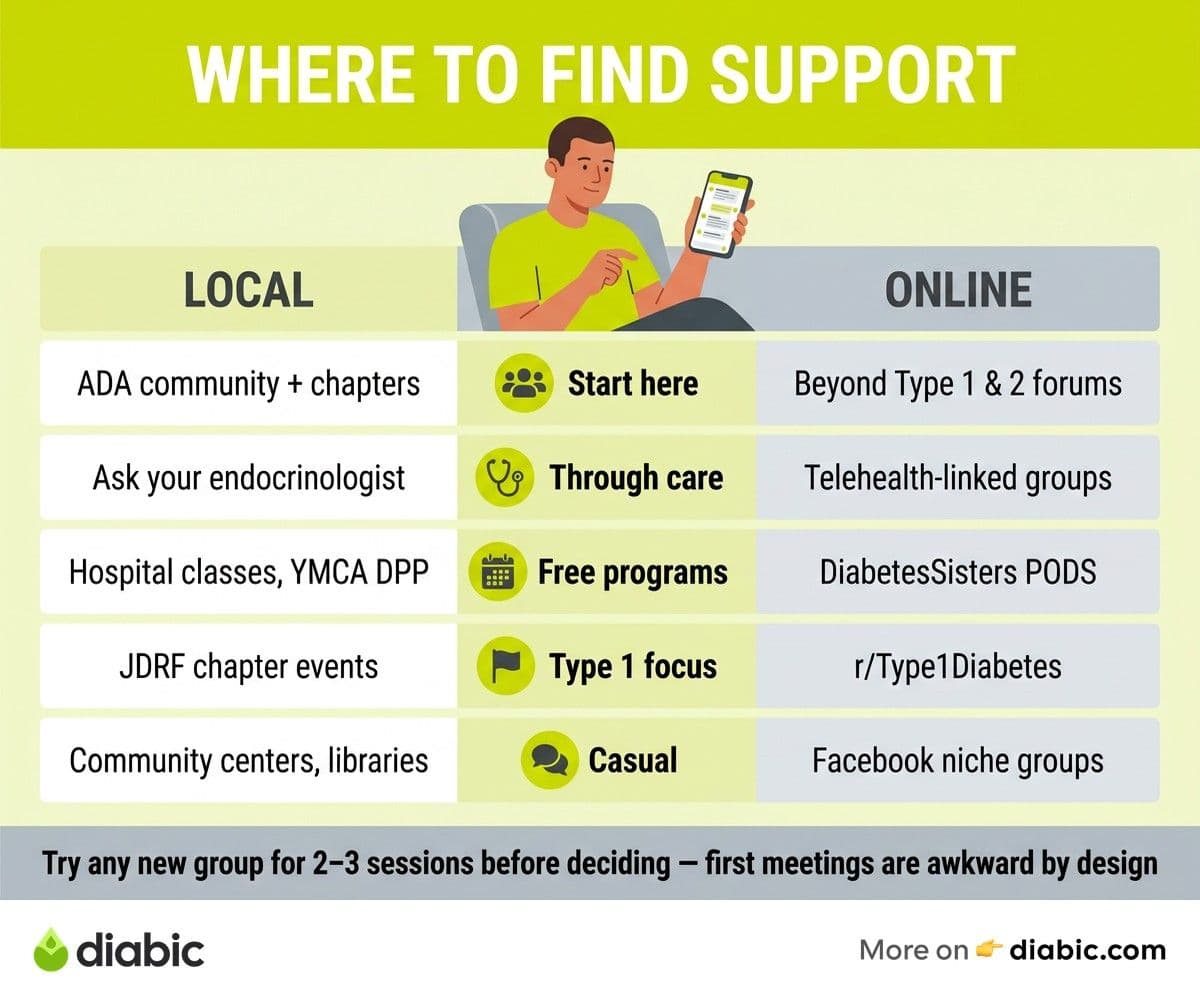
The best starting point for U.S. readers is the American Diabetes Association community page, which hosts an active online forum and lists local events through ADA chapters. You can search by zip code for in-person events, walks, expos, and educational sessions where local support contacts often gather. Even if a city does not have a permanent peer support group, there is usually a diabetes educator or community health worker nearby who can point you to one.
Your healthcare team is the second underused resource, and they tend to have local intelligence that does not show up online. Ask your endocrinologist, primary care doctor, or certified diabetes care and education specialist if they know of groups, especially ones that meet at affiliated hospitals. Many large health systems run free diabetes self-management education classes that double as soft support groups, since the same six to ten people meet weekly for a series. If you are early in coping with a diagnosis, these structured classes can be especially helpful because the curriculum gives the conversation a backbone.
A few other places to check that people often forget about:
- Local hospital community health calendars, which list free programs that rarely show up in general search results
- YMCA branches that run the CDC-recognized Diabetes Prevention Program for prediabetes and adjacent peer groups for type 2
- Community centers, libraries, and senior centers, which often host quiet but long-running groups
- Faith communities and cultural organizations, which sometimes run health ministries with diabetes-specific programs
- For type 1 specifically, JDRF chapters host events, peer mentoring through the T1D Care Kit, and family programs around the country
If you are caregiving for a child or partner, look specifically for caregiver groups. Watching someone you love manage diabetes carries its own weight, and caregivers benefit from spaces where they can vent without worrying about how it lands at home.
Online Diabetes Support Communities
Online groups have changed what is possible for people who cannot easily get to in-person meetings, and they have become especially important for shift workers, rural residents, and anyone with mobility or transportation barriers. Beyond Type 1 and its companion Beyond Type 2 platform run active forums and social channels with a younger, mobile-first feel. Their content covers technology reviews, mental health, and identity in a way that traditional medical content rarely does.
DiabetesSisters serves women with all types of diabetes through online discussion groups and PODS (Part of DiabetesSisters) meetups in many cities. Their virtual gatherings are small, facilitated, and intentional, which is helpful if large open forums feel overwhelming. The Diabetes Online Community, often shortened to DOC, is a looser network of bloggers, podcasters, and social media users who use hashtags like #DOC and #DSMA to find each other. It is less structured but extremely welcoming.
Reddit and Facebook fill in the rest of the landscape with high-traffic, peer-led spaces. The r/diabetes, r/Type1Diabetes, r/diabetes_t2, and r/diabetes_t1 subreddits are active around the clock and tend to be candid about everything from device failures to insurance fights. Facebook hosts hundreds of niche groups for specific situations: pumpers, runners, parents of newly diagnosed kids, people on GLP-1 medications, and so on. Pros of online groups include round-the-clock access, the option to stay anonymous, and zero geographic limits. The trade-off is variable moderation quality, occasional misinformation, and the way social media itself can erode the calm you came for. Pick groups with active, identified moderators and leave any space that feels harsh or salesy.
Choosing the Right Group for You
The first decision is whether you want a type-specific group or a general one. Type 1, type 2, LADA, MODY, and gestational diabetes share some experiences but diverge in important ways, and people in mixed groups sometimes feel their concerns get flattened. Type-specific groups go deeper on the technical and emotional details that match your situation. General diabetes groups, on the other hand, are easier to find locally and can introduce you to perspectives you would not otherwise encounter.
The second decision is format. In-person groups offer body language, snacks, and the social commitment of showing up, which some people need to follow through. Online groups offer flexibility, a low barrier to entry, and access on the days you cannot face leaving the house. Hybrid models, where a group meets in person but streams sessions, have grown since 2020 and often give you the best of both. Think honestly about your schedule and your energy. A group you actually attend is better than a perfect group you never make it to.
Facilitation style is the third variable. Professionally facilitated groups, often led by a diabetes educator, social worker, or psychologist, tend to stay focused and handle conflict well. Peer-led groups can feel more equal and less clinical, with conversation that flows where members need it to go. Both formats produce real benefits, and the best choice depends on what you need at this stage. We generally suggest giving any new group two or three sessions before deciding. The first meeting is awkward by definition, and the second often reveals whether the people and the rhythm are right for you. If after three you are still dreading it, move on without guilt. If finding motivation for self-care is your main struggle, look for groups that explicitly include goal-setting or behavior change support, since those tend to translate community into action. People navigating intimacy concerns may also want to read our piece on diabetes and relationships alongside any group work, since partner dynamics often come up in support spaces.
A Practical First Step This Week
If this all still feels heavy, pick one small action. Open the ADA community page, search a JDRF chapter near you, or post a single question in a Reddit thread. Send a message to your diabetes educator asking what local groups they recommend, and let yourself wait for a reply. Connection rarely arrives in a single dramatic moment. It builds quietly through small doors that you keep walking through, and finding diabetes support groups near me is just one of those doors.
Frequently Asked Questions
Where can I find diabetes support groups near me?
Start with the American Diabetes Association community page and chapter event finder, which lists local events by zip code. Ask your endocrinologist or diabetes educator about hospital-affiliated groups and self-management education classes, which often function as ongoing peer support. JDRF chapters serve type 1 communities specifically, while YMCAs, community centers, and faith organizations frequently host free diabetes-related programs that do not always appear in general search results.
Are there online diabetes support groups for adults?
Yes, and the options have expanded a lot. Beyond Type 1 and Beyond Type 2 host active forums and social communities, DiabetesSisters offers women-focused virtual groups and PODS meetups, and the broader Diabetes Online Community is reachable through hashtags like #DOC and #DSMA. Reddit subreddits like r/diabetes and r/Type1Diabetes are active around the clock, and Facebook hosts hundreds of niche groups for specific situations and treatment paths. Choose spaces with active moderators and leave any group that feels unsafe or commercial.
Shahriar P. Shuvo is the founder of Diabic. He has lived with diabetes for over 14 years, and built Diabic to deliver the practical, evidence-based self-management tools he wished existed when he was first diagnosed. By trade, Shahriar is a senior design and frontend engineer with 6+ years shipping products at Agora, Timescale (now Tiger Data), and ShareTrip. He writes from the intersection of lived diabetes experience and product craft, focused on what works in daily management rather than what sounds good in a textbook.
Medically reviewed by
Dr. Shanto Arian is an internal medicine physician now specializing in clinical and aesthetic dermatology, with a parallel academic focus on epidemiology and public health. He holds an MBBS, MPH, MSc (UK), MRCP (UK), MRCPI (Ireland), Diploma in Dermatology (UK), and Diploma in Aesthetic Medicine (USA). Dr. Arian trained in internal medicine, including hospital work on hematology cases such as graft-versus-host disease, before moving toward dermatology. Skin is one of the earliest places diabetes shows itself, from acanthosis nigricans and diabetic dermopathy to slow foot wound healing, and that intersection is where his clinical and Diabic-review work meet. On Diabic, Dr. Arian medically reviews content on diabetes diagnosis, complications, dermatologic manifestations, and pharmacotherapy, ensuring every claim aligns with current ADA, NICE, and peer-reviewed literature.
More from Living with Diabetes
View all
A Gentle Chair Yoga Routine for people with diabetes
A gentle chair yoga for people with diabetes routine with safe poses, modifications for neuropathy, retinopathy, and joint pain, plus tips for older.

Shift Work and Diabetes: Managing Irregular Hours
Shift work and diabetes is a tough combination. Learn how to manage meals, sleep, medication, and blood sugar when your hours rotate or flip overnight.

Dating with Diabetes: When to Tell a New Partner
Dating with diabetes brings unique disclosure questions. Here is when to tell a new partner, what to say, and how to handle the conversation with.
Clinician-reviewed habits, plain-language guides, and honest answers - the small shifts that make living with diabetes feel lighter, every day.