Meditation and Blood Sugar: What Science Actually Shows
Explore what peer-reviewed research reveals about meditation and blood sugar, including realistic A1C effects, study findings, and how to start a daily.

In this article(8)
The idea that sitting quietly with your eyes closed could nudge your numbers in the right direction sounds suspicious at first. We get it. After years of being told that diabetes management is mostly about food, medication, and movement, the suggestion that breath and attention belong on that list can feel like wishful thinking.
The research on meditation and blood sugar is more interesting than you might expect, though. It does not promise miracles, and it will not replace your medication or your meal plan. What it does suggest is that a regular practice can lower stress hormones in measurable ways, and those hormones happen to be the same ones that push glucose upward when life gets loud.
In this article, we walk through what the studies actually report, why the mechanism makes biological sense, and how you can build a sustainable practice that fits into a real day. We will also be honest about the limits of the evidence so you can decide for yourself whether this is worth your time.
From my experience: I picked up a five-minute morning practice after a tough stretch at work in 2020, mostly skeptical, mostly to see what would happen on the Dexcom. The morning numbers themselves did not move dramatically, but the post-lunch climbs got noticeably gentler within a few weeks, and I stopped reaching for a second coffee at 3 p.m. The biggest surprise was how often I caught a low earlier, because I was actually paying attention to my body instead of pushing through the foggy feeling.
The Science Behind Meditation and Blood Sugar
Meditation is not a single thing. The umbrella covers mindfulness practices, transcendental meditation, loving-kindness meditation, body scans, and guided relaxation, among others. What most of them share is a shift in the autonomic nervous system away from "fight or flight" and toward "rest and digest", which physiologists call parasympathetic activation.
When the parasympathetic side of the nervous system takes over, your heart rate slows, your breathing deepens, and a cascade of hormonal signals tells your liver to ease up on releasing stored glucose. The American Diabetes Association acknowledges in its Standards of Care that psychosocial care, including stress management, belongs in a complete diabetes treatment plan. That is not the same as endorsing meditation as a treatment, but it is a clear signal that the mind-body link in diabetes is taken seriously by mainstream medicine.
Research on glycemic outcomes has grown steadily over the past two decades. Trials have looked at fasting blood glucose, postprandial glucose, A1C, and even insulin sensitivity. The picture that emerges is modest but real, and it pairs nicely with what we already know about yoga poses for diabetes and other movement-based stress reducers.
How Stress Hormones Drive Up Blood Sugar
To understand why meditation might matter, it helps to look at what stress does inside the body. Cortisol, the hormone most associated with chronic stress, signals the liver to release glucose into the bloodstream. This is a useful response if you need to outrun a threat, but unhelpful if the "threat" is a tense email or a long commute repeated daily for years.
Adrenaline plays a complementary role. It pulls glucose out of storage and makes muscle and fat cells temporarily more resistant to insulin. The combination of cortisol and adrenaline in chronic doses creates a steady upward pressure on blood sugar that no amount of careful eating can fully offset. We see this pattern often in readers managing diabetes anxiety and stress, where psychological strain shows up in the data before it shows up in their awareness.
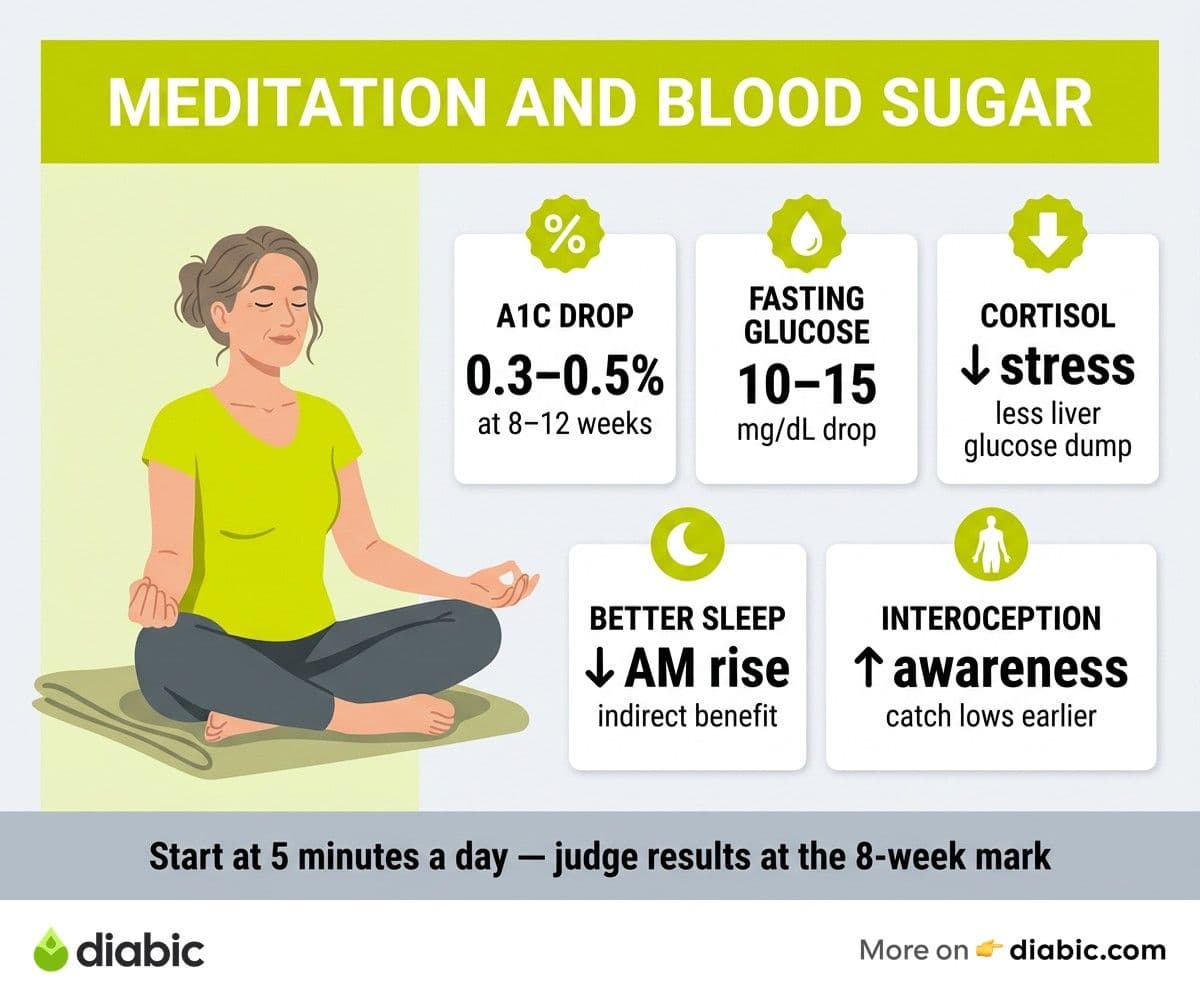
Researchers have measured cortisol responses in meditators and non-meditators, and the pattern is consistent. A study published in the Journal of Alternative and Complementary Medicine found that participants in an eight-week mindfulness program showed lower cortisol reactivity to laboratory stressors compared to controls. Lower cortisol reactivity means the body returns to baseline faster after a stressful event, which keeps glucose excursions smaller and shorter.
What the Research Shows on Meditation and Blood Sugar
Several systematic reviews and meta-analyses have looked at meditation interventions for people with type 2 diabetes. A 2018 review published in the Journal of Diabetes Research pooled data from randomized trials and reported small but statistically significant improvements in fasting blood glucose and A1C among meditation groups. Effect sizes varied, with average fasting glucose reductions in the range of 10 to 15 mg/dL across studies that ran 8 to 12 weeks.
A 2023 systematic review in the journal Mindfulness examined mindfulness-based interventions specifically and found A1C reductions of roughly 0.3 to 0.5 percentage points compared to control groups. That is a meaningful number, though it is smaller than what most medications achieve and roughly comparable to what you might expect from adding regular walks or modest dietary changes. The honest read is that meditation is not a replacement for proven therapies but can be a worthwhile addition.
Research from the National Center for Complementary and Integrative Health emphasizes that meditation appears safe for most people with chronic conditions and may help with related concerns like sleep quality, anxiety, and depression, all of which influence glucose indirectly. You can read the NCCIH overview on meditation and mindfulness for a balanced summary of what is and is not well established.
A few caveats are worth naming. Many studies are small, use varied meditation protocols, and rely on self-reported practice time. The placebo and attention-control effects are hard to separate from the meditation itself. Benefits also seem to require consistency. Sporadic practice does not appear to move biomarkers, which matches what most experienced meditators will tell you.
How Mindfulness Changes Eating and Self-Care
One of the more interesting findings in the literature is that meditation seems to help with diabetes outcomes partly by changing behavior, not just biochemistry. Mindfulness training improves interoception, the awareness of internal body signals, which can translate into better recognition of hunger, fullness, and the early symptoms of low or high blood sugar.
A randomized trial published in the Journal of the Academy of Nutrition and Dietetics found that adults with type 2 diabetes who completed a mindful eating program showed similar improvements in A1C and weight to a standard diabetes self-management program, despite spending less time on nutrition education. The mindfulness group reported less stress eating and more satisfaction with smaller portions. That kind of behavior shift compounds over months in ways that are hard to capture in a 12-week trial.
There is also a sleep angle. Poor sleep raises insulin resistance and morning glucose, and meditation practices have a strong evidence base for improving sleep onset and quality. If your evenings end in racing thoughts or restless sleep, the indirect glucose benefit from a short bedtime practice may be larger than the direct effect on cortisol.
How to Start a Practice for Better Blood Sugar
Starting small is the difference between a habit that lasts and one that fizzles by week three. We suggest five minutes a day for the first two weeks, even if you feel ready for more. The point of the early phase is not to meditate well, it is to prove to yourself that the slot in your day exists and that you will show up for it.
Pair meditation with something you already do without thinking. After your morning blood sugar check, before you start your coffee, or right after you brush your teeth at night all work because they piggyback on a stable cue. Apps like Insight Timer, Calm, and Headspace offer guided sessions that take the guesswork out of what to do, and most have free options that are perfectly adequate for getting started. If app-based practice does not appeal, simple breathing exercises for blood sugar can serve as a no-frills entry point.
For people specifically interested in the diabetes angle, body scan meditation deserves a special mention. The practice involves moving attention slowly through the body, noticing sensations without trying to change them. This builds the same interoceptive skill that helps with hunger cues and early symptom recognition, and the slow pacing tends to be calming for nervous systems that have been on high alert. A starter framework for mindfulness and diabetes can help you string sessions together into a real practice.
Track your blood sugar before and after sessions for the first month if you are curious about your personal response. Some people see a clear postprandial difference after a 10-minute practice, others notice changes mainly in fasting numbers, and a few see no measurable shift but report feeling better. All three are normal, and the data can help you decide where meditation fits in your overall plan. Bring what you find to your next appointment with your diabetes care team.
FAQ
Can meditation lower blood sugar levels?
Research suggests that consistent meditation practice can produce modest reductions in fasting blood glucose and A1C in people with type 2 diabetes, typically in the range of 10 to 15 mg/dL fasting and 0.3 to 0.5 percentage points of A1C over 8 to 12 weeks. The effect appears to come from lower cortisol output, better sleep, and improved eating awareness rather than any direct action on insulin or pancreatic function. Meditation is best treated as a complementary practice that works alongside medication, nutrition, and movement, not as a replacement.
How does meditation affect blood sugar?
Meditation activates the parasympathetic nervous system, which lowers cortisol and adrenaline output. Both hormones normally raise blood sugar by signaling the liver to release stored glucose and by increasing insulin resistance in muscle and fat cells. By blunting the chronic stress response, the link between meditation and blood sugar reduces the steady upward pressure on glucose that affects many people managing diabetes. Mindfulness also improves awareness of hunger, fullness, and early symptoms of high or low blood sugar, which supports better day-to-day self-care decisions.
Shahriar P. Shuvo is the founder of Diabic. He has lived with diabetes for over 14 years, and built Diabic to deliver the practical, evidence-based self-management tools he wished existed when he was first diagnosed. By trade, Shahriar is a senior design and frontend engineer with 6+ years shipping products at Agora, Timescale (now Tiger Data), and ShareTrip. He writes from the intersection of lived diabetes experience and product craft, focused on what works in daily management rather than what sounds good in a textbook.
Medically reviewed by
Dr. Rezwana Parvin Rumpa is an obstetrics and gynaecology specialist with clinical focus on gestational diabetes, PCOS, and fertility. She holds the MRCOG (Final Part) from the Royal College of Obstetricians and Gynaecologists in London, the MRCPI (Final Part) from the Royal College of Physicians of Ireland, and an MBBS from Shaheed Monsur Ali Medical College under Dhaka University. Dr. Rumpa serves as a Senior Medical Officer in the Obs and Gynae department at BRB Hospitals Ltd, where she has spent three years managing prenatal care, emergency obstetric cases, and women's-health surgery. On Diabic, she medically reviews content for women living with diabetes, with particular attention to pregnancy, PCOS, and reproductive-health intersections.
More from Living with Diabetes
View all
A Gentle Chair Yoga Routine for people with diabetes
A gentle chair yoga for people with diabetes routine with safe poses, modifications for neuropathy, retinopathy, and joint pain, plus tips for older.

Shift Work and Diabetes: Managing Irregular Hours
Shift work and diabetes is a tough combination. Learn how to manage meals, sleep, medication, and blood sugar when your hours rotate or flip overnight.

Dating with Diabetes: When to Tell a New Partner
Dating with diabetes brings unique disclosure questions. Here is when to tell a new partner, what to say, and how to handle the conversation with.
Clinician-reviewed habits, plain-language guides, and honest answers - the small shifts that make living with diabetes feel lighter, every day.