How to Create a School Management Plan for Diabetes
A step-by-step parent guide to building a school management plan diabetes-ready: 504 plan, DMMP, accommodations, and how to work with school staff.

In this article(13)
A school management plan diabetes families rely on is the document that keeps your child safe during the hours you cannot be there. It tells the nurse, the teacher, and the substitute exactly what to do when the meter beeps in the middle of math class. Whether your child is starting kindergarten or transferring to a new school, getting this plan in place is one of the most important things you can do as a parent.
The work feels heavy at first because it sits at the intersection of medicine, education, and federal law. The good news is that schools are required to support your child, and there are templates, advocates, and free resources that have done the hard thinking already. We will walk you through the structure, the legal pieces, and the small details that make a plan actually work in a real building full of real kids.
What Is a School Management Plan Diabetes Families Need
A school diabetes management plan is a formal document that spells out how the school will support your child's daily care. It usually has two layers that work together. The first is the Diabetes Medical Management Plan, often called the DMMP, written and signed by your child's endocrinologist. The second is the legal accommodations plan, most often a 504 Plan under Section 504 of the Rehabilitation Act of 1973.
Diabetes is recognized as a disability under federal law because it substantially limits a major life function. That recognition gives your child enforceable rights at any school that receives federal funding, which covers nearly every public school and many private ones. The American Diabetes Association built an entire campaign around this called Safe at School, and it is the single best resource we point parents toward.
A solid plan covers blood sugar monitoring, insulin administration, snacks, low and high treatment, and emergency protocols. It should be updated every school year and any time your child's regimen changes, like when they start a pump or switch to a new CGM. If your child is in middle or high school and exploring diabetes at work legal rights for future jobs, the same advocacy muscles you build now will serve them later.
How to Get a 504 Plan for Diabetes at School
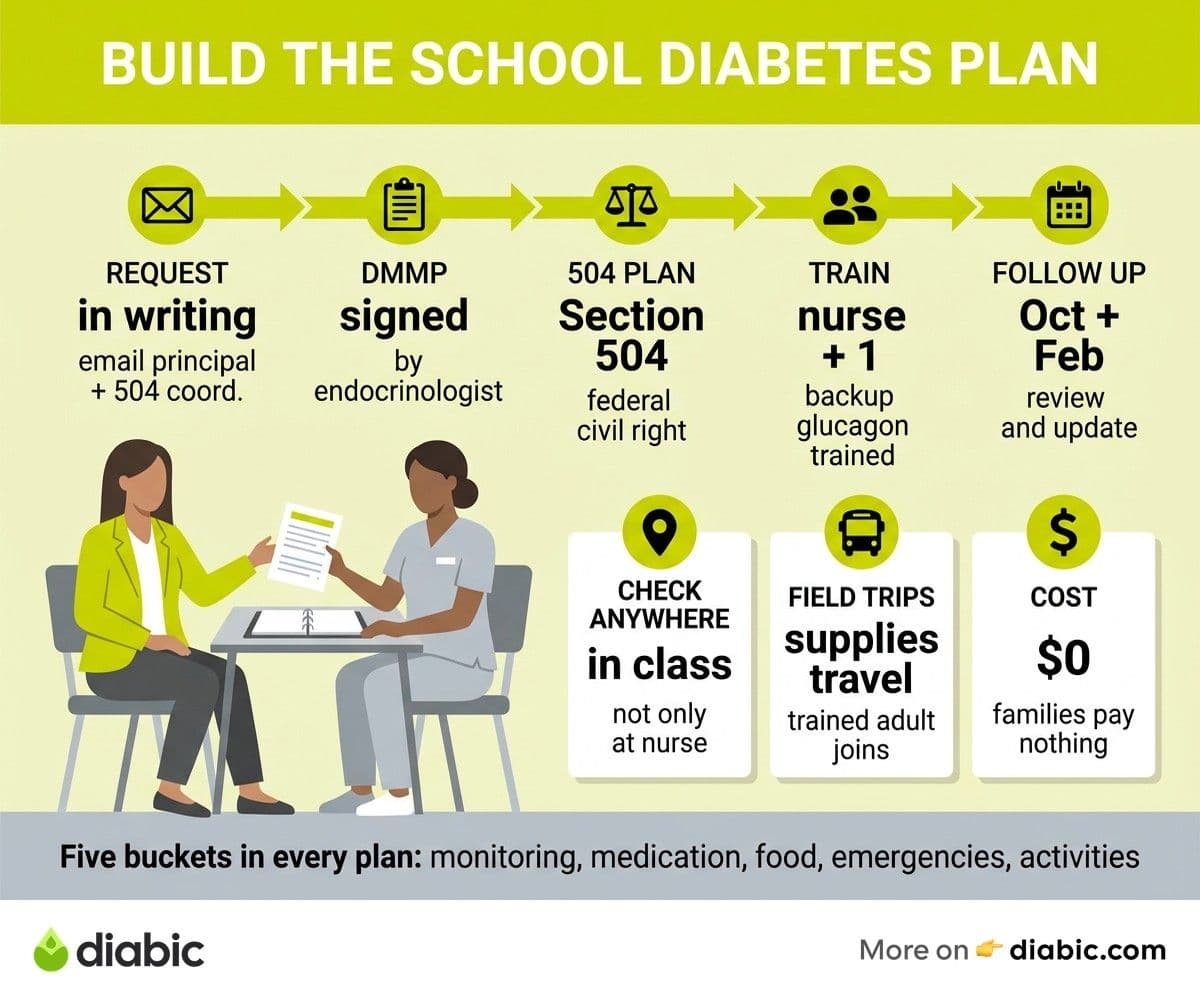
Start with a written request. Email the school principal and the 504 coordinator (most districts have one) and ask for a 504 meeting to discuss your child's diabetes accommodations. Putting it in writing creates a paper trail and starts the legal clock for the school's response. Federal guidance from the US Department of Education lays out the basics of Section 504 and what schools must do when a request comes in.
Bring documentation to the meeting. You will need a signed DMMP from your child's endocrinologist that lists target ranges, insulin doses, supply lists, and emergency steps. The endo's office is used to writing these and most have a template ready. If your child has been hospitalized or recently diagnosed, request a letter that summarizes the diagnosis as well.
Walk in with a list of specific accommodations. Vague language like "child needs support" is harder to enforce than specifics like "child may check blood sugar in the classroom and is not required to go to the nurse." Our parent's guide to type 1 diabetes has a sample list you can adapt. You also have the right to disagree with what the school proposes and request changes, and you can bring an advocate or another family member to any meeting.
When Schools Push Back
Most schools want to do the right thing. A few will try to limit accommodations, ask your child to walk to the nurse for every check, or refuse to administer glucagon. If that happens, calmly cite Section 504 and the ADA's Safe at School materials, and ask for the district's compliance officer. Pushback usually softens once it becomes clear you know the law.
What Your Plan Should Include: Back-to-School Diabetes Checklist
A complete back-to-school diabetes checklist for the plan itself should cover five buckets: monitoring, medication, food, emergencies, and activities. Working through each one prevents the gaps that get exposed on the messiest days, like the substitute teacher day or the fire drill day.
Blood sugar monitoring should specify how often, when, and who supervises. Younger children may need an adult to help interpret numbers. Older kids on CGMs may only need permission to glance at their phone. Specify that the child can check anywhere, not only at the nurse's office, and that follow-along data can go to a parent's phone if your CGM allows it.
Insulin and medication procedures need to name who administers, where, and how doses are calculated. If your child uses an insulin pump, the plan should state that they (or trained staff) operate it during the school day. The JDRF (now Breakthrough T1D) school advisory toolkit has sample plan templates that include this language.
Snack and meal accommodations matter more than parents realize. The plan should let your child eat or drink at any time, in any classroom, including during tests. Lunch should be at a consistent time, and they should be allowed to finish eating without being rushed. For sports for kids with diabetes, the plan should also cover pre-activity snacks, hydration, and supply access at practice and games.
Emergency Protocols
Spell out exactly what staff should do for a low (under your child's threshold) and a severe low (unconscious or unable to swallow). Glucagon administration should be authorized and at least two staff members trained. The plan should list who to call and in what order, including parents, the school nurse, and 911. Highs above a certain threshold should trigger ketone testing if your child is on insulin.
Field trips and extracurriculars are where plans often fall apart. The accommodations follow your child off campus, which means a trained adult must be on every trip and supplies travel too. Spell this out so no one has to argue about it the morning of the zoo trip.
Working with Teachers and School Staff
A plan is only as good as the humans implementing it. We have seen perfectly written 504 plans fail because the homeroom teacher never read past page one. Spend the first weeks of school doing the relationship work, and you will save yourself a year of phone calls.
Meet each teacher in person or by video before or during the first week. Bring a one-page diabetes quick-reference sheet they can keep in their grade book or post inside a desk drawer. The CDC's school health guidance for chronic conditions has examples of what these one-pagers can include. Keep it scannable: signs of low and high, what to do, who to call.
Train the school nurse and at least one backup. Nurses rotate, get sick, and cover multiple buildings in some districts. If only one person knows where the glucagon lives and how to use it, your plan has a single point of failure. Ask for a backup staff member, often a school secretary or an athletic trainer, to be trained alongside the nurse.
Build a daily communication channel. Some families use a paper log that travels in the backpack, others use the school's parent app, others text the nurse directly. Pick what works for everyone and stick with it. This is also a great moment to share our guide on explaining diabetes to kids, so teachers can use age-appropriate language with classmates if questions come up.
From My Experience
From my experience: I was diagnosed with type 1 in middle school, and the difference between the years my parents pushed for a written plan and the years they did not was night and day. In the years without a plan, I missed class for every check, ate lunch alone in the nurse's office, and got pulled from a field trip because no one was "trained." The year my mom showed up with a binder, a signed DMMP, and a list of accommodations, the principal apologized within ten minutes. The plan did not change my diabetes. It changed how the school treated me.
Putting It All Together for the School Year
Once the plan is signed, calendar two follow-ups: one in October after routines settle, and one in February before standardized testing season. Both are good moments to ask the nurse what is working, what is not, and whether anything in the regimen has shifted at home. Small adjustments mid-year are easier than waiting for next August.
Save digital copies of the plan, the DMMP, and any email with the school in one folder. If you ever need to escalate to the district or file a complaint with the Office for Civil Rights, you will have the documentation ready. Most parents never need to escalate, but a small minority do, and being organized matters when you do.
Above all, keep the door open for your child. Ask them how school is going beyond just the numbers. A solid school management plan diabetes families build together is a tool for safety, but the real win is when your child feels like a normal kid who happens to have a routine. Talk to your doctor about what to include in the DMMP, and let your child help shape the small details so the plan reflects how they actually live their day. That is what every accommodation, signature, and backup snack is ultimately for.
Frequently Asked Questions
How do I get a 504 plan for diabetes at school?
Send a written request to the school principal and 504 coordinator asking for a 504 meeting. Bring a Diabetes Medical Management Plan signed by your child's endocrinologist and a list of specific accommodations you are requesting. The school must respond and schedule a meeting under federal law. If you and the school disagree, you can request changes and, if needed, escalate to the district or the US Department of Education's Office for Civil Rights.
What should a school diabetes management plan include?
A complete plan covers blood sugar monitoring (when, where, and who supervises), insulin and medication procedures, snack and meal accommodations including eating during class and tests, emergency protocols for highs and lows including glucagon, and provisions for field trips and extracurriculars. It should also list trained backup staff and a daily communication channel between home and school.
Can my child carry diabetes supplies at school?
Yes, in most states older children can self-carry supplies including meters, insulin pens, and glucagon, with permission outlined in the 504 plan and DMMP. State laws vary, so check the ADA's Safe at School state-by-state resource. Self-carry rights are typically expanded for middle and high schoolers.
Does a 504 plan cost money?
No. Schools cannot charge families for 504 plans, accommodations, or related staff training that supports a school management plan diabetes families request. The protections are part of federal civil rights law, not a paid service.
Shahriar P. Shuvo is the founder of Diabic. He has lived with diabetes for over 14 years, and built Diabic to deliver the practical, evidence-based self-management tools he wished existed when he was first diagnosed. By trade, Shahriar is a senior design and frontend engineer with 6+ years shipping products at Agora, Timescale (now Tiger Data), and ShareTrip. He writes from the intersection of lived diabetes experience and product craft, focused on what works in daily management rather than what sounds good in a textbook.
Medically reviewed by
Dr. Rezwana Parvin Rumpa is an obstetrics and gynaecology specialist with clinical focus on gestational diabetes, PCOS, and fertility. She holds the MRCOG (Final Part) from the Royal College of Obstetricians and Gynaecologists in London, the MRCPI (Final Part) from the Royal College of Physicians of Ireland, and an MBBS from Shaheed Monsur Ali Medical College under Dhaka University. Dr. Rumpa serves as a Senior Medical Officer in the Obs and Gynae department at BRB Hospitals Ltd, where she has spent three years managing prenatal care, emergency obstetric cases, and women's-health surgery. On Diabic, she medically reviews content for women living with diabetes, with particular attention to pregnancy, PCOS, and reproductive-health intersections.
More from Living with Diabetes
View all
A Gentle Chair Yoga Routine for people with diabetes
A gentle chair yoga for people with diabetes routine with safe poses, modifications for neuropathy, retinopathy, and joint pain, plus tips for older.

Shift Work and Diabetes: Managing Irregular Hours
Shift work and diabetes is a tough combination. Learn how to manage meals, sleep, medication, and blood sugar when your hours rotate or flip overnight.

Dating with Diabetes: When to Tell a New Partner
Dating with diabetes brings unique disclosure questions. Here is when to tell a new partner, what to say, and how to handle the conversation with.
Clinician-reviewed habits, plain-language guides, and honest answers - the small shifts that make living with diabetes feel lighter, every day.