Fasting and Diabetes: What You Need to Know
Fasting and diabetes can mix safely for some, but not all. Learn the benefits, risks, types of fasting, and how to plan it with your doctor.

In this article(10)
Fasting and diabetes is a topic that generates strong opinions on both sides. Some people swear it changed how their bodies respond to insulin. Others worry, with good reason, that skipping meals could send blood sugar swinging in dangerous directions.
The truth sits between those camps. For some people with type 2 diabetes, fasting may improve insulin sensitivity and support steady weight loss. For others, especially those on insulin or sulfonylureas, it can raise the risk of hypoglycemia. The right answer depends on your medications, your monitoring habits, and a careful conversation with your doctor.
This guide walks through what actually happens to your blood sugar when you fast, what the research shows about benefits and risks, the main types of fasting people try, and how to approach any fasting protocol safely if your provider gives the green light.
How Fasting Affects Blood Sugar
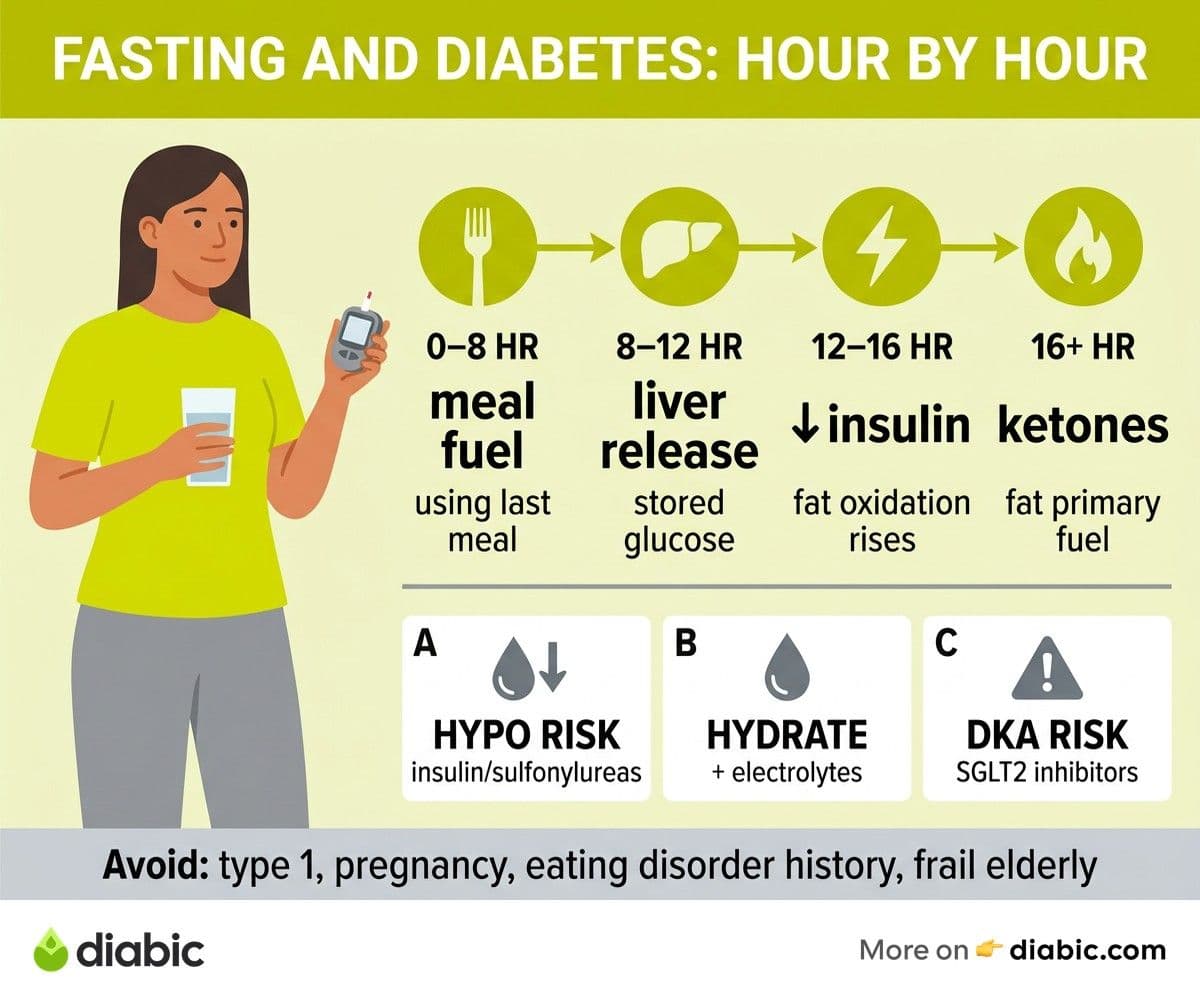
When you stop eating for an extended period, your body shifts through predictable stages. In the first few hours, your blood sugar dips slightly as glucose from your last meal is used up. Insulin levels fall, which is part of why fasting interests researchers studying insulin resistance.
After eight to twelve hours, your liver starts releasing stored glucose through a process called glycogenolysis. This is one reason morning fasting blood sugar can sometimes look higher than expected, especially in people with type 2 diabetes whose livers may overproduce glucose overnight. The phenomenon is sometimes called the dawn effect.
Beyond about sixteen hours, the body begins to rely more heavily on fat for fuel, producing ketones in the process. Insulin sensitivity often improves during this phase, which is why short fasting windows have become a popular self-management tool. The American Diabetes Association acknowledges that some forms of intermittent fasting may help people with type 2 diabetes when done with medical guidance.
If you are curious whether fasting with type 2 diabetes is appropriate for your situation, the answer almost always depends on which medications you take and how stable your numbers run day to day.
Potential Benefits of Fasting for Diabetes
Does fasting help diabetes? The honest answer is that it can, for the right person, under the right conditions. Research has identified several mechanisms that may explain the benefits people report.
The most consistent finding is improved insulin sensitivity. When the pancreas is not constantly being asked to release insulin in response to meals, the body's cells often become more responsive to the insulin that is already there. A 2018 case series published in Diabetes Care showed three patients with type 2 diabetes who were able to discontinue insulin therapy after a structured therapeutic fasting protocol with medical oversight.
Weight loss is another commonly cited benefit. Fasting naturally limits the eating window, which for many people leads to a calorie reduction without the burden of strict tracking. Even modest weight loss of five to seven percent of body weight has been shown to meaningfully improve glycemic markers.
Researchers have also noted reductions in inflammatory markers and improvements in measures of oxidative stress during regular fasting. Some early studies suggest a possible role in preserving beta cell function, though this work is still preliminary and not yet a basis for clinical recommendations.
Risks and Safety Concerns
Can fasting help diabetes safely? Sometimes. The risks deserve equal attention to the benefits, and they are not the same for everyone.
Hypoglycemia is the most immediate concern. If you take insulin, sulfonylureas, or meglitinides, your medication is working to lower blood sugar regardless of whether you have eaten. Skipping meals without adjusting medication can cause serious low blood sugar, sometimes severe enough to require emergency care. This is why any fasting plan in this category must be supervised by your prescriber.
Dehydration is another risk people underestimate. Many fasting protocols allow water, tea, and black coffee, but the absence of food means you also lose the fluid you would normally get from meals. People with diabetes are already at higher risk of dehydration during periods of higher blood sugar, so deliberate fluid intake matters.
Certain groups should generally avoid fasting altogether or do it only under specialist care. These include people with type 1 diabetes (where the risk of diabetic ketoacidosis is real), pregnant or breastfeeding women, anyone with a history of eating disorders, people with significant kidney disease, and frail older adults. The question of whether fasting can reverse diabetes is interesting from a research standpoint, but reversal is not a guarantee, and aggressive fasting without medical oversight can do harm.
Mayo Clinic emphasizes that intermittent fasting is not appropriate for everyone and recommends discussing it with a clinician before starting, particularly when chronic conditions are involved.
Types of Fasting Used by People with Diabetes
Not all fasts look alike. The main approaches differ in how long the fasting window lasts, what is allowed during it, and how often it repeats.
16/8 intermittent fasting restricts eating to an eight-hour window each day, typically something like noon to eight in the evening. It is one of the more sustainable formats and is often the first protocol people try. If you are exploring 16/8 intermittent fasting, starting with a 12-hour window and gradually extending it tends to be easier on blood sugar stability.
5:2 fasting involves eating normally five days a week and significantly reducing calories (around 500 to 600) on two non-consecutive days. Some people find this easier psychologically because most days remain normal. Others find the very-low-calorie days hard to manage with diabetes medications.
Time-restricted eating is closely related to 16/8 but emphasizes aligning meals with daylight hours. Eating earlier in the day, sometimes called early time-restricted feeding, has shown promising results in small studies on insulin sensitivity.
Religious fasting, particularly during Ramadan, is a meaningful practice for millions of people with diabetes. The World Health Organization and the International Diabetes Federation have published Ramadan-specific guidance, and most diabetes specialists recommend a pre-Ramadan medical review to adjust medications and create a monitoring plan. For many, fasting during Ramadan is possible with the right preparation. For others, Islamic teaching itself permits exemption when health is at risk.
Extended fasting (more than 24 hours) is generally not recommended for people with diabetes outside of supervised clinical settings. The risks of hypoglycemia, electrolyte imbalance, and ketoacidosis grow substantially with longer fasts. Curiosity about this approach should be channeled into a conversation with an endocrinologist, not a self-experiment. Reading more about intermittent fasting for type 2 diabetes is a better starting point than jumping to the most aggressive option.
Approaching Fasting and Diabetes Safely
If your healthcare provider supports a fasting trial, a few practical steps make the difference between a useful experiment and a stressful one.
Talk to your doctor before you start. This is not a formality. Your provider may need to adjust the timing or dose of certain medications, particularly insulin and sulfonylureas. They may also want a baseline A1C and a check on kidney function before you change your eating pattern.
Monitor your blood sugar more often during any fasting attempt, especially in the first two weeks. If you use a continuous glucose monitor, you already have a window into how your body responds. If you use a finger-stick meter, plan to check before, during, and after fasting windows, and any time you feel symptoms of low blood sugar.
Plan how you will break the fast. A meal of mostly refined carbs after a long fast can cause sharp glucose spikes. Aim for a balanced first meal with protein, healthy fat, and fiber-rich vegetables. Save simple carbs for last on the plate.
Know when to stop. Symptoms like shakiness, sweating, dizziness, confusion, or a blood glucose reading below 70 mg/dL mean you should eat right away, regardless of where you are in your fasting window. Fasting is a tool. Your safety always comes first.
From my experience: After 14 years living with diabetes, I have tried short fasting windows on and off, mostly the 12-hour overnight kind. What surprised me was that the right window for me was not what worked for someone else in my online support group. My morning numbers behave better when I eat dinner earlier rather than skipping breakfast. The lesson I keep coming back to is that fasting is personal, the data on your meter is the only voice that really matters, and a good endocrinologist will help you read what it is saying.
Frequently Asked Questions
Is it safe to fast when you have diabetes?
Fasting can be safe for some people with type 2 diabetes, but it depends on your medications, your overall health, and how closely you can monitor your blood sugar. People on insulin or sulfonylureas face higher hypoglycemia risk and need their medications adjusted before fasting. People with type 1 diabetes, women who are pregnant, and anyone with a history of eating disorders or significant kidney disease should generally avoid fasting unless under specialist supervision. Always discuss fasting with your healthcare provider first.
Can fasting help with diabetes management?
Some research suggests that intermittent fasting may improve insulin sensitivity, support weight loss, and reduce inflammation in people with type 2 diabetes. The benefits are most pronounced when fasting is combined with overall healthy eating during eating windows, regular physical activity, and consistent sleep. Results vary widely between individuals, and fasting should be approached as one tool among many, not as a standalone treatment for diabetes.
Will fasting raise my blood sugar?
It can, in some cases. Your liver releases stored glucose during longer fasting windows, which is a normal physiological response. People with type 2 diabetes whose livers overproduce glucose may see fasting blood sugar rise rather than fall, particularly in the morning. Tracking your numbers over a two-week trial period is the only way to know how your body responds.
How long should I fast if I have diabetes?
Most people start with a 12-hour overnight fast and gradually extend the window if their numbers stay stable. The 16/8 protocol is a common next step. Extended fasts of 24 hours or longer are not recommended without medical supervision, particularly if you take blood sugar lowering medications.
The relationship between fasting and diabetes is real, but it is not magic, and it is not for everyone. If you and your doctor decide to give it a try, treat the first month as data collection. Watch your numbers, watch how you feel, and be willing to adjust. Diabetes management rewards curiosity paired with caution, and fasting is one of many tools you can carry without ever needing to commit to it forever.
Shahriar P. Shuvo is the founder of Diabic. He has lived with diabetes for over 14 years, and built Diabic to deliver the practical, evidence-based self-management tools he wished existed when he was first diagnosed. By trade, Shahriar is a senior design and frontend engineer with 6+ years shipping products at Agora, Timescale (now Tiger Data), and ShareTrip. He writes from the intersection of lived diabetes experience and product craft, focused on what works in daily management rather than what sounds good in a textbook.
Medically reviewed by
Dr. Shanto Arian is an internal medicine physician now specializing in clinical and aesthetic dermatology, with a parallel academic focus on epidemiology and public health. He holds an MBBS, MPH, MSc (UK), MRCP (UK), MRCPI (Ireland), Diploma in Dermatology (UK), and Diploma in Aesthetic Medicine (USA). Dr. Arian trained in internal medicine, including hospital work on hematology cases such as graft-versus-host disease, before moving toward dermatology. Skin is one of the earliest places diabetes shows itself, from acanthosis nigricans and diabetic dermopathy to slow foot wound healing, and that intersection is where his clinical and Diabic-review work meet. On Diabic, Dr. Arian medically reviews content on diabetes diagnosis, complications, dermatologic manifestations, and pharmacotherapy, ensuring every claim aligns with current ADA, NICE, and peer-reviewed literature.
More from Diet & Fitness
View all
Simple Diabetes Exercise Routine for Beginners
A simple diabetes exercise routine for beginners with a 7-day plan, strength basics, and safety tips to help you move more without feeling overwhelmed.

Diabetes Friendly Smoothie Recipes: 5 No-Spike Picks
Five diabetes friendly smoothie recipes that balance protein, fat, and fiber to keep blood sugar steady. Includes a simple framework for building your own.

Can Exercise Prevent Diabetes? Research Says Yes
Can exercise prevent diabetes? Landmark studies show a 58% lower risk with regular activity. Here's how much you need and which workouts help most.
Clinician-reviewed habits, plain-language guides, and honest answers - the small shifts that make living with diabetes feel lighter, every day.