Weight Loss for Prediabetes: A Realistic Approach
Weight loss for prediabetes does not require extreme dieting. Learn the 5-7% target, what works, and how to set realistic, sustainable goals.

In this article(11)
- How Much Weight Do You Need to Lose to Reverse Prediabetes?
- Does Losing Weight Help Prediabetes?
- A Prediabetes Diet That Supports Weight Loss
- Lifestyle Changes That Support Sustainable Weight Loss
- Can Prediabetes Be Reversed Through Weight Loss Alone?
- Setting Realistic Goals for Weight Loss for Prediabetes
Weight loss for prediabetes does not require extreme dieting or punishing exercise routines. Research consistently shows that even modest weight loss, around 5 to 7 percent of body weight, can significantly reduce the risk of progressing to type 2 diabetes. Here is a realistic approach that focuses on sustainability over speed.
The pressure to lose a lot fast is the single biggest reason people give up. The good news is that the science actually supports a slower, smaller, steadier path. You do not need to drop 30 pounds to see real metabolic change.
How Much Weight Do You Need to Lose to Reverse Prediabetes?
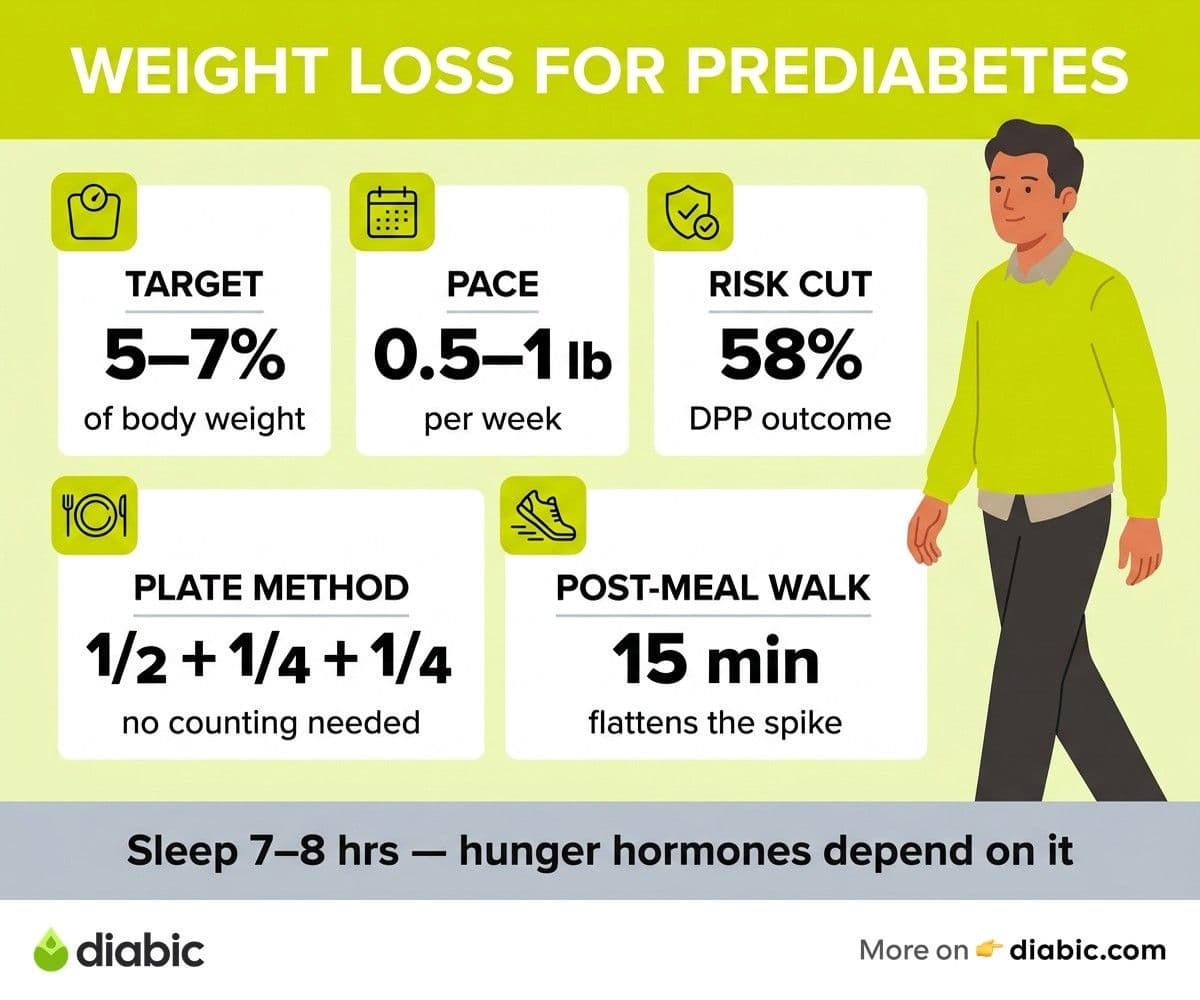
The answer comes from one of the most influential diabetes studies ever conducted. The Diabetes Prevention Program showed that participants who lost just 5 to 7 percent of their body weight reduced their risk of developing type 2 diabetes by 58 percent over three years. People over 60 saw an even larger 71 percent risk reduction.
Five to seven percent does not sound like much. For someone who weighs 200 pounds, that is 10 to 14 pounds. For a 180-pound person, it is 9 to 13 pounds. These are amounts most people can reach in three to six months with steady changes.
Why does such a small amount of weight loss have such an outsized effect? It comes down to where the fat is. Visceral fat (the kind stored around the liver and pancreas) is the most metabolically active and the most damaging to insulin sensitivity. When you lose weight, this is often the first fat to go. Even modest reductions in visceral fat improve how your body handles glucose.
Does Losing Weight Help Prediabetes?
Yes, and the mechanisms are well understood. When excess fat (especially visceral fat) shrinks, your liver becomes more sensitive to insulin and stops over-producing glucose. Your muscles also pull glucose out of the blood more efficiently. The result is lower fasting blood sugar and improved A1C numbers, often within a few months.
The American Diabetes Association consistently lists weight management as a top intervention for diabetes prevention. Their guidelines reflect the DPP findings and decades of supporting research showing that lifestyle-based weight loss outperforms metformin alone for people in the prediabetes range.
There is also a snowball effect. Modest weight loss tends to improve sleep, energy, blood pressure, and cholesterol at the same time. These improvements make the next pound easier to lose, which is why the first 10 pounds usually feel harder than the next 10. For more on the broader picture, our guide to whether prediabetes can be reversed explains the full range of evidence.
From my experience: Most people I have talked with chase a number that is far higher than they actually need. The first 10 pounds will move your A1C more than the next 30. If you can shift the goal from "lose a lot" to "lose 7 percent and hold it," the pressure drops and the consistency follows.
A Prediabetes Diet That Supports Weight Loss
A good prediabetes diet does not depend on calorie counting. It depends on choosing foods that fill you up for fewer calories. Vegetables, lean protein, legumes, and high-fiber whole grains take up space in your stomach and slow digestion, so you eat less without feeling hungry.
The plate method is the most practical tool. Fill half your plate with non-starchy vegetables, a quarter with lean protein (chicken, fish, tofu, eggs, or legumes), and a quarter with a whole grain or starchy vegetable. Add a small amount of healthy fat from olive oil, avocado, or nuts. This single rule, applied at most meals, naturally controls portions without measuring anything.
What backfires is extreme restriction. Cutting carbs to near zero or dropping to 1,000 calories a day produces fast initial loss, but most people regain it within a year. The body adapts to severe restriction by lowering metabolism and increasing hunger hormones, making the weight nearly impossible to keep off. Slow loss preserves muscle mass and keeps your metabolism intact.
Stick with foods you actually enjoy. If you hate kale, do not eat kale. There are dozens of vegetables, and the one you will eat regularly beats the one you keep buying and throwing out.
Lifestyle Changes That Support Sustainable Weight Loss
Lifestyle change for prediabetes is the part where most weight loss plans quietly fall apart. The diet is only one piece. Sleep, movement, stress, and emotional eating all influence whether the weight comes off and stays off.
Build consistent eating patterns first. Eating at roughly the same times each day stabilizes hunger hormones and prevents the late-night grazing that derails most efforts. Skipping meals usually leads to overeating later, not weight loss.
Move every day, but do not aim for a punishing workout schedule. The DPP target was 150 minutes of moderate activity per week, which is just over 20 minutes a day. Walking after meals is one of the most underrated tools for blood sugar control. A 15-minute walk after dinner often flattens the post-meal glucose spike more than any single food choice. Our guide to small lifestyle changes that add up covers practical examples.
Address emotional eating directly. Many people eat in response to stress, boredom, or fatigue rather than hunger. Naming the trigger is the first step. Sometimes the answer is a 10-minute walk, a glass of water, or a short call with a friend rather than another snack.
Sleep is the silent saboteur. Getting fewer than six hours a night raises ghrelin (the hunger hormone) and lowers leptin (the fullness hormone). You end up hungrier and crave more refined carbs. Aiming for seven to eight hours is one of the highest-uses things you can do for weight loss.
Can Prediabetes Be Reversed Through Weight Loss Alone?
Often, yes, but it depends on where you start and how long you have had prediabetes. The DPP and other studies show that weight loss alone, paired with modest physical activity, can return blood sugar to a normal range for many people with prediabetes.
Combining weight loss with broader lifestyle changes (improved diet quality, regular activity, better sleep, stress management) produces stronger and more lasting results than weight loss alone. The diet and exercise pieces support each other, and the metabolic benefits compound.
For some people, lifestyle changes are not enough on their own. If you have had prediabetes for several years, have a family history of diabetes, or have other risk factors like polycystic ovary syndrome (PCOS), your provider may recommend metformin in addition to lifestyle changes. The DPP showed that metformin is most effective for people who are younger, have higher BMI, or have a history of gestational diabetes. Our guide to prediabetes treatment options walks through when medication makes sense.
Setting Realistic Goals for Weight Loss for Prediabetes
The CDC National Diabetes Prevention Program recommends a weight loss target of 0.5 to 1 pound per week. This pace adds up to 26 to 52 pounds per year, which is more than enough to reach the 5 to 7 percent target for most people.
Faster loss is not better. People who lose more than 2 pounds a week tend to lose more muscle, hit plateaus sooner, and regain more quickly. Slower loss preserves muscle mass, which keeps your metabolic rate higher and makes it easier to maintain.
Stop measuring progress only with the scale. Energy levels, fasting blood sugar trends, A1C readings, waist circumference, and how clothes fit are often better indicators of metabolic improvement than weight alone. Some people see their A1C drop by half a point before the scale moves much.
When you hit a plateau (and you will), do not panic and slash calories. Plateaus are usually a sign that your body is recalibrating. Hold the new pattern for two to three weeks before changing anything. If the plateau persists, small changes work better than dramatic ones: a longer walk, slightly larger vegetable portions, or addressing sleep and stress.
FAQ
How much weight do you need to lose to reverse prediabetes?
Research from the Diabetes Prevention Program shows that losing 5 to 7 percent of your body weight can reduce the risk of type 2 diabetes by 58 percent. For many people, that translates to 10 to 15 pounds. Even smaller losses can produce measurable improvements in A1C and fasting glucose.
Does losing weight help prediabetes?
Yes. Weight loss, particularly the reduction of visceral fat, improves insulin sensitivity and can help normalize blood sugar levels. Even modest weight loss produces meaningful health benefits, often within three to six months.
How fast should I lose weight with prediabetes?
The CDC recommends 0.5 to 1 pound per week as a sustainable pace. Faster loss tends to be regained, while slower loss preserves muscle mass and keeps your metabolism intact. Aim for steady progress over months, not weeks.
What if weight loss is not happening despite my efforts?
Plateaus are normal and usually pass within two to three weeks. If progress stalls longer than that, look at sleep, stress, and hidden calories first before cutting more food. If nothing changes, talk to your provider about whether other factors (thyroid issues, medications, hormonal changes) are involved.
A realistic approach to weight loss for prediabetes starts with letting go of the all-or-nothing mindset. The pattern that wins is small, steady, and built around food and movement you can sustain for years. Five to seven percent is a small target with outsized payoff.
Shahriar P. Shuvo is the founder of Diabic. He has lived with diabetes for over 14 years, and built Diabic to deliver the practical, evidence-based self-management tools he wished existed when he was first diagnosed. By trade, Shahriar is a senior design and frontend engineer with 6+ years shipping products at Agora, Timescale (now Tiger Data), and ShareTrip. He writes from the intersection of lived diabetes experience and product craft, focused on what works in daily management rather than what sounds good in a textbook.
Medically reviewed by
Dr. Rezwana Parvin Rumpa is an obstetrics and gynaecology specialist with clinical focus on gestational diabetes, PCOS, and fertility. She holds the MRCOG (Final Part) from the Royal College of Obstetricians and Gynaecologists in London, the MRCPI (Final Part) from the Royal College of Physicians of Ireland, and an MBBS from Shaheed Monsur Ali Medical College under Dhaka University. Dr. Rumpa serves as a Senior Medical Officer in the Obs and Gynae department at BRB Hospitals Ltd, where she has spent three years managing prenatal care, emergency obstetric cases, and women's-health surgery. On Diabic, she medically reviews content for women living with diabetes, with particular attention to pregnancy, PCOS, and reproductive-health intersections.
More from Diabetes Knowledge
View all
6 Safe Dessert for Gestational Diabetes Recipes You Can
Six dessert for gestational diabetes recipes that satisfy your sweet tooth without spiking blood sugar, with carb counts and pairing tips you can use.

8 High Fiber Foods That Help with Prediabetes
Add these 8 high fiber foods for prediabetes to slow glucose absorption, support steady blood sugar, and meet the daily fiber target most people miss.

Mediterranean Diet for Prediabetes: A Practical Guide
The mediterranean diet for prediabetes is one of the best-studied eating patterns for prevention. Here is what to eat, what to avoid, and how to start.
Clinician-reviewed habits, plain-language guides, and honest answers - the small shifts that make living with diabetes feel lighter, every day.