Small Lifestyle Changes for Prediabetes, Big Results
A small lifestyle change for prediabetes, done consistently, can rival medication. Here is what actually works and how to build habits that stick.

In this article(12)
You do not need to overhaul your entire life to make a meaningful difference with prediabetes. A single, well-chosen lifestyle change for prediabetes, done consistently, can produce results that rival medication in clinical trials. The trouble is that most advice piles ten changes on you at once and asks you to start them all on Monday.
That approach almost never lasts past Wednesday. What does last is a smaller, slower set of shifts that compound over weeks and months. This guide walks through the changes that move blood sugar the most, how much weight loss really matters, and how to build habits that hold up when life gets busy.
What Lifestyle Changes Help with Prediabetes
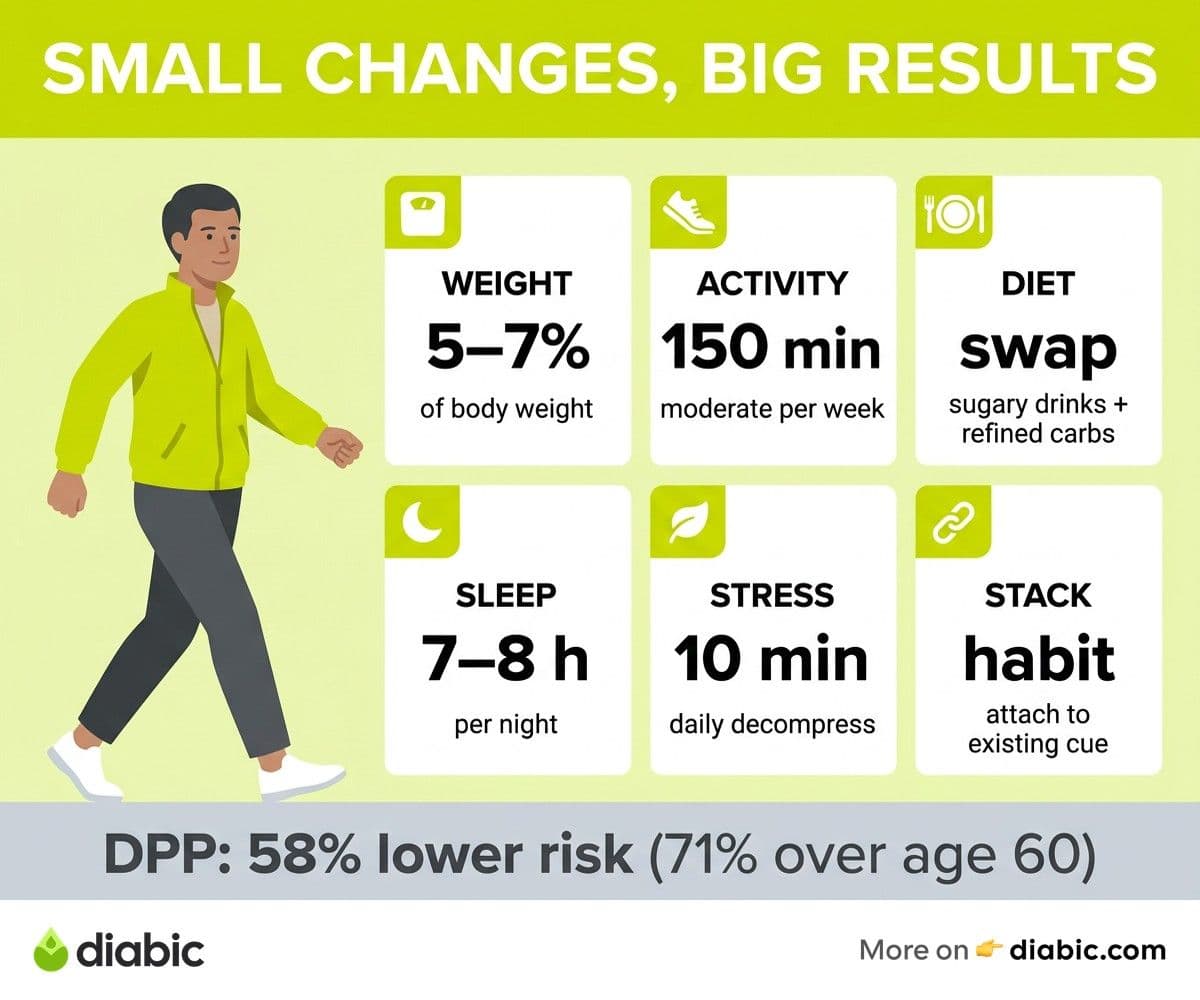
The strongest evidence for any prediabetes intervention comes from the Diabetes Prevention Program, a large multi-center trial run by the National Institute of Diabetes and Digestive and Kidney Diseases. Participants who made structured lifestyle changes cut their risk of developing type 2 diabetes by 58 percent over three years. For people over 60, the risk reduction climbed to 71 percent.
Those numbers came from changes that, on paper, sound modest. Participants aimed for 7 percent body weight loss and 150 minutes of moderate activity per week. They were not asked to follow a named diet or train for a marathon. They were asked to be consistent.
That is the underrated lesson of the DPP. Small, repeated actions outperformed dramatic overhauls because participants could actually keep doing them. Three pillars carry most of the work: what you eat, how you move, and how you manage sleep and stress. Get even partial traction on each, and your blood sugar usually follows.
Dietary Adjustments That Move the Needle
You do not have to give up bread, pasta, or rice to make progress with a prediabetes diet. The single highest-uses shift for most people is reducing refined carbohydrates and sugary drinks, since both push blood sugar up quickly and offer little fiber to slow the rise.
Start with the easy swaps. Sparkling water in place of soda. Whole grain bread in place of white. A piece of fruit instead of a fruit-flavored snack. None of these require willpower at every meal once they become the default in your kitchen.
From there, the goal is to add rather than restrict. More fiber from beans, lentils, vegetables, and whole grains. More lean protein at breakfast and lunch to steady appetite through the afternoon. Healthy fats from olive oil, nuts, avocado, and fatty fish to round out meals.
You do not need a named diet plan to see improvement. Mediterranean-style eating, DASH, and lower-carb approaches all show benefit in research, and the best one is the one you can keep eating in six months. Pick the patterns that fit your kitchen, your culture, and your budget.
Weight Loss for Prediabetes: How Much Makes a Difference
The most surprising finding from the DPP was how little weight loss it took to change outcomes. The target was 7 percent of body weight, and even people who reached only 5 percent saw meaningful risk reduction. For someone weighing 200 pounds, that is 10 to 14 pounds, not 50.
That range matters because it is achievable without extreme measures. Most people can move toward 5 to 7 percent through gradual dietary changes and added movement, no crash diets required. Slow, steady weight loss also tends to stick longer than rapid loss.
A few practical strategies make this easier. Track meals for a week to spot patterns rather than to count every calorie forever. Front-load protein and fiber at breakfast so you are less likely to snack later. Build a short walk into your post-meal routine, since movement after eating helps blunt blood sugar spikes.
If you want a deeper look at what to expect at this stage, our guide to realistic weight loss for prediabetes walks through pacing, plateaus, and the role of measurement.
Movement That Counts
The 150 minutes of moderate activity per week target sounds like a lot until you break it down. That is 30 minutes, five days a week, of anything that gets your heart rate up a bit. Walking briskly, cycling, swimming, dancing, or working in the garden all count.
Movement helps prediabetes through two pathways. It improves how well your muscles take up glucose from the bloodstream, and it makes your cells more sensitive to insulin over time. Both effects show up after a single session and build with regular practice.
Equally important, and often skipped, is reducing the time you spend sitting. Long, uninterrupted sitting blocks raise blood sugar even in people who exercise daily. Standing up for two or three minutes every half hour, or taking a five-minute walk after meals, makes a measurable difference.
Pick something you can do without driving to it. The best activity is the one you will still be doing six months from now, not the one that sounds most impressive on paper.
Can Lifestyle Changes Alone Reverse Prediabetes
For many people, yes. The DPP showed that lifestyle intervention alone produced larger risk reductions than metformin in nearly every age group studied. People who reached the diet, weight, and activity targets often saw their fasting glucose and A1C return to the normal range.
That said, lifestyle changes are not always enough on their own. The CDC notes that some people, particularly those with very high A1C levels, a strong family history, or other metabolic issues, may benefit from adding medication alongside lifestyle work. That is a conversation to have with your doctor, not a sign of failure.
The framing matters. Lifestyle changes are the foundation regardless of whether medication is added. We cover this in more depth in our look at whether prediabetes can be reversed and in the related overview of prediabetes treatment options.
The 58 percent risk reduction from the DPP is also a long-term number. Follow-up studies tracked participants for over 20 years and found that the benefit persisted, with lower diabetes incidence still visible decades later. Acting now buys you years of better metabolic health.
Sleep, Stress, and Blood Sugar
Sleep and stress get the least attention in most prediabetes advice and probably deserve the most. Poor sleep, defined as fewer than six hours per night or fragmented sleep, worsens insulin resistance within just a few nights. The Sleep Foundation summarizes research showing that consistent short sleep is linked to higher fasting glucose and a greater risk of type 2 diabetes.
Stress works through a similar mechanism. Chronic stress keeps cortisol elevated, and cortisol pushes the liver to release glucose into the bloodstream. Over time, this combination strains the same insulin response that is already struggling in prediabetes.
The interventions here do not have to be elaborate. A consistent bedtime, a dark and cool room, and avoiding screens for the last 30 minutes of the day improve sleep for most people. For stress, simple practices like a daily 10-minute walk, slow breathing, or talking with a friend tend to outperform anything that requires an app subscription.
From my experience: after 14 years of living with diabetes, the variable that most reliably wrecks my numbers is not a meal or a missed walk. It is a short night. One night of five hours of sleep can push my morning blood sugar up by 20 to 30 points, even when nothing else has changed. Treating sleep as a non-negotiable was the single highest-return adjustment I made.
Building a Lifestyle Change for Prediabetes That Lasts
The reason most lifestyle plans fail has nothing to do with motivation. It is that people try to change too many things at once, and willpower runs out. The fix is to start with one change at a time and let each new habit become automatic before adding another.
Habit stacking helps. Attach a new habit to one you already do. After your morning coffee, take a 10-minute walk. After lunch, drink a glass of water. After brushing your teeth, set out tomorrow's workout clothes. The existing routine becomes the cue, so you do not have to remember.
Environmental design does even more. Keep cut vegetables at eye level in the fridge and put the chips on a high shelf. Lay your walking shoes by the door. Have the water bottle filled and ready. The easier the right choice is to make, the less you have to negotiate with yourself.
The CDC's National Diabetes Prevention Program is built around this exact idea. It uses small group coaching over a year to help participants build one habit at a time, and the results closely match the original DPP trial. If you want structured support, ask your doctor whether you qualify for a recognized program in your area.
Track progress in a way that motivates rather than shames you. A simple tally of walking days per week, or a weekly weigh-in viewed as a trend rather than a daily verdict, tends to keep people engaged. Celebrate small wins along the way, since they are what compound into the big ones.
FAQ
What lifestyle changes help with prediabetes?
The most impactful changes include improving your diet quality, increasing physical activity to at least 150 minutes per week, and aiming for 5 to 7 percent body weight loss if needed. Improving sleep and managing daily stress also support blood sugar in ways that surprise most people.
Can lifestyle changes alone reverse prediabetes?
For many people, yes. The Diabetes Prevention Program trial showed that lifestyle changes alone reduced type 2 diabetes risk by 58 percent, and many participants returned to normal blood sugar levels without medication. Some people may still benefit from adding medication alongside lifestyle work, which is a conversation to have with your doctor.
How quickly can a lifestyle change for prediabetes show results?
Many people see improvements in fasting glucose within a few weeks of consistent changes, and A1C, which reflects three months of blood sugar, usually shifts within 8 to 12 weeks. The pace depends on starting point, sleep quality, and how stable the changes are. Consistency matters more than intensity.
Is it better to focus on diet or exercise first for prediabetes?
Both matter, but most research suggests that dietary changes have the larger short-term impact on blood sugar, while exercise compounds the benefit and protects results over time. If you have to pick one to start, begin with the change that feels most doable, since the habit that sticks is the one that works.
The most encouraging part of prediabetes is that it is the moment when small actions still carry the most weight. A 10-minute walk after dinner, a swap from soda to sparkling water, a slightly earlier bedtime. Pick one lifestyle change for prediabetes, stack a few of these, and let them run for a few months. The numbers usually take care of themselves.
Shahriar P. Shuvo is the founder of Diabic. He has lived with diabetes for over 14 years, and built Diabic to deliver the practical, evidence-based self-management tools he wished existed when he was first diagnosed. By trade, Shahriar is a senior design and frontend engineer with 6+ years shipping products at Agora, Timescale (now Tiger Data), and ShareTrip. He writes from the intersection of lived diabetes experience and product craft, focused on what works in daily management rather than what sounds good in a textbook.
Medically reviewed by
Dr. Rezwana Parvin Rumpa is an obstetrics and gynaecology specialist with clinical focus on gestational diabetes, PCOS, and fertility. She holds the MRCOG (Final Part) from the Royal College of Obstetricians and Gynaecologists in London, the MRCPI (Final Part) from the Royal College of Physicians of Ireland, and an MBBS from Shaheed Monsur Ali Medical College under Dhaka University. Dr. Rumpa serves as a Senior Medical Officer in the Obs and Gynae department at BRB Hospitals Ltd, where she has spent three years managing prenatal care, emergency obstetric cases, and women's-health surgery. On Diabic, she medically reviews content for women living with diabetes, with particular attention to pregnancy, PCOS, and reproductive-health intersections.
More from Diabetes Knowledge
View all
6 Safe Dessert for Gestational Diabetes Recipes You Can
Six dessert for gestational diabetes recipes that satisfy your sweet tooth without spiking blood sugar, with carb counts and pairing tips you can use.

8 High Fiber Foods That Help with Prediabetes
Add these 8 high fiber foods for prediabetes to slow glucose absorption, support steady blood sugar, and meet the daily fiber target most people miss.

Mediterranean Diet for Prediabetes: A Practical Guide
The mediterranean diet for prediabetes is one of the best-studied eating patterns for prevention. Here is what to eat, what to avoid, and how to start.
Clinician-reviewed habits, plain-language guides, and honest answers - the small shifts that make living with diabetes feel lighter, every day.