Low Blood Sugar Symptoms That Hit Without Warning
Learn the low blood sugar symptoms that strike without warning, how to respond fast with the ADA Rule of 15, and when to call for help.

In this article(8)
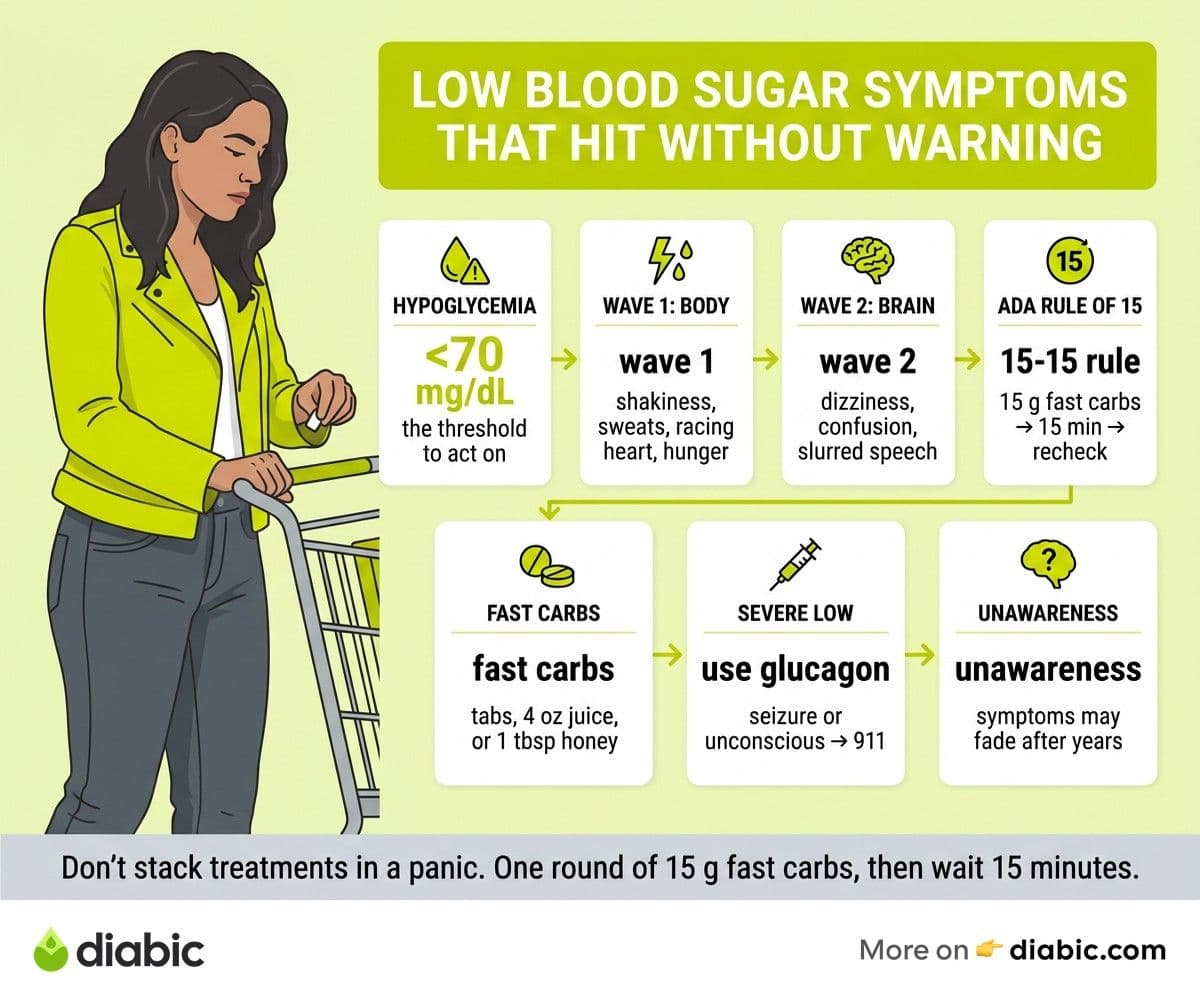
You're standing in line at the grocery store when your hands start trembling, your shirt feels suddenly damp, and the lights overhead seem too bright. Within five minutes you're gripping the cart handle, unsure if you can make it to your car. Low blood sugar symptoms can hit that fast, and recognizing them in the moment is one of the most useful skills anyone living with diabetes can build.
Hypoglycemia, defined as a blood glucose reading below 70 mg/dL, is one of the most common and dangerous swings the body can take when you're managing insulin or certain oral medications. The tricky part is that symptoms can vary wildly between people, between episodes, and even between mornings and evenings. We wrote this guide so you and the people who love you can spot a low quickly, treat it correctly, and know when something has crossed into emergency territory.
Recognizing Low Blood Sugar Symptoms Fast
The classic warning signs of a low usually start in your nervous system before your brain catches on. According to the Mayo Clinic's overview of hypoglycemia, the earliest cues are often physical and a little jarring, almost like the body is shouting through every sense at once. Most people describe a combination of shakiness, cold sweats that appear out of nowhere, and a heart that suddenly feels like it's running uphill.
Hunger is another reliable signal, and it's not the gentle "I could eat" kind of hunger. It's the sudden, urgent kind that makes you want to tear into anything sweet. Some people feel queasy or even nauseated alongside the hunger, which can be confusing because the instinct might be to skip food when your stomach feels off. Pair these with tingling around the lips or fingers, and you have a fairly classic hypoglycemia opening act.
The next wave of hypoglycemia symptoms tends to involve your head more than your body. Dizziness, lightheadedness, and a foggy sort of confusion can creep in, sometimes with a side of irritability that feels out of proportion to whatever's happening around you. We've heard people describe snapping at a partner over something minor, only to realize later their glucose had dropped into the 50s. If you're noticing patterns like these, our guide on diabetes symptoms that sneak up on you can help you connect the dots.
When a low keeps progressing without treatment, the symptoms get harder to ignore and harder to manage on your own. Vision can blur, speech can slur, and coordination can get clumsy enough that pouring a glass of juice becomes a real challenge. This is the point where someone watching might assume you've been drinking, which is one reason medical identification matters so much. The faster you recognize these signs, the more options you have.
Why Hypoglycemia Symptoms Appear Suddenly
Your brain runs almost entirely on glucose, so when blood sugar dips below a certain threshold, your nervous system pulls a fire alarm. That's the surge of adrenaline behind the shakiness, sweating, and racing heart. The whole physiological response is designed to push you toward food immediately, which is why a low can feel so urgent and slightly panicky even when nothing scary is happening around you.
Insulin is usually the trigger. When you take insulin or certain pills like sulfonylureas, your body has more glucose-clearing power circulating than it might need at any given moment. Skip a meal, eat less than expected, exercise harder than planned, or stack doses too closely together, and the math tips toward hypoglycemia. The CDC notes that even routine activities like a longer walk after dinner can lower glucose for hours afterward, sometimes well into the night.
A particularly tough version of this is hypoglycemia unawareness, where the early warning symptoms fade or disappear entirely. People who have lived with diabetes for many years, who experience frequent lows, or who have certain nerve complications can lose the adrenaline-driven cues that normally save them. Instead of shakiness at 65 mg/dL, the first sign might be confusion at 45 mg/dL, which is a much harder situation to self-treat. If your lows feel quieter than they used to, that's worth a conversation with your provider.
It also helps to remember that hypoglycemia is the mirror image of high glucose, not just a different problem. Understanding the full range of high blood sugar symptoms gives you context for why your body reacts so dramatically to lows. People who are newly diagnosed often find that learning type 1 diabetes symptoms that come on fast helps them appreciate why insulin dosing requires such fine-tuning in the first place.
Mild vs Severe Low Blood Sugar: Know the Difference
Not every low looks the same, and treating them as if they do can lead to overcorrection, undertreatment, or missed emergencies. The NIDDK breaks hypoglycemia into three rough tiers, and learning which tier you're in changes what you do next. The differences matter for you, your family, and anyone who might respond if you're at work, on the road, or asleep.
Mild lows usually involve those nervous-system symptoms we covered earlier: shakiness, sweating, hunger, mild anxiety, and a faster pulse. You can still think clearly, talk normally, and treat yourself with fast-acting carbs without help. These are the lows most people with insulin-dependent diabetes will encounter regularly, and they respond well to a quick correction if you catch them early. The goal here is acting before the next tier shows up.
Moderate lows show up when glucose has dropped further and your brain starts running short on fuel. You might feel weak, struggle to concentrate, get a headache, or find that simple tasks feel suddenly hard. Speech can slow down, and you may need to read the same sentence three times before it lands. At this stage you can usually still self-treat, but it helps to sit down, alert someone nearby, and stay put until your numbers come back up.
Severe lows are medical emergencies. We're talking about seizures, loss of consciousness, or being awake but so disoriented that you can't safely chew, swallow, or follow instructions. At this point fast-acting carbs are not an option because aspiration becomes a real risk. This is where glucagon, an injectable or nasal hormone that tells the liver to release stored glucose, becomes the right tool. Talk to your doctor about whether a glucagon prescription belongs in your kit, and make sure at least one person you live with knows where it is and how to use it.
How to Respond When Symptoms Strike
The single most useful protocol to memorize is the ADA Rule of 15, sometimes called the 15-15 rule. The American Diabetes Association recommends consuming 15 grams of fast-acting carbohydrates, waiting 15 minutes, and then rechecking your glucose. If you're still below 70 mg/dL, repeat the cycle. If you've come back into range, eat a small balanced snack to keep things stable until your next meal.
Fast-acting carbs are the heroes of the moment, and the best options are surprisingly boring on purpose. Glucose tablets are designed for exactly this situation and let you count grams precisely. Four ounces of regular juice, four ounces of regular soda (not diet), a tablespoon of honey, or a tube of glucose gel all do the job. We keep tablets in every bag, the car console, and the nightstand because lows do not check your schedule.
What you want to avoid during an active low might be counterintuitive. Skip chocolate, peanut butter crackers, ice cream, and anything else that combines sugar with fat or protein, because those slow down absorption right when you need glucose to hit your bloodstream quickly. Save those mixed snacks for the follow-up snack after your numbers have recovered. Also avoid stacking treatments, which means don't pile on a juice, three glucose tabs, and a granola bar in the first ninety seconds because the panic feels overwhelming.
If symptoms suggest a severe low, or if someone with you can't safely swallow, that's the moment to use glucagon and call emergency services. Knowing the difference between this scenario and one that resolves with a juice box is part of why we encourage everyone to write a personal hypoglycemia plan with their care team. While you're at it, take a few minutes to learn the DKA red flags to act on, because diabetes can swing in both directions and recognizing either extreme keeps you and your people safer.
Preventing Low Blood Sugar Episodes
Prevention starts with patterns, and patterns start with data. The CDC's guidance on managing blood sugar emphasizes consistent monitoring around meals, physical activity, and medication doses, because the moments lows happen are rarely random. A continuous glucose monitor can be especially helpful here since it shows trends and trajectory, not just a single number, and many people find that one feature alone reduces nighttime lows significantly.
Timing matters more than most of us realize when we're new to insulin. Eating too late after a rapid-acting dose, exercising before a meal, or drinking alcohol on an empty stomach can all set up a low that arrives hours after you'd expect. Working with your provider on dose timing, basal rates, and exercise adjustments is one of the highest-uses things you can do, and we cover the basics in our piece on insulin therapy for type 1.
Wearing medical identification deserves more attention than it usually gets. A bracelet, necklace, or even a clearly labeled phone lock screen can save lives during a severe low when you can't speak for yourself. First responders are trained to look for these cues, and the few seconds it takes them to recognize hypoglycemia rather than other emergencies can change the outcome significantly. If jewelry feels uncomfortable, silicone bands and shoe tags work just as well.
From my experience: After fourteen years with type 1, I can tell you that lows feel different at 2 a.m. than they do at 2 p.m. Nighttime ones often skip the sweat-and-shake announcement entirely, which is why I keep glucose tabs on my nightstand and have a standing rule with my partner about not assuming I'm just being grumpy when I wake up disoriented. Your patterns will be your own, but writing them down for a few weeks shows you things no textbook will.
Building a low-prevention routine isn't about achieving perfect numbers. It's about reducing the size and frequency of swings so that when a low does happen, it's catchable, treatable, and not a crisis. Track what triggers your episodes, share that log with your care team, and adjust gradually. Small wins stack up faster than you'd expect.
Frequently Asked Questions
What does low blood sugar feel like?
Low blood sugar typically feels like a sudden wave of shakiness, sweating, and intense hunger that arrives with little warning. Many people describe feeling lightheaded, anxious, or weirdly irritable, almost as if their body is in a panic without a clear cause. As glucose drops further, vision can blur, speech can slur, and coordination suffers in ways that feel obvious to people watching. The whole sensation can come on within five to ten minutes, which is why having a treatment plan ready in advance matters so much.
How to tell if blood sugar is low?
The most reliable way to tell is to check with a glucose meter or continuous glucose monitor, since a reading below 70 mg/dL confirms hypoglycemia. Physical cues like trembling hands, a racing heartbeat, sweating, sudden hunger, and difficulty concentrating are strong indicators that match up with low readings most of the time. If you can't test in the moment, the safer move is to treat the symptoms as a low and recheck once you're stable. Untreated lows are far more dangerous than an extra fifteen grams of carbs.
The takeaway is that low blood sugar symptoms rarely give you a long runway, so the prep work matters more than the heroics in the moment. Keep glucose tabs in the places you actually spend time, share your hypoglycemia plan with the people closest to you, and bring any pattern of frequent lows back to your provider rather than tolerating them. Talk to your doctor about whether a glucagon prescription, a CGM, or a dose adjustment fits your situation, especially if your warning signs are getting quieter.
Shahriar P. Shuvo is the founder of Diabic. He has lived with diabetes for over 14 years, and built Diabic to deliver the practical, evidence-based self-management tools he wished existed when he was first diagnosed. By trade, Shahriar is a senior design and frontend engineer with 6+ years shipping products at Agora, Timescale (now Tiger Data), and ShareTrip. He writes from the intersection of lived diabetes experience and product craft, focused on what works in daily management rather than what sounds good in a textbook.
Medically reviewed by
Dr. Shanto Arian is an internal medicine physician now specializing in clinical and aesthetic dermatology, with a parallel academic focus on epidemiology and public health. He holds an MBBS, MPH, MSc (UK), MRCP (UK), MRCPI (Ireland), Diploma in Dermatology (UK), and Diploma in Aesthetic Medicine (USA). Dr. Arian trained in internal medicine, including hospital work on hematology cases such as graft-versus-host disease, before moving toward dermatology. Skin is one of the earliest places diabetes shows itself, from acanthosis nigricans and diabetic dermopathy to slow foot wound healing, and that intersection is where his clinical and Diabic-review work meet. On Diabic, Dr. Arian medically reviews content on diabetes diagnosis, complications, dermatologic manifestations, and pharmacotherapy, ensuring every claim aligns with current ADA, NICE, and peer-reviewed literature.
More from Diabetes Knowledge
View all
6 Safe Dessert for Gestational Diabetes Recipes You Can
Six dessert for gestational diabetes recipes that satisfy your sweet tooth without spiking blood sugar, with carb counts and pairing tips you can use.

8 High Fiber Foods That Help with Prediabetes
Add these 8 high fiber foods for prediabetes to slow glucose absorption, support steady blood sugar, and meet the daily fiber target most people miss.

Mediterranean Diet for Prediabetes: A Practical Guide
The mediterranean diet for prediabetes is one of the best-studied eating patterns for prevention. Here is what to eat, what to avoid, and how to start.
Clinician-reviewed habits, plain-language guides, and honest answers - the small shifts that make living with diabetes feel lighter, every day.