Prediabetes Treatment Options That Work
Explore prediabetes treatment options backed by research, from lifestyle changes and diet shifts to metformin, and learn how to build a plan that fits.

In this article(30)
Prediabetes treatment is rarely about overhauling your life overnight. The approaches that consistently work in the research are surprisingly grounded: small dietary shifts, regular movement, modest weight loss, and in some cases, medication. None of it is glamorous, but the data on what actually moves the needle is encouraging.
If you have just been told your A1C is in the prediabetes range, you are not alone. Roughly 1 in 3 American adults are in the same boat, and most of them have no idea. The reassuring news is that prediabetes is one of the most reversible conditions in modern medicine when caught early and approached with a realistic plan. This guide walks through the treatment options that the evidence supports and how to think about building a plan you will actually stick with.
Lifestyle Changes as Prediabetes Treatment
Lifestyle change is the foundation of every credible plan in this space. The reason is simple: the data behind it is some of the strongest in preventive medicine.
What the Diabetes Prevention Program showed
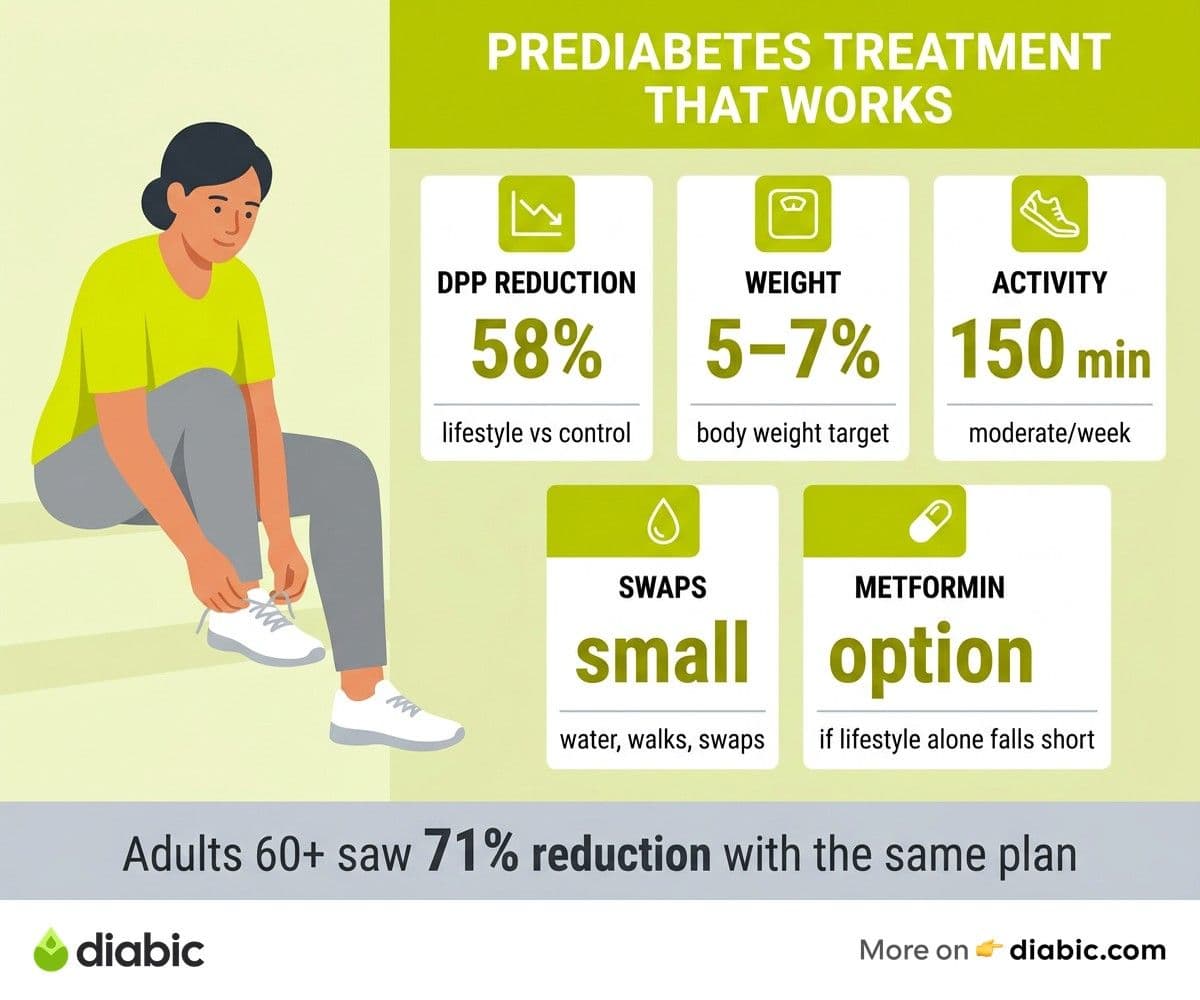
The landmark Diabetes Prevention Program (DPP) trial followed more than 3,000 adults with prediabetes for several years. Participants who made structured lifestyle changes reduced their risk of progressing to type 2 diabetes by 58 percent. According to the CDC's National DPP overview, adults over 60 saw an even larger 71 percent reduction. Lifestyle change outperformed metformin in that same trial, which surprised a lot of clinicians at the time.
The DPP did not ask people to lose massive amounts of weight or take up extreme exercise. The targets were modest, and that is exactly why they worked.
Weight loss of 5 to 7 percent
The DPP weight loss target was just 5 to 7 percent of body weight. For someone weighing 200 pounds, that is 10 to 14 pounds. Once you cross that threshold, insulin sensitivity improves, visceral fat drops, and blood sugar tends to come down with it.
This is not a number anyone should grind toward through punishing restriction. The participants who succeeded ate balanced meals, moved most days, and made incremental changes they could maintain.
Moving 150 minutes per week
The other DPP target was 150 minutes per week of moderate-intensity physical activity. According to the NIDDK summary of DPP results, this works out to about 30 minutes a day, five days a week. Brisk walking counts. Cycling, swimming, dancing, hiking, and gardening all count.
The activity does not have to happen in one block. Three 10-minute walks count just as much as one 30-minute session. What matters is the cumulative time and consistency.
Why small changes outperform overhauls
Drastic plans look impressive on paper, but they rarely survive contact with real life. The people who do best in long-term studies tend to be the ones who layer one small change on top of another rather than trying to flip everything at once. Trading one sugary drink for water, walking after dinner, swapping white rice for brown a few nights a week. None of those changes feel heroic, but stacked over months, they shift the trajectory.
Dietary Approaches for Prediabetes
There is no single prediabetes diet, and that is a feature, not a bug. The flexibility means you can build something that actually fits your taste, budget, and culture.
Reducing refined carbs and added sugars
Refined carbohydrates and added sugars hit the bloodstream fast, triggering big insulin responses. Cutting back, not cutting out, is usually enough to see meaningful change. White bread, sugary cereals, soda, fruit juice, and most packaged snacks fall into this category.
You do not need to count grams obsessively. Reading labels for added sugars and ingredient lists short enough to recognize gets you most of the way there.
Building meals around fiber, vegetables, and lean protein
Fiber slows glucose absorption, vegetables add volume without spiking blood sugar, and protein helps you feel full long after the meal. A plate that is roughly half non-starchy vegetables, a quarter lean protein, and a quarter whole grains or starchy vegetables tends to keep blood sugar steady.
Beans, lentils, oats, berries, leafy greens, eggs, fish, and chicken are all workhorses of a prediabetes-friendly kitchen. Our prediabetes diet guide breaks down specific foods and easy swaps in more depth.
Mediterranean, DASH, and low-glycemic patterns
Three eating patterns have the strongest evidence for prediabetes and metabolic health: Mediterranean, DASH, and low-glycemic. The Mediterranean pattern emphasizes vegetables, fish, olive oil, legumes, and whole grains. The DASH pattern was originally designed for blood pressure but has clear benefits for blood sugar too. Low-glycemic eating focuses on choosing carbs that release glucose more slowly.
These patterns overlap more than they differ. Pick the one that feels most livable and start there.
Working with a dietitian
A registered dietitian who specializes in diabetes can save you months of trial and error. Many insurance plans cover medical nutrition therapy for prediabetes, especially if your provider includes a referral. If you are considering medication alongside diet changes, metformin for prediabetes covers what to expect when both approaches are combined.
Prediabetes Medication Options
Lifestyle change is the first-line treatment, but medication has a real place in the conversation, especially for people at higher risk of progression.
Metformin
Metformin is the only medication formally recommended by the ADA's guidance for prediabetes for prevention of progression. It works by reducing how much glucose your liver produces and improving how your cells respond to insulin. It has decades of safety data behind it and is generally well-tolerated.
In the DPP, metformin reduced diabetes risk by 31 percent. That is meaningful, though less than the 58 percent reduction from intensive lifestyle change. Most providers think of metformin as a complement to lifestyle change, not a replacement.
When your doctor may suggest medication
Metformin tends to be considered when one or more of these factors are present: a BMI of 35 or higher, age under 60, a history of gestational diabetes, an A1C closer to the diabetes range (around 6.0 to 6.4), or a strong family history of type 2 diabetes. Your doctor weighs your full picture, including other health conditions, before suggesting it.
Side effects, when they happen, are usually digestive: nausea, loose stools, or stomach upset in the first few weeks. Starting at a low dose and taking it with food helps most people get past the adjustment period.
Other medications used off-label
Some endocrinologists prescribe other diabetes medications off-label for prediabetes in select cases, including GLP-1 receptor agonists for people who also have obesity. These are not standard approaches, and insurance coverage varies. If your provider raises this option, ask about the evidence specific to your situation.
For broader context on the medication landscape after diabetes does develop, type 2 diabetes treatment covers the full range of options.
Combining medication with lifestyle changes
The DPP and follow-up studies are clear: lifestyle change plus metformin tends to produce better results than either alone for people at high risk. Medication is not a shortcut around the lifestyle work. It is an additional tool that buys you time and metabolic room while you build sustainable habits.
Monitoring Your Progress
Treatment without monitoring is guesswork. Tracking the right numbers tells you whether your plan is working and where to adjust.
A1C testing every three to six months
A1C reflects your average blood sugar over the past three months. For prediabetes, most providers retest every three to six months while you are actively making changes, then annually once your numbers are stable. A drop of even 0.2 to 0.3 points is meaningful evidence that your plan is working.
If you want a refresher on how the prediabetes range is defined and what the cutoffs mean for you, prediabetes: why catching it now matters covers the key thresholds.
Home blood sugar monitoring
Home glucose meters are not strictly required for prediabetes, but some people find them useful for short stretches. Checking your fasting number a few mornings a week, or testing after specific meals, can show you which foods spike you the most. That information is hard to get any other way.
Continuous glucose monitors (CGMs) are increasingly available without a prescription and offer an even fuller picture. They are not necessary for everyone, but they can be motivating for people who learn well from real-time feedback.
Weight and waist circumference
The scale is not the only measure of progress, and for many people it is not the most informative one. Waist circumference reflects visceral fat better than total weight does, and visceral fat is the type most closely tied to insulin resistance. Measuring monthly with a soft tape gives you a useful trend line.
Energy, sleep quality, and how clothes fit are also legitimate signals. They often shift before the scale does.
Adjusting based on results
If your A1C is not budging after six months of consistent effort, that is data, not failure. It might mean it is time to talk to your provider about adding metformin, working with a dietitian, or addressing factors like sleep apnea or stress that affect blood sugar. The plan should evolve with the results.
Building a Realistic Treatment Plan
The best prediabetes treatment plan is the one you can actually live with. Ambition is useful at the start, but consistency is what produces results.
Setting achievable goals with your care team
Sit down with your provider and pick two or three concrete goals for the next three months. Not 10 goals. Two or three. Something like: walk 25 minutes after dinner four nights a week, swap soda for sparkling water, and add a vegetable to lunch. Specific, measurable, and small enough to actually do.
Write them down. Tell someone. Check in at three months and adjust.
Finding accountability
Some people thrive with a partner, a workout class, or a peer group. Others do better with a tracking app, a journal, or quarterly appointments with their provider. There is no right answer, only the one that keeps you returning to the work week after week.
The CDC-recognized National DPP runs both in-person and online versions of structured lifestyle change programs, often covered by insurance. They are built around the same evidence as the original trial and provide a year of coaching and group support.
Overcoming setbacks
Setbacks are not signs that the plan is broken. A holiday week, a stressful month at work, a stretch of poor sleep, all of those can throw blood sugar and habits off course. The people who succeed long-term are not the ones who avoid setbacks. They are the ones who restart sooner.
Be kind to yourself in the restart. Shame and self-blame burn through motivation faster than almost anything else.
Why treatment is ongoing
Prediabetes is not a condition you treat for six months and then forget. Even after your A1C returns to normal, the underlying metabolic vulnerability does not fully disappear. Maintaining the habits that got you there is what keeps the numbers stable.
That said, ongoing does not mean exhausting. Once habits become routine, the daily effort drops dramatically. For more on what reversal actually means in practice, can prediabetes be reversed digs into the long-term picture.
From my experience: I was diagnosed with diabetes 14 years ago, and for the first few years I treated every blood sugar reading as a pass-fail test. What finally changed was learning to see numbers as feedback rather than judgment. The same shift helps the people in our community who are working through prediabetes. When the next A1C check becomes a chance to learn rather than a final exam, it gets a lot easier to keep showing up for the small daily choices that actually move the needle.
FAQ
How is prediabetes treated?
Prediabetes is primarily treated with lifestyle changes: a balanced eating pattern, 150 minutes of weekly physical activity, and modest weight loss of 5 to 7 percent of body weight. For people at higher risk, metformin may be added. The Diabetes Prevention Program showed these interventions can cut the risk of developing type 2 diabetes by more than half.
Do you need medication for prediabetes?
Not everyone with prediabetes needs medication. Lifestyle changes alone are highly effective for most people. Your doctor may suggest metformin if you have a BMI of 35 or higher, are under 60, have a history of gestational diabetes, or if your A1C is in the higher end of the prediabetes range. Talk to your provider about what fits your specific risk profile.
How long does this kind of treatment take to work?
Most people see meaningful changes in A1C within three to six months of consistent lifestyle work. Some see improvement faster, especially if blood sugar started near the lower end of the prediabetes range. Metformin tends to start affecting fasting blood sugar within a few weeks, though A1C changes still take three months to register.
Can a prediabetes plan fail?
It is not really fair to call it failure when the plan does not produce the expected change. Genetics, sleep, stress, other medications, and underlying conditions can all blunt the response. If your numbers are not moving, that is information for your care team to investigate, not a verdict on your effort. The Mayo Clinic overview covers what providers typically look at when results plateau.
Effective prediabetes treatment is rarely dramatic, but it is reliably effective when the plan fits your life. Pick one or two changes you can sustain, give them three months, and let the data tell you what to do next.
Shahriar P. Shuvo is the founder of Diabic. He has lived with diabetes for over 14 years, and built Diabic to deliver the practical, evidence-based self-management tools he wished existed when he was first diagnosed. By trade, Shahriar is a senior design and frontend engineer with 6+ years shipping products at Agora, Timescale (now Tiger Data), and ShareTrip. He writes from the intersection of lived diabetes experience and product craft, focused on what works in daily management rather than what sounds good in a textbook.
Medically reviewed by
Dr. Shanto Arian is an internal medicine physician now specializing in clinical and aesthetic dermatology, with a parallel academic focus on epidemiology and public health. He holds an MBBS, MPH, MSc (UK), MRCP (UK), MRCPI (Ireland), Diploma in Dermatology (UK), and Diploma in Aesthetic Medicine (USA). Dr. Arian trained in internal medicine, including hospital work on hematology cases such as graft-versus-host disease, before moving toward dermatology. Skin is one of the earliest places diabetes shows itself, from acanthosis nigricans and diabetic dermopathy to slow foot wound healing, and that intersection is where his clinical and Diabic-review work meet. On Diabic, Dr. Arian medically reviews content on diabetes diagnosis, complications, dermatologic manifestations, and pharmacotherapy, ensuring every claim aligns with current ADA, NICE, and peer-reviewed literature.
More from Diabetes Knowledge
View all
6 Safe Dessert for Gestational Diabetes Recipes You Can
Six dessert for gestational diabetes recipes that satisfy your sweet tooth without spiking blood sugar, with carb counts and pairing tips you can use.

8 High Fiber Foods That Help with Prediabetes
Add these 8 high fiber foods for prediabetes to slow glucose absorption, support steady blood sugar, and meet the daily fiber target most people miss.

Mediterranean Diet for Prediabetes: A Practical Guide
The mediterranean diet for prediabetes is one of the best-studied eating patterns for prevention. Here is what to eat, what to avoid, and how to start.
Clinician-reviewed habits, plain-language guides, and honest answers - the small shifts that make living with diabetes feel lighter, every day.