Low-Carb Diet and Diabetes: What to Know
A practical guide to the low-carb diet and diabetes, including what the research says, sample meals, risks to watch for, and how to transition safely.

In this article(9)
A low-carb diet and diabetes come up together in almost every conversation about blood sugar management. Open any diabetes forum and you will find passionate arguments about how few carbs is too few, whether breakfast should be eggs or oats, and what counts as "low" in the first place. People shouting from both ends of the spectrum can make a low-carb diet and diabetes feel like a debate rather than a tool. The conflicting advice can be exhausting, especially when you just want to eat in a way that keeps your numbers steady.
Here is what the research actually says, what a low-carb approach looks like in real life, and how to decide if it fits your situation. We will also cover the risks worth knowing about, because cutting carbs is not the same for everyone with diabetes.
How the Low-Carb Diet and Diabetes Connection Works
Every gram of carbohydrate you eat eventually breaks down into glucose, which raises your blood sugar. So when you reduce carbs, the post-meal spike that drives so much of diabetes management gets smaller. That is the simple version of how the low-carb diet and diabetes connection works. The longer version is more interesting.
In the short term, lower-carb eating tends to flatten the curve after meals. Many people see their fasting numbers improve within a week or two, and some on type 2 diabetes medications need adjustments quickly because their numbers fall fast. Over the longer term, research published in Diabetes Care and other peer-reviewed journals has shown that low-carb eating patterns can lower A1C, support weight loss, and sometimes reduce the need for medication. The American Diabetes Association now recognizes low-carb and very low-carb eating as valid options for adults with type 2 diabetes, while emphasizing that there is no single "diabetes diet."
From my experience: After 14 years with diabetes, I have cycled through every approach you can name. What I learned is that low-carb is less about a magic number of grams and more about understanding how your body responds. Cutting refined carbs almost always helps. Cutting whole foods like beans, fruit, and oats sometimes helps and sometimes leaves you tired. The difference is personal, and you only learn it by paying attention to your meter.
Low-carb is not the same as no-carb. Most people who succeed long term still eat carbohydrates from non-starchy vegetables, some fruit, legumes, nuts, and a small portion of whole grains. The shift is away from refined sugar, white flour, sugary drinks, and large servings of starchy sides. Pairing this with the principles of low glycemic foods for diabetes often works even better, because you are addressing both the quantity and the quality of the carbs you keep.
What a Low Carbohydrate Diet Looks Like for Diabetes
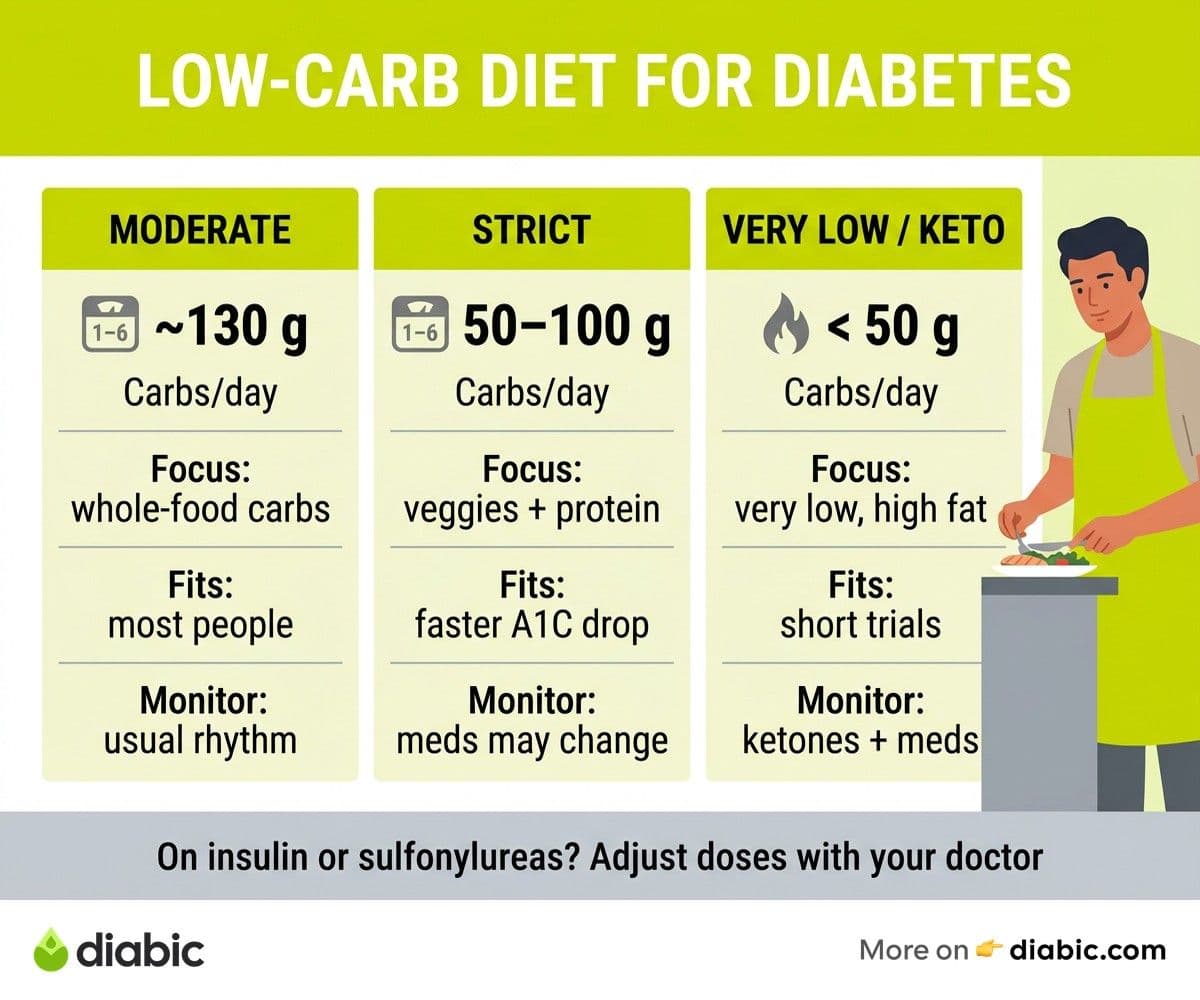
There is no official cutoff for a "low carb" diet, but the most common ranges in the low carbohydrate diet and diabetes research look like this. A moderate low-carb plan sits at roughly 130 grams of carbs per day or less. A stricter version drops to 50-100 grams. A very low-carb or ketogenic plan goes under 50 grams. Where you land depends on your goals, medications, activity level, and how your body responds.
Foods to prioritize on a low-carb plan:
- Lean proteins: chicken, turkey, fish, eggs, tofu, tempeh, plain Greek yogurt
- Healthy fats: olive oil, avocado, nuts, seeds, olives, fatty fish like salmon
- Non-starchy vegetables: leafy greens, broccoli, cauliflower, peppers, zucchini, mushrooms, asparagus, green beans
- Berries in modest portions, since they tend to spike blood sugar less than tropical fruits
- Legumes and lentils in measured servings if they fit your carb target
- Cheese and full-fat dairy in moderation
Foods to limit:
- Sugary drinks, including most fruit juices and sweetened coffee drinks
- White bread, white rice, pastries, and most packaged snacks
- Large servings of pasta, potatoes, and other starchy sides
- Many breakfast cereals (even ones marketed as healthy)
- Sweet sauces, ketchup-heavy dressings, and added-sugar condiments
You do not have to memorize lists. A useful shortcut is to fill half your plate with non-starchy vegetables, a quarter with protein, and a quarter (or less) with whole-food carbs. If you want a primer on which foods cause the biggest blood sugar swings, our guide to foods that spike blood sugar covers the usual suspects and some surprising ones.
Building a Low-Carb Meal Plan for Diabetes
A low carb diet for diabetes meal plan does not have to be complicated. The core idea is to anchor every meal with protein, add fats and non-starchy vegetables, and treat carbs as a smaller side rather than the main event. The CDC's diabetes meal planning resources describe a similar plate-based approach that works well at lower carb totals.
Here is a sample day at roughly 80-100 grams of carbs:
- Breakfast: Two eggs scrambled with spinach and feta, plus half an avocado. About 8g carbs.
- Snack: Plain Greek yogurt with a small handful of berries. About 12g carbs.
- Lunch: Grilled chicken over mixed greens with cucumbers, peppers, olives, olive oil, half a cup of chickpeas. About 25g carbs.
- Snack: A small apple with a tablespoon of almond butter. About 18g carbs.
- Dinner: Baked salmon, roasted broccoli and cauliflower, half a cup of quinoa. About 25g carbs.
Reading nutrition labels is where many people get tripped up. Look at the "total carbohydrates" number, not just sugar, because starchy ingredients like flour and corn syrup count too. Subtract fiber if your dietitian uses net carbs (this depends on your country and care plan). Watch out for serving sizes that are smaller than what you actually eat. The diabetes plate method is a label-free shortcut that pairs nicely with low-carb eating.
If you are early in your journey or working through prediabetes, a gentler entry point can be smart. Our low carb starter guide for prediabetes walks through a slower transition. Meal prep is the other piece. Cooking proteins and chopping vegetables on a Sunday means weeknight meals are 10-minute assembly jobs. That consistency is what actually moves your A1C, not any single perfect meal.
Potential Risks and Who Should Be Cautious
Cutting carbs is not risk-free, especially if you take medication that lowers blood sugar. People on insulin, sulfonylureas, or meglitinides can develop hypoglycemia (low blood sugar) when their carb intake drops suddenly. The fix is to talk to your prescriber before you change how you eat so doses can be adjusted. The Mayo Clinic's overview of low-carb diets covers safety considerations in detail.
Nutrient gaps are another risk if a plan is not built thoughtfully. Cutting too many plant foods can shortchange you on fiber, magnesium, potassium, and folate. Going heavy on processed meats and butter without much variety can push saturated fat higher than is ideal, especially if you have heart concerns alongside your diabetes. A registered dietitian can help you build a plan that protects nutrient intake while still hitting your carb targets.
People who should talk to a doctor before starting a low-carb plan include those with kidney disease, those who are pregnant or breastfeeding, those with a history of disordered eating, and anyone on multiple diabetes medications. None of these are absolute disqualifiers, but each one changes how the plan should be built. Going slow and getting blood work after a few months is a smart way to make sure low-carb is working for your whole body, not just your A1C.
How to Transition to Low-Carb Eating Gradually
Crash-changing your diet rarely sticks. A week-by-week transition tends to feel less punishing and gives your body and medications time to adjust. Here is a gentle path many people find workable.
- Week 1: Cut sugar-sweetened drinks. Replace them with water, sparkling water, unsweetened tea, or coffee. This single change often drops post-meal numbers noticeably.
- Week 2: Swap refined grains for whole grains and shrink the portion. Half a cup cooked instead of a cup, brown rice instead of white, whole-grain bread instead of soft white sandwich bread.
- Week 3: Add a protein and a non-starchy vegetable to every meal. Build the meal around them, then add a smaller carb portion on the side.
- Week 4: Start tracking carbs at a few meals a day to see where you actually land. You may already be at a moderate low-carb level without trying.
- Beyond: Decide with your care team whether to go lower, stay where you are, or adjust based on your A1C and how you feel.
Smart swaps that do not feel like deprivation make this easier. Cauliflower rice in a stir-fry, lettuce wraps instead of buns at lunch, Greek yogurt instead of sweet yogurt cups, and dark chocolate squares instead of candy bars are familiar examples. None of them require a special trip to a specialty store.
Track what matters: blood sugar readings before and 1-2 hours after meals, energy levels, hunger between meals, and how you sleep. A simple notebook works. So does a glucose-tracking app paired with a notes section for meals. Patterns show up within 2-3 weeks if you write things down honestly.
FAQ
Is a low carb diet good for diabetes?
Research suggests that reducing carbohydrate intake can help lower blood sugar levels and improve A1C for many people with type 2 diabetes. The best approach depends on your medications, activity level, and personal health goals, so working with your healthcare team is recommended. People with type 1 diabetes can also benefit from carb reduction, but insulin dosing requires careful adjustment and provider involvement.
How many carbs should a person with diabetes eat per day?
There is no single number that works for everyone. The ADA does not specify an exact amount but notes that many people with diabetes do well with 45-60 grams of carbs per meal, while others thrive on less. A moderate low-carb plan often lands at about 130 grams per day, while stricter versions go under 100 or under 50 grams. Your doctor or dietitian can help you find the right range based on your medications and health goals.
What is the difference between low-carb and keto for diabetes?
Low-carb is a broad term covering anywhere from about 130 grams down to 50 grams of carbs per day. Keto, or ketogenic eating, sits below roughly 50 grams of carbs and aims to put your body into ketosis, where it burns fat for fuel. Both can support blood sugar management, but keto is more restrictive and carries a higher risk of hypoglycemia for people on certain medications. Talk to your doctor before going keto if you have diabetes.
A low-carb diet and diabetes pairing is one tool among many, not a one-way ticket to better health. The best plan is the one you can actually live with, that your medications support, and that leaves room for the foods and traditions that matter to you. Start small, watch your numbers, and adjust as you learn what your body says back. The low-carb diet and diabetes story is yours to write, one meal at a time, and the version that sticks is almost always the one shaped by your own meter readings rather than someone else's rules.
Shahriar P. Shuvo is the founder of Diabic. He has lived with diabetes for over 14 years, and built Diabic to deliver the practical, evidence-based self-management tools he wished existed when he was first diagnosed. By trade, Shahriar is a senior design and frontend engineer with 6+ years shipping products at Agora, Timescale (now Tiger Data), and ShareTrip. He writes from the intersection of lived diabetes experience and product craft, focused on what works in daily management rather than what sounds good in a textbook.
Medically reviewed by
Dr. Shanto Arian is an internal medicine physician now specializing in clinical and aesthetic dermatology, with a parallel academic focus on epidemiology and public health. He holds an MBBS, MPH, MSc (UK), MRCP (UK), MRCPI (Ireland), Diploma in Dermatology (UK), and Diploma in Aesthetic Medicine (USA). Dr. Arian trained in internal medicine, including hospital work on hematology cases such as graft-versus-host disease, before moving toward dermatology. Skin is one of the earliest places diabetes shows itself, from acanthosis nigricans and diabetic dermopathy to slow foot wound healing, and that intersection is where his clinical and Diabic-review work meet. On Diabic, Dr. Arian medically reviews content on diabetes diagnosis, complications, dermatologic manifestations, and pharmacotherapy, ensuring every claim aligns with current ADA, NICE, and peer-reviewed literature.
More from Diet & Fitness
View all
Simple Diabetes Exercise Routine for Beginners
A simple diabetes exercise routine for beginners with a 7-day plan, strength basics, and safety tips to help you move more without feeling overwhelmed.

Diabetes Friendly Smoothie Recipes: 5 No-Spike Picks
Five diabetes friendly smoothie recipes that balance protein, fat, and fiber to keep blood sugar steady. Includes a simple framework for building your own.

Can Exercise Prevent Diabetes? Research Says Yes
Can exercise prevent diabetes? Landmark studies show a 58% lower risk with regular activity. Here's how much you need and which workouts help most.
Clinician-reviewed habits, plain-language guides, and honest answers - the small shifts that make living with diabetes feel lighter, every day.