Travel Insurance for people with diabetes: What's Covered
Travel insurance for people with diabetes often excludes pre-existing conditions. Learn what to look for, how to compare policies, and how to file a claim.

In this article(9)
Travel insurance for people with diabetes is not optional; it is a safety net that could save you thousands if something goes wrong abroad. Yet many standard policies exclude pre-existing conditions, leaving people with diabetes scrambling to understand what is actually covered when they need help most.
The fine print on a generic travel insurance policy can read like a wall, and most of us only learn what is missing after a medical scare in another country. That is the wrong moment to realize your insurer treats diabetes as an automatic exclusion. This guide walks through where standard plans fall short, what features matter for a person with diabetes, how to compare specialist providers, and how to file a claim if something goes wrong.
We wrote this with both occasional and frequent travelers in mind. Whether you are planning a single beach trip or a year of multi-country travel, the same principles apply: read the fine print, ask the right questions, and document everything.
Why Standard Travel Insurance Falls Short for Diabetes
Most off-the-shelf travel insurance policies were not designed with chronic conditions in mind. They are built for healthy travelers who might break an ankle or come down with food poisoning. When you live with diabetes, that mismatch becomes a problem fast.
The first issue is the pre-existing condition clause. Most basic policies exclude any condition you were diagnosed with or treated for in a defined "lookback period" before purchasing the policy. For diabetes, that means anything from an insulin pump malfunction to diabetic ketoacidosis (DKA) could be denied as a pre-existing complication. The American Diabetes Association flags this as one of the biggest planning gaps for people with diabetes who travel.
Emergency medical coverage is the second weak spot. Even when a policy lists generous limits, it may quietly exclude diabetic emergencies such as DKA, severe hypoglycemia requiring hospitalization, or insulin pump replacement. We have seen policies cover the emergency room visit but refuse to reimburse the insulin needed during the stay. That distinction matters because the real cost of diabetes management abroad can climb into five figures within a single hospital admission.
Trip cancellation clauses also tend to disappoint. If you cancel because your endocrinologist advises against travel after a recent A1C spike, a generic policy will likely treat that as a pre-existing condition issue and decline the refund. Even something as simple as a delayed insulin shipment may not qualify as a covered reason.
Finally, the language insurers use to describe "stable" diabetes varies wildly. Some define it as no medication changes in 60 days. Others require 90 or 180 days. A few demand no hospitalizations in the past year. Those definitions decide whether your claim is paid, so they deserve more attention than the marketing copy on the homepage.
What to Look for in a Diabetes-Friendly Policy
Once you know what to look for, the picture clears up quickly. A diabetes-friendly travel insurance policy has four features that set it apart from a generic plan, and each one is worth confirming in writing before you pay.
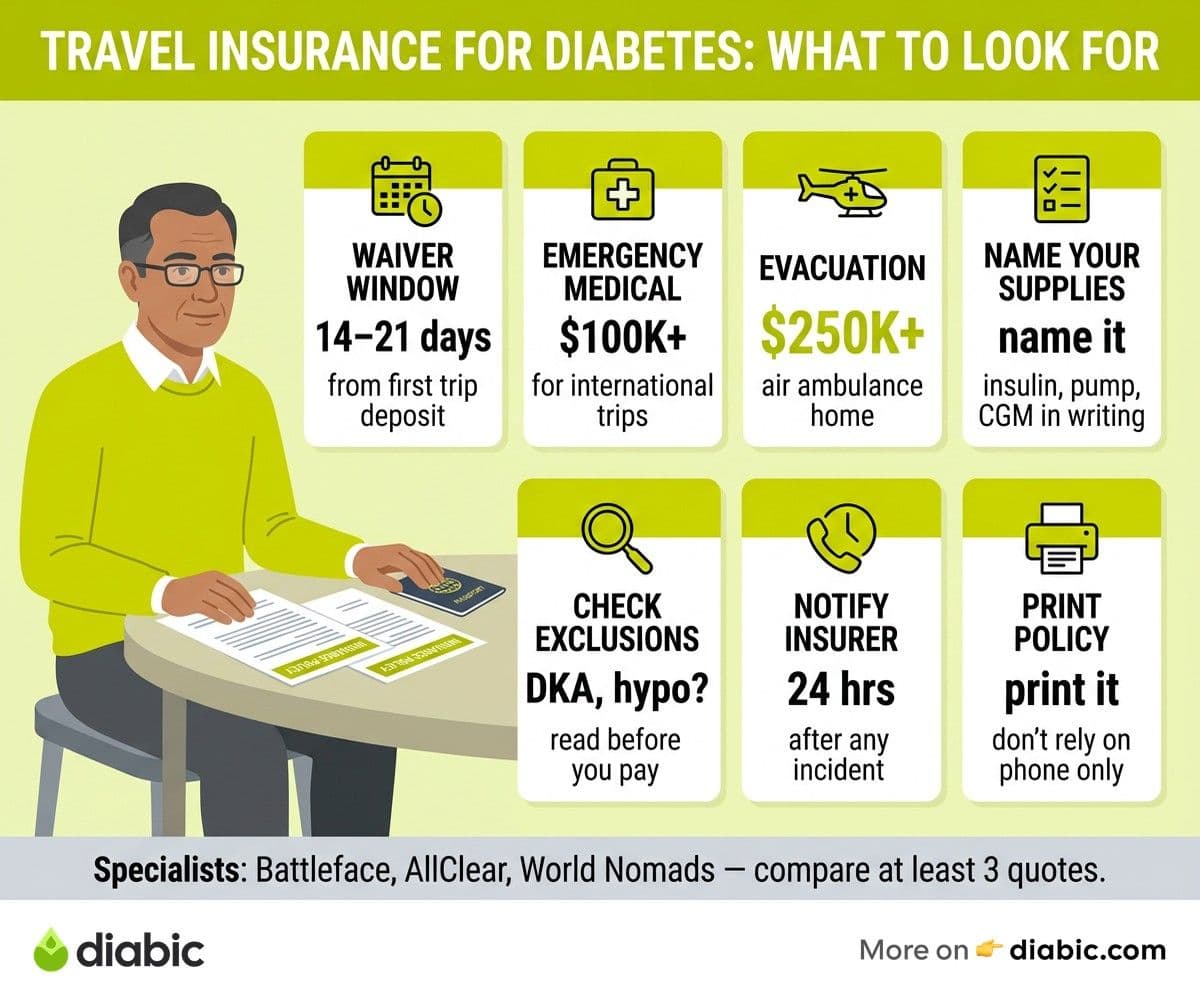
The first is a pre-existing condition waiver. This is the single most important feature for a person with diabetes. Insurers usually offer the waiver only if you purchase the policy within 14 to 21 days of making your first trip deposit. Buy it later and you lose access to the waiver, no matter how much you spend on the policy. Diabetes UK travel insurance guidance underscores how often travelers miss this window.
Second is robust emergency medical coverage. For international trips, aim for at least $100,000 in emergency medical benefits. Hospitals in Western Europe, Japan, and parts of Latin America can charge $5,000 or more per night in intensive care, and a DKA admission can stretch across several days. Domestic trips can usually run with a lower limit, but international travel deserves the higher number.
Third, look for medical evacuation coverage of $250,000 or more. This pays for the air ambulance home if a local hospital cannot manage your condition. It is the line item that separates a stressful but survivable trip from a financially devastating one. The US State Department's medicine and health page for travelers urges travelers to confirm that their plan covers medical evacuation before leaving the country.
Fourth, confirm coverage for lost, stolen, or damaged medical supplies. A dropped insulin vial in Bali or a stolen pump in Barcelona is not a small expense. Look for policies that name insulin, CGMs, and pumps in their personal property language rather than burying them under a generic medical equipment cap. While you compare, it also helps to read up on insulin storage while traveling and on insurance coverage for diabetes supplies so you can ask each insurer the right follow-up questions.
Questions to Ask Before You Buy
A short list of questions saves hours of back-and-forth later:
- What is your pre-existing condition lookback period, and what counts as "stable" for diabetes?
- Are insulin, pumps, CGMs, and glucagon explicitly covered under medical equipment loss?
- Does the policy cover diabetic ketoacidosis, severe hypoglycemia, and infusion site infections?
- Is medical evacuation included, or is it a paid add-on?
- What is the time window to file a claim after an incident?
Comparing Travel Insurance for People with Diabetes
A handful of specialist providers focus on travelers with chronic conditions. Battleface, AllClear, and World Nomads are the three most commonly recommended in the diabetes community, though availability varies by country of residence. Each runs a medical screening at quote time so they can price the pre-existing condition coverage rather than exclude it.
From my experience: I have lived with type 1 diabetes for 14 years, and the first time I priced specialist diabetes travel insurance for a three-week trip, I winced at the premium. It was nearly triple my generic quote. Then I added up the cost of replacing my pump, two months of insulin, and a hypothetical evacuation, and the math flipped. The premium ended up being a small fraction of what one bad day could cost out of pocket.
Credit card travel insurance is a tempting shortcut, especially on premium cards. The catch is that most premium card policies still apply pre-existing condition exclusions unless you book the trip on that card and the trip falls under a specified dollar threshold. Read the benefits guide carefully or call the issuer's benefits administrator before assuming you are covered. Employer travel insurance through corporate cards or business plans is similar; the underlying policy almost always carries a pre-existing condition clause.
If you travel more than three or four times a year, an annual multi-trip policy may save real money compared to single-trip coverage. The trade-off is that annual policies often cap individual trip length at 30 or 45 days, so longer adventures need a separate policy on top. Frequent business travelers, snowbirds, and digital nomads tend to land on annual policies after one or two single-trip cycles.
For travelers planning to spend extended time abroad, an international traveling with diabetes plan should pair the insurance with pharmacy access research before departure. The two go hand in hand because your insurer's pre-authorization process often requires the name of a specific in-network or partner clinic.
How to File a Claim for Diabetes-Related Issues
A travel insurance claim only works as well as the paper trail behind it. The first habit that pays off is keeping every receipt, even ones that look small. Pharmacy invoices, taxi receipts to and from clinics, and itemized hospital bills all count. Most insurers will not reimburse an expense without a receipt, and many require the receipt to be in the local language with a translation attached.
Documenting the timeline of an incident matters almost as much as the receipts. If you ended up in an emergency room with severe hypoglycemia, write down what time you started feeling symptoms, when you tested, what you ate or injected, and when you arrived at the hospital. Photos of your blood glucose readings, pump screens, or hospital paperwork strengthen the file. The more your claim reads like a clear sequence of events, the easier it is for an adjuster to approve.
Reach out to your insurer within 24 hours of an incident whenever possible. Most policies require notification within a defined window, and a missed deadline is one of the most common reasons claims get denied. Use the 24-hour emergency line printed on your policy card; calling the standard customer service line during business hours can cost you days. The US State Department guidance on medical emergencies abroad recommends contacting both your insurer and the nearest US embassy if you are hospitalized.
Carry a printed policy summary and your emergency contact card with you, not just digital copies. Phones die, networks fail, and language barriers can make it hard to log in to a customer portal from a hospital bed. A laminated card with your policy number, insurer's 24-hour line, blood type, allergies, and current medications is one of the cheapest insurance moves you can make. If you are planning your route by car, a diabetes road trip checklist can double as your domestic equivalent of this card.
If a claim is denied, do not assume the answer is final. Most insurers have an internal appeals process, and many denials get overturned when you submit additional documentation or request a medical review. Travel insurance ombudsmen exist in the UK, Canada, and parts of the EU for travelers who exhaust internal appeals.
Frequently Asked Questions
Does travel insurance cover diabetes supplies?
Some policies cover lost, stolen, or damaged diabetes supplies under personal property, and some cover them under medical equipment. The limits vary widely, from a few hundred dollars on a generic policy to several thousand on a specialist plan. Confirm in writing that insulin, pumps, and CGMs are named in the policy, and keep receipts for all your supplies in case you need to make a claim.
What is the best travel insurance for people with diabetes?
There is no single best provider because availability depends on your country of residence, age, destination, and how recently your diabetes management has changed. Battleface, AllClear, and World Nomads are commonly recommended, but the right answer for you may be a specialist broker who can shop several insurers at once. Compare at least three quotes, focus on pre-existing condition waivers and evacuation coverage, and read the medical exclusions before paying.
Can I get travel insurance if my diabetes is not well managed?
Yes, though your premium will likely be higher and you may face a longer lookback period for the pre-existing condition waiver. Insurers will usually ask about your last A1C, recent hospitalizations, medication changes, and any complications. Be honest on the application; misrepresenting your condition voids the policy and almost always leads to denied claims. Talk to your doctor before the trip if you are unsure whether your management is stable enough to travel.
A short next step: pull up the policy you already have, search the document for "pre-existing condition," and read what comes up. If the language is vague or excludes diabetes by default, it is worth pricing a specialist policy before your next trip.
The honest case for travel insurance for people with diabetes is that the upside on a calm trip is small and the downside on a bad day can be life-changing. A specialist policy will cost more than a generic plan, and it will pay for itself in a single hospital admission overseas. Travel insurance for people with diabetes works best when you read the fine print before you book, choose an insurer that names insulin and pumps in writing, and carry the policy summary on paper as well as on your phone. Make the calls early, save the receipts, and let the coverage do the heavy lifting if anything goes sideways.
Shahriar P. Shuvo is the founder of Diabic. He has lived with diabetes for over 14 years, and built Diabic to deliver the practical, evidence-based self-management tools he wished existed when he was first diagnosed. By trade, Shahriar is a senior design and frontend engineer with 6+ years shipping products at Agora, Timescale (now Tiger Data), and ShareTrip. He writes from the intersection of lived diabetes experience and product craft, focused on what works in daily management rather than what sounds good in a textbook.
Medically reviewed by
Dr. Shanto Arian is an internal medicine physician now specializing in clinical and aesthetic dermatology, with a parallel academic focus on epidemiology and public health. He holds an MBBS, MPH, MSc (UK), MRCP (UK), MRCPI (Ireland), Diploma in Dermatology (UK), and Diploma in Aesthetic Medicine (USA). Dr. Arian trained in internal medicine, including hospital work on hematology cases such as graft-versus-host disease, before moving toward dermatology. Skin is one of the earliest places diabetes shows itself, from acanthosis nigricans and diabetic dermopathy to slow foot wound healing, and that intersection is where his clinical and Diabic-review work meet. On Diabic, Dr. Arian medically reviews content on diabetes diagnosis, complications, dermatologic manifestations, and pharmacotherapy, ensuring every claim aligns with current ADA, NICE, and peer-reviewed literature.
More from Living with Diabetes
View all
A Gentle Chair Yoga Routine for people with diabetes
A gentle chair yoga for people with diabetes routine with safe poses, modifications for neuropathy, retinopathy, and joint pain, plus tips for older.

Shift Work and Diabetes: Managing Irregular Hours
Shift work and diabetes is a tough combination. Learn how to manage meals, sleep, medication, and blood sugar when your hours rotate or flip overnight.

Dating with Diabetes: When to Tell a New Partner
Dating with diabetes brings unique disclosure questions. Here is when to tell a new partner, what to say, and how to handle the conversation with.
Clinician-reviewed habits, plain-language guides, and honest answers - the small shifts that make living with diabetes feel lighter, every day.