Insulin Storage While Traveling: Coolers, Packs, Tips
Insulin storage while traveling matters more than most travelers realize. Here's how to keep your supply safe with the right coolers and habits.

In this article(10)
A vacation, a work trip, a weekend wedding. None of these should be threatened by a vial of insulin that sat in a hot rental car for two hours. Yet for people who depend on insulin every day, this is the recurring worry that travels with you everywhere. Insulin storage while traveling is not a minor logistical detail. It is the difference between a working dose and a degraded one, and it is also one of the easier problems to solve once you know what gear and habits actually work.
This guide walks through the temperature science you need to know, the cooler products people with diabetes actually rely on, and a few accommodation hacks that have saved more than one trip from going sideways. We will also cover how to pack a travel insulin kit that holds up across delays. If you are planning a flight, pair this with our TSA rules for diabetes supplies post to cover the full airport-to-hotel pipeline.
How Temperature Affects Insulin on the Road
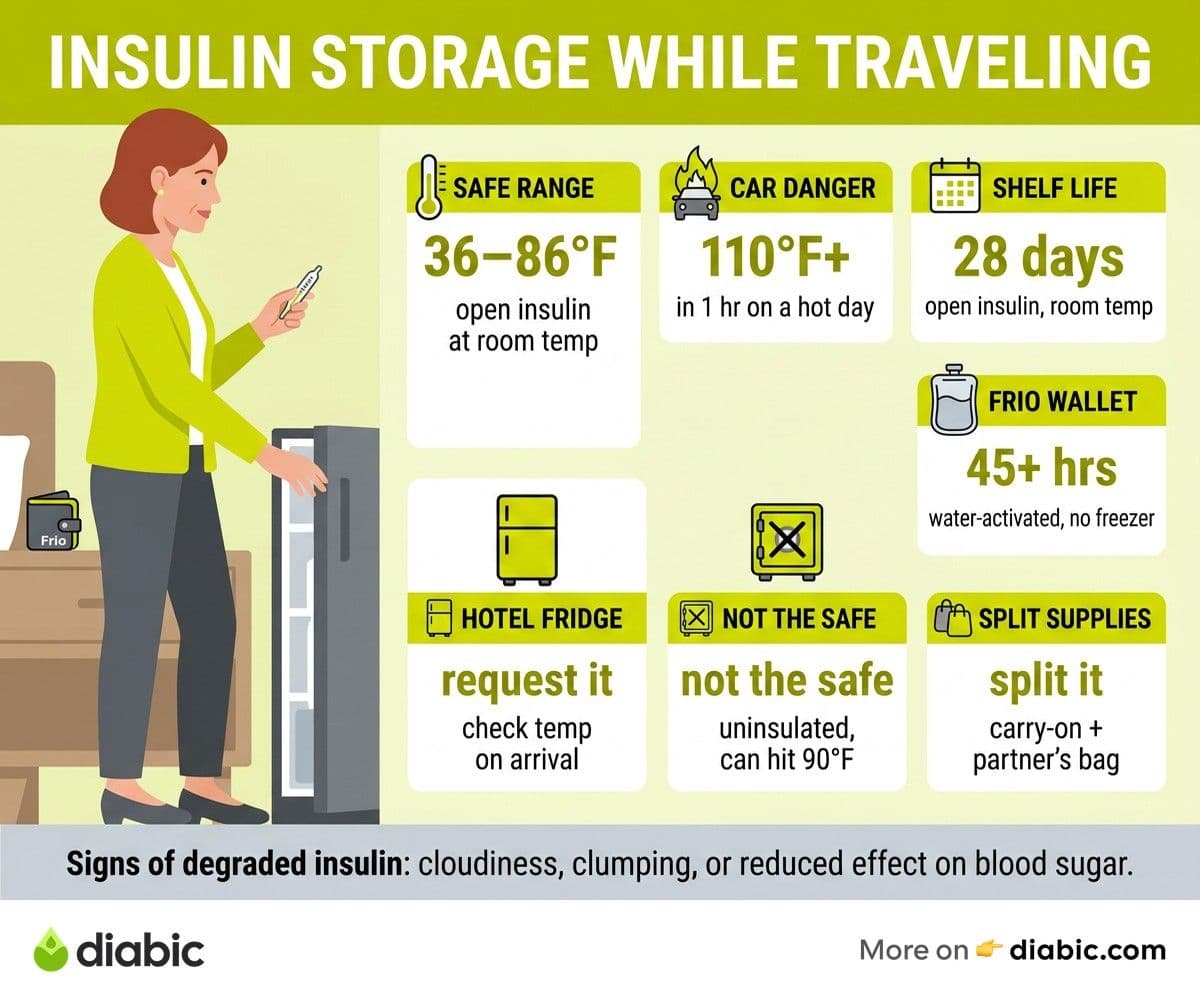
Insulin is a protein, and proteins denature when they get too hot or too cold. The FDA's guidance on insulin storage is straightforward: unopened insulin should be refrigerated between 36 and 46 degrees Fahrenheit, and opened insulin can stay at room temperature, up to 86 degrees Fahrenheit, for about 28 days. Manufacturers like Eli Lilly and Novo Nordisk publish product-specific timelines on their package inserts, and a few of their newer products tolerate slightly different ranges.
Heat above 86 degrees Fahrenheit is the most common hazard for insulin storage while traveling. Insulin left in a closed car on a 75 degree day can hit interior temperatures north of 110 degrees within an hour. Glove compartments are even worse. Direct sunlight on a windowsill, a bag near a heating vent in a hotel room, and the inside of a checked suitcase on a hot tarmac all qualify as risk zones.
Cold matters too. Insulin that freezes is no longer usable, even if it thaws back to a clear liquid. Checked baggage in cargo holds can drop below freezing on long flights, and a beach cooler with too much ice can chill insulin past the point of safety.
Signs of degraded insulin include cloudiness in a normally clear formulation, clumping, frosting along the sides of the vial, or a noticeably reduced effect on your blood sugar. If you suspect your insulin has been compromised, set it aside and use a fresh supply. The cost of a wasted vial is far less than the cost of a missed dose.
Best Insulin Cooler Bags and Travel Packs
A good travel cooler does not need to be expensive. It does need to maintain a steady temperature for the length of your trip without freezing your supply. The market has matured a lot in the last few years, and there are now reliable options at every price point.
Frio cooling wallets are the most popular choice for a reason. They activate with cold water rather than a freezer, then keep insulin between 64 and 78 degrees Fahrenheit for up to 45 hours. They re-activate with another soak. That makes them ideal for hiking, camping, multi-day road trips, or any place a freezer is not guaranteed. They are TSA-friendly and pass through screening without trouble.
Vivi Cap takes a different approach. The insulated cap fits over a standard insulin pen and uses passive insulation to maintain pen temperature in heat or cold. It is rechargeable and reusable indefinitely. The cap shines for short days when you only need to carry one or two pens, like a beach day or a long hike, but it does not replace a full cooler for multi-day trips.
MedAngel sells a small Bluetooth temperature sensor that lives inside whatever bag or cooler you use. The companion app sends you an alert if your insulin has crossed a danger threshold. It is not a cooler itself, but it pairs well with any storage system and gives peace of mind during long transits. We use it ourselves on summer travel.
Budget options exist too. A basic insulated lunch bag with a small reusable gel pack from any pharmacy can keep insulin in range for several hours. The trade-off is fewer hours of protection and no temperature monitoring. For a weekend trip with a hotel mini-fridge as a home base, this is often enough.
Premium hard-sided cases like the 4AllFamily cooler include multiple cooling modes for power outages or international trips with unreliable refrigeration. These are overkill for a domestic weekend, but worth the investment for medical missions, long international travel, or anyone who travels frequently in extreme climates.
If you are flying, the airport security with diabetes gear walkthrough covers exactly how each of these products behaves through TSA screening.
Hotel and Accommodation Storage Tips
Most hotels will provide a mini-fridge on request for medical needs at no extra charge. Call the property a few days before check-in and ask. Frame it as a medical request, not a preference, and the answer is almost always yes. The American Diabetes Association's travel guidance explicitly recommends this as a first step on arrival.
Never store insulin in the in-room safe. The interior of a hotel safe is uninsulated and uncontrolled, and rooms cool off significantly when housekeeping turns the thermostat up during the day. We have seen safes hit 90 degrees in summer-month travel. The mini-fridge or your travel cooler is always a safer call.
For day trips away from your hotel, transfer your daily supply into a Frio wallet or insulated bag with a fresh gel pack. Leave the bulk of your unopened pens or vials in the fridge, locked in your suitcase. Do not bring your full supply on a hike or a beach day. If your bag gets lost or left behind, you do not want to lose the entire week's insulin in one go.
Backup plans matter when refrigeration fails. Power outages happen, and not every Airbnb has a working fridge. If you find yourself without refrigeration, sandwich your insulin between gel packs inside an insulated bag, refresh the gel packs every 8 hours from any nearby hotel ice machine or convenience store freezer, and do not let the insulin make direct contact with the ice. This is a short-term workaround, not a multi-day solution. For longer stays, our road trip meal planning with diabetes post covers backup planning across rural routes.
Packing for Insulin Storage While Traveling
Carry double your expected supply. A two-day trip can easily turn into four when a connection is missed or a snowstorm shuts down the airport. The extra weight is negligible, and the cost of running out abroad is high.
Split your supplies between bags. Half goes in your carry-on, half in a travel companion's carry-on or your personal item. This is a simple habit that pays off the rare times a bag is delayed. The CDC's recommendations for traveling with chronic conditions reinforce this practice.
Include a sharps container or a labeled rigid bottle for used needles. Hotel housekeeping cannot dispose of loose sharps safely, and most countries require travelers to bring used needles home. A small Coghlan's prescription bottle works in a pinch.
Add a temperature monitor like the MedAngel sensor we mentioned earlier. The alert function alone is worth the price during long-haul flights or summer trips through hot climates.
Keep a basic glucose-low kit in the same pouch. Glucose tabs, gummies, juice boxes for the airport. The kit moves as a unit, which makes the supply easier to track day-to-day.
From my experience: I have lived with type 1 diabetes for 14 years, and the insulin storage problem has gone from a constant worry to a solved puzzle for me. Two Frio wallets, a MedAngel sensor, and a habit of splitting supplies between bags has carried me through every trip including a two-week stretch in Southeast Asia in July. The one mistake I made early on was trusting a hotel mini-bar fridge without checking it. The fridge was off, my insulin sat at room temperature for a day before I noticed, and I had to find a pharmacy in a city where I did not speak the language. Now I check the fridge with a thermometer the moment I check in.
If you are traveling internationally, our traveling with diabetes internationally post walks through pharmacy access, prescription labeling for customs, and the global brand names of common insulin products. For anyone watching their pharmacy budget, our affordable insulin options guide is a useful read before you depart.
FAQ
How long can insulin stay out of the fridge while traveling?
Most insulin products are stable at room temperature, defined as below 86 degrees Fahrenheit, for up to 28 days once a vial or pen has been opened. Unopened insulin should be refrigerated. Specific products vary, so check the package insert from your manufacturer. Always avoid heat above 86 degrees and any freezing temperatures.
Can you bring insulin cooler packs through airport security?
Yes. The TSA explicitly permits gel packs and frozen accessories used to keep medically necessary liquids cool. Officers may inspect them, but they are allowed in carry-on bags without quantity limits. Activated Frio wallets and similar evaporative coolers also pass through screening without issue.
What should I do if my insulin gets too hot during a trip?
If you suspect your insulin has been exposed to heat above 86 degrees Fahrenheit for an extended period, set that supply aside and switch to a fresh vial or pen. Watch your blood sugar response carefully. If you have any doubt, contact your provider or a local pharmacy for a replacement. Never trust degraded insulin to deliver a full dose.
How do I keep insulin cold on a long flight?
Pack it in a Frio wallet or an insulated cooler bag with a temperature monitor. Keep it in your carry-on, never in checked luggage. The cargo hold can drop below freezing, which destroys insulin. If your trip is long enough that your Frio needs reactivation, refresh it in the airport bathroom sink between flights.
What is the best insulin cooler bag for travel?
The best cooler depends on your trip length and climate. Frio wallets work for almost everyone and re-activate with water, making them ideal for travel without reliable freezer access. Vivi Cap is a strong choice for short days when you only carry a pen or two. 4AllFamily and similar premium hard cases are best for medical missions or long international travel in extreme climates. Pair any of these with a MedAngel sensor for temperature monitoring.
Insulin storage while traveling rewards a small amount of preparation with a much smoother trip. Pick a cooler that fits your travel style, ask for the hotel mini-fridge, split your supply across bags, and add a temperature monitor if you can. The setup pays for itself the first time a delay turns a weekend into a longer adventure.
Shahriar P. Shuvo is the founder of Diabic. He has lived with diabetes for over 14 years, and built Diabic to deliver the practical, evidence-based self-management tools he wished existed when he was first diagnosed. By trade, Shahriar is a senior design and frontend engineer with 6+ years shipping products at Agora, Timescale (now Tiger Data), and ShareTrip. He writes from the intersection of lived diabetes experience and product craft, focused on what works in daily management rather than what sounds good in a textbook.
Medically reviewed by
Dr. Shanto Arian is an internal medicine physician now specializing in clinical and aesthetic dermatology, with a parallel academic focus on epidemiology and public health. He holds an MBBS, MPH, MSc (UK), MRCP (UK), MRCPI (Ireland), Diploma in Dermatology (UK), and Diploma in Aesthetic Medicine (USA). Dr. Arian trained in internal medicine, including hospital work on hematology cases such as graft-versus-host disease, before moving toward dermatology. Skin is one of the earliest places diabetes shows itself, from acanthosis nigricans and diabetic dermopathy to slow foot wound healing, and that intersection is where his clinical and Diabic-review work meet. On Diabic, Dr. Arian medically reviews content on diabetes diagnosis, complications, dermatologic manifestations, and pharmacotherapy, ensuring every claim aligns with current ADA, NICE, and peer-reviewed literature.
More from Living with Diabetes
View all
A Gentle Chair Yoga Routine for people with diabetes
A gentle chair yoga for people with diabetes routine with safe poses, modifications for neuropathy, retinopathy, and joint pain, plus tips for older.

Shift Work and Diabetes: Managing Irregular Hours
Shift work and diabetes is a tough combination. Learn how to manage meals, sleep, medication, and blood sugar when your hours rotate or flip overnight.

Dating with Diabetes: When to Tell a New Partner
Dating with diabetes brings unique disclosure questions. Here is when to tell a new partner, what to say, and how to handle the conversation with.
Clinician-reviewed habits, plain-language guides, and honest answers - the small shifts that make living with diabetes feel lighter, every day.