Dating with Diabetes: When to Tell a New Partner
Dating with diabetes brings unique disclosure questions. Here is when to tell a new partner, what to say, and how to handle the conversation with.

In this article(9)
Dating already comes with its own brand of nervous energy, and dating with diabetes adds another layer of vulnerability on top of it. You might find yourself rehearsing what to say in the shower, wondering whether to mention your CGM before the appetizers arrive, or quietly checking your blood sugar in the bathroom. We have heard versions of this story from hundreds of people in our community, and the through line is always the same: disclosure feels harder than it usually turns out to be.
The good news is that you get to decide the timing, the words, and the depth of the conversation. There is no script that fits every relationship, and there is no rule that says you owe a stranger your full medical history on a first date. What helps is having a flexible framework, a few practical scripts to fall back on, and the reassurance that most people respond with curiosity rather than rejection.
From my experience: I have lived with type 1 since my early twenties, and the disclosure conversation got dramatically easier once I started wearing a Dexcom on my arm. On a third date a few years ago, my date pointed at the sensor and asked what it was, and I gave a one-line answer somewhere between the appetizer and the entree. The whole exchange took about ninety seconds, and the relief afterward made me realize how much energy I had been spending dreading it. Letting the device introduce the topic took the script-rehearsing pressure off entirely.
When to disclose: dating with diabetes on your own terms
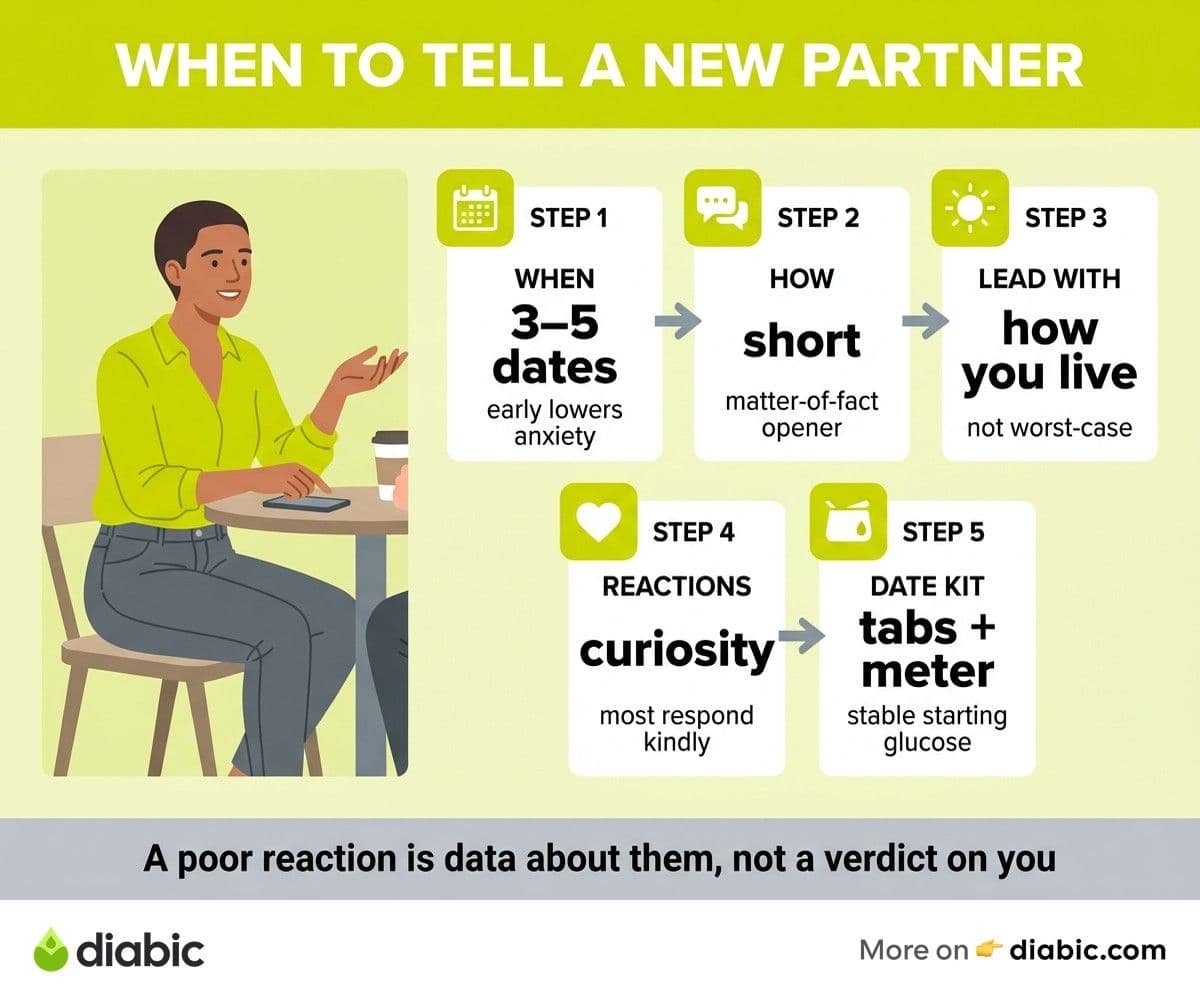
There is no single right moment to bring up your condition, but earlier conversations tend to lower your anxiety more than they raise the stakes. If you carry a low-grade dread of "the talk" through three or four dates, that pressure usually spills into how present you feel during dinner. Telling someone within the first few dates often turns disclosure into a brief detail rather than a buried secret, and it gives the other person time to absorb the information without feeling blindsided.
Some people prefer to mention diabetes in a dating app bio or during early text exchanges so it never becomes a Big Reveal. Others like to wait until they sense real interest, then bring it up over coffee. Both approaches are valid. The American Diabetes Association notes in its resources on social and emotional support that openness with people close to you tends to reduce stress and improve self-care over time, and dating partners eventually fall into that circle if the relationship grows.
A useful rule of thumb is to disclose before the relationship turns physically intimate or emotionally serious, whichever comes first. Intimacy can affect blood sugar, hypoglycemia symptoms can mimic other things, and a partner who knows what is going on can support you instead of panicking. If you have ever wondered about telling your boss about your diabetes, the same logic applies: disclosure works best when it happens before a moment of need rather than during one.
If you wear a visible insulin pump, a Dexcom, or a Libre sensor, the topic may come up on its own. A partner notices the patch on your arm, asks a kind question, and you answer honestly. This is often the easiest version of the conversation because it is reactive rather than scripted, and it lets your device do part of the introduction for you.
How to have the conversation without overthinking it
Keep the first mention short, matter of fact, and confident. Something like, "By the way, I have type 1 diabetes, so I wear this little sensor on my arm and check my numbers throughout the day. It is part of my routine and not a big deal, but I wanted you to know." That kind of opener does three things at once: it names the condition, normalizes the daily reality, and signals that you are not asking for sympathy.
Lead with what you manage well rather than the worst-case scenarios. If you launch into kidney complications and amputation statistics on a first date, you are not giving your partner a fair picture of your life. Most people with diabetes have full careers, active social lives, and healthy relationships. Frame the conversation around how you live, not around the medical risks you read about in pamphlets. According to Diabetes UK guidance on relationships and dating, people who feel positive about their condition tend to communicate it more effectively.
Gauge their reaction, but do not expect a perfect response on the first try. Some people will ask thoughtful questions. Others will pause, blink, and say something slightly clueless before recovering. Curiosity is a green flag even when it shows up clumsily, and a follow-up question like "What does that mean day to day?" usually means they want to understand. Give yourself and your partner permission to learn together rather than expecting a polished exchange.
Be ready for the basics, because most new partners will not know much about the condition. You can explain in plain terms that your pancreas does not make enough insulin or your body does not use it well, that you check your blood sugar to keep it in a safe range, and that you sometimes need a snack or a quick injection. A short, clear explanation goes further than a long one, and you can fill in details over time as the relationship deepens.
Handling common reactions and misconceptions
Most people respond with kindness and a few honest questions. They will ask whether you can eat sugar, whether you got it from eating too many sweets, or whether your version is "the bad kind." These misconceptions are tiring, but they are not personal. A calm, friendly correction works far better than frustration. Saying "Actually, type 1 is autoimmune and not related to sugar intake" is a simple line that educates without lecturing.
Some partners have already been close to someone with diabetes, and that experience colors their reaction. They may worry, project, or compare you to a relative who managed things very differently. Listen for what they are actually saying underneath the surface. Often the worry is care in disguise, and it gives you an opening to share how your routine works and why you feel steady about it. If you want a deeper read on partnership dynamics, our piece on diabetes and relationships for couples walks through long-term communication patterns in more detail.
If someone reacts poorly, with disgust, dismissal, or a quick exit, that response is information about them, not about you. A partner who cannot handle a chronic condition early on is unlikely to handle a flu, a job loss, or any future health curveball with grace. We know how much it stings when someone disappears after disclosure, and we are not minimizing that hurt. We are also gently reminding you that someone who self-selects out of your life over honest information has saved you future heartbreak.
Lean on community when a reaction lands hard. Talking with other people who have dated and disclosed makes the experience feel less isolating, and our roundup of diabetes support groups and where to find them lists both online and in-person options. JDRF runs peer connection programs that include young adults navigating dating, and many local chapters host social events where the disclosure conversation never has to happen at all.
Practical dating tips for steady blood sugar
Check your blood sugar before you head out, because a slightly low number at the start of a date can spiral once nerves and a delayed dinner reservation enter the picture. Aim for a comfortable starting range, top up with a small snack if needed, and keep glucose tabs or a juice box within reach. Confidence on a date is partly chemistry and partly preparation, and stable numbers help both.
Choose restaurants where you can preview the menu online, since unfamiliar dishes and surprise carb counts make dosing a guessing game. If your date suggests a place you do not know, it is fine to look it up beforehand or to ask the server a few questions. Most servers handle dietary questions every shift and will not blink. You can also lean into shareable plates that let you portion freely instead of committing to one entree.
Carry your supplies discreetly in a small pouch or bag, including a meter or backup CGM sensor, fast-acting carbs, and your insulin if you take it. Many people in our community keep a "date kit" packed and ready so they never have to rummage at the last minute. If alcohol is on the table, pace yourself, eat alongside drinking, and remember that alcohol can lower blood sugar hours later. For more on safer drinking strategies, our guide to sex and diabetes and what helps covers the overlap between alcohol, intimacy, and blood sugar in more depth.
Plan around physical intimacy if and when it becomes part of the picture. Sex is exercise, and exercise affects blood sugar, so a quick check beforehand and a snack nearby can prevent an unwelcome low at an unwelcome moment. The NIDDK overview of diabetes and sexual health is a useful reference if you want to understand the physiology behind these adjustments.
Building trust through openness
You do not have to teach your partner everything at once. Trust grows in layers, and so should the depth of what you share. Early on, a partner needs to know what diabetes is, what your daily rhythm looks like, and what to do if your blood sugar drops. Later, you can talk through the harder parts: the bad days, the burnout, the financial stress of supplies, the moments when the condition feels heavier than usual.
Teach your partner basic hypoglycemia recognition once the relationship is steady enough to warrant it. Show them what shakiness, sudden sweating, confusion, or unusual quietness can look like in you, and walk them through the fix: juice, glucose tabs, or a sugary snack, followed by a recheck. If you use glucagon, show them where it lives and how it works. This is not a heavy conversation when you frame it as a quick safety briefing rather than a worst-case rehearsal.
Invite curiosity about your devices, your routines, and your data without making it homework. Many partners find CGM graphs genuinely interesting, and a few will start cheering on flat lines like a sports score. If your partner wants to learn, lean in. If they prefer to stay at arm's length from the medical details, that is also fine, as long as they respect your need to manage things on your own terms.
Vulnerability builds connection, and hiding diabetes builds quiet distance. Hiding the condition usually means hiding moments of low energy, weird food choices, sudden bathroom trips, and middle-of-the-night highs, which adds up to a lot of energy spent pretending. Letting a partner in on the real picture often deepens the relationship faster than waiting for the "right" time. Our community echoes this again and again: the people who disclosed early rarely regret it, while the people who waited too long usually wish they had not.
Frequently asked questions
When should I tell someone I am dating about my diabetes?
There is no fixed timeline, but most people feel best disclosing within the first three to five dates or before the relationship becomes physically or emotionally intimate. Earlier conversations reduce your anxiety, give your partner time to ask questions, and prevent the topic from becoming a buried secret. Trust your instincts on timing, and let the depth of the relationship guide how much you share at first.
How do I talk about diabetes on a first date?
Keep it brief and casual, more of a mention than a monologue. A line like "I have diabetes, so I wear this sensor and keep snacks handy, but it is not a big deal" usually does the job. You can answer follow-up questions naturally, save the deeper details for later dates, and let the conversation move on once the basics are covered.
What if my partner reacts badly to the disclosure?
A poor reaction tells you something important about how that person handles vulnerability and chronic conditions. It is not a reflection of your worth or your desirability, even though it can sting in the moment. Reach out to friends, community groups, or a therapist who understands chronic illness, and remind yourself that the right partner will treat your honesty as a strength rather than a problem.
Dating with diabetes asks for a little more preparation and a little more honesty, and both of those things tend to make relationships better, not worse. Trust your timing, lead with how you live rather than what you fear, and lean on your community when a conversation does not go the way you hoped. The right partner will meet your openness with care, and the rest is the regular, beautiful work of building something real together.
Shahriar P. Shuvo is the founder of Diabic. He has lived with diabetes for over 14 years, and built Diabic to deliver the practical, evidence-based self-management tools he wished existed when he was first diagnosed. By trade, Shahriar is a senior design and frontend engineer with 6+ years shipping products at Agora, Timescale (now Tiger Data), and ShareTrip. He writes from the intersection of lived diabetes experience and product craft, focused on what works in daily management rather than what sounds good in a textbook.
Medically reviewed by
Dr. Rezwana Parvin Rumpa is an obstetrics and gynaecology specialist with clinical focus on gestational diabetes, PCOS, and fertility. She holds the MRCOG (Final Part) from the Royal College of Obstetricians and Gynaecologists in London, the MRCPI (Final Part) from the Royal College of Physicians of Ireland, and an MBBS from Shaheed Monsur Ali Medical College under Dhaka University. Dr. Rumpa serves as a Senior Medical Officer in the Obs and Gynae department at BRB Hospitals Ltd, where she has spent three years managing prenatal care, emergency obstetric cases, and women's-health surgery. On Diabic, she medically reviews content for women living with diabetes, with particular attention to pregnancy, PCOS, and reproductive-health intersections.
More from Living with Diabetes
View all
A Gentle Chair Yoga Routine for people with diabetes
A gentle chair yoga for people with diabetes routine with safe poses, modifications for neuropathy, retinopathy, and joint pain, plus tips for older.

Shift Work and Diabetes: Managing Irregular Hours
Shift work and diabetes is a tough combination. Learn how to manage meals, sleep, medication, and blood sugar when your hours rotate or flip overnight.

Travel Insurance for people with diabetes: What's Covered
Travel insurance for people with diabetes often excludes pre-existing conditions. Learn what to look for, how to compare policies, and how to file a claim.
Clinician-reviewed habits, plain-language guides, and honest answers - the small shifts that make living with diabetes feel lighter, every day.