Traveling with Diabetes Internationally: Pharmacy Access
Traveling with diabetes internationally? Learn how to plan pharmacy access, get insulin abroad, handle emergencies, and travel with confidence in any.

In this article(14)
Traveling with diabetes internationally means planning beyond packing. You need to know where to find insulin and supplies in a country where you may not speak the language or understand the healthcare system. Having a pharmacy access plan is the difference between a minor hiccup and a trip-ruining emergency.
This guide covers how to prepare before you leave, what to expect at pharmacies in different countries, how to handle a diabetes emergency abroad, and the documents that smooth out every interaction. The goal is to make international travel feel like a regular trip rather than a medical expedition.
Pre-Trip Planning for International Diabetes Travel
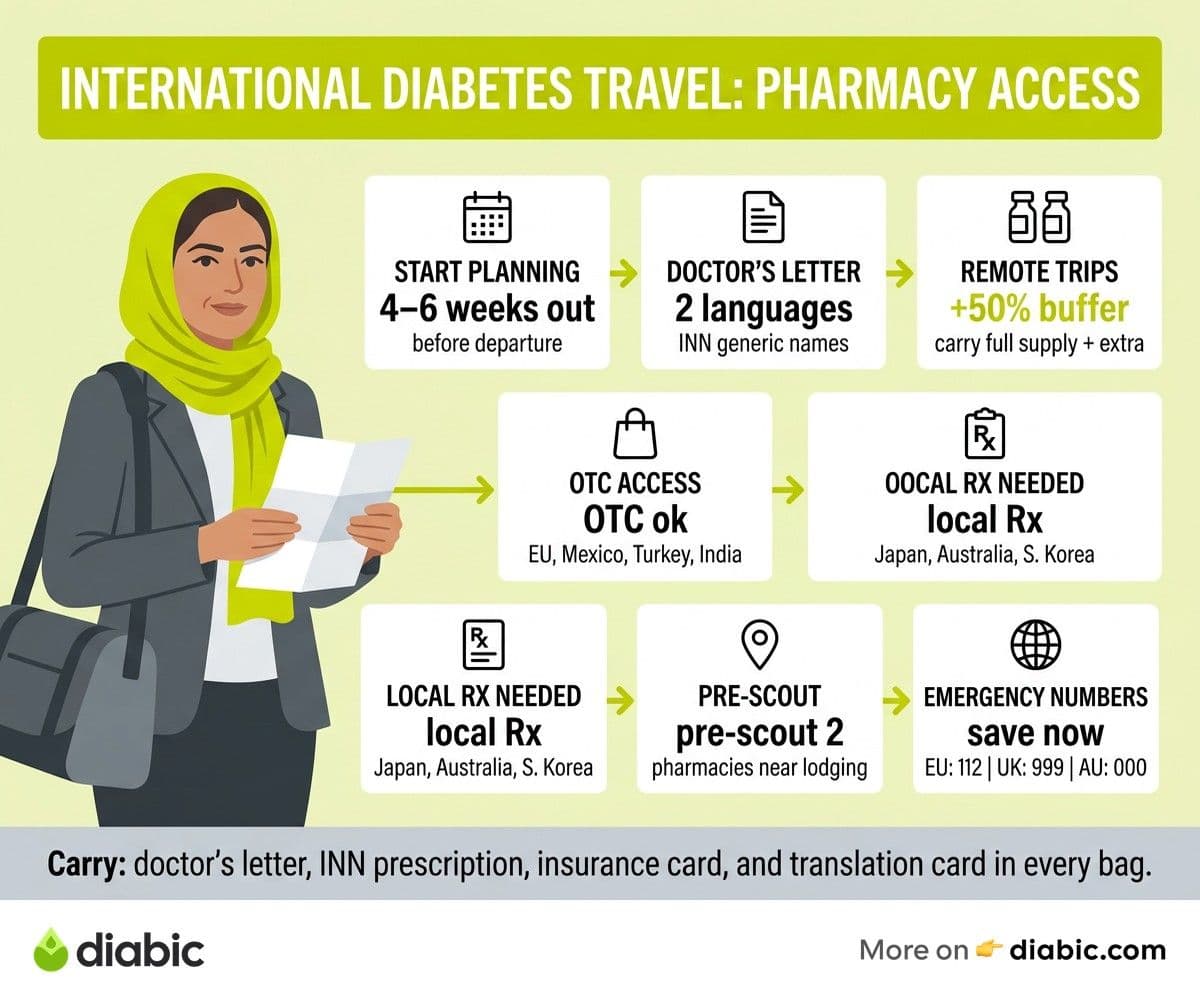
Strong pre-trip preparation removes most of the stress from traveling with diabetes internationally. Start at least four to six weeks before departure so you have time to gather documents, refill prescriptions, and contact your insurance. Last-minute trips are doable but leave less margin for surprises.
Get a doctor's letter on official letterhead listing every medication, device, and supply you carry, including doses and the conditions they treat. Ask for the letter in English and, when possible, in the language of your destination, since some pharmacies and customs officers will only accept documents they can read. The American Diabetes Association's international travel guide walks through what the letter should include, from generic medication names to your prescribing physician's contact information.
Carry the international nonproprietary names, also called INN names, for your medications rather than the US brand names you are used to. Lantus, Humalog, and Novolog are familiar at home, but pharmacists in Lisbon or Lima may know them only as insulin glargine, insulin lispro, and insulin aspart. The CDC's guidance on traveling abroad with medicine recommends keeping prescriptions with both generic and brand names exactly for this reason.
Check whether your specific insulin type is sold in your destination before you leave. Concentrated insulins like U-500 and certain ultra-rapid analogs are not available in every country, and substitutions can affect your blood sugar. The WHO Essential Medicines List gives you a starting view of what is stocked, and the embassy of your destination country can confirm details.
Two more pre-trip tasks save real headaches abroad. Set up [travel insurance for people with diabetes](/traveling-with-diabetes/travel-insurance-for-people with diabetes-whats-covered) that explicitly covers your pre-existing condition and medical evacuation. And read up on adjusting insulin across time zones so you arrive with a plan instead of guessing on the plane.
A 4-week pre-trip checklist
Four weeks out, schedule a check-in with your endocrinologist and request the doctor's letter and prescription duplicates. Three weeks out, contact your travel insurance provider and confirm coverage for diabetes-related emergencies. Two weeks out, refill all medications and supplies for double the trip length. One week out, photograph every prescription and supply, and store the photos in cloud backup and a family member's email.
Country-by-Country Pharmacy Access Guide
Pharmacy access varies dramatically across borders, and understanding the broad categories helps you plan. Some countries treat insulin as an over-the-counter item, others require a local prescription, and a few have such limited supply that bringing your own is the only safe option. Always confirm specifics with your destination's national health ministry or the International Diabetes Federation country profiles before you travel.
Mexico, much of the European Union, Turkey, and India sell most insulins over the counter or with a copy of your home prescription. Pharmacies in tourist areas often stock multiple brands, and pharmacists frequently speak enough English to handle a simple request. Prices are often lower than in the United States, which can make refilling abroad surprisingly affordable for travelers without insurance coverage.
Japan, Australia, South Korea, and several Middle Eastern countries require a local prescription before they will dispense insulin, even with a foreign doctor's letter. You typically need to visit a local clinic or hospital, present your home prescription and ID, and receive a country-specific prescription before the pharmacy will fill it. This process can take half a day, so build in time and bring extra supplies for the gap.
Remote regions of sub-Saharan Africa, parts of Southeast Asia, and certain Pacific islands face genuine insulin shortages. Travelers heading to these areas should carry their full trip supply plus a 50 percent buffer in original packaging, with backup supplies in checked luggage as a last resort. Insulin storage while traveling becomes especially important in hot climates where pharmacy refrigeration may be unreliable.
Pharmacy hours and language considerations matter as much as availability. In southern Europe, pharmacies often close for several hours at midday and on Sundays. In Japan, pharmacy staff may speak limited English but respond well to written notes. In Latin America, smaller towns may have only one pharmacy serving a wide area, so plan around its schedule. The same goes for [travel insurance for people with diabetes](/traveling-with-diabetes/travel-insurance-for-people with diabetes-whats-covered) coverage in remote regions, which sometimes requires pre-authorization for emergency refills.
From my experience: I once landed in a small Italian town on a Sunday and realized I had left my backup insulin in the previous hotel. Every pharmacy was closed except a single farmacia di turno, the rotating after-hours pharmacy. The pharmacist took my home prescription, called the listed physician's number, and dispensed a vial within 20 minutes. That hour taught me to always know how the after-hours pharmacy system works in any country I visit.
Three rules of thumb for any destination
Bring twice the supplies you think you need, split between carry-on and a partner's bag. Save the addresses of two pharmacies near each lodging location before you leave. And carry enough cash or a working credit card to pay for emergency supplies on the spot, since insurance reimbursement is almost always retroactive.
How to Handle a Diabetes Emergency Abroad
Emergencies happen even with the best planning, and knowing the steps in advance keeps a stressful moment from becoming a crisis. The most common situations are lost or damaged insulin, hypoglycemia in a public place, and minor illness that disrupts blood sugar. Each has a clear playbook.
Locate the nearest hospital and clinic before you arrive in each city, not after something goes wrong. Pin them on Google Maps with offline access enabled, and save the addresses in your notes app along with their hours and emergency contact numbers. The US State Department embassy locator provides up-to-date lists of recommended local hospitals and English-speaking physicians for travelers, and similar locator tools exist for most home countries.
Local emergency numbers are not always 911. Europe uses 112 for most emergencies, the United Kingdom uses 999, Australia uses 000, and Japan uses 119 for ambulance and 110 for police. Write the right number for each destination on a card in your wallet, and program it into your phone the day you arrive. A medical emergency is the worst time to fumble with a search engine.
Carry a diabetes emergency card written in the local language. The card should say "I have diabetes. If I am unconscious or confused, please give me sugar or call an ambulance." Free templates exist on diabetes organization websites, and translation apps can produce a usable version in minutes. Keep one in your wallet, one in your phone, and one with whoever is traveling with you.
Contact your travel insurance provider as soon as something happens, even before you go to the hospital if it is not life-threatening. Most policies require notification within 24 to 48 hours and pre-authorization for non-emergency care. Save the international toll-free claims number in your phone, and keep a screenshot in case you lose service. Affordable insulin programs at home can help if your trip ends with an out-of-pocket bill that takes time to reimburse.
When to go to a hospital versus a pharmacy
Persistent high blood sugar with vomiting, signs of diabetic ketoacidosis, or severe low blood sugar with loss of consciousness need a hospital. Lost supplies, minor illness, and routine refills can usually be handled at a pharmacy. When in doubt, call your insurance provider's nurse line first, since most policies include 24-hour medical advice in any language.
Essential Documents and Communication Tools for International Travel
Solid paperwork makes every interaction smoother, from customs to pharmacies to hospitals. The goal is redundancy: digital copies, paper copies, and copies stored with a family member at home. Losing your wallet should not mean losing your medical history.
Carry a printed prescription in both the local language and English, refreshed before each trip. Pharmacies are often willing to honor a foreign prescription if it includes the generic medication name, dose, prescribing physician's contact information, and the date. Some travelers laminate the prescription to protect it from spills and humidity, while others use clear sleeves in a passport-sized organizer.
Medical ID jewelry or apps remain one of the most useful tools when something goes wrong. The Medical ID feature built into iPhones and Android devices can display your conditions, medications, and emergency contacts on a locked screen, in any language you choose. Physical bracelets with the words "type 1 diabetes" or "insulin dependent" in the local language work alongside digital tools, especially if your phone runs out of battery.
Embassy contact information for your home country belongs in your phone, your wallet, and a family member's email before you leave. The embassy can help locate physicians, replace lost passports tied to medical emergencies, and provide translation support in serious situations. Save the regional consulate too if you are traveling outside the capital city, since consulates often handle local matters faster than the main embassy.
International diabetes translation cards, available free from organizations like Beyond Type 1 and the IDF, cover dozens of languages. They include phrases like "I need orange juice or sugar" and "Please call an ambulance, I am having a diabetes emergency." Print two copies, store one digitally, and keep one in the same pouch as your insulin so you never have to dig for it. If you are flying first, flying with diabetes supplies covers the airport-side checklist that pairs with this travel kit.
A printable starter pack for international trips
Doctor's letter on official letterhead, prescription with generic names, list of all medications and doses, embassy and consulate contact card, travel insurance card with claims number, local emergency number, and a translation card in the destination language. Keep one copy in your carry-on, one in your luggage, and one in cloud storage you can access from any device.
Final Thoughts on Traveling with Diabetes Internationally
Diabetes does not have to limit where you go. Travelers manage type 1 and type 2 diabetes successfully across every continent, and the tools available now, from CGMs to translation apps to international insurance, make access easier than ever. Plan carefully, pack twice what you think you need, and treat the planning itself as the trip's first chapter.
Pick one action from this guide to do this week: schedule the doctor's letter, set up travel insurance, or print a translation card for your next destination. Small steps compound into a travel routine that holds up in any country. Then start dreaming about the next stamp in your passport.
For more on managing trips smoothly, explore the rest of our traveling library or join the Diabic community for stories from people with diabetes who have crossed borders, time zones, and language barriers.
Frequently Asked Questions
How do I get insulin abroad without a prescription?
In countries where insulin is sold over the counter, you can typically buy it by showing your home prescription, a doctor's letter listing the medication, or a previous insulin label. Mexico, much of the European Union, Turkey, and India fall into this category. Always carry the generic medication name and concentration, since brand availability varies. In countries that require a local prescription, plan to visit a clinic or hospital first.
Which countries sell insulin over the counter?
Mexico, most European Union countries, Turkey, India, and several Latin American countries allow over-the-counter insulin purchases or accept foreign prescriptions directly. Japan, Australia, South Korea, the United States, and several Middle Eastern countries require a local prescription. The International Diabetes Federation country profiles and the WHO Essential Medicines List give the most current picture. Always confirm with your destination's health ministry before relying on over-the-counter access.
Does travel insurance cover diabetes emergencies abroad?
Most comprehensive travel insurance plans cover diabetes-related emergencies when you declare diabetes as a pre-existing condition during purchase. Coverage typically includes hospital visits, prescription refills, medical evacuation, and trip interruption due to illness. Confirm what your policy covers before you travel, save the claims phone number on your phone, and keep all receipts for reimbursement.
What documents should I always carry when traveling with diabetes?
Carry a doctor's letter listing your medications and devices, a printed prescription with generic medication names, your travel insurance card, embassy contact information, and a diabetes translation card in the local language. Keep digital copies in cloud storage and physical copies in two separate bags. The goal is redundancy, so losing one copy never leaves you stranded.
The honest summary on traveling with diabetes internationally is that the planning is the hard part, and once it is done the trip itself feels like any other. Build the kit, pre-scout the pharmacies, and trust that the people you meet along the way are usually kind and helpful when you need them. Then go enjoy the trip, because the world is too interesting to skip.
Shahriar P. Shuvo is the founder of Diabic. He has lived with diabetes for over 14 years, and built Diabic to deliver the practical, evidence-based self-management tools he wished existed when he was first diagnosed. By trade, Shahriar is a senior design and frontend engineer with 6+ years shipping products at Agora, Timescale (now Tiger Data), and ShareTrip. He writes from the intersection of lived diabetes experience and product craft, focused on what works in daily management rather than what sounds good in a textbook.
Medically reviewed by
Dr. Shanto Arian is an internal medicine physician now specializing in clinical and aesthetic dermatology, with a parallel academic focus on epidemiology and public health. He holds an MBBS, MPH, MSc (UK), MRCP (UK), MRCPI (Ireland), Diploma in Dermatology (UK), and Diploma in Aesthetic Medicine (USA). Dr. Arian trained in internal medicine, including hospital work on hematology cases such as graft-versus-host disease, before moving toward dermatology. Skin is one of the earliest places diabetes shows itself, from acanthosis nigricans and diabetic dermopathy to slow foot wound healing, and that intersection is where his clinical and Diabic-review work meet. On Diabic, Dr. Arian medically reviews content on diabetes diagnosis, complications, dermatologic manifestations, and pharmacotherapy, ensuring every claim aligns with current ADA, NICE, and peer-reviewed literature.
More from Living with Diabetes
View all
A Gentle Chair Yoga Routine for people with diabetes
A gentle chair yoga for people with diabetes routine with safe poses, modifications for neuropathy, retinopathy, and joint pain, plus tips for older.

Shift Work and Diabetes: Managing Irregular Hours
Shift work and diabetes is a tough combination. Learn how to manage meals, sleep, medication, and blood sugar when your hours rotate or flip overnight.

Dating with Diabetes: When to Tell a New Partner
Dating with diabetes brings unique disclosure questions. Here is when to tell a new partner, what to say, and how to handle the conversation with.
Clinician-reviewed habits, plain-language guides, and honest answers - the small shifts that make living with diabetes feel lighter, every day.