Simplifying Medication Management for Elderly Diabetes
Practical strategies for medication management elderly diabetes patients can use to reduce pill burden, lower side effects, and stay safer day to day.

In this article(15)
Medication management elderly diabetes patients face often involves juggling five, ten, or even fifteen different pills a day, and that complexity quietly drives missed doses, dangerous interactions, and unnecessary side effects. When the morning routine starts to feel like a small pharmacy shift, something is off. Simplifying the regimen rarely means doing less for your health. More often, it means doing the right things with fewer moving parts.
Older adults with diabetes are usually not on many medications by accident. Each pill was added for a reason, often years apart, by different specialists working on different problems. Over time, the cumulative pile becomes its own risk factor. The good news is that simplification has become a recognized clinical priority, and your care team has more tools than ever to lighten the load without compromising your blood sugar, blood pressure, or heart protection.
In this guide, we walk through why polypharmacy gets out of hand in older adults, which diabetes medications deserve a closer look in your sixties and beyond, and how to start a productive conversation about trimming the list. We will keep the focus on practical steps you can take at your next appointment.
Why Medication Management Elderly Diabetes Needs Simplification
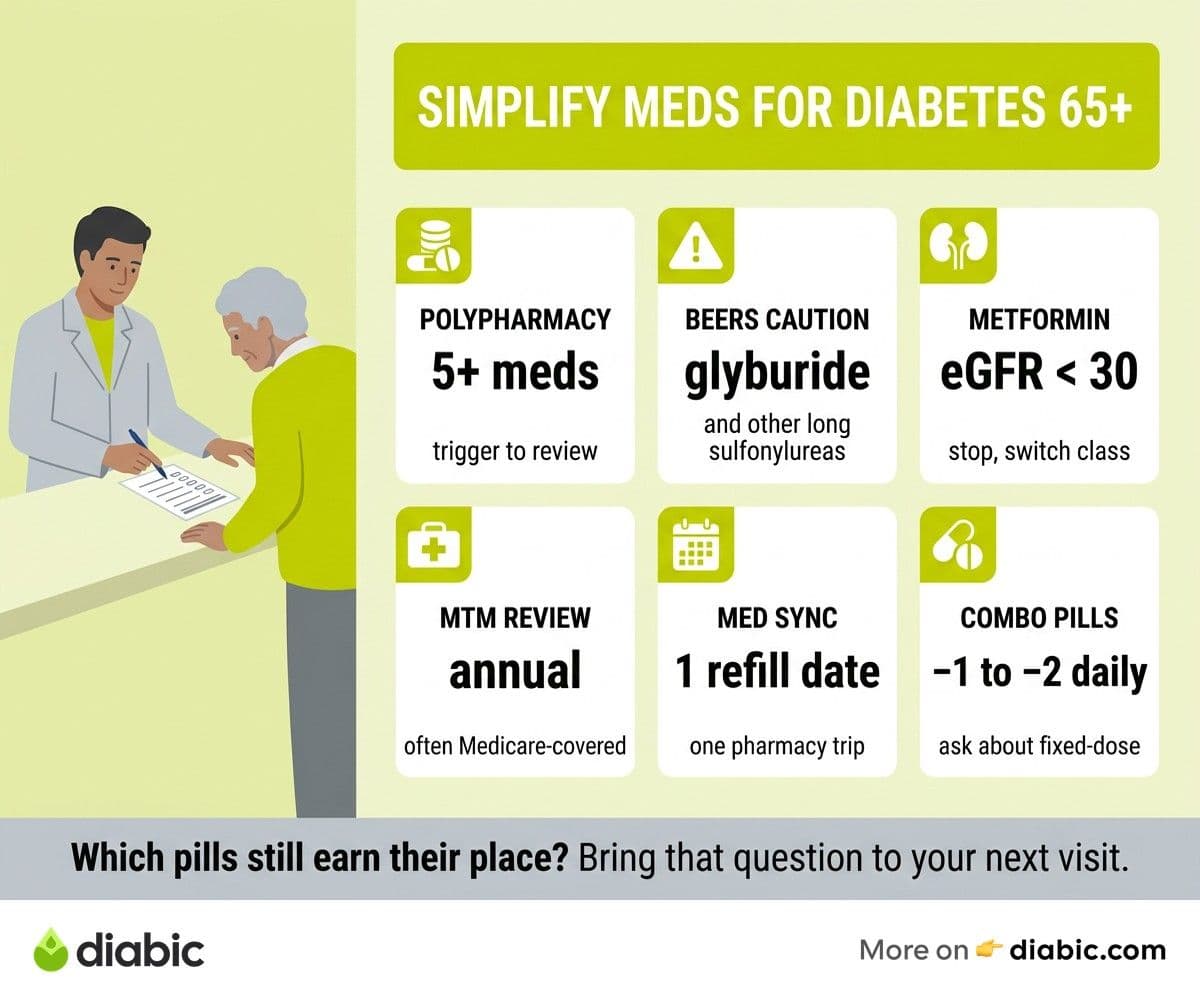
Polypharmacy, usually defined as taking five or more prescription medications, is the norm rather than the exception for older adults with diabetes. Studies cited by the American Diabetes Association Standards of Care show that adults over 65 with diabetes commonly take medications for blood sugar, blood pressure, cholesterol, kidney protection, mood, sleep, and pain, often with overlapping side effect profiles. Each addition makes sense in isolation. The cumulative routine is what creates problems.
Complexity drives non-adherence in a predictable way. When you have to remember whether the small white pill goes with breakfast, the oblong yellow one needs to wait two hours after dairy, and the blue capsule cannot mix with grapefruit, even motivated people miss doses. Research in pharmacy adherence suggests that adherence drops sharply once daily medication counts climb above four or five, and missed doses can swing glucose, blood pressure, and kidney function in unpredictable ways.
Drug interactions become harder to track as the list grows. The American Geriatrics Society Beers Criteria catalogs medications that are potentially inappropriate for older adults precisely because the risks shift with age. Sliding-scale insulin, long-acting sulfonylureas, and certain sleep medications all appear on that list. Your kidneys and liver process drugs differently at 75 than they did at 50, so a dose that was fine a decade ago may now be too much.
Cost is the quiet third factor. Many older adults split pills, skip refills, or quietly stop taking expensive medications without telling their providers. That is a safety issue, not a discipline issue. If you are facing the challenges of managing diabetes after 65, affordability is a legitimate part of the conversation, and a simpler list often costs less.
Common Diabetes Medications and Their Challenges in Seniors
Diabetes in seniors looks different than it does at 40, and the medications that worked well in middle age can carry new risks in later decades. Knowing what to watch for in each class makes the conversation with your provider far more productive.
Metformin and Kidney Function
Metformin remains a first-line therapy for most older adults with type 2 diabetes, and the ADA continues to recommend it when kidney function allows. The catch is that metformin clears through the kidneys, so as kidney function declines with age, the dose needs to come down or the medication needs to stop. Your provider tracks this with an estimated glomerular filtration rate, or eGFR, drawn from a simple blood test. If your eGFR drops below 30, metformin generally comes off the list, and a different agent takes its place.
Sulfonylureas and Hypoglycemia
Sulfonylureas like glipizide and glyburide were workhorse drugs for decades, and many older adults are still taking them. The problem is hypoglycemia, particularly with longer-acting versions. The Beers Criteria specifically discourages glyburide in older adults because the risk of severe, prolonged low blood sugar is too high. If you wake up shaky in the night or feel suddenly confused before lunch, your sulfonylurea is worth a serious second look with your doctor.
Insulin Regimens
Insulin still plays a key role for many older adults, particularly those with type 1 diabetes or longstanding type 2. The simplification question with insulin is usually about regimen complexity rather than whether to use it at all. Multiple daily injections with carb counting demand mental energy that may not match where you are today. Once-daily basal insulin, sometimes paired with a single mealtime dose, often delivers most of the benefit with a fraction of the cognitive load.
GLP-1 Receptor Agonists and SGLT2 Inhibitors
Newer classes have shifted the conversation in older adults' favor. GLP-1 receptor agonists, including weekly injections, lower glucose with a low risk of hypoglycemia and offer cardiovascular and weight benefits that matter at any age. SGLT2 inhibitors protect the kidneys and heart in ways that older adults often need most. Both classes come with their own considerations, including dehydration risk, urinary tract infections, and gastrointestinal side effects, so they are not automatic wins. They are, however, worth asking about if you have not yet.
Working Toward a Simplified Diabetes Management Plan
Simplification rarely happens by accident. You usually have to ask for it, and the ask works best when it is specific. The clinical term for thoughtfully reducing medications is deprescribing, and the Endocrine Society along with the ADA both endorse deprescribing as part of person-centered care for older adults with diabetes.
A productive starting question for your next appointment sounds like this. "I am taking 11 medications, and I would like to know which ones still earn their place on the list." Your provider may not have time to answer fully in one visit, but the request opens the door. From there, you can schedule a dedicated medication review, sometimes with a clinical pharmacist, to walk through every drug.
Pharmacist-led medication therapy management is one of the most underused tools in diabetes care. Research published in the Journal of the American Pharmacists Association shows that pharmacist reviews catch interactions, duplications, and inappropriate prescribing that physicians, working in 15-minute slots, often miss. Many Medicare plans cover an annual comprehensive medication review at no cost. If you have not had one, ask your pharmacist whether you qualify.
Questions Worth Bringing to the Appointment
A few specific questions tend to move things forward. "Is there a once-daily version of any of these medications?" "Can two of these be combined into one pill?" "Which medications could I safely stop if my A1C goal were slightly relaxed?" "Is there anything on this list that the Beers Criteria flags for adults my age?"
That last question is particularly useful. Many providers appreciate knowing you have done a little homework, and it signals that you want a careful, age-appropriate plan rather than a one-size-fits-all approach. Pair these questions with a written list of every medication, supplement, and over-the-counter pill you take, and you will have a much more efficient visit. For broader strategy, our guide to simplified diabetes management routines for seniors walks through how the daily picture fits together.
Reducing Hypoglycemia Risk Through Medication Adjustments
Hypoglycemia is the single biggest danger tied to medication management elderly diabetes routines bring. A serious low can cause falls, fractures, hospitalizations, and confusion that mimics dementia. The hypoglycemia risk in older adults article goes deeper, but the medication piece deserves a clear summary here.
The classes most associated with low blood sugar are sulfonylureas, meglitinides, and insulin. Metformin alone almost never causes hypoglycemia. GLP-1 receptor agonists and SGLT2 inhibitors carry low intrinsic hypoglycemia risk, though they can amplify lows when combined with insulin or sulfonylureas. If your medication list pairs insulin with a sulfonylurea, ask whether one of the two could come off.
Dose adjustment is often the simplest fix. The ADA suggests that A1C targets for older adults can reasonably range from 7.0% to 8.5% depending on health status, function, and life expectancy. A target of 7% might have made sense at 55. At 78, with frailty or cognitive change, an A1C closer to 7.5% or 8% may be safer because it leaves more room before lows. That is a conversation worth having explicitly, since "we should aim for tighter control" is rarely the right answer at this stage.
Monitoring During Medication Changes
When medications change, glucose patterns shift in the first two to four weeks. A continuous glucose monitor, even short term, can catch overnight lows or post-meal spikes that fingersticks miss. If a CGM is not an option, more frequent fingersticks for a few weeks gives you and your provider real data to refine the plan. Either way, do not assume the new regimen is dialed in until you have actually watched what it does.
Tools and Tips for Managing Fewer Medications Better
Even after simplification, most older adults with diabetes will still take several medications. The goal becomes managing those few medications well, with as little daily friction as possible.
A weekly pill organizer with day and time slots remains the single most helpful low-tech tool. Filling it on Sunday turns a daily decision into a once-a-week task. Models with built-in alarms or pairing with a phone app help if you tend to lose track of time. For families coordinating care across distance, smart pill dispensers can send alerts when a dose is missed, which closes a loop that used to require a phone call.
Pharmacy synchronization is one of the most underrated services in modern pharmacy. Most chain and independent pharmacies will line up all your refills to a single monthly pickup date, so you are not running back twice a week for different prescriptions. Ask your pharmacy about "med sync" by name. The first month requires a short prescription on a couple of medications to align them, after which you collect everything together going forward.
Combination medications quietly cut pill counts. Several diabetes drugs come in fixed-dose combinations, including metformin paired with a DPP-4 inhibitor or SGLT2 inhibitor. Blood pressure medications similarly combine well. If you take three pills that could be two, your provider can usually swap them with a single prescription change. Caregivers and family members can play a real role here too. A weekly check-in to refill the organizer, review side effects, and flag any concerns turns medication management into a shared task instead of a solo one.
Frequently Asked Questions
How can you simplify diabetes medications for elderly patients?
Start by asking the healthcare team to review every medication for current necessity, then look for combination pills that consolidate doses and once-daily versions of medications you currently take multiple times a day. Discuss whether your A1C target can be safely relaxed to allow deprescribing of higher-risk medications like sulfonylureas. Pharmacy synchronization, a weekly pill organizer, and an annual pharmacist-led medication review round out the practical pieces.
What medication management tips work for seniors with diabetes?
Use a weekly pill organizer with clear day and time slots, set phone or smartwatch alarms for dose times, and keep an updated medication list in your wallet for emergencies. Schedule regular medication reviews with your pharmacist, ideally annually, to catch interactions and duplications early. Ask your pharmacy about med sync so all refills land on the same monthly date, and bring a family member or caregiver into the loop if remembering doses has become harder.
When should an older adult ask about deprescribing diabetes medications?
Reasonable triggers include a recent hospitalization, a fall, a new diagnosis of dementia or frailty, an A1C consistently below 7%, frequent low blood sugar, or simply feeling overwhelmed by the daily routine. If your medication list has grown to ten or more, that alone is a reason to ask. Deprescribing is a structured, evidence-based process, not a request to do less for your health.
Better medication management elderly diabetes care starts with one honest conversation with your provider or pharmacist. Bring your full medication list, name two or three pills you would most like to consolidate or stop, and ask what a deprescribing plan might look like over the next six months. Talk to your doctor about whether your A1C target still fits where you are today, and consider asking about combination medications, once-daily options, and pharmacy sync at the same visit. Small changes here can return real time and energy to the rest of your day.
Shahriar P. Shuvo is the founder of Diabic. He has lived with diabetes for over 14 years, and built Diabic to deliver the practical, evidence-based self-management tools he wished existed when he was first diagnosed. By trade, Shahriar is a senior design and frontend engineer with 6+ years shipping products at Agora, Timescale (now Tiger Data), and ShareTrip. He writes from the intersection of lived diabetes experience and product craft, focused on what works in daily management rather than what sounds good in a textbook.
Medically reviewed by
Dr. Shanto Arian is an internal medicine physician now specializing in clinical and aesthetic dermatology, with a parallel academic focus on epidemiology and public health. He holds an MBBS, MPH, MSc (UK), MRCP (UK), MRCPI (Ireland), Diploma in Dermatology (UK), and Diploma in Aesthetic Medicine (USA). Dr. Arian trained in internal medicine, including hospital work on hematology cases such as graft-versus-host disease, before moving toward dermatology. Skin is one of the earliest places diabetes shows itself, from acanthosis nigricans and diabetic dermopathy to slow foot wound healing, and that intersection is where his clinical and Diabic-review work meet. On Diabic, Dr. Arian medically reviews content on diabetes diagnosis, complications, dermatologic manifestations, and pharmacotherapy, ensuring every claim aligns with current ADA, NICE, and peer-reviewed literature.
More from Living with Diabetes
View all
A Gentle Chair Yoga Routine for people with diabetes
A gentle chair yoga for people with diabetes routine with safe poses, modifications for neuropathy, retinopathy, and joint pain, plus tips for older.

Shift Work and Diabetes: Managing Irregular Hours
Shift work and diabetes is a tough combination. Learn how to manage meals, sleep, medication, and blood sugar when your hours rotate or flip overnight.

Dating with Diabetes: When to Tell a New Partner
Dating with diabetes brings unique disclosure questions. Here is when to tell a new partner, what to say, and how to handle the conversation with.
Clinician-reviewed habits, plain-language guides, and honest answers - the small shifts that make living with diabetes feel lighter, every day.