Crossing Time Zones: Insulin Changes to Make
How to handle time zone changes and insulin: east vs west adjustments, basal vs bolus strategies, and a practical travel schedule.

In this article(9)
Time zone changes and insulin dosing become a real puzzle the first time you travel across a continent or ocean with diabetes. Your carefully timed schedule suddenly does not match the clock on the wall. Whether you are gaining or losing hours, getting the doses right is one of the trickiest parts of international travel with diabetes.
The good news is that the principles are predictable once you understand them. Basal insulin runs on a 24-hour cycle. Bolus insulin follows your meals, not your watch. The art is bridging the gap between your home schedule and your destination schedule without stacking doses or leaving gaps.
This guide walks through the general framework. Specific dose adjustments must come from your endocrinologist or diabetes care team, who knows your insulin sensitivity, basal rates, and history. Use this as a starting conversation with them, not as a substitute.
Why Time Zone Changes and Insulin Don't Mix Easily
Basal insulin is designed to provide a steady background level of insulin around the clock. Most basal regimens (whether long-acting injection or pump basal rates) assume a consistent 24-hour rhythm. When you cross time zones, the body's clock and your insulin schedule fall out of sync.
Two scenarios drive most of the trouble.
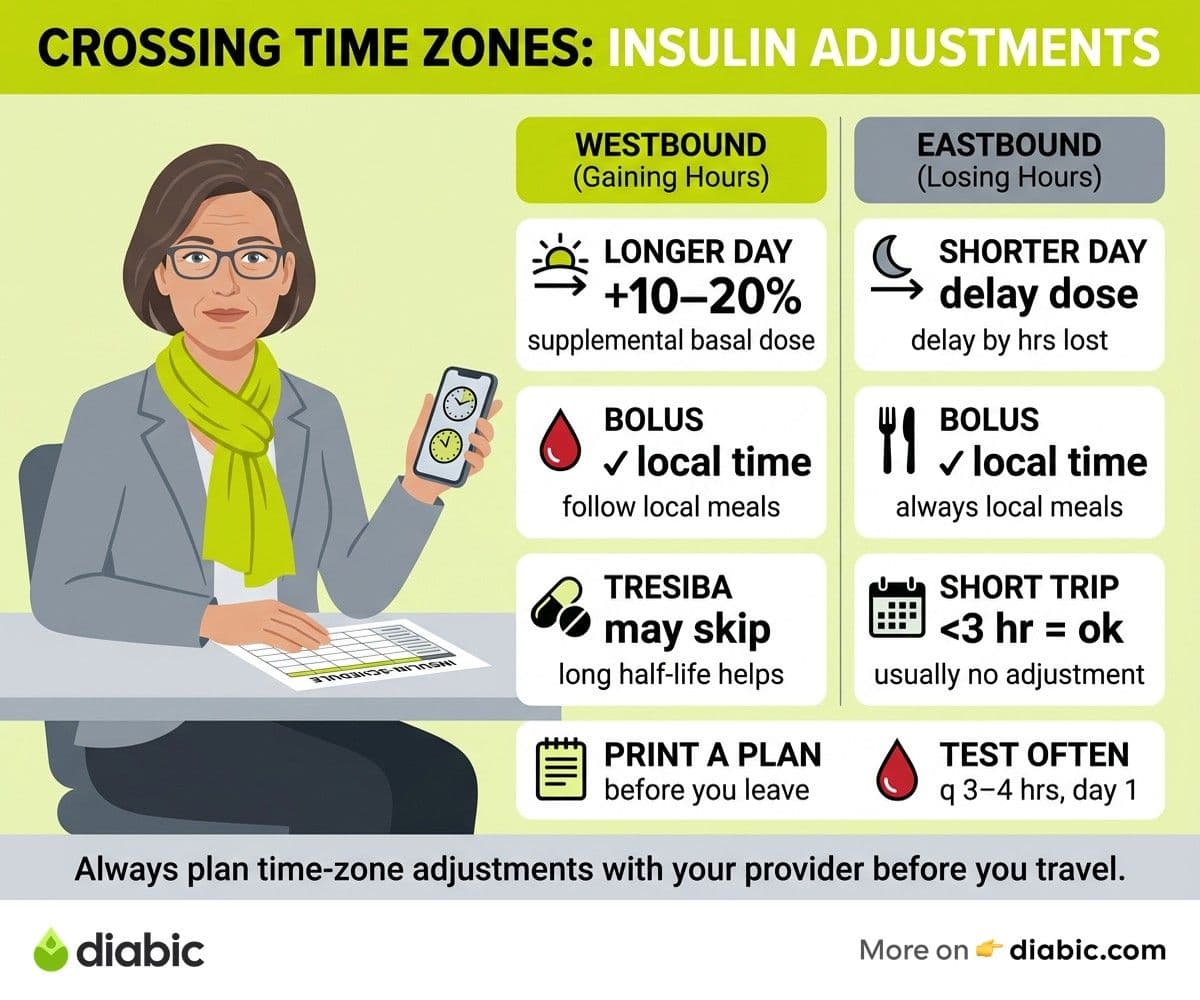
Traveling west (gaining hours). Your day gets longer. If you fly from New York to Los Angeles (3 hours west), your day from morning of departure to bedtime at destination is 27 hours instead of 24. Your basal insulin from the morning will run out before the new bedtime. You may need a small supplemental dose or a temporary basal rate increase to cover the extra hours.
Traveling east (losing hours). Your day gets shorter. Flying from Los Angeles to New York compresses 24 hours into 21. If you take your usual evening basal at the new destination time, it can overlap with the previous dose still in your system, raising the risk of overnight hypoglycemia. The fix is usually to delay or reduce the next dose.
Bolus insulin (rapid-acting for meals and corrections) is simpler. It follows your eating schedule, not your watch. If you eat lunch at the airport at 2 pm local time, you bolus for that lunch regardless of what time your home clock shows. Our piece on traveling internationally with diabetes covers other logistics like pharmacy access and prescription refills abroad.
How to Adjust Basal Insulin When Traveling
The right approach depends on whether you use a pump, long-acting injections (Lantus, Tresiba, Levemir), or NPH. The American Diabetes Association recommends working with your provider to map out adjustments before any trip that crosses three or more time zones.
Traveling west (gaining time). Your usual basal will fall short by the number of hours you gained. Common provider strategies:
- For long-acting injections: take a small supplemental dose (often 10 to 20 percent of your usual basal) at your bedtime in the new time zone, then resume your normal schedule on the new local time the next day
- For pump users: program a temporary basal increase or extend your usual basal rate by the number of hours gained
- For Tresiba (ultra-long-acting): often requires no adjustment for trips of 3 hours or less, since the drug's long half-life smooths the transition
Traveling east (losing time). Your basal doses will overlap if taken at the new local time. Common strategies:
- Delay your next basal dose by the number of hours you lost (e.g., if you lost 3 hours, take your usual evening dose 3 hours later than your new local schedule for one day)
- Or take a smaller dose at your new local time the first night to bridge to your normal schedule
- For pump users: shift your pump clock gradually across two or three days, or change it all at once at your destination and adjust temp basal rates
For trips of 1 to 2 hours of time difference (most domestic US travel), most people do not need to adjust basal at all. Just shift your meal-time boluses to local meal times.
For long-acting insulins like Lantus, your provider may suggest a bridging strategy: split your usual dose, take part on the home schedule and part on the new schedule, then transition fully on day two. For Tresiba, the long half-life often means you can continue your usual dose on local time without adjustment for shorter trips. The JDRF travel resources include similar frameworks aimed at type 1 patients.
Managing Bolus Insulin Across Time Zones
Bolus insulin is the simpler half of the equation. The rule is to follow food, not the clock.
Eat lunch at noon local time? Bolus for lunch. Eat dinner at 8 pm local time? Bolus for dinner. Your home time zone does not matter for meal coverage.
Airport and airplane meals create complications because they often arrive at odd hours. A 6 am breakfast service on an overnight flight may hit when your body thinks it is 11 am. Check your blood sugar before bolusing for any unscheduled meal. If your reading is high, give the meal bolus plus your correction. If it is low or trending down, eat the carbs and consider holding the bolus until you confirm the trend.
Activity and stress during travel also shift your insulin needs. Walking miles through airports can drop blood sugar. Sitting still for 12 hours can raise it. Sleep disruption from jet lag affects insulin sensitivity for a few days. Adjust correction factors based on what you see on your CGM or meter, not what you would expect at home. Our companion piece on insulin storage while traveling covers how to keep your insulin viable during all of this.
Always keep fast-acting glucose (tabs, juice, gummies) in your carry-on within easy reach. Hypoglycemia during transit is the single biggest risk, especially on long flights. Do not pack your sugar source in your checked bag.
From my experience: After more than a decade with diabetes, the trip that taught me the most was a 14-hour flight east. I followed my usual schedule at home time and stacked two basal doses 6 hours apart. I woke up at 45 mg/dL in a hotel room with no easy snack. Now I always print a calendar of my adjusted doses before any trip over 4 time zones, and I keep glucose tabs on my body, not in my bag. The Joslin Diabetes Center travel guide has good worksheets for this kind of planning.
Creating a Travel Insulin Schedule
The best protection against dosing mistakes is a written plan you map out before you leave. The mental math is hard at 3 am in a hotel room with jet lag.
Five steps to build the schedule:
- Calculate the time difference between your home and destination. Note the direction (east or west).
- Sketch out departure day to destination bedtime. Include all planned doses (basal, meal boluses if you can predict meal times) at home time, then map to local time.
- Decide on bridging doses with your provider. This is the part you cannot solo. Have the conversation a week before you leave so they can review your basal pattern and any concerns.
- Set alarms for the first 48 hours at the destination, until your body clock starts adjusting. Use a dual time zone watch or phone app to keep both clocks visible.
- Plan to test more often. Every 3 to 4 hours during the first day, including overnight. CGM users have an easier time, but still set high and low alarms tighter than usual.
Pack at least double the insulin and supplies you expect to need. Some travelers double again for international trips where pharmacy refills can be uncertain. Our flying with diabetes supplies guide covers TSA rules for carrying extra. Once you arrive, our piece on building a daily self-care routine helps re-establish a steady pattern in the new time zone.
Diabetes UK's published guidance on travelling with diabetes emphasizes the same point: have the plan in writing before you leave, talk to your team, and over-pack supplies.
FAQ
How do I adjust insulin when changing time zones?
For trips crossing three or more time zones, work with your provider to plan dose adjustments. Westbound (longer day) usually needs a small supplemental basal dose to cover extra hours. Eastbound (shorter day) often requires delaying the next basal dose to avoid overlap. Bolus insulin always follows your meal schedule on local time.
Do time zones affect insulin dosing schedule?
Yes. Basal insulin assumes a 24-hour cycle, so crossing time zones disrupts that timing. Bolus insulin is less affected because it follows meals rather than the clock. Trips under 3 hours of time difference rarely need basal adjustment, while longer trips (especially eastbound or transcontinental) usually do.
Should I keep insulin on home time or local time?
Switch to local time as quickly as possible. Bolus immediately on local meal schedule. For basal, transition over one day with your provider's guidance. Trying to stay on home time prolongs the disruption and increases the risk of dosing errors.
Can I take long-acting insulin like Tresiba on a trip without adjusting?
Tresiba's ultra-long half-life often allows continued dosing on local time without adjustment for trips of three hours or less. Longer trips may still need a transition plan. Always confirm with your provider before traveling.
When you handle time zone changes and insulin with a written plan and your provider's input, the trip becomes manageable. The first night is the hardest. After that, your body and your insulin start to settle on the new schedule.
Shahriar P. Shuvo is the founder of Diabic. He has lived with diabetes for over 14 years, and built Diabic to deliver the practical, evidence-based self-management tools he wished existed when he was first diagnosed. By trade, Shahriar is a senior design and frontend engineer with 6+ years shipping products at Agora, Timescale (now Tiger Data), and ShareTrip. He writes from the intersection of lived diabetes experience and product craft, focused on what works in daily management rather than what sounds good in a textbook.
Medically reviewed by
Dr. Shanto Arian is an internal medicine physician now specializing in clinical and aesthetic dermatology, with a parallel academic focus on epidemiology and public health. He holds an MBBS, MPH, MSc (UK), MRCP (UK), MRCPI (Ireland), Diploma in Dermatology (UK), and Diploma in Aesthetic Medicine (USA). Dr. Arian trained in internal medicine, including hospital work on hematology cases such as graft-versus-host disease, before moving toward dermatology. Skin is one of the earliest places diabetes shows itself, from acanthosis nigricans and diabetic dermopathy to slow foot wound healing, and that intersection is where his clinical and Diabic-review work meet. On Diabic, Dr. Arian medically reviews content on diabetes diagnosis, complications, dermatologic manifestations, and pharmacotherapy, ensuring every claim aligns with current ADA, NICE, and peer-reviewed literature.
More from Living with Diabetes
View all
A Gentle Chair Yoga Routine for people with diabetes
A gentle chair yoga for people with diabetes routine with safe poses, modifications for neuropathy, retinopathy, and joint pain, plus tips for older.

Shift Work and Diabetes: Managing Irregular Hours
Shift work and diabetes is a tough combination. Learn how to manage meals, sleep, medication, and blood sugar when your hours rotate or flip overnight.

Dating with Diabetes: When to Tell a New Partner
Dating with diabetes brings unique disclosure questions. Here is when to tell a new partner, what to say, and how to handle the conversation with.
Clinician-reviewed habits, plain-language guides, and honest answers - the small shifts that make living with diabetes feel lighter, every day.